
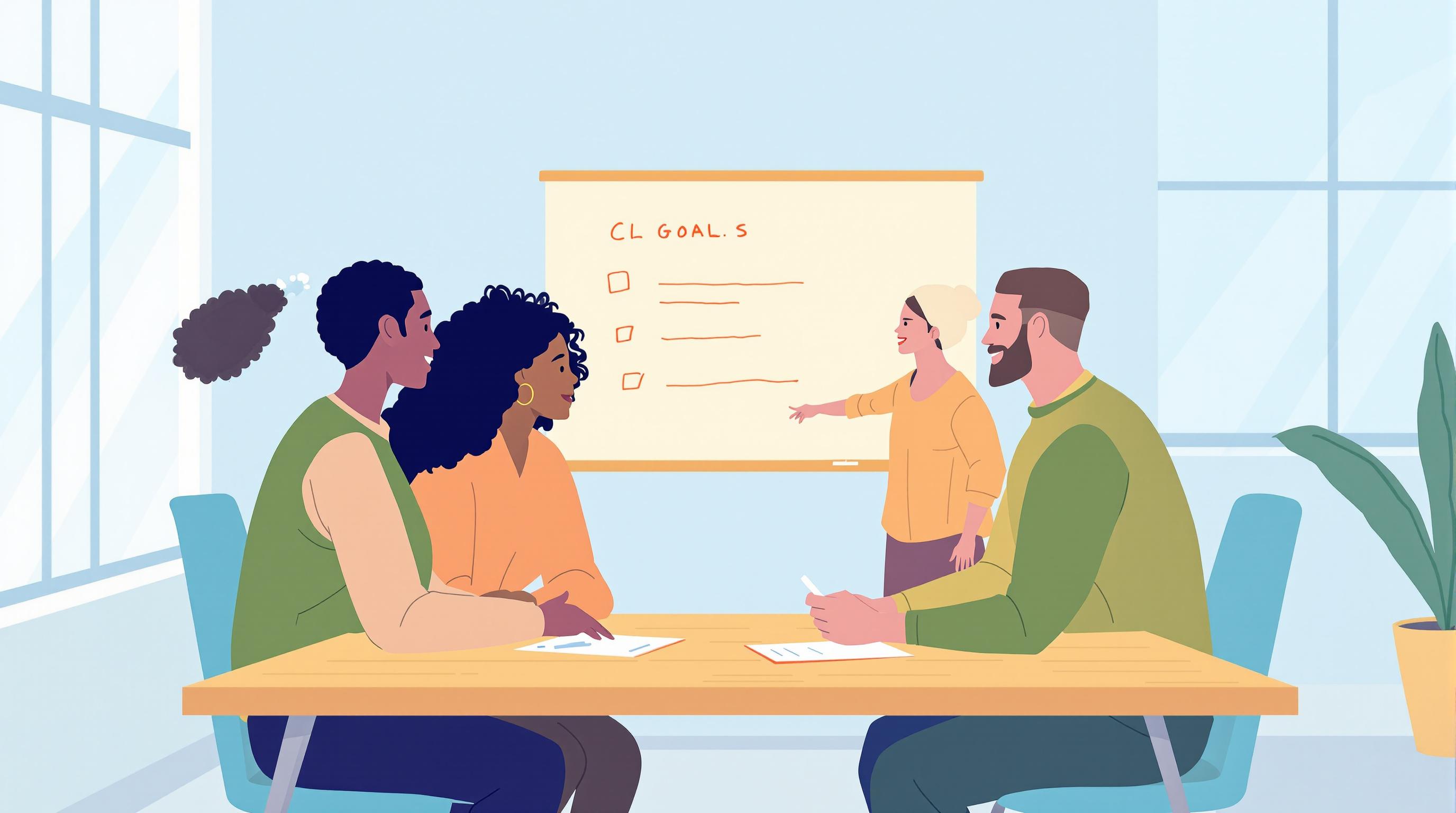
How to Support Teams Without Micromanaging
Micromanaging hurts team productivity and morale, leading to 37% higher burnout rates and 23% longer project cycles. Instead, leaders can boost performance by fostering autonomy, setting clear goals, and tracking progress effectively. Here’s how:
- Define Clear Goals: Use SMART goals to make objectives actionable and measurable (e.g., "Reduce API response time to <100ms for 99% of requests").
- Delegate with Trust: Assign tasks based on team strengths and allow autonomy, with clear failure boundaries to maintain accountability.
- Improve Communication: Use structured meetings, asynchronous updates, and feedback systems to keep teams aligned without constant oversight.
- Track Outcomes, Not Tasks: Focus on metrics like sprint velocity and bug resolution time, avoiding micromanagement tools like activity logs.
The Art of Delegation: Empowering Your Team Without Micromanaging
What is Micromanagement?
Micromanagement in technical teams happens when leaders exert too much control, disrupting workflows and slowing progress. According to GD Mission Systems, this can lead to 23% longer cycle times due to approval delays and 40% more context-switching caused by interruptions [10][11].
This is especially problematic for technical teams that rely on deep focus and specialized skills. It goes against the autonomy that is essential for their success [12].
Signs of Micromanagement
Micromanagement often shows up in specific behaviors that hurt productivity and creativity. Here are some common examples:
| Behavior | Impact | Example |
|---|---|---|
| Excessive Code Reviews | Delays deployments and creates bottlenecks | Adding multiple review layers beyond what the team requires [4] |
| Over-detailed Task Management | Increases context-switching by 40% | Forcing developers to use screen-sharing during coding sessions [11] |
| Constant Status Demands | Interrupts focused work cycles | Scheduling multiple daily check-ins outside of agile ceremonies [12] |
| Tool Configuration Control | Slows development workflows | Requiring manager sign-off for minor environment adjustments [10] |
Benefits of Hands-Off Leadership
Companies like GitHub and Cloudflare have shown how stepping back can boost efficiency. GitHub replaced manual approvals with automated CI/CD pipelines, maintaining quality while giving engineers more freedom [7].
Cloudflare introduced a lightweight request-for-comments system, allowing engineers to propose solutions through architecture reviews instead of waiting for pre-approvals [2]. This approach encourages clear goal-setting, which we'll explore in the next section.
Define Clear Goals
Teams with clear objectives see a 14% boost in productivity compared to those without structured targets [6].
Set SMART Goals
Technical teams perform better when their goals are specific and measurable, rather than vague. For instance, instead of saying, "improve security", a SMART goal would be: "Implement OAuth2 authentication for API endpoints by Q3 with ≤5% error rate" [3].
Using SMART goals also helps minimize micromanagement. In fact, 76% of organizations applying this method report meeting their objectives [9]. Here's how you can break it down:
| Component | Traditional Approach | SMART Example | Why It Works |
|---|---|---|---|
| Specific | "Improve cloud infrastructure" | "Migrate 75% of legacy databases to AWS RDS using Terraform" | Removes ambiguity, making tasks actionable |
| Measurable | "Enhance performance" | "Reduce API response time to <100ms for 99% of requests" | Enables clear progress tracking |
| Achievable | "Modernize all systems" | "Update 3 critical services per quarter" | Keeps goals realistic, avoiding burnout |
| Relevant | "Implement new technologies" | "Adopt containerization to reduce deployment time by 40%" | Aligns with business priorities |
| Time-bound | "Ongoing improvements" | "Complete migration by November 30, 2025" | Sets a clear deadline for accountability |
Define Team Member Roles
Clearly defining roles helps reduce confusion and empowers teams to work without constant oversight. The RACI matrix is especially useful in DevOps settings, where responsibilities often overlap [14].
"The LAUGH framework (Listen-Analyze-Understand-Guardrails-Handoff) adapts roles during scope changes while maintaining autonomy, reducing status meetings by 40%" [6][13].
To make this practical, technical leaders should:
- Regularly update role documents (e.g., every quarter)
- Clearly outline escalation paths and collaboration guidelines
For example, a machine learning engineer's role document might detail their independence in developing models while specifying when and how they should collaborate with DevOps teams [11].
With clear goals and roles in place, leaders can shift their focus to building trust through effective delegation - a key point in the next section.
sbb-itb-8feac72
Build Team Trust
Shifting from control to empowerment is essential for building trust within teams. Studies show that teams with higher trust are 42% more productive and take greater initiative in solving problems [10].
Delegate Tasks Effectively
Delegation works best when you understand your team’s strengths and weaknesses. The Birkman Trust Cycle highlights that combining clear accountability with autonomy can boost psychological safety by 31% [1]. Here's how technical teams often approach delegation:
| Delegation Level | Check-ins | Success Markers | Example |
|---|---|---|---|
| Entry Level | Weekly | Basic task completion | Code reviews |
| Intermediate | Bi-weekly | Problem-solving initiative | Leading feature development |
| Advanced | Monthly | Strategic decision-making | Owning product architecture |
To avoid micromanaging while keeping accountability intact, try the "70-30 rule": aim for 70% alignment with existing skills and 30% stretch goals [10].
"The key to effective delegation isn't just assigning tasks - it's creating clear failure boundaries that define when intervention becomes necessary. This approach reduced escalations by 38% while maintaining quality standards." [1]
Use Mentorship to Guide Teams
Mentorship programs can have a big impact when they focus on growth rather than oversight. Google's "g2g" (Googler-to-Googler) program is a great example. In 2022, it involved over 7,000 employees, boosting belonging scores by 49% and cross-functional collaboration by 35%.
Here are a few ways technical leaders can create impactful mentorship programs:
- Skill-Based Pairing: Match mentors and mentees based on quarterly skill assessments to balance strengths [2].
- Guided Autonomy Sessions: Use weekly check-ins to encourage strategic thinking. Let mentees do 80% of the talking while mentors guide them with open-ended questions [2][5].
- Progressive Responsibility: Challenge mentees with real-world projects, supported by their mentors. Cornell’s leadership certification program uses this method, leading to a 42% increase in employee initiative [10].
The focus of mentorship should always be on results, not rigid processes. These strategies naturally lead to measurable improvements, which will be discussed in the tracking section.
Improve Team Communication
Trust is crucial for delegation, but structured communication keeps it running smoothly. Technical leaders should create systems that avoid micromanagement by focusing on structure, asynchronous methods, and clear outcomes. It's worth noting that 86% of workplace failures are linked to issues in collaboration and communication [8].
Run Better Meetings
Slack's experiment with no-meeting Fridays led to a 23% increase in developer productivity and reduced stress levels [2]. Meetings, when done right, can support team autonomy. Here's a breakdown of how different types of meetings can help:
| Meeting Type | Frequency | Purpose |
|---|---|---|
| Daily Standup | 15 min daily | Address blockers & set priorities |
| Problem-Solving | Weekly | Collaborate on solutions |
| Strategic Sync | Monthly | Align on direction |
To make meetings more effective, stick to time limits and share clear agendas ahead of time [3].
Create Feedback Systems
Feedback systems should promote autonomy while keeping the team aligned. For example, weekly anonymous pulse surveys combined with monthly growth-focused 1:1s helped reduce status meetings by 32% in distributed engineering teams [2].
"Leaders who ask at least three questions before giving directives see noticeable improvements in team initiative and problem-solving skills" [10].
For remote teams, asynchronous tools are especially useful for maintaining communication:
| Channel | Purpose |
|---|---|
| Video Updates | Explain complex topics |
| Shared Dashboards | Provide real-time metrics |
| Peer Reviews | Encourage skill development |
Blameless postmortems are another great tool - they focus on fixing process issues rather than blaming individuals [11]. By aligning with the SMART goals framework, they emphasize measurable improvements in systems. Programs for tech leaders, like those using AI-driven sentiment analysis, can help identify communication bottlenecks without resorting to intrusive monitoring.
Track Progress Effectively
Clear communication is just the start - tracking outcomes without micromanaging is what keeps teams aligned. Studies reveal that 86% of teams are more engaged when managers focus on results instead of daily tasks [4].
Choose Key Metrics
The secret to effective progress tracking is picking the right metrics. For example, an OKR system boosted project completion rates by 23% and improved employee satisfaction by 15%.
| Metric Category | Focus | Avoid |
|---|---|---|
| Productivity | Sprint velocity, milestone completion | Hours logged, keyboard activity |
| Quality | Bug resolution time, customer satisfaction | Individual error counts |
| Team Health | Sprint burndown, blocked task resolution | Daily activity logs |
"Leaders who focus on 2-3 core metrics aligned with SMART goals see a 40% reduction in team stress levels compared to those tracking 5+ KPIs per member" [3].
By using automated dashboards to track milestones in real time, teams stay informed without feeling micromanaged. This approach ties directly into SMART goals, fostering accountability through transparency rather than control.
Schedule Regular Check-ins
How you structure check-ins matters. Research indicates that bi-weekly sprint reviews strike the right balance between oversight and respecting deep work time [11].
Here’s a framework for technical teams:
| Check-in Type | Format | Focus Areas |
|---|---|---|
| Sprint Review | Structured | Align with quarterly SMART goals |
| Quick Sync | 15-min standup | Immediate priorities |
| Deep Dive | 45-min | Review mentorship program outcomes |
When deadlines are missed, avoid blaming individuals. Instead, use methods like the "5 Whys" during post-mortems to uncover root causes without creating a culture of blame [5].
"What 2 adjustments would help hit the revised deadline? This question empowers teams to own their recovery plans instead of having solutions imposed" [11].
Conclusion
Balancing trust, clear goals, and oversight can significantly enhance team performance. Harvard research reveals that fostering autonomy can boost productivity by 20-25% [12]. Similarly, findings from Birkman International highlight that high-trust teams require 60% less direct oversight while still meeting performance standards [1].
In 2022, Google's leadership training program, led by People Analytics head Prasad Setty, demonstrated the power of clear goals and structured feedback. Teams that adopted these practices saw a 23% rise in productivity and a 31% increase in employee satisfaction within six months. Additionally, micromanagement reports dropped by 15% due to goal-aligned feedback systems.
Shifting from daily updates to milestone-based reviews allows leaders to effectively combine technical expertise with leadership skills [3]. By focusing on outcome-driven tracking, structured feedback, and delegation built on trust, leaders can empower their teams to perform at their best while maintaining accountability.
Prioritizing results over rigid processes builds high-performing teams that thrive on autonomy.