
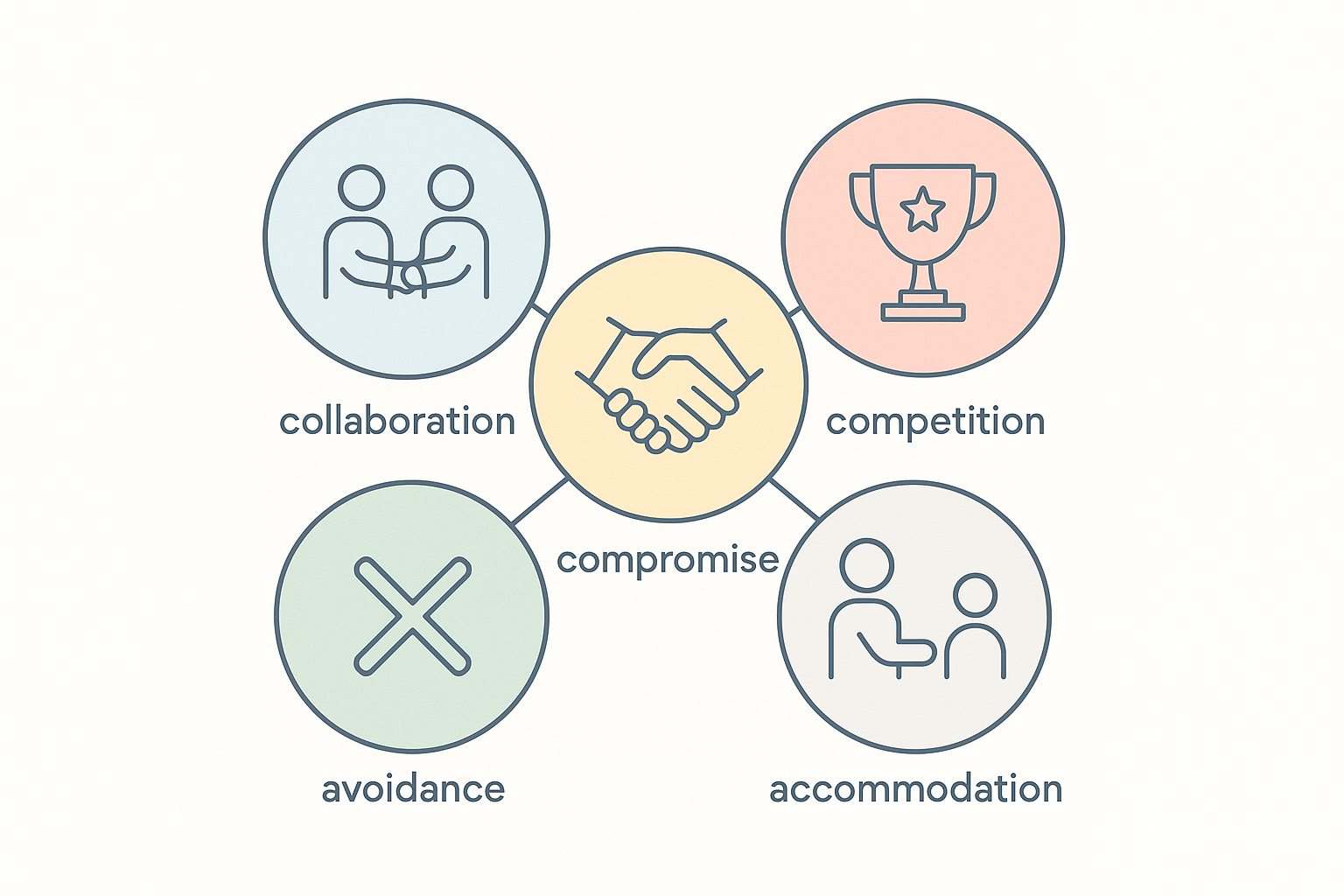
5 Conflict Styles in the Dual Concern Model
Conflict is inevitable in teams, but how you handle it can make or break success. The Dual Concern Model offers a simple way to understand and manage conflicts by balancing assertiveness (your needs) and empathy (others' needs). It defines five conflict styles:
- Competing (High Assertiveness, Low Empathy): Quick, decisive actions for emergencies but may harm relationships.
- Collaborating (High Assertiveness, High Empathy): Ideal for complex problems, fostering win-win outcomes.
- Compromising (Moderate Assertiveness, Moderate Empathy): Balances interests for faster resolutions but may not fully satisfy anyone.
- Avoiding (Low Assertiveness, Low Empathy): Useful for non-urgent issues but risks leaving problems unresolved.
- Accommodating (Low Assertiveness, High Empathy): Strengthens relationships by yielding, but overuse may undermine priorities.
Quick Comparison
| Style | Assertiveness | Empathy | Outcome | Best For |
|---|---|---|---|---|
| Competing | High | Low | Win-Lose | Emergencies, enforcing rules |
| Collaborating | High | High | Win-Win | Complex decisions, building trust |
| Compromising | Moderate | Moderate | Give and Take | Tight deadlines, temporary solutions |
| Avoiding | Low | Low | No Action | Minor issues, cooling off tensions |
| Accommodating | Low | High | Yield-Lose | Maintaining harmony, deferring to experts |
Understanding these styles helps leaders navigate conflicts effectively, ensuring better teamwork and outcomes.
Mastering Conflict Management - The Dual Concern Model Explained (13 Minutes)
Core Elements of the Dual Concern Model
The Dual Concern Model is built around two key dimensions: assertiveness and empathy [2][3]. These elements are essential for technical leaders aiming to manage team dynamics effectively.
Assertiveness reflects how strongly someone stands up for their own interests during a conflict. It involves actions like:
- Clearly communicating personal needs
- Stating priorities with confidence
- Sharing opinions openly
- Proactively addressing disputes
On the other hand, empathy (also referred to as cooperativeness) focuses on understanding and valuing others' perspectives. It enhances team interactions by emphasizing:
- Active listening and validating others' viewpoints
- Building and maintaining strong relationships
- Considering the emotional impact of decisions
- Striving for solutions that benefit everyone involved
When combined, these dimensions give rise to different conflict management styles, each with its own characteristics:
| Conflict Style | Assertiveness Level | Empathy Level | Primary Outcome |
|---|---|---|---|
| Competing | High | Low | Win-Lose |
| Collaborating | High | High | Win-Win |
| Compromising | Moderate | Moderate | Give and Take |
| Avoiding | Low | Low | No Action |
| Accommodating | Low | High | Yield-Lose |
Choosing the right style often depends on factors like the urgency of the situation, the importance of relationships, the complexity of the issue, and the organizational context. For example, collaboration works well for intricate decisions requiring input from multiple stakeholders, while a competitive approach may be necessary in time-sensitive scenarios [1].
This flexibility is especially crucial in technical environments where decisions can have far-reaching consequences. By mastering these dimensions and understanding when to use each conflict style, leaders can turn challenges into opportunities for team growth and better outcomes [1].
Being adept in all five styles allows leaders to adapt seamlessly to any conflict situation.
1. Competing (Win-Lose)
The Competing style is all about prioritizing personal goals through assertiveness, often with little regard for others' input or feelings. It's a forceful approach aimed at securing quick results, even if it strains team dynamics [3].
When to Use Competing:
This style works best in scenarios like:
- Handling system outages that demand immediate solutions
- Enforcing safety or compliance regulations
- Tackling time-critical challenges
- Rolling out necessary but unpopular changes
Key Characteristics:
- Strong, direct communication
- A focus on achieving results quickly
- Minimal attention to others' viewpoints
While this approach can deliver fast outcomes, overusing it risks harming team morale and increasing turnover [3].
Practical Implementation:
To use the Competing style effectively:
- Explain your reasoning clearly: Help your team understand the "why" behind the decision.
- Reserve it for emergencies: Save this approach for situations where speed and decisiveness are crucial.
- Address concerns afterward: Once the crisis is resolved, take time to listen to your team's feedback and rebuild trust.
This style can be especially useful for technical teams when maintaining critical standards or resolving urgent system issues that could compromise security or stability.
However, it's important to recognize the potential downsides:
- Increased tension and conflicts within the team
- Less voluntary participation in discussions
- Lower overall engagement from team members
- Greater resistance to leadership decisions
- Reduced willingness to share information openly
2. Collaborating (Win-Win)
The Collaborating style represents the peak of both assertiveness and cooperation in the Dual Concern Model. It’s an approach that shines when tackling intricate technical challenges [1].
Key Characteristics
- A strong focus on meeting both personal and team needs
- Encouraging open dialogue and active listening
- Emphasis on creative problem-solving
- Commitment to building long-term relationships
These elements make collaboration a go-to strategy for situations where mutual success is the goal.
When to Use Collaboration
This style works best in scenarios where:
- Decisions are complex and require input from multiple areas of expertise.
- Long-term team dynamics and relationships are critical to achieving goals.
- Out-of-the-box thinking is necessary to develop innovative solutions.
- Stakeholders have valid and strongly held interests that need to be addressed.
How to Implement Collaboration
To make collaboration effective, technical leaders can:
- Dedicate sufficient time for open discussions.
- Foster an environment where every team member feels encouraged to contribute their perspective.
- Use structured problem-solving methods to keep discussions focused and productive.
Research backs this approach, showing that teams employing collaborative conflict resolution tend to experience higher trust levels and greater innovation [3]. This not only strengthens relationships but also results in solutions that stand the test of time.
| Aspect | Impact on Team | Solution Quality |
|---|---|---|
| Time Investment | Requires more upfront effort | Produces durable, long-term outcomes |
| Engagement Level | High participation from all members | Generates well-rounded solutions |
| Implementation Success | Encourages buy-in and support | Reduces obstacles during execution |
Practical Applications
Collaboration is particularly useful in areas such as:
- Designing system architectures
- Planning cross-functional projects
- Improving team workflows
- Deciding how to prioritize technical debt
Challenges to Watch For
While collaboration is powerful, it’s not without its hurdles. Teams may face:
- Limited time to engage in deep discussions.
- Resistance from members who prefer other decision-making styles.
- Risk of overanalyzing, leading to delays.
- Occasional unnecessary deep dives into minor issues.
The key to successful collaboration lies in creating a space where team members feel comfortable sharing their ideas while staying focused on actionable outcomes. Striking the right balance between openness and efficiency is essential for navigating complex technical challenges effectively.
3. Compromising (Give and Take)
Compromising is about finding a middle ground. It blends assertiveness with empathy, aiming for solutions where everyone gives a little to get a little. This approach, part of the Dual Concern Model, emphasizes mutual concessions to resolve conflicts efficiently [3].
Core Characteristics
The essence of the compromising style includes:
- Balancing individual and team priorities
- Seeking acceptable solutions rather than perfect ones
- Adopting a "give and take" mindset for quicker resolutions
- Ensuring partial satisfaction for all involved parties
When Compromise Works Best
Compromising shines in technical settings when:
- Time is tight, making full collaboration unfeasible
- Two equally skilled team members propose conflicting yet valid technical approaches
- Temporary solutions are needed for intricate systems
- Deadlines are looming, and progress takes precedence
Strategic Implementation
In high-pressure technical environments, compromises can be streamlined with these strategies:
| Aspect | Strategy | Expected Outcome |
|---|---|---|
| Time Management | Set clear boundaries for discussions | Faster decision-making |
| Solution Scope | Focus on core requirements | Achievable middle ground |
| Team Dynamics | Ensure balanced input | Stronger relationships |
| Implementation | Document trade-offs | Clear reference for the future |
Practical Limitations
While compromise is useful, it comes with its own set of challenges:
- Results may fall short of optimal technical solutions
- Temporary fixes often require revisiting later
- Risks setting a precedent for settling rather than solving
- Can obscure deeper architectural issues
Communication Techniques
To make compromise effective, technical leaders should:
- Clearly outline trade-offs, ensuring all parties understand both the benefits and drawbacks. This shifts the focus from rigid positions to shared interests.
- Use conditional language, such as: "Let’s implement the basic version now, with enhancements planned for the next sprint."
Making Informed Trade-offs
When navigating compromises, it’s crucial to distinguish between:
-
Non-negotiable Elements
These include security, core functionality, and performance standards that directly impact system reliability. -
Flexible Components
Elements like feature sets, implementation methods, and timelines that allow room for negotiation.
Measuring Success
The success of a compromise can be gauged by:
- How efficiently the solution is implemented
- Stakeholder satisfaction with the outcome
- Whether the solution holds up over time
It’s worth noting that compromise often falls short of the true "win-win" outcomes that collaboration can deliver [3]. However, it allows teams to address pressing issues while keeping long-term objectives in sight.
Next, we’ll dive into the Avoiding style, a low-engagement approach that wraps up the Five Conflict Styles framework.
sbb-itb-8feac72
4. Avoiding (No Action)
Avoiding is a passive approach to conflict management. It involves low assertiveness and minimal engagement with the needs of both yourself and others [3]. While it may seem like a way to sidestep issues, its effectiveness depends entirely on the context.
Strategic Avoidance vs. Harmful Neglect
Not all avoidance is created equal. Here's how intentional, strategic avoidance differs from harmful neglect:
| Aspect | Strategic Avoidance | Harmful Neglect |
|---|---|---|
| Timing | Used as a temporary delay | Issues are indefinitely pushed aside |
| Decision Process | A deliberate, thoughtful choice | A default response without consideration |
| Impact Assessment | Risks are carefully weighed | Consequences are ignored or unknown |
| Follow-up | Includes a planned review or revisit date | No follow-through or resolution plan |
| Team Communication | Expectations are clearly communicated | Creates confusion and uncertainty |
When Avoidance Works
Strategic avoidance can be a useful tool, especially in technical teams, when applied in the right circumstances. Here are a few scenarios where it might make sense:
- Critical Focus Periods: During high-stakes deployment or deadlines, when distractions could derail progress.
- Emotional Tensions: When emotions are running high, and a pause could help everyone regain perspective.
- Low-Priority Issues: For minor concerns that don’t affect core deliverables or team goals.
- Need for More Information: When waiting could lead to better-informed decisions.
Recognizing Harmful Avoidance
While avoidance can be helpful, it’s important to recognize when it’s causing more harm than good. Persistent avoidance can damage team dynamics and morale [1]. Be on the lookout for these red flags:
- Ongoing disagreements about project priorities that never get resolved.
- Rising tension in meetings, especially across different teams or departments.
- A noticeable drop in participation during technical discussions.
- Informal subgroups forming around unresolved issues, leading to fragmentation.
Practicing Healthy Avoidance
If avoidance is necessary, make sure it’s handled in a way that keeps the team aligned and productive:
- Define Boundaries: Clearly separate issues that need immediate attention from those that can wait.
- Set Timeframes: Schedule specific times to revisit postponed matters.
- Document Decisions: Keep a record of why avoidance was chosen and outline follow-up actions.
Evaluating the Decision to Avoid
Before choosing avoidance, take a moment to assess its potential impact using these key factors:
-
Urgency
Determine how critical the issue is to project deliverables and team cohesion. -
Resources
Compare the effort required to address the issue immediately versus postponing it. -
Risks
Consider the possible consequences of delaying resolution, including unresolved tensions or a drop in morale.
Communicating the Decision
When opting for avoidance, it’s essential to communicate clearly. Acknowledge the issue briefly, explain why it’s being postponed, and provide a timeframe for revisiting it. Keep communication channels open for urgent concerns to ensure the team feels heard and supported.
The success of avoidance as a strategy depends on using it thoughtfully and sparingly. Leaders must carefully distinguish between postponing for the team’s benefit and simply pushing problems down the road. When done right, avoidance can create space to focus or cool off, but it should always lead to eventual resolution - not become a habit.
5. Accommodating (Yield-Lose)
The accommodating style focuses on prioritizing others' needs over one's own, reflecting a low self-interest but a high regard for team harmony and relationships [3]. Leaders who use this approach often yield to maintain cohesion and foster collaboration within their teams [3].
Strategic Value of Accommodating
Accommodating isn’t about being passive - it’s a conscious decision to step back when the situation calls for it. Here’s how this approach can play out in different scenarios:
| Scenario | Value of Accommodating | Impact on Leadership |
|---|---|---|
| Technical Expertise | High when a team member has greater domain knowledge | Builds trust and reinforces credibility |
| Project Timeline | Medium when deadlines allow for flexibility | Sustains team momentum |
| Team Dynamics | High during team-building or resolving conflicts | Strengthens relationships and morale |
| Critical Decisions | Low when essential deliverables are at risk | May jeopardize project outcomes |
When to Choose Accommodation
This style works best under specific conditions, such as:
- When strengthening relationships matters more than "winning" a particular issue.
- When maintaining team harmony is a top priority.
- When the other party has significantly more expertise or experience.
- When the issue holds greater importance to others than it does to you.
Setting Healthy Boundaries
Although accommodating can foster goodwill, it’s important to strike a balance. Leaders should:
- Document Decisions: Record instances of accommodation and the reasoning behind them to ensure transparency.
- Establish Limits: Clearly define what issues can be yielded and where to draw the line.
- Communicate Intent: Share the rationale behind decisions to accommodate, ensuring alignment and understanding.
- Monitor Patterns: Watch for overuse, as habitual accommodation can undermine authority or effectiveness.
Real-World Application
Imagine a software development team where a project manager agrees to a senior developer’s request to use a preferred tool for a sprint. This decision respects the developer’s expertise and builds trust, while still aligning with the project’s overall goals.
Recognizing Warning Signs
Over-accommodation can lead to challenges. Be vigilant for signs like:
- Delays in critical technical decisions.
- A growing expectation among team members for automatic agreement.
- Personal frustration or resentment from yielding too often.
- A slowdown in project progress due to excessive flexibility.
Building Balanced Leadership
Great leaders know how to balance flexibility with authority. To use accommodation effectively:
- Strategic Yielding: Focus on minor issues where compromise is easy but stand firm on critical matters.
- Clear Communication: Always explain why a decision to accommodate was made.
- Relationship Building: Leverage accommodation to strengthen bonds and foster trust within the team.
- Continuous Growth: Develop both technical expertise and interpersonal skills to navigate conflicts adeptly.
Programs like those offered by Tech Leaders (https://technical-leaders.com) can help leaders refine their ability to manage conflicts while maintaining technical excellence. When used thoughtfully, the accommodating style can create an environment where team members feel valued and heard, without losing sight of project objectives. This balance is key to fostering both collaboration and success.
Using These Styles in Technical Teams
Applying these approaches within technical teams emphasizes the balance between assertiveness and empathy, ensuring project demands are met effectively. Technical teams often face conflicts over coding standards, architectural decisions, and project priorities. By leveraging the Dual Concern Model's dimensions, these strategies can be directly applied to technical scenarios.
Strategic Application in Technical Environments
| Conflict Style | Technical Scenario | When to Use | Impact |
|---|---|---|---|
| Competing | Critical bug fixes | During urgent production incidents or security issues | Ensures swift resolution and decisive action |
| Collaborating | System architecture decisions | When addressing complex challenges or cross-team dependencies | Promotes innovation and builds team alignment |
| Compromising | Sprint planning | When negotiating resources or prioritizing features | Balances workloads and keeps progress steady |
| Avoiding | Minor code style debates | For non-critical issues during high-pressure periods | Keeps focus on more pressing priorities |
| Accommodating | Domain-specific technical decisions | When deferring to subject matter experts | Utilizes specialized knowledge effectively |
These examples highlight how each style can influence technical performance and team dynamics in meaningful ways.
Real-World Applications
Each conflict style offers unique value depending on the technical challenge at hand. For example, during a critical production incident, a competing style - such as appointing an incident commander - can ensure rapid resolution. On the other hand, when making significant architectural decisions, a collaborative approach that includes structured discussions and thorough documentation enables teams to align on the best path forward.
Adapting Styles to Project Phases
Planning Phase:
- Collaborate on major architectural choices.
- Compromise when allocating resources.
- Avoid unnecessary debates on minor technical details.
Development Phase:
- Use a competing approach to address critical technical issues.
- Encourage collaboration for seamless interface and integration development.
Deployment Phase:
- Compete when making go/no-go decisions.
- Avoid focusing on non-essential optimizations.
- Compromise on release timelines if needed.
By tailoring conflict management strategies to each project phase, leaders can maintain efficiency and drive technical success.
Building Effective Technical Leadership
Strong technical leadership relies on a few key practices:
- Make decisions based on objective data to maintain credibility.
- Document decisions and establish clear escalation processes to build trust.
- Create an environment of psychological safety where team members feel comfortable sharing ideas and concerns.
AI Project Management Considerations
AI projects bring unique challenges because of their experimental nature and ethical complexities. Leaders in this space must carefully balance:
- Model accuracy against computational efficiency.
- Feature development with the risk of accumulating technical debt.
- Ethical responsibilities alongside business demands.
- Pushing for innovation while ensuring system stability.
Developing Conflict Management Skills
Training programs for technical leaders can provide the tools needed to handle conflicts effectively. These programs often include scenario-based learning and personalized coaching. One participant shared their experience:
"The Tech Leader Program is the missing support system I needed when I was growing my career...a go-to resource for each and every question about how to diversify and grow our impact, influence, and income without depending on our employers."
- Todd Larsen, Co-Founder, Tech Leaders [4]
Studies show that adapting conflict management styles to specific situations significantly improves team performance and project outcomes [3]. No single style works for every scenario, so technical leaders must remain flexible, adjusting their approach based on the context and goals. This adaptability, combined with technical expertise, allows teams to handle conflicts effectively while staying focused on innovation and delivery.
Key Points to Remember
When applying the Dual Concern Model, it's essential to understand how each conflict style can be used effectively. Each approach has its strengths, and knowing when to use them can make a big difference in resolving conflicts and maintaining strong team dynamics.
Style Guide
Here's a quick reference for different conflict styles and when to use them:
| Conflict Style | When to Use | What to Keep in Mind |
|---|---|---|
| Competing | High-pressure situations or emergencies | Quick decisions are crucial, but it may strain relationships. |
| Collaborating | Tackling complex problems or working on cross-team projects | Encourages teamwork and builds stronger, long-term partnerships. |
| Compromising | Negotiations around resources or timelines | Strikes a balance but may leave all parties slightly dissatisfied. |
| Avoiding | Non-urgent issues during busy periods | Helps conserve energy but risks leaving problems unresolved. |
| Accommodating | When expert input is needed or to maintain harmony | Strengthens relationships but may sacrifice your own priorities. |
Critical Success Factors
To make the most of these strategies, technical leaders should focus on two main areas:
- Evaluate the situation: Consider both the urgency of the issue and the impact on relationships before selecting a conflict style.
- Be adaptable: Master all five styles instead of relying on just one. Research shows that leaders who effectively switch between styles improve team problem-solving by 35% [3].
Avoiding Pitfalls
Conflict management isn't without its challenges. Here's how to sidestep common mistakes:
- Keep an eye on how decisions affect team morale over time.
- Document outcomes and establish clear escalation processes to handle unresolved issues.
- Regularly review whether the chosen conflict style aligns with your team's evolving needs.
FAQs
What are the five conflict-handling styles in the Dual Concern Model, and how can leaders apply them effectively?
The Dual Concern Model outlines five distinct approaches to handling conflict: competing, collaborating, compromising, avoiding, and accommodating. Each approach reflects a balance between prioritizing your own goals and considering the goals of others.
For leaders, understanding and applying these styles can make a big difference in managing conflicts effectively. For example, the collaborating style is ideal for tackling complex problems where everyone's input is crucial, ensuring a well-rounded solution. On the other hand, an avoiding style might be more suitable for minor disagreements that don't require immediate resolution. By recognizing when and how to use these approaches, leaders can handle conflicts with greater adaptability and purpose, leading to smoother dynamics and better results within technical teams.
What are the risks of relying too much on one conflict style, and how can leaders avoid them?
Overrelying on one conflict style can disrupt team dynamics and hinder effective decision-making. For instance, constantly avoiding conflict can leave problems unresolved, while an overly competitive approach might foster tension and discourage teamwork.
To address these challenges, leaders should aim to adjust their conflict management strategies depending on the situation and their team's needs. Building self-awareness through regular feedback and personal reflection can help pinpoint tendencies to overuse certain approaches. Additionally, participating in leadership training programs that blend technical expertise with interpersonal skill development can provide practical tools for handling conflicts more constructively.
How does the Dual Concern Model guide leaders in balancing assertiveness and empathy during conflicts?
The Dual Concern Model offers a roadmap for leaders to handle conflicts by striking a balance between assertiveness - standing firm on your own needs - and empathy, which involves understanding and considering others' perspectives. The model identifies five distinct conflict-handling styles: competing, collaborating, compromising, avoiding, and accommodating. Each style represents a different mix of prioritizing your own goals versus the goals of others.
When leaders grasp these styles, they can adjust their approach depending on the situation. This ensures conflicts are resolved in a way that not only addresses the issue but also preserves and strengthens relationships. For leaders, this balance is crucial - it builds trust and encourages teamwork, both essential for a cohesive and productive team environment.