

Top 7 Active Listening Strategies for Leaders
Active listening is a game-changer for leaders, especially in technical fields. It builds trust, improves communication, and helps uncover problems and solutions that might otherwise be missed. Here are seven strategies to help leaders listen better and lead more effectively:
- Remove Distractions: Stay fully present during conversations by silencing notifications, closing unnecessary tabs, and focusing on the speaker.
- Use Reflective Listening: Paraphrase what’s said to confirm understanding and acknowledge emotions.
- Ask Open-Ended Questions: Encourage dialogue by using "What" or "How" questions to explore challenges and gather insights.
- Pay Attention to Nonverbal Cues: Observe body language and tone to pick up on unspoken concerns or emotions.
- Recognize Emotions and Show Empathy: Address underlying feelings to create a safe space for honest conversations.
- Summarize and Clarify: Restate key points to ensure alignment and avoid misunderstandings.
- Take Action Based on Feedback: Show that input matters by following through on what you hear.
Active listening isn’t just about hearing words - it’s about understanding, responding, and acting. These strategies help leaders create an environment where teams feel heard, valued, and empowered to contribute their best ideas.
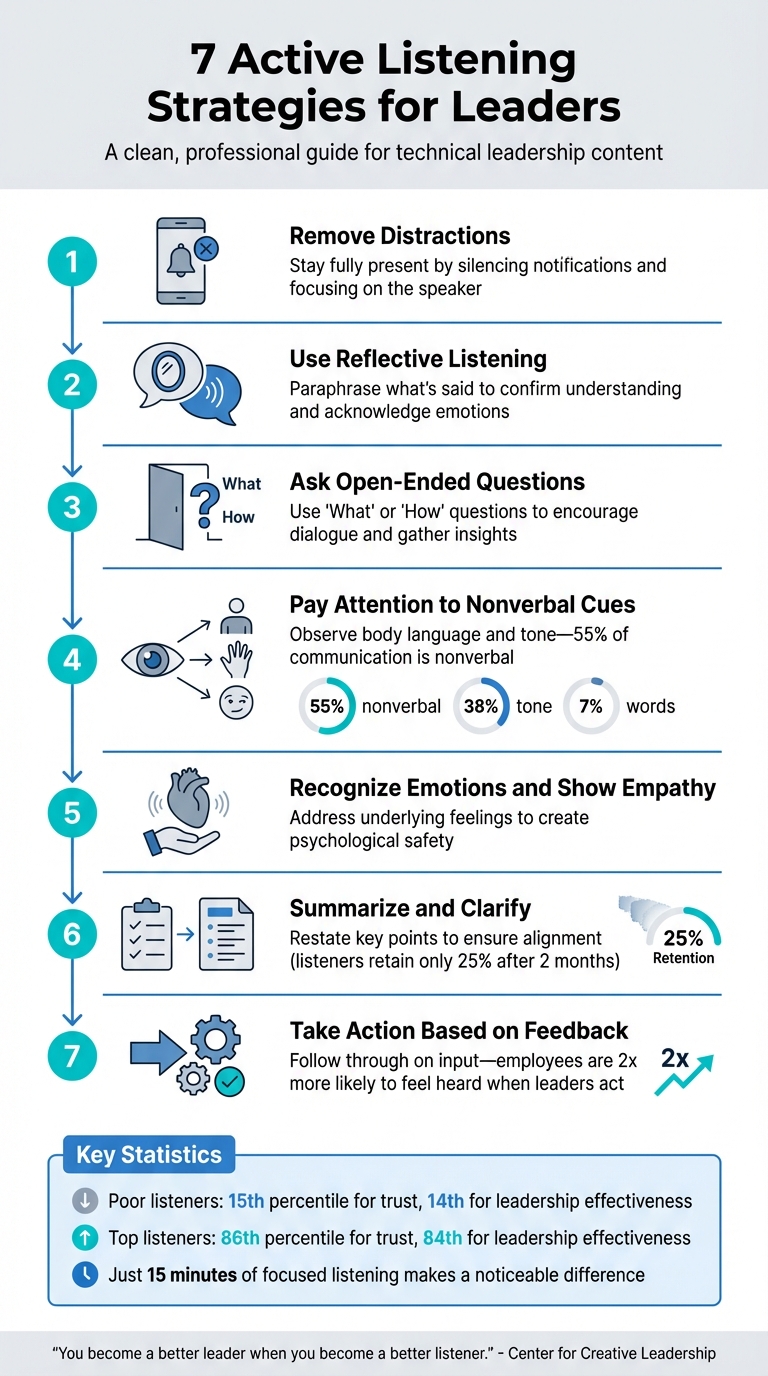
7 Active Listening Strategies for Effective Leadership
1. Remove Distractions and Stay Present
Effectiveness in Leadership Communication
Being fully present can turn everyday interactions into meaningful exchanges. Removing distractions shows that you value the person in front of you more than the ping of an incoming email. This approach is especially critical in technical environments, where clear communication can be the difference between success and setbacks.
"In a world of distraction, full presence is a rare and powerful signal of respect." – Berkeley Executive Education [4]
The steps are simple but impactful: silence your phone, turn off email notifications, and close unnecessary tabs before meetings [9]. For virtual meetings, focus on the camera to create the impression of eye contact [2]. Matt Mead, Chief Technology Officer at SPR, emphasizes this point:
"We've taught our managers that it is extra critical to proactively remove distractions so online video meetings, especially one-on-one meetings with their direct reports, can be focused" [6].
Relevance to Technical Roles
For technical leaders, staying present is especially challenging but crucial. They juggle constant alerts, code reviews, and system issues while needing to pick up on subtle signals that might reveal hidden obstacles or usability problems. Consider the example of Unum, an insurance company that introduced a leadership program in 2018 focused on listening and feedback. This initiative increased management confidence levels from 45% to 70% and drove program participation from 50 to 200 learners [8]. Similarly, a global tech company held monthly "Listening Hours", where employees could openly discuss challenges with managers. During the rollout of a new training platform, these sessions uncovered unexpected usability issues, leading to better adoption rates [8].
Building Trust and Collaboration
A distraction-free environment fosters trust and encourages collaboration. It creates the psychological safety teams need to share bold ideas or admit mistakes without fear. One simple way to show you're engaged is to let colleagues speak for at least two uninterrupted minutes before responding [10]. During video calls, taking visible notes can also signal your full attention [2]. If you're feeling overwhelmed, take a moment to center yourself before the meeting begins. Organizational psychologist Caitlin Collins from Betterworks explains the value of this approach:
"Once everyone has shared, the team starts to come back together, everyone is able to take a deep breath, and we're able to listen more attentively" [6].
2. Use Reflective Listening to Build Trust
Effectiveness in Leadership Communication
Reflective listening involves paraphrasing what someone says while acknowledging the emotions behind their words. It’s not just about repeating what you hear - it’s about showing you truly understand. Phrases like, "What I'm hearing is..." or "It sounds like you're feeling frustrated by the project delay," validate both the speaker's message and their emotions. This transforms a simple conversation into a meaningful connection [1][7].
This approach can help avoid misunderstandings before they escalate. Psychologists Carl Rogers and Richard Farson explain it well:
"It requires that we get inside the speaker, that we grasp, from his point of view, just what it is he is communicating to us" [11].
When used effectively, reflective listening doubles the chances that team members feel genuinely heard [1]. Justin Rosenstein, Co-Founder of Asana, highlights this idea:
"When your teammate brings up the problem they need to solve, reflect back on what they're saying ('What I hear you saying is…'). Sometimes just hearing a problem relayed back inspires someone to realize they already know the answer" [7].
This method is particularly valuable in technical environments, where subtle details often shape solutions.
Relevance to Technical Roles
In technical roles, leaders often jump straight to problem-solving. Reflective listening encourages a pause to fully understand the problem before proposing solutions. For example, summarizing a colleague’s explanation of a new workflow can help clarify confusing steps and prevent operational errors [11].
This practice is especially important for teams with neurodivergent members, who may rely less on nonverbal cues like eye contact. In such cases, paraphrasing and summarizing ensure everyone feels included and understood [5].
Ability to Build Trust and Team Collaboration
Reflective listening turns routine conversations into opportunities to build trust. By acknowledging both facts and emotions, leaders show that every perspective matters. In technical settings, taking the time to fully understand issues and summarize discussions not only reduces mistakes but also strengthens team relationships.
One useful strategy is the 80/20 rule: spend 80% of the conversation listening and only 20% talking [1]. Summarizing key points helps clarify next steps and shifts the focus from mere transactions to meaningful collaboration [4]. This approach lays the groundwork for trust and a more cohesive team dynamic.
3. Ask Open-Ended Questions to Encourage Dialogue
Effectiveness in Leadership Communication
Open-ended questions can turn one-sided instructions into meaningful conversations. Instead of asking, "Did you finish the code review?" consider reframing it as, "What challenges did you encounter during the code review?" This shift invites discussion and helps uncover any underlying issues. Questions starting with "What" or "How" are especially effective because they encourage deeper engagement without sounding like an interrogation. Rob Henrikson, Head of Operations at MediaCrossing, puts it perfectly:
"You want to get the person talking as much as you possibly can to uncover either the root of what's being asked of you or that person's perspective." [6]
This approach is particularly useful for tackling technical challenges, where asking the right questions can lead to valuable insights.
Relevance to Technical Roles
In technical environments, open-ended questions serve a dual purpose: they spark conversation and act as tools for problem-solving. For technical leaders, these questions are essential for identifying the root causes of complex issues. For example, asking, "How did you arrive at this conclusion?" or "What specific approaches have you tried?" can quickly highlight obstacles and guide the team toward solutions. This kind of inquiry is especially important when assessing new systems or troubleshooting intricate technical problems. Many successful global initiatives have shown how prioritizing active listening can reshape workplace dynamics for the better.
Building Trust and Encouraging Team Collaboration
Asking open-ended questions sends a clear message: every voice on the team is valued. Questions like, "What possibilities do you see?" create an environment where team members feel safe sharing their ideas. This approach acknowledges their expertise, fostering collaboration and mutual respect. By transforming routine questions into opportunities for active listening, leaders not only build trust but also encourage innovation and open dialogue. This creates a culture where candid conversations thrive, driving both creativity and teamwork.
4. Pay Attention to Nonverbal Cues and Body Language
Effectiveness in Leadership Communication
Words only scratch the surface of communication. In face-to-face interactions, 55% of communication is nonverbal, 38% comes from vocal tone, and just 7% relies on the actual words spoken [15][6]. For technical leaders, this means tuning into what isn’t being said. Imagine a developer who says they’re confident about meeting a deadline, but their crossed arms and avoidance of eye contact tell a different story. This approach, known as focused nonverbal listening, involves interpreting vocal tones and body language to uncover emotions that words might conceal [12].
To show you’re fully engaged, adopt an open posture - relax your arms, lean slightly forward, and nod to indicate you’re following along [1][7]. In virtual meetings, maintain "eye contact" by looking directly into the camera and keeping your video on to signal your presence [2][7]. These small adjustments are especially important in technical discussions, where complex topics can make verbal communication harder to interpret.
Relevance to Technical Roles
Technical work environments add their own layer of complexity to reading nonverbal cues. Challenges like process bottlenecks or employee frustration often show up through subtle signs - hesitation, sighs, or tense body language - rather than explicit complaints [13]. Encouraging open dialogue can start with simple actions like nodding, which invites the speaker to elaborate [14]. Even a slight head tilt can signal curiosity and attentiveness. However, physical barriers like laptops or monitors can unintentionally block meaningful communication [14][6].
It’s also important to note that neurodivergent team members may express themselves differently. For example, limited eye contact or fidgeting doesn’t necessarily mean they’re disengaged - it’s just a different way of processing and interacting [15].
Ability to Build Trust and Team Collaboration
Nonverbal cues don’t just help decode emotions; they also strengthen team relationships. Positive body language from leaders can create an atmosphere where even the quieter team members feel comfortable speaking up [1][4]. When leaders act on what they’ve heard, employees are twice as likely to feel truly listened to, compared to situations where no follow-up action is taken [1]. This matters, especially since 89% of recruiters say poor soft skills - like a lack of empathy or communication - are the main reason new hires fail [13].
Mirroring a speaker’s expressions or posture can deepen connections and show genuine empathy [14][15]. To balance engagement and comfort, maintain eye contact for about three seconds before glancing away briefly [16]. These small but intentional behaviors demonstrate respect and create a safe space for team members to share their honest thoughts and ideas.
5. Recognize Emotions and Show Empathy
Effectiveness in Leadership Communication
Understanding emotions goes beyond just hearing words; it’s about noticing the feelings behind them. Imagine a team member saying, "I'm fine with the new deployment schedule", but their flat tone and withdrawn body language suggest otherwise. These subtle signals might point to stress or frustration. Leaders who can pick up on these cues have the opportunity to address concerns before they grow into bigger issues. Simple phrases like "You seem frustrated" or "I sense concern about this change" not only validate what someone is feeling but also open the door for meaningful conversations [1][5].
This ability to recognize emotions is especially important in leadership roles, where addressing emotional undercurrents can prevent potential conflicts. In fast-paced technical fields, where stress often hides beneath the surface, this skill becomes even more crucial.
Relevance to Technical Roles
Technical environments come with their own set of emotional hurdles. Engineers and developers frequently deal with the stress of evolving technologies, shifting processes, and frustrating delays [13]. For leaders in these spaces, spotting emotional cues can act as a diagnostic tool, uncovering challenges that might not come up in standard project updates. Pairing this with reflective listening helps leaders gain a more complete understanding of team dynamics.
Open-ended questions are another way to encourage team members to share their feelings. Asking things like, "How did that sprint feel?" or "What concerns do you have about this migration?" can help surface emotional and technical roadblocks. It’s also important to note that neurodivergent team members may express emotions in ways that differ from traditional expectations. In these cases, focusing on their words rather than relying solely on nonverbal cues is essential [5].
Ability to Build Trust and Team Collaboration
Empathy plays a key role in creating a sense of psychological safety, which is critical for fostering collaboration and innovation. When team members feel their emotions are acknowledged and respected, they’re more likely to share bold ideas, admit when they’re struggling, and take calculated risks [4]. Research even suggests that employees are twice as likely to feel genuinely heard when leaders not only listen but also act on the feedback they receive [1].
A great example of this comes from UPS CEO David Abney, who in 2014 launched a global "listening leadership tour" to gather input from employees and customers. By responding to the feedback he received, Abney reshaped the company’s culture. One employee summed up the impact of seeing leadership act on their ideas as:
"earth-shattering" for morale [2].
The takeaway? Empathy without action falls short. Leaders who combine emotional awareness with decisive follow-up build the trust needed to encourage collaboration and drive success.
sbb-itb-8feac72
6. Summarize and Clarify to Ensure Understanding
Effectiveness in Leadership Communication
Summarizing helps restate key points to confirm everyone is on the same page, while clarifying involves asking direct questions to eliminate any confusion. Together, these techniques ensure leaders make decisions based on facts, not assumptions [1][6].
The importance of this can't be overstated. Research shows that listeners retain only about 25% of a discussion after two months [5]. By summarizing key points during transitions or at the end of conversations, leaders can align expectations about tasks and next steps [1][7]. This approach is especially critical in technical environments where precision is non-negotiable.
Relevance to Technical Roles
In technical roles, summarizing becomes a tool for identifying gaps and confirming details. Paraphrasing technical feedback, for instance, ensures clarity and invites further input [6]. Imagine a developer raises a concern about database migration. Instead of assuming you understand, you could say, "So, if I’m following, the current schema won’t support the new feature unless we do significant refactoring?" [4]. This not only clarifies but also encourages deeper discussion.
For neurodivergent team members, who may communicate differently - like using less eye contact or unique body language - summarizing and paraphrasing their words can make a big difference. These actions focus on their message, ensuring they feel heard and understood [5].
Ability to Build Trust and Team Collaboration
When leaders take time to summarize and clarify, they show they value the speaker’s input and are actively listening. This strengthens trust and creates a sense of psychological safety, encouraging team members to share ideas and voice concerns [4]. As the Center for Creative Leadership explains:
"Active listening combined with taking action fosters and encourages employee voice... which is important for organizations because it's positively related to better decision-making." [1]
In remote work settings, these practices become even more essential. Simple gestures like taking visible notes or providing a quick recap can confirm mutual understanding [2][7]. These small but deliberate actions help avoid miscommunication, preserve relationships, and keep projects on track.
7. Take Action Based on Feedback
Effectiveness in Leadership Communication
Listening without action is like planting seeds but never watering them - it doesn't lead to growth. Research from the Center for Creative Leadership reveals that employees are twice as likely to feel heard when leaders take action, even if their listening skills aren't flawless, compared to leaders who listen but fail to act [1]. This is especially critical in technical environments, where feedback often fuels progress and innovation.
Relevance to Technical Roles
For technical leaders, taking action begins with understanding what the speaker needs - whether it's a listening ear, specific guidance, or collaborative problem-solving [1]. Matt Mead, CTO at SPR, emphasizes the importance of eliminating distractions during one-on-one meetings to maintain focus [6]. After a productive discussion, summarize key takeaways and clearly outline the next steps to ensure everyone is on the same page. When an immediate solution isn't available, acknowledge the value of the feedback and encourage ongoing conversations [3]. Following up on feedback, as mentioned earlier, strengthens trust and reinforces the commitment to addressing team concerns.
Building Trust and Fostering Collaboration
Taking action on feedback sends a powerful message: your team's input matters. This approach cultivates psychological safety, empowering team members to share bold ideas and openly discuss challenges without fear of judgment [1][4]. Combining active listening with decisive action amplifies employee voices and creates a collaborative culture [1]. To make this a consistent practice, integrate active listening into structured processes like retrospectives, performance reviews, and feedback loops [4]. For instance, conducting "stay interviews" - where you ask team members what excites them about their work and what frustrates them - can help uncover insights that might otherwise go unnoticed.
At Tech Leaders, we believe that truly effective leadership in technical roles stems from a commitment to listening and taking purposeful, informed action.
Active Listening For Leaders
Conclusion
Active listening isn’t just a skill - it’s a cornerstone of trust, collaboration, and problem-solving. When leaders truly listen to their teams, they create an environment where concerns are understood, nonverbal cues are acknowledged, and feedback leads to meaningful action. This sense of psychological safety empowers teams to tackle even the toughest challenges.
The numbers speak for themselves: leaders who are poor listeners rank in the 15th percentile for trust and 14th for leadership effectiveness. In contrast, top listeners soar to the 86th and 84th percentiles in these areas, respectively [17]. And here’s the kicker - just dedicating 15 minutes to focused, intentional listening can make a noticeable difference [17].
"You become a better leader when you become a better listener." - Center for Creative Leadership [1]
So, how can you improve your listening game? Start with the 80/20 rule: spend 80% of the time listening and only 20% talking [17]. Simple actions like closing your laptop during conversations show your team they have your full attention [4][6]. Use reflective phrases such as, "If I’m understanding you correctly..." to confirm alignment and ensure clarity [4][3]. These small but consistent habits not only reduce miscommunications but also save valuable development time [4][6].
However, listening alone isn’t enough. Trust is built when leaders take action based on what they hear. Teams need to see tangible results from their feedback to feel genuinely valued [1]. At Tech Leaders, we firmly believe that mastering active listening is the first step in bridging the gap between technical expertise and effective leadership.
FAQs
What are the best ways for leaders to eliminate distractions during virtual meetings?
To keep virtual meetings on track, leaders should begin by setting clear expectations. Share a brief agenda beforehand, and remind participants to silence notifications, close unrelated tabs, and find a quiet spot to join the call. Assign a facilitator to steer the conversation, enforce a no multitasking rule, and use features like the "raise hand" or chat tools to handle side questions without disrupting the discussion.
During the meeting, demonstrate active listening by maintaining eye contact, summarizing key points, and pausing before responding to ensure you’ve understood fully. Encourage engagement by asking participants to keep their cameras on (or off if connection issues arise) and including moments for focused reflection without distractions. These approaches help turn virtual meetings into efficient, distraction-free discussions where everyone can contribute meaningfully.
How does empathy enhance active listening for technical leaders?
Empathy plays an essential role in active listening, particularly for technical leaders. It enables leaders to do more than just process words - they can grasp the emotions and concerns underlying the conversation. By setting aside judgment, thoughtfully reflecting on what’s being shared, and acknowledging the speaker’s experiences, leaders build trust and establish a psychologically safe space. This kind of environment encourages team members to share ideas openly or voice concerns without hesitation.
In technical fields, where problem-solving often involves intricate challenges, empathy-driven listening can reveal hidden assumptions or emotional factors that purely data-focused discussions might miss. The result? Quicker problem-solving, boosted team morale, and a culture that encourages fresh ideas and collaboration. For any leader looking to inspire and guide their team, active listening - rooted in empathy - is an indispensable skill.
Why is acting on feedback essential for building trust within a team?
Acting on feedback sends a clear message to your team: their ideas and concerns matter. It shows that you’re not just listening but are also committed to making improvements. This builds trust and encourages a collaborative atmosphere.
When leaders take concrete actions based on input, it strengthens their credibility and creates a space where team members feel valued and respected. The result? Stronger relationships, open communication, and a motivated team ready to contribute at their best.