

Adapting Change Training for Virtual Teams
Managing change in virtual teams requires a shift in how training is delivered. Remote work has made traditional, in-person methods less practical, pushing organizations to adopt online formats that address the challenges of distributed teams. Virtual training can match or even surpass in-person sessions when structured effectively, focusing on short, interactive modules and leveraging digital tools for collaboration.
Key points:
- Virtual Training Benefits: Flexible scheduling, cost savings, and accessibility for remote teams.
- Challenges: Screen fatigue, home distractions, and limited informal networking.
- Success Factors: Use breakout rooms, interactive elements, and clear communication norms.
- In-Person Training Strengths: Stronger connections, real-time feedback, and richer communication.
- Blended Approach: Combine in-person sessions for relationship-building with virtual modules for ongoing learning.
Takeaway: To lead change in remote environments, focus on shorter sessions, interactive tools, and clear strategies for trust and collaboration. Programs like Tech Leaders help engineers develop the skills needed to manage change in distributed teams.
Change Management - A Guide for Remote Teams
1. Traditional Change Management Training
In the U.S., traditional change management training often takes the form of full- or half-day classroom workshops. These sessions bring together project managers, team leaders, HR professionals, and middle managers to explore established frameworks like ADKAR and Kotter's 8 Steps. This conventional format serves as the benchmark against which virtual training is now evaluated.
Learner Environment
These in-person sessions are conducted in dedicated spaces equipped with tools like whiteboards, flip charts, and printed handouts to support hands-on activities. The setting encourages practical exercises and spontaneous collaboration. Scheduled coffee breaks and shared meals provide valuable opportunities for networking and peer learning, strengthening the overall experience [1] [2] [5].
Communication Norms
Face-to-face training benefits from the ability to read nonverbal cues such as body language, facial expressions, and tone. This allows facilitators to adapt their approach in real time, addressing disengagement or resistance to change as it arises. The shared physical space fosters a dynamic and responsive dialogue between trainers and participants [1] [2] [6].
Engagement Strategies
Facilitators in traditional training sessions rely heavily on interactive methods to keep participants engaged. Role-playing exercises, simulations, and case studies are used to connect theoretical concepts to real-world challenges. Activities like force-field analyses and stakeholder mapping encourage collaborative problem-solving, often resulting in actionable visuals. Participants are frequently asked to bring an active change initiative to the session, using it as a live case study to develop practical deliverables such as draft change plans or communication strategies. While research shows both virtual and in-person training can lead to significant learning gains - and virtual formats sometimes even outperform in knowledge retention - participants often prefer in-person sessions for their relationship-building opportunities [1] [5] [6].
Evaluation and Feedback
Traditional programs use tools like pre-assessments, pulse checks, and post-course surveys to gauge content relevance, instructor performance, and the application of skills. Metrics such as stakeholder satisfaction and project outcomes are often tracked. The in-person format also allows trainers to provide immediate feedback during breaks or post-session discussions, enhancing the learning process [1] [5] [6].
2. Virtual Change Management Training
Virtual training takes the traditional learning experience and moves it online, requiring thoughtful planning to address the challenges of digital platforms and physical distance. When designed effectively, remote programs can match - or even surpass - the effectiveness of in-person training [1]. Below, we explore how virtual training reshapes the learning environment, communication practices, engagement strategies, and evaluation methods.
Learner Environment
Remote training hinges on a reliable set of tools. Platforms like Zoom or Microsoft Teams handle live sessions, while tools like Miro or Mural are used for collaborative activities. A learning management system serves as a central hub for resources. Many organizations opt for smaller groups of 6–12 participants and schedule sessions to accommodate various U.S. time zones, with recordings available for flexibility [8][9]. To ease the transition, tech onboarding sessions familiarize participants with the tools, reducing confusion and cognitive overload.
Guidelines around camera use, virtual backgrounds, and managing interruptions help create a professional atmosphere. Tips like using headphones, ensuring proper lighting, and turning off unnecessary notifications can mimic the focus of an in-person training room. These efforts also help establish a sense of psychological safety, making participants more comfortable in the virtual environment.
Communication Norms
Clear communication frameworks are essential in virtual settings. Many programs introduce "ways of working" documents that clarify how participants should interact. For example, live video is reserved for complex discussions, while quick questions are addressed in chat windows. Shared documents track decisions, and asynchronous tools like Slack or Teams keep conversations going between sessions. A single source of truth - such as Confluence or Notion - is often used to store key resources like process diagrams and FAQs.
Facilitators use features like hand-raising and round-robin participation to ensure everyone has a voice. Response-time agreements, such as replying to forum posts within 24 hours, help maintain a sense of connection and prevent learners from feeling isolated [8][9].
Engagement Strategies
To combat screen fatigue, virtual training sessions are typically broken into 60–90 minute modules, with regular breaks. Breakout rooms are used every 10–15 minutes for small group activities, such as practicing resistance conversations or drafting change strategies. These groups, usually consisting of 3–5 participants, are given clear roles and time-limited tasks to ensure productivity.
Interactive elements like polls, quizzes, and word clouds keep participants engaged, while working on real organizational change projects makes the training immediately applicable. Additional options, such as office hours and peer coaching pods, provide opportunities for deeper engagement outside formal sessions [9][3].
Evaluation and Feedback
Virtual platforms make it easier to gather and analyze feedback at all four Kirkpatrick levels. Post-session surveys measure aspects like session relevance, facilitation quality, and pacing (Level 1). Knowledge and skill improvements are tracked through pre- and post-tests, scenario-based questions, and graded exercises within the learning management system (Level 2) [1]. Behavioral changes, such as how often participants use structured communication or stakeholder mapping, are assessed 30–90 days after training through manager and self-assessments (Level 3). Finally, organizations can tie training outcomes to performance metrics like adoption rates, faster deployment cycles, or fewer incidents (Level 4) [8][9].
Digital tools also provide detailed metrics, such as completion rates, breakout room participation, and forum activity. This data allows for quicker adjustments and continuous improvement [8].
sbb-itb-8feac72
Pros and Cons
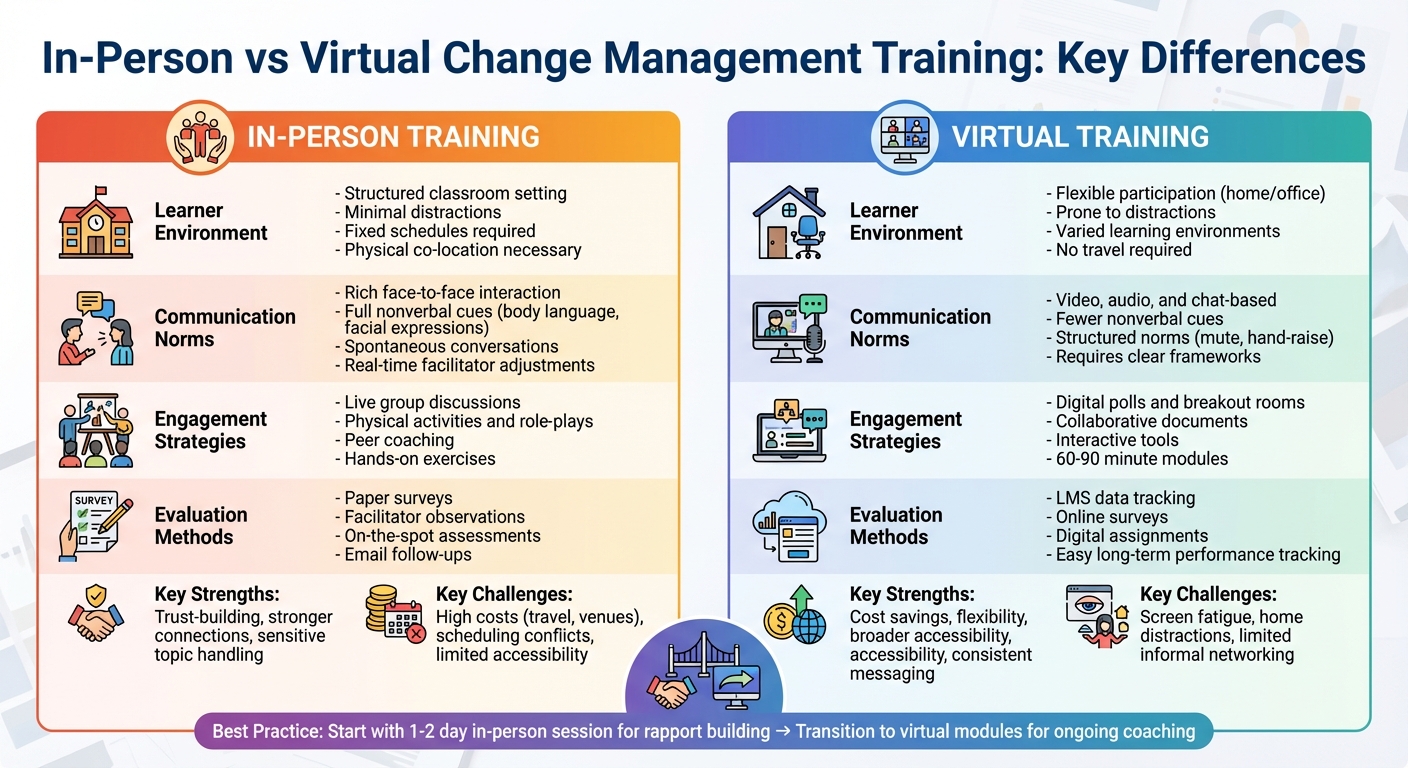
In-Person vs Virtual Change Management Training Comparison
Both in-person and virtual change management training come with their own set of strengths and challenges. In-person training shines when it comes to building trust and fostering connections. Facilitators can pick up on subtle body language cues to identify confusion or resistance, and participants often bond during breaks or informal conversations [1][5]. This format is particularly effective for addressing sensitive topics like organizational politics or resistance to change, where nonverbal communication plays a key role. However, in-person sessions can be expensive, with costs for travel, venues, and accommodations easily reaching thousands of dollars per workshop across U.S. time zones [7][5]. Additionally, scheduling conflicts may make it difficult for remote participants to join [9][4].
Virtual training, on the other hand, offers flexibility, cost savings, and broader accessibility. Teams spread across the U.S. can participate without the need for travel, and organizations can deliver consistent messaging to a large audience quickly [9][7][5]. A study comparing virtual and in-person leadership training for physicians found that both formats led to significant knowledge gains, with virtual training even outperforming in some areas [1]. That said, virtual sessions come with their own hurdles, such as screen fatigue, home distractions, and fewer opportunities for informal networking. Without careful planning - like incorporating frequent breakout sessions or clear participation guidelines - virtual training risks becoming a one-sided presentation [9][1].
The following table breaks down these pros and cons, comparing key elements of the two formats:
| Dimension | In-Person Training | Virtual Training |
|---|---|---|
| Learner Environment | Structured classroom setting with minimal distractions; requires fixed schedules and physical co-location | Flexible participation from home or office; prone to distractions and varied learning environments |
| Communication Norms | Rich face-to-face interaction with nonverbal cues; spontaneous conversations; real-time facilitator adjustments [1][2][4][5] | Video, audio, and chat-based communication; fewer nonverbal cues; relies on structured norms like mute and hand-raise [8][1][2][7][5] |
| Engagement Strategies | Live group discussions, physical activities, role-plays, and peer coaching [1][2][5] | Digital tools like polls, breakout rooms, and collaborative documents; requires effort to maintain engagement and avoid fatigue [8][1][7][5] |
| Evaluation Methods | Paper surveys, facilitator observations, and on-the-spot assessments; follow-ups via email [1][5] | LMS data, online surveys, and digital assignments; easier tracking of long-term participation and performance [1][7][5] |
This comparison highlights why many organizations in the U.S. are adopting a blended approach. For example, they might start with a one- or two-day in-person session to build rapport and then transition to virtual modules for ongoing coaching and reinforcement - saving on travel expenses while maintaining momentum [1][5][6]. Programs like Tech Leaders illustrate how virtual formats can effectively combine leadership development, AI strategy, and change management, helping engineers step into consulting and advisory roles.
Conclusion
The rise of remote and hybrid work has made virtual change training a critical tool for engineering leaders in the U.S. Studies indicate that virtual leadership and change programs can achieve - or even surpass - in-person results when structured with shorter, interactive sessions and clear strategies for fostering trust in distributed teams [1][5]. However, success hinges on redesigning training for the virtual format, rather than simply replicating in-person agendas on platforms like Zoom.
To put these principles into action, engineering leaders should anchor virtual change programs around a key initiative - such as transitioning to the cloud, rolling out AI tools, or implementing a CI/CD pipeline. Create a focused training series of 2–4 sessions, each lasting 60–90 minutes [8][3]. These sessions should combine live, interactive workshops with self-paced materials, use breakout rooms to tackle real-world engineering challenges, and track metrics like deployment success rates or cycle-time improvements to refine the approach [8][1][9].
In addition to technical frameworks, virtual change leadership requires skills that many engineers may not have formally developed: communicating with stakeholders, influencing without direct authority, presenting data-driven stories, and navigating workplace dynamics remotely. Programs like Tech Leaders are designed to address this gap. They offer engineering leadership and entrepreneurship training tailored to help technical professionals develop the leadership, AI strategy, and consulting skills necessary for managing distributed teams and transitioning into advisory roles. By focusing on these areas, Tech Leaders equips professionals to successfully lead change in virtual environments. This targeted approach is key to thriving in today’s distributed work landscape.
FAQs
What are effective strategies for reducing screen fatigue and distractions during virtual change management training?
To help reduce screen fatigue and cut down on distractions during virtual change management training, aim for short, interactive sessions that hold participants' attention. Breaking up the flow with engaging multimedia - like videos or animations - can make the content feel less tedious and more enjoyable.
It’s also important to build in regular, scheduled breaks. These pauses give participants a chance to recharge, making it easier for them to stay focused. On top of that, using tools such as AI-powered platforms can simplify processes and boost interaction without overwhelming the group. Together, these techniques foster a more engaging and effective virtual learning environment.
What are the advantages of combining virtual and in-person methods in change management training?
A mixed approach to change management training brings together virtual and in-person methods, offering a range of benefits. By addressing various learning preferences, it creates a more engaging and memorable experience for participants.
This method also offers flexibility, making it easier for individuals to fit training into their busy schedules. Plus, it encourages teamwork by combining the use of digital tools with the value of face-to-face interactions. The result? Teams can embrace change initiatives with greater ease and effectiveness.
How can the effectiveness of virtual training programs be evaluated?
Evaluating how well virtual training programs work involves several approaches. You can gather participant feedback, conduct skill assessments, and monitor engagement levels to get a clear picture of their impact. Tools like surveys, quizzes, and performance reviews are commonly used to measure how much knowledge participants retain and how effectively they apply their skills.
It's also helpful to track progress against specific learning goals and analyze real-time data. This can reveal how the training contributes to team performance and individual growth. These strategies ensure that virtual training delivers meaningful outcomes for everyone involved.