
AI in Cybersecurity: Ethical Risks and Responsibilities
AI is transforming cybersecurity by enabling faster threat detection and automated responses. However, it also introduces risks like privacy violations, bias, and misuse. Here's what you need to know:
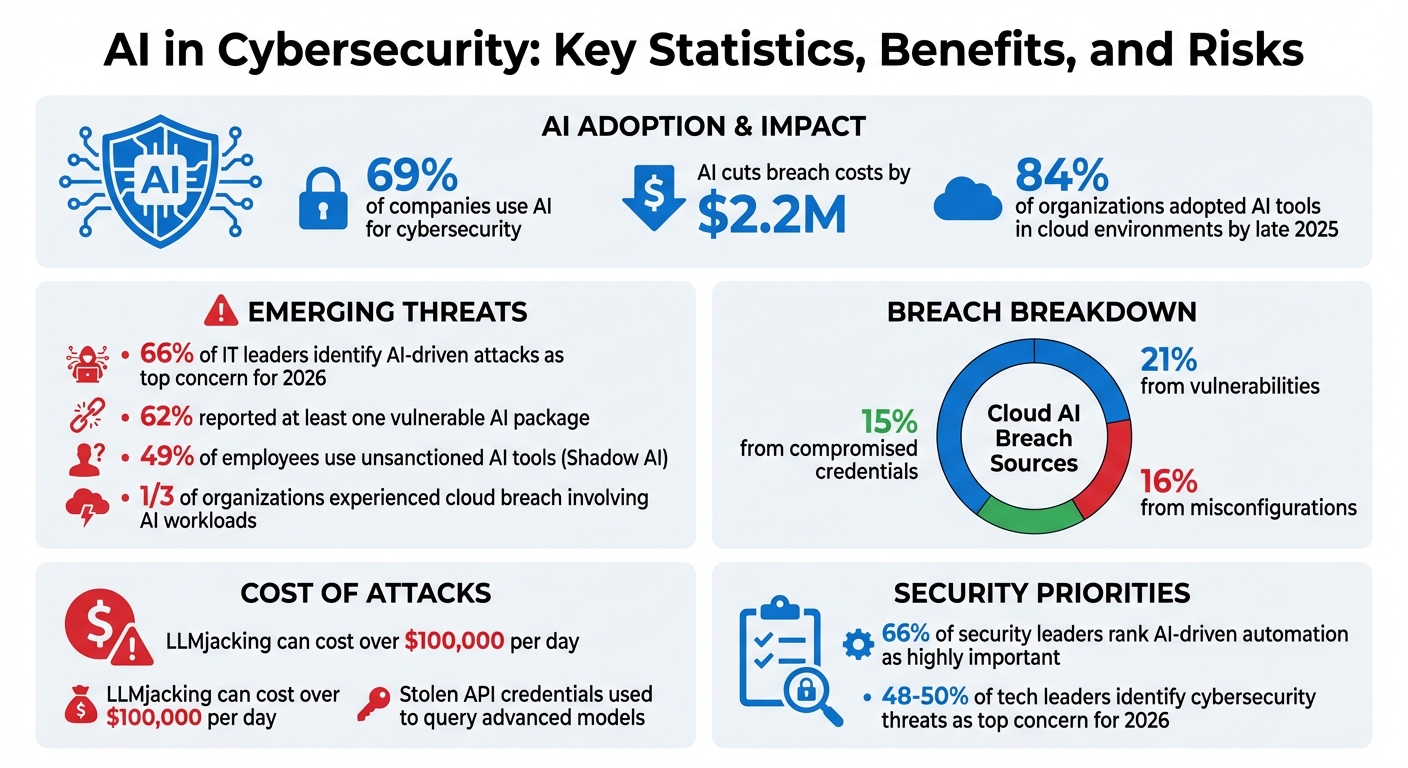
- AI’s Benefits: 69% of companies use AI for cybersecurity, cutting breach costs by $2.2M. It detects anomalies, predicts threats, and automates defenses.
- Key Risks: Privacy concerns arise due to vast data usage. Bias in training data can lead to unfair outcomes. AI tools are also being exploited for sophisticated attacks like phishing and data poisoning.
- Emerging Threats: Indirect prompt injections, LLMjacking (API credential theft), and Shadow AI (employees using unsanctioned tools) are growing concerns.
- What Leaders Can Do: Implement AI risk assessments, ensure transparency, and establish governance frameworks to balance security and ethical use.
The challenge lies in leveraging AI’s capabilities responsibly while addressing these risks to maintain trust and accountability.
AI in Cybersecurity: Key Statistics, Benefits, and Risks in 2025-2026
1. Privacy Risks vs. Security Enhancements
Privacy and Security Trade-offs
AI-driven cybersecurity takes a different approach compared to traditional methods. Instead of relying on signature-based detection to identify known threats, it uses anomaly-based analysis, which requires vast amounts of data to spot unusual patterns [1]. While this approach strengthens security by identifying anomalies, it also raises privacy concerns due to the sheer volume of data required. This trade-off highlights the tension between improving security and protecting sensitive information.
The numbers paint a clear picture of the challenge. By late 2025, 84% of organizations had adopted AI tools in cloud environments, but 62% reported at least one vulnerable AI package in their systems [2]. Alarmingly, one-third of these organizations experienced a cloud breach involving AI workloads, with 21% stemming from vulnerabilities, 16% from misconfigurations, and 15% from compromised credentials [2].
Adding to these risks is the rise of "Shadow AI", where employees use public AI chatbots for proprietary tasks without adhering to internal data protection protocols. By inputting sensitive information - like proprietary code, customer data, or HIPAA-protected details - into these systems, they may unintentionally expose data to platforms that store conversations for purposes like quality control or model training [1][2].
| Traditional Cybersecurity | AI-Driven Cybersecurity |
|---|---|
| Uses signature-based detection to identify known threats [1] | Relies on anomaly-based analysis using machine learning [1] |
| Limited by human oversight; slower response times [1] | Operates continuously at machine speed, analyzing large datasets instantly [1] |
| Reactive; addresses threats after detection [1] | Proactive; predicts and mitigates threats before they occur [1] |
| Requires less data, limiting the scope of breaches | Requires extensive data, increasing the risk of leaks during model training [1][2] |
| Vulnerable to standard bugs and misconfigurations | Faces unique risks like prompt injection and data poisoning [1][2] |
The shift to AI introduces new vulnerabilities, making the privacy-security balance even trickier. For instance, indirect prompt injection allows attackers to embed harmful commands in emails or documents that AI systems later process, potentially leading to data leaks [2]. Another serious threat is LLMjacking, where attackers steal API credentials to access large language models. This can rack up costs exceeding $100,000 per day as stolen credentials are used to query advanced models [2]. These emerging threats are forcing tech leaders to weigh the undeniable security benefits of AI against its very real privacy risks.
Ethical AI in Cybersecurity: Can We Trust the Machines Defending Us?
2. Bias and Data Misuse vs. Fair Decision-Making Frameworks
Beyond privacy concerns, AI also presents challenges like bias and data misuse, which can compromise decision-making in cybersecurity.
Bias and Fairness Impacts
AI systems in cybersecurity grapple with two key issues: intentional data misuse and unintentional bias. Intentional misuse involves tactics like data poisoning and bias injection, which deliberately distort AI outcomes [1][2]. On the other hand, unintentional bias stems from prejudices in training data, potentially influencing AI decisions in areas such as access control or threat assessment [1][4]. As Malwarebytes highlights:
"AI systems can inherit biases from the data they are trained on, which can lead to discriminatory outcomes." [1]
Addressing these challenges requires distinct strategies. Combating data misuse often involves adversarial training, where models are exposed to simulated attack scenarios during development. Meanwhile, reducing unintentional bias calls for clear governance practices and adherence to regulatory frameworks, like risk management protocols [4]. With 66% of IT leaders identifying AI-driven attacks as a top concern heading into 2026 [3], tackling both issues is crucial for cybersecurity resilience.
Accountability and Oversight
Effective oversight isn't just about good intentions - it demands structured governance. A cross-functional committee, including representatives from Legal, Ethics and Compliance, Privacy, Information Security, R&D, and Product Management, can help identify vulnerabilities and promote balanced decision-making [6]. This team should also adopt risk-based classification systems, aligning internal policies with frameworks like the EU AI Act to categorize AI systems into risk tiers: Unacceptable, High, Limited, and Minimal.
OneTrust underscores this point:
"Automation accelerates work, but human judgment remains essential, especially for high-risk systems." [6]
Such governance ensures transparency and accountability, helping organizations meet ethical standards while deploying AI-driven solutions.
Transparency and Governance
Explainable AI (XAI) plays a critical role in mission-critical environments, allowing security teams to interpret and validate AI-generated alerts [5]. To build trust into AI systems, organizations can integrate tools like the NIST AI Risk Management Framework (AI RMF) 1.0 and its Generative AI Profile during design, development, and evaluation phases [5].
Additional safeguards can further enhance security, including:
- Federated learning: Facilitates collaborative threat intelligence across networks while preserving privacy.
- Adversarial defense mechanisms: Strengthens models against data manipulation.
- Principle of least privilege: Restricts AI tools to only the data and resources they need, minimizing potential damage from breaches [2].
Finally, logging every AI-based cybersecurity action creates an auditable trail, ensuring full accountability for system activities [6]. These measures collectively help organizations maintain fairness, security, and trust in their AI systems.
sbb-itb-8feac72
Pros and Cons
AI can sift through enormous datasets at lightning speed to spot anomalies and predict potential attacks. For example, it excels at identifying zero-day attacks by detecting unusual behavior patterns rather than relying solely on known threat signatures. Predictive analytics even allows AI to forecast attacks before they happen. No wonder 66% of security leaders rank AI-driven automation as highly important for staying ahead of emerging threats [8].
But with these strengths come serious concerns. The same AI systems that monitor network traffic for threats can also collect sensitive personal data, sparking debates around privacy and surveillance. A lack of transparency in how AI systems make decisions only deepens these concerns. As Charles Owen-Jackson from IBM points out:
"The purpose of AI is to augment human intelligence, not to replace it. Machines can't be held accountable if something goes wrong" [7].
Bias in AI is another pressing issue. When algorithms are trained on flawed or biased data, they can perpetuate unfair profiling or discriminatory practices. For example, 49% of employees admit to using unsanctioned AI tools [2], and one-third of organizations have already reported cloud data breaches involving AI workloads [2].
| AI Benefit | Description | Ethical Concern |
|---|---|---|
| Real-time Detection | Quickly identifies threats across large datasets | Privacy/Surveillance: Risk of exposing sensitive personal data |
| Improved Decision-Making | Analyzes risks to prioritize and respond effectively | Opacity (Black Box): Lack of clarity in how conclusions are reached |
| Automation & Efficiency | Handles routine security tasks, reducing workload | Bias & Fairness: Potential for unfair profiling or targeting |
| Proactive Defense | Anticipates and blocks threats before they occur | Accountability: Uncertainty over responsibility when automated actions fail |
| Continuous Adaptation | Learns from new data to counter evolving tactics | Complacency: Risk of over-reliance on AI, leading to weaker human vigilance |
Striking a balance between AI's potential and its ethical challenges is essential. Organizations that approach AI deployment with care - emphasizing human oversight, transparent processes, and regular auditing - are more likely to succeed in the long run. As Michael Impink from Harvard DCE aptly says:
"If it becomes commonplace to use AI, the firms who use it ethically and responsibly will gain a competitive advantage" [9].
This balance not only mitigates risks but also sets a standard for responsible AI use in the tech industry.
Responsibilities for Tech Leaders
As we delve deeper into the risks and ethical challenges of AI, it's clear that tech leaders have a critical role to play in addressing these issues. The dual challenge of deploying AI in cybersecurity is particularly pressing. With 66% of senior IT and business decision-makers identifying AI-generated attacks as the most significant data threat by 2026 [3], the urgency for action is undeniable. To tackle this, leaders must go beyond technical solutions and adopt a broader approach that integrates AI with human factors, organizational values, and societal considerations [10].
A good starting point is conducting AI impact assessments. The NIST AI Risk Management Framework provides a practical structure, focusing on four key functions:
- Govern: Establish a culture of risk awareness and management.
- Map: Contextualize risks and understand their impacts.
- Measure: Continuously analyze and monitor risks.
- Manage: Prioritize and act based on risk data [10].
These assessments should involve a diverse group of stakeholders - technologists, developers, risk managers, legal experts, and civil liberties advocates - to ensure accountability throughout the AI lifecycle, from design to deployment [11]. This aligns with earlier discussions on addressing privacy and bias concerns. NIST highlights the importance of this holistic view:
"AI risks – and benefits – can emerge from the interplay of technical aspects combined with societal factors related to how a system is used, its interactions with other AI systems, who operates it, and the social context in which it is deployed" [10].
Team training is another essential responsibility for tech leaders. With the rise of unauthorized tool usage and vulnerabilities in AI packages, teams must be equipped to handle challenges like bias mitigation, adversarial robustness testing, and maintaining human oversight in decisions that affect individual rights. Training should also cover emerging threats such as prompt injections, supply chain poisoning, and LLMjacking [2].
Cross-functional collaboration is key to moving ethical AI practices from mere compliance to a strategic asset. Leaders should assign clear accountability at every stage of the AI lifecycle and maintain detailed documentation on the system’s purpose, design outcomes, and limitations [11]. Programs like Tech Leaders play a vital role in bridging technical and non-technical skills, helping professionals navigate AI ethics, regulation, and team management effectively.
Ultimately, deploying AI ethically isn't just about meeting regulatory requirements - it’s a way to gain a competitive edge. By investing in impact assessments, robust training, and collaborative governance, organizations can leverage AI's potential while minimizing risks. With nearly 50% of tech leaders identifying cybersecurity threats as their top concern for 2026 [3], the time to act is now.
Conclusion
AI has revolutionized cybersecurity by enabling faster threat detection, continuous surveillance, and predictive defenses. However, it also introduces serious ethical concerns - ranging from algorithmic bias and privacy breaches to the rise of AI-driven cyberattacks, which many experts now see as a growing danger [3].
To address these risks, the path forward requires establishing clear ethical guidelines and practices. Transparency, accountability, and fairness must guide every stage of AI deployment. This includes making AI's decision-making processes understandable, assigning human oversight for outcomes, and rigorously testing systems to minimize bias. Striking the right balance between advancing technology and ensuring safety is critical [4].
FAQs
How can organizations ensure AI enhances cybersecurity without compromising privacy?
Organizations can harness AI's cybersecurity advantages while safeguarding privacy by embedding a privacy-by-design philosophy into every stage of the AI development process. This means setting clear data-handling rules, limiting data collection to only what’s absolutely needed, and employing methods like differential privacy or federated learning to protect sensitive information. Ongoing monitoring and maintaining transparent documentation are essential to prevent AI systems from unintentionally exposing private data.
In practice, companies can take steps like separating data environments - securely storing raw logs while ensuring only anonymized data is used in AI models. Implementing strict access controls and conducting regular tests to identify biases or privacy vulnerabilities also play a key role. While AI is powerful for enhancing threat detection and automating responses, weak privacy measures can leave systems open to exploitation. Pairing advanced AI tools with strong governance policies allows organizations to boost security without compromising user privacy.
For tech leaders looking to adopt these strategies, Tech Leaders provides training programs that blend technical skills with leadership and ethical AI practices, enabling executives to create responsible, effective AI-driven solutions.
How can we reduce bias in AI systems used for cybersecurity?
Reducing bias in AI-driven cybersecurity systems requires tackling its root causes, like biased training data or opaque decision-making. Left unchecked, bias can lead to overlooked threats, unjust alerts, or even leave systems open to adversarial attacks. Addressing it head-on isn't just a nice-to-have - it's a must.
Here are some practical steps organizations can take:
- Establish governance policies: Bring together a multidisciplinary team - security experts, data scientists, and legal professionals - to oversee the development and deployment of AI models. Collaboration ensures a well-rounded approach.
- Diversify data sources: Use training datasets that reflect a wide range of scenarios and demographics. Regularly document sources and perform quality checks to minimize skewed results.
- Test for bias regularly: Make fairness testing a standard part of model validation. For example, evaluate how the system performs across different groups, and conduct ongoing audits after deployment.
- Increase transparency: Leverage explainability tools and maintain detailed documentation to help teams identify and address biased decisions effectively.
For tech leaders, adopting these measures means more than just improving cybersecurity - it’s about ensuring fairness and accountability. By embedding bias reduction into your AI strategy, you not only strengthen your defenses but also build trust in your systems.
What is the role of tech leaders in promoting ethical AI use in cybersecurity?
Tech leaders have a big responsibility when it comes to making sure AI is used responsibly in cybersecurity. Their job goes beyond just developing tools - they need to build safeguards into the process, like conducting impact assessments, setting up ongoing monitoring, and implementing accountability measures. This careful approach ensures that potential risks are identified and addressed before AI tools are introduced into sensitive areas.
Key actions include integrating human-in-the-loop oversight, running thorough bias tests, and keeping documentation clear and transparent. These steps help catch and prevent unintended consequences, such as errors or oversights, before they become real problems.
It’s also important for leaders to align their strategies with new regulatory standards. Setting up cross-functional ethics committees can provide an extra layer of oversight for AI practices. Regular audits of AI-powered security systems are another must - they can help catch issues like false positives or weaknesses that could be exploited by attackers.
Collaboration is another cornerstone of responsible AI use. By connecting with industries, academic institutions, and government bodies, tech leaders can exchange ideas, share effective strategies, and encourage responsible AI adoption that serves both organizations and the broader community.