
How AI Enhances Customer Data Analysis
AI transforms how businesses analyze customer data by solving key challenges like data overload, disconnected systems, and manual errors. It enables real-time insights, predicts trends, and automates tasks, helping companies improve customer satisfaction and boost revenue. Here’s a quick breakdown of how AI is changing the game:
- Handles massive data volumes: Processes structured and unstructured data instantly, eliminating delays and inefficiencies.
- Unifies fragmented data: Combines data from multiple sources to create a complete customer view.
- Reduces errors: Automates processes to ensure accuracy and consistency across channels.
- Provides actionable insights: Predicts customer behavior, identifies risks, and suggests next steps.
- Enhances personalization: Dynamically segments customers and tailors experiences in real time.
Companies using AI report major improvements, like a 25% rise in customer satisfaction and a 10% increase in revenue. The shift from outdated methods to AI-driven solutions isn’t just helpful - it’s necessary to stay competitive in today’s fast-paced market.
How to Use AI For Customer Insights
sbb-itb-8feac72
Problems with Traditional Customer Data Analysis
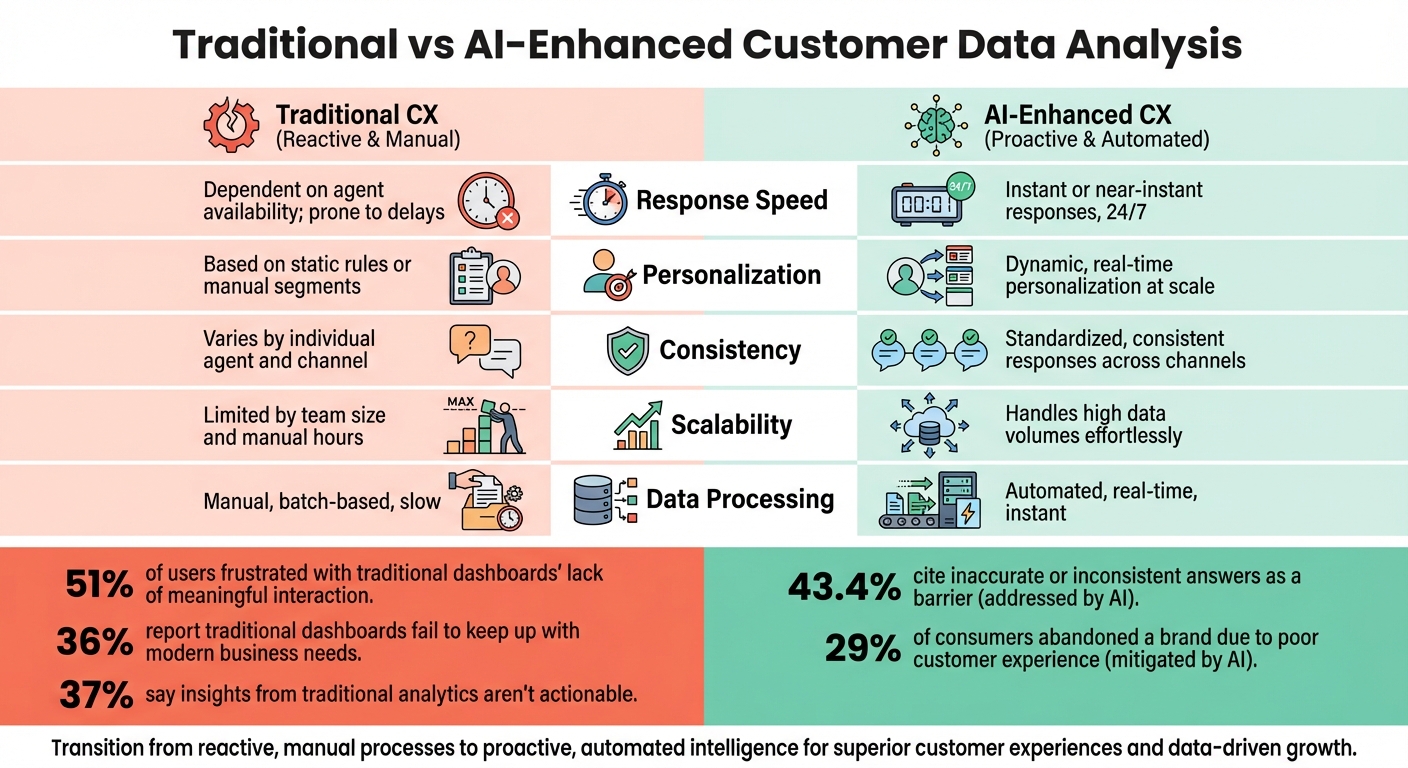
Traditional vs AI-Enhanced Customer Data Analysis Comparison
Traditional methods of analyzing customer data have long faced three major hurdles that make it difficult for businesses to truly understand their customers. These issues not only slow down decision-making but also prevent companies from effectively responding to customer needs. Let's break down these challenges.
Too Much Data to Handle
The sheer volume of customer data pouring into businesses has overwhelmed traditional tools. In fact, 51% of users say their biggest frustration with traditional dashboards is the lack of meaningful interaction with data [1]. When teams rely on manual processes, managing thousands of customer interactions every day becomes an uphill battle. This is why only 13% of contact centers analyzing more than 80% of their calls still use manual listening [9], highlighting how unsustainable these methods are at scale.
Speed is another casualty of this data overload. 36% of users report that traditional dashboards fail to keep up with modern business needs [1]. While competitors may adapt to customer trends within hours, teams stuck with outdated methods are still piecing together reports from last week. To make matters worse, 37% of professionals say insights from traditional analytics aren’t actionable [1], meaning all that effort often fails to produce strategies that actually work.
Disconnected Data Sources
Customer data often lives in separate, unconnected systems. For example, an e-commerce platform might store purchase histories, while a CRM tracks sales interactions, a support tool logs complaints, and social media software monitors engagement. The problem? These systems rarely communicate with each other. As a result, 69% of brands identify inaccurate or insufficient first-party data as a major challenge to understanding their customers [10].
Integration is another headache. 41.5% of enterprise leaders say integration issues with existing systems are a major obstacle to scaling AI-powered analytics [7]. Legacy systems only make this worse. Aleksandra Sidorowicz, Senior Machine Learning Engineer at Future Processing, explains:
Legacy systems operate on outdated technology stacks or proprietary formats that are incompatible with modern AI frameworks. Bridging this gap requires adaptations and integrations that might not align quickly and seamlessly [8].
Because of these challenges, only 19% of businesses globally feel they have a complete profile of their customers [10]. Without a unified view, decisions are based on fragmented and incomplete data, creating even more problems for manual processing.
Manual Processing Errors and Delays
Relying on humans to process data introduces errors and slows everything down. Non-standardized formats, inconsistent units or currencies, and uncoordinated workflows across departments lead to mistakes and mixed messages for customers. It’s no surprise that 43.4% of respondents cite inaccurate or inconsistent answers as a major barrier to adopting advanced analytics [7].
Traditional customer experience also depends heavily on agent availability, which means slower responses compared to automated systems that can operate around the clock. This inconsistency is costly - 29% of consumers have abandoned a brand due to poor customer experience [4].
| Dimension | Traditional CX | AI-Enhanced CX |
|---|---|---|
| Response Speed | Dependent on agent availability; prone to delays | Instant or near-instant responses, 24/7 |
| Personalization | Based on static rules or manual segments | Dynamic, real-time personalization at scale |
| Consistency | Varies by individual agent and channel | Standardized, consistent responses across channels |
| Scalability | Limited by team size and manual hours | Handles high data volumes effortlessly |
These challenges make it clear why businesses are increasingly turning to AI. It’s no longer a luxury - it’s essential for thriving in a world where customer expectations are higher than ever.
How AI Solves Data Analysis Problems
AI is transforming how businesses tackle data analysis challenges, replacing slow, manual processes with real-time, automated solutions. This shift enables companies to act on insights as they emerge, rather than relying on outdated reports.
AI simplifies and accelerates complex data tasks. What used to take days - like gathering, cleaning, and merging data - is now done in minutes. AI systems process data from websites, IoT devices, and customer interactions as it flows in, delivering actionable insights on the spot. For example, the AI analytics market is predicted to grow at a 22.6% annual rate, reaching $223.3 billion by 2034 [11]. In November 2025, Autodesk revamped its analytics platform, reducing manual work and achieving a 10x boost in data ingestion speed while needing three times fewer staff [5]. Furthermore, businesses that integrate AI into customer experience strategies report a 15% to 20% rise in customer satisfaction, a 5% to 8% increase in revenue, and a 20% to 30% reduction in service costs [6]. These advancements lay the groundwork for specialized AI features like real-time data processing, automated customer segmentation, and sentiment analysis.
Real-Time Data Processing
Speed is a game-changer in decision-making. AI processes customer data instantly, whether it’s from support tickets, website activity, or social media mentions. This real-time capability has become essential as customer expectations evolve.
Take the example of a major US airline that, in October 2025, implemented machine learning to personalize compensation for flight delays. The AI system distinguished between frequent flyers and leisure travelers in real time, resulting in a 210% improvement in targeting at-risk customers, an 800% jump in customer satisfaction, and a 59% reduction in churn among high-value passengers [6].
AI also excels at analyzing unstructured data - like social media posts, call recordings, and PDFs - revealing insights that traditional tools often miss. It can uncover trends and patterns in days that might take human analysts weeks to identify. Additionally, natural language querying allows non-technical users to ask straightforward questions, like "Why did sales drop last month?" without needing to write complex SQL queries or depend on analysts to generate reports.
| Capability | Traditional Analytics | AI-Powered Analytics |
|---|---|---|
| Data Processing | Manual, batch-based, slow | Automated, real-time, instant |
| Data Types | Structured (tables) | Structured & unstructured |
| User Interface | Static dashboards, SQL | Natural language, chatbots |
| Insight Type | Descriptive (Hindsight) | Predictive/Prescriptive |
| Actionability | Human interpretation | Proactive alerts, automation |
AI doesn’t just make data analysis faster - it also sharpens customer focus by identifying unique patterns and behaviors.
Automated Customer Segmentation
AI tackles fragmented customer data by dynamically grouping customers based on their behaviors, preferences, and needs. This automated segmentation uncovers patterns that might be overlooked using traditional methods.
For instance, machine learning analyzes millions of data points to identify high-value customer segments, predict early signs of churn, and recognize brand advocates. These insights are continuously updated as new data comes in. In November 2025, the Canadian Football League used AI to consolidate over 120 data points per fan into a unified Customer 360 view. By delivering personalized content based on this segmentation, they achieved a 9x increase in conversion rates and a 3x improvement in fan retention [5].
AI also integrates data types that traditional tools struggle with, such as call transcripts, email sentiment, and social media activity. A global payments processor, for example, developed a machine learning model to predict which merchants might scale down their business within a week. By mapping targeted interventions - like fee adjustments or technical support - to specific groups, they estimated a 20% annual reduction in merchant attrition [6].
Sentiment and Intent Analysis
AI goes a step further by interpreting customer emotions and intentions, offering a deeper understanding of their needs. Using Natural Language Processing (NLP), AI can analyze unstructured feedback from reviews, social media, chat logs, and support tickets - something manual processes simply can’t handle at scale.
This isn’t just about labeling feedback as positive or negative. AI can perform detailed opinion mining, identifying specific likes and dislikes. For instance, customers might appreciate a product’s quality but criticize its pricing, or praise a service team while noting delivery delays [12].
Intent analysis categorizes customer interactions by purpose - whether someone is checking an order status, exploring product options, or troubleshooting an issue. AI uses this information to offer personalized solutions proactively.
It also identifies early warning signs before they escalate. A sudden spike in negative feedback about a product feature, an increase in frustrated customer interactions, or declining engagement from loyal users can all trigger automated alerts. This allows businesses to address problems immediately, instead of discovering them weeks later in a report.
AI for Predictive and Preventive Strategies
AI is changing the game for businesses by moving them from simply reacting to problems to actively preventing them. This shift not only strengthens customer relationships but also gives companies a clear edge over competitors. Businesses that integrate AI into their customer experience strategies report impressive results, such as a 25% increase in revenue, a 30% boost in customer satisfaction, and a 25% improvement in customer retention [2].
Predictive Analytics for Customer Behavior
AI excels at uncovering patterns in massive datasets - patterns that humans might never spot. By analyzing things like purchase history, browsing habits, and social media activity, machine learning models can predict key outcomes such as customer churn, lifetime value, and demand changes. Here's a striking stat: 78% of companies using predictive analytics have reported a noticeable rise in customer satisfaction [2].
Take Netflix, for example. Its AI-driven recommendation system predicts what users are likely to watch next, driving a 75% increase in user engagement while significantly boosting revenue [2]. Similarly, Telecom Italia used predictive analytics to identify customers at risk of leaving. By offering personalized retention strategies, they managed to cut churn rates by up to 30% [2].
The impact of these proactive strategies is clear. Companies leading in AI-driven marketing enjoy 60% faster revenue growth compared to their competitors and adapt to market trends at twice the speed [13]. Tools like Pecan AI’s predictive modeling boast 90% accuracy and are 8x faster than traditional manual methods [14]. Amazon also uses predictive analytics to identify upsell and cross-sell opportunities, increasing average order values and enhancing customer satisfaction [2].
But AI doesn’t stop at predicting outcomes - it takes action to prevent problems before they arise.
Preventing Problems Before They Happen
AI goes beyond making predictions; it actively steps in to stop issues before they affect customers. By analyzing real-time data, sentiment, and behavior, AI can trigger interventions that resolve potential problems before they even surface.
"Imagine you're an airline and you could use all of your customers' interaction either by phone or chat to understand the sentiment and understand intent. You can now proactively offer a discount on their next flight based on sentiment analysis. That's the future." – Kishan Chetan, Executive Vice President and General Manager, Salesforce Service Cloud [3]
This kind of proactive approach feeds into systems like Next Best Experience (NBE) engines, which ensure that the right actions are taken at the right time. For example, if a customer has an unresolved complaint, the system can pause marketing campaigns targeted at them to avoid further frustration.
In contact centers, AI-powered voice analytics can identify buying signals and successful agent techniques, reducing canceled orders by 10% to 20% [15].
The ability to act immediately on insights is crucial. AI detects early warning signs - like billing mistakes, equipment malfunctions, or a drop in customer engagement - and resolves these issues before they escalate. This shift from merely solving problems to actively building stronger relationships fosters a level of customer loyalty that’s tough for competitors to beat.
Connecting Data Across All Customer Touchpoints
The real challenge in understanding your customers isn’t a lack of data - it’s that this data is scattered across too many systems. You’ve got customer information sitting in CRM tools, billing systems, web analytics, mobile event logs, call center records, and social media platforms. When these sources don’t talk to each other, it leaves you with an incomplete picture, making it difficult to create personalized experiences that resonate.
Here’s the reality: 80% of IT departments say data silos are a major barrier to digital transformation[16]. On the flip side, 52% of consumers have stopped buying from a brand after just one bad experience[4]. Often, these issues arise because companies lack access to a full, connected view of the customer journey. To solve this, businesses need systems that integrate and unify data across all touchpoints.
This is where AI steps in, breaking down silos and creating a comprehensive Customer 360 view. By using methods like batch ingestion, real-time streaming, and zero-copy federation, AI can access and unify data without needing to replicate it[16]. This is especially important given that up to 80% of the data organizations collect is unstructured[16] - think emails, call transcripts, and social media posts. Advanced Customer 360 models combine structured and unstructured data, revealing deeper insights into customer sentiment and intent[5].
A great example of this in action is Autodesk. In November 2025, they revamped their Customer 360 analytics platform, achieving a 10x increase in data ingestion speed while cutting the required staff by two-thirds[5]. This kind of transformation shows how unifying data can dramatically improve efficiency.
AI doesn’t just unify data - it also coordinates actions across departments. AI-powered decision engines ensure marketing, sales, and service teams work together seamlessly. For instance, if a customer has an unresolved service issue, the system automatically pauses marketing emails to avoid adding to their frustration. This kind of orchestration can reduce service costs by 20% to 30%[6] and prevents the disconnected experiences that push customers away. By consolidating data and coordinating actions, AI enables proactive, frictionless customer experiences that build loyalty and trust.
Conclusion
AI is reshaping how businesses analyze customer data. While traditional analytics focused on reporting past events, AI takes it a step further by predicting trends and recommending actions. This shift from reactive analysis to proactive strategy is what separates companies that thrive from those that merely get by.
By addressing long-standing challenges like fragmented data, reliance on specialized analysts, and limited insight into customer behavior, AI paves the way for smarter, more proactive customer engagement. It eliminates data silos and provides actionable insights, enabling businesses to respond quickly and effectively to customer needs.
For technical leaders, the path forward is clear: centralize data, break down silos, and experiment with impactful AI applications, such as churn prediction, to achieve measurable results. AI takes on repetitive tasks like data cleaning and pattern detection, allowing teams to focus on making strategic decisions that truly matter.
The companies leading the way with AI integrate analytics into everyday workflows, ensure ethical oversight, and align team incentives to create seamless customer experiences. With 70% of executives acknowledging that customer expectations are evolving faster than their organizations can keep up [4], the real question isn’t whether to adopt AI - it’s how to do so effectively and quickly.
For technical professionals stepping into leadership roles, bridging the gap between technical expertise and business strategy is critical. Platforms like Tech Leaders (https://technical-leaders.com) help turn technical know-how into actionable insights that drive a competitive edge in today’s AI-driven world. The tools are ready - the advantage lies with leaders who know how to use them strategically.
FAQs
How does AI bring together customer data from different platforms?
AI makes it easier to bring together customer data from multiple sources - like CRM systems, e-commerce platforms, social media, and IoT devices - by automatically spotting and fixing differences in formats, structures, and quality. Using machine learning, it identifies patterns and builds a shared data structure, while real-time tools clean up issues such as duplicate entries or missing information. The result? A seamless and reliable dataset.
Once the data is unified, AI-powered analytics can create a detailed Customer 360 view. This view combines purchase history, behavior patterns, and demographic details into one clear and actionable profile. With this unified data, businesses can offer personalized experiences, improve their forecasting accuracy, and confidently make decisions based on solid insights. Tech Leaders equips engineering professionals with the expertise to design and manage these AI-driven data processes, helping them transform complex data into valuable business intelligence.
What are the main advantages of using AI for real-time customer data analysis?
AI brings a lot to the table when it comes to real-time customer data analysis. By streamlining data processing, it delivers insights that are not only fast but also precise and timely. This automation takes over complex analytical tasks, minimizing human error and allowing teams to focus on more strategic priorities.
On top of that, AI can help businesses lower operational expenses while uncovering new opportunities to increase revenue. With quicker access to actionable insights, teams can make smarter decisions and adapt rapidly to evolving customer demands, improving both efficiency and competitiveness.
How does AI-powered predictive analytics improve customer satisfaction?
AI-driven predictive analytics is transforming how businesses understand and engage with their customers. By anticipating customer needs and behaviors, companies can craft tailored experiences, provide timely responses, and address potential concerns before they become major problems.
Using advanced technologies like machine learning for predicting churn or natural language processing to analyze sentiment, businesses gain a clearer picture of customer behavior. These insights empower companies to refine their strategies and foster deeper, more meaningful connections with their audience.