

How Authentic Leaders Drive Employee Engagement
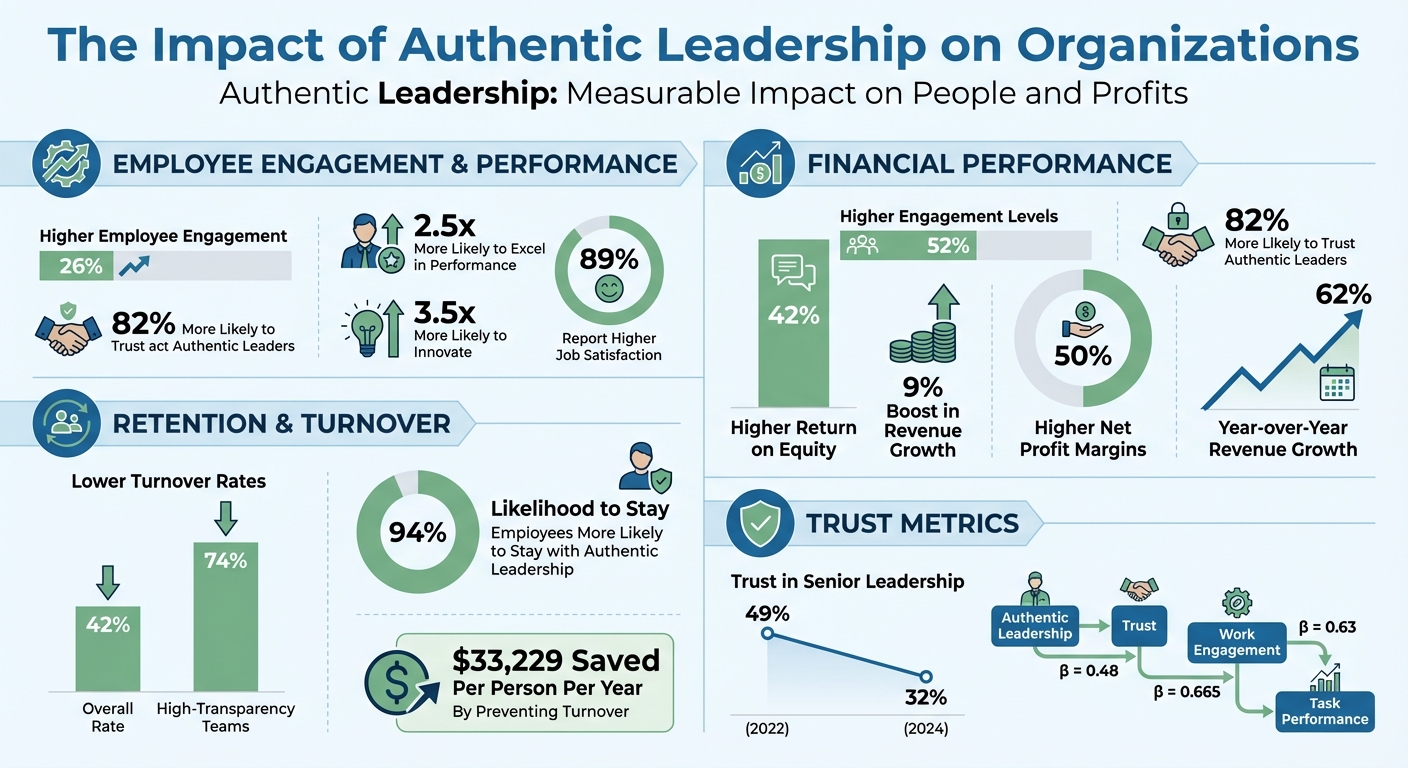
Employee engagement improves when leaders focus on self-awareness, transparency, and aligning actions with values. Research shows that organizations with such leadership experience:
- 26% higher employee engagement
- Employees are 2.5x more likely to excel and 3.5x more likely to innovate
- 42% lower turnover rates
A study from November 2025 also highlights the importance of "authenticity fit" - when leaders and employees share similar levels of authenticity, anxiety drops, and retention improves. Conversely, mismatches can lead to increased anxiety and turnover.
Leaders who prioritize trust, open communication, and ethical decision-making see measurable results, including higher revenue growth and improved team performance. This leadership style isn't just about principles; it directly impacts productivity, innovation, and employee satisfaction.
Authentic Leadership Impact on Employee Engagement and Business Performance
Authentic Leadership & Employee Engagement: A Former Entertainment Executive's Take
sbb-itb-8feac72
What is Authentic Leadership?
Authentic leadership is a leadership style rooted in self-awareness, ethical decision-making, and fostering trust. Instead of focusing on appearances or short-term gains, authentic leaders rely on their values and self-insight to guide their teams. This contrasts with traditional leadership approaches that might prioritize achieving goals at the expense of principles or ethical standards.
The concept dates back to the ancient Greek aphorism "Know thyself" but gained renewed attention in the 2000s through the work of Bill George and colleagues. Authentic leadership emerges from personal experiences and defining moments that shape a leader's ethical and principled behavior. Unlike charismatic leadership, which often relies on exceptional qualities in rare circumstances, authentic leadership is grounded in consistent ethical practices that promote trust and stability.
Core Components of Authentic Leadership
Authentic leadership is built on four key components, developed by researchers Walumbwa, Avolio, and Gardner. These elements are often measured through the 16-item Authentic Leadership Questionnaire and work together to create a leadership style that inspires trust and engagement.
- Self-Awareness: Authentic leaders understand their own strengths, weaknesses, and the impact of their actions. They actively seek feedback to improve their interactions and decision-making.
- Relational Transparency: By openly sharing their thoughts, emotions, and information, leaders build trust and foster genuine relationships with their teams.
- Internalized Moral Perspective: Leaders stay true to their internal values and moral standards, resisting external pressures to compromise their principles.
- Balanced Processing: Leaders objectively evaluate information, welcome differing viewpoints, and make decisions that are fair and unbiased.
| Component | Key Behavior | Impact |
|---|---|---|
| Self-Awareness | Seeking feedback to improve interactions | Better alignment between leader and team |
| Relational Transparency | Openly sharing true thoughts and feelings | Builds trust and loyalty |
| Internalized Moral Perspective | Acting in line with core values | Strengthens integrity and ethical climate |
| Balanced Processing | Considering diverse perspectives | Leads to higher-quality decisions |
Why Authentic Leadership Matters
The principles of authentic leadership have a direct and positive impact on organizational performance and employee trust. While transformational leadership focuses on achieving organizational goals, authentic leadership emphasizes staying true to one's values. A meta-analysis of 100 studies involving 25,452 participants found a strong correlation (ρ = 0.72) between authentic and transformational leadership. However, authentic leadership proved to be a stronger predictor of group performance and behaviors that benefit the organization [3].
The effectiveness of authentic leadership lies in how its components work together. Theories like Social Contagion and Social Exchange offer insights into its influence. According to Social Contagion Theory, when leaders demonstrate resilience and ethical behavior, these qualities spread throughout their teams, encouraging positive practices. Social Exchange Theory suggests that employees respond to a leader’s fairness and openness with increased engagement. A 2023 study of 476 hotel employees in Dubai highlighted how relational transparency, internalized moral perspective, and balanced processing significantly boosted work engagement, with trust playing a pivotal role [5].
Authentic leaders also reduce uncertainty and create a sense of security within their teams. As researcher Peus explained:
The relations between authentic leadership and followers' work-related attitudes as well as perceived team effectiveness are mediated by perceived predictability of the leader, a particular facet of trust [6].
How Authentic Leadership Drives Employee Engagement
Authentic leadership has a profound impact on employee engagement, reshaping how teams interact and thrive. The results are clear and measurable, with significant improvements in team dynamics.
Building Trust and Psychological Safety
Trust is the cornerstone of employee engagement, and authentic leaders cultivate it by practicing relational transparency - openly sharing their thoughts, emotions, and decisions with their teams. They also engage in balanced processing, actively considering diverse perspectives before making choices. This approach makes employees feel valued and respected. According to Social Contagion Theory, when leaders demonstrate resilience and ethical behavior during tough times, these traits spread throughout their teams, reducing negativity and fostering positive attitudes [5].
The statistics back this up: 82% of employees are more likely to trust leaders who exhibit authentic behaviors, while teams with high levels of transparency see 74% lower turnover rates [2]. This is increasingly vital, as trust in senior leadership has dropped from 49% in 2022 to just 32% in 2024 [7]. Authentic leaders counter this decline by maintaining consistency between their words and actions, creating a sense of predictability. This consistency helps employees feel psychologically safe, encouraging them to take risks and share ideas without fear of judgment.
Once trust is established, authentic leaders deepen engagement by aligning their actions with their core values.
Aligning Values with Actions
Employees pay closer attention to what leaders do than to what they say. Authentic leaders consistently act in line with their core values, rather than succumbing to external pressures. This behavior fosters a sense of ethical leadership that inspires employees to match that standard with their own commitment and effort. Employees under authentic leaders are 2.5 times more likely to deliver their best performance and 3.5 times more likely to propose new ideas and solutions [2].
Transparent communication plays a big role here. Companies that prioritize clear and open communication report a 42% higher return on equity compared to those that don't [2]. When leaders "walk the talk", employees respond with increased motivation and loyalty.
With trust and values firmly in place, authentic leaders take the next step by empowering employees to innovate and take ownership of their work.
Empowering Autonomy and Innovation
Authentic leaders create environments where employees feel empowered to make decisions and innovate. By consistently acting on their core values, leaders inspire employees to take ownership of their roles [1]. This sense of autonomy has a direct impact on engagement: 89% of employees working under authentic leaders report higher job satisfaction, which translates to 52% higher engagement levels [2].
The concept of "authenticity fit", where both leaders and employees operate with a high degree of authenticity, is key here. When this alignment exists, anxiety decreases, and overall well-being improves [1]. Organizations that embrace authentic leadership practices have seen a 42% drop in turnover rates and a 9% boost in revenue growth [2]. This creates a workplace where employees feel confident to share ideas, experiment, and contribute their best work without fear of judgment or failure.
Research Evidence Supporting Authentic Leadership
Study Findings on Engagement and Performance
The link between authentic leadership and employee engagement isn’t just a concept - it’s backed by extensive research across various industries and regions. A meta-analysis of 214 primary studies involving a massive sample size of 196,300 participants found clear connections between authentic leadership and improvements in performance, job satisfaction, and extra-role behavior [4]. These results highlight tangible shifts in how employees perform under authentic leaders.
In April 2023, researcher Asier Baquero examined 476 surveys from hotel employees in Dubai to explore how specific leadership behaviors influenced engagement. The study revealed that relational transparency and balanced processing had a positive effect on work engagement. Additionally, trust in the leader fully mediated the connection between a leader's self-awareness and employee engagement [5]. Summing up the findings, Baquero stated:
"Authentic leadership and its subscales are proven to be an excellent tool for achieving employee WE [work engagement] and TL [trust in the leader]." [5]
Another study, conducted in February 2022, surveyed 357 Indonesian civil servants who had worked under the same leader for at least two years. Using multivariate analysis, researcher Farah Putri Wenang Lusianingrum demonstrated that authentic leadership significantly increased trust (coefficient β = 0.48), which in turn drove work engagement (β = 0.665) and ultimately boosted task performance (β = 0.63) [8]. This research underscores trust as the vital link between a leader’s style and measurable performance outcomes. Together, these studies shed light on how cultural and organizational factors can shape the effectiveness of authentic leadership.
The Role of Organizational Culture
While leadership behaviors directly impact employee outcomes, the organizational culture amplifies how these practices resonate throughout a company. Culture serves as the backdrop that determines how authentic leadership translates into engagement. Leaders who exhibit ethical behavior help embed shared values into the organization, reducing negative practices and fostering a healthier work environment [5]. This creates a ripple effect where the leader’s values influence daily operations.
One key aspect of authentic leadership - internalized moral perspective - stands out in this context. Leaders who base decisions on personal ethical standards, rather than external pressures, contribute to a fair organizational climate. This ethical foundation encourages innovation by creating an environment where employees feel supported and valued. Research also highlights that cultural dimensions like power distance and individualism at the national level can influence how strongly authentic leadership impacts performance outcomes. This shows that the broader cultural context plays a crucial role in determining how effective these leadership practices can be [4].
How Tech Leaders Can Apply Authentic Leadership
Modeling Core Leadership Values
Tech leaders can bring authentic leadership to life by focusing on four essential dimensions: relational transparency, internalized moral perspective, balanced processing, and self-awareness. These principles influence how you make decisions, address challenges, and interact with your team.
Relational transparency is about being open and honest, especially when making tough calls. For instance, if a project shifts direction or features are cut due to budget issues, explaining the reasoning can prevent speculation and foster trust. Indra Nooyi, former CEO of PepsiCo, exemplified this by writing personal letters to the parents of her senior executives, expressing gratitude for their children’s contributions. She shared:
I want them to know me as a person, rather than just [as] an executive [10].
Sharing personal stories and lessons helps build real connections with your team.
Balanced processing means actively seeking diverse perspectives before making decisions. Instead of dictating the choice of a tech stack, consider hosting discussions where team members, regardless of their seniority, can share their thoughts. Research backs this up: a study involving 40 hospital supervisors showed that role-playing and case discussions during a 4.5-hour training session improved authentic leadership behaviors and trust among employees [11].
Internalized moral perspective ensures you stick to your principles, like refusing to compromise on security or testing standards, even under tight deadlines. Similarly, self-awareness involves recognizing your own limitations and being willing to seek input from experts. This not only demonstrates a commitment to growth but also encourages your team to adopt the same mindset.
When it comes to communication, avoid relying on AI for personal or sensitive messages. A Zapier study from June 2025 revealed that employees could identify AI-generated messages 59% of the time, and they found these messages less helpful [10]. While AI can assist with research or drafting, ensure that your final messages are personal and genuine.
By practicing these values, you lead by example, creating an environment where teams feel empowered to innovate.
Empowering Technical Teams Through Autonomy
Once you've embraced authentic leadership principles, the next step is empowering your team. Giving them autonomy not only boosts innovation but also strengthens trust and engagement. By providing a clear vision and a stable set of values, you allow your team to take ownership of their work while staying aligned with broader goals. This often leads to a "social contagion effect", where employees respond with higher engagement and positive behaviors [5].
Helping your team connect their work to a larger purpose is critical. When engineers understand how their efforts impact users or the company, they’re more likely to make independent, thoughtful decisions. A psychologically safe environment further encourages experimentation without fear of criticism.
Fostering kindness in feedback processes, like code reviews or post-mortems, can turn critiques into opportunities for growth. For example, exercises that categorize behaviors - such as "vulnerability" (admitting mistakes) and "balanced processing" (seeking input) - can help teams navigate challenges constructively. Studies show a strong link between authentic leadership and employee trust, which correlates with higher job satisfaction (0.51) and organizational commitment (0.49) [11].
It's also essential to set clear boundaries for AI use within your team. While AI can streamline operations, sensitive decisions like performance reviews or major architectural choices should remain human-led. Shopify CEO Tobias Lütke demonstrated this by requiring proof that AI couldn’t handle a role before approving new hires [14].
Using Leadership Training Programs
Leadership training programs are another way to bridge the gap between technical expertise and authentic leadership. Moving from a technical role to a leadership position requires developing skills like emotional intelligence, mindfulness, and conflict resolution - areas that extend beyond traditional engineering training [13][15].
Tools like 360-degree feedback systems can help you understand how your leadership style is perceived compared to how you intend to lead. One Fortune 500 company that adopted authentic leadership training saw a 15% boost in employee engagement within a year. Their program included role-playing scenarios and case discussions to improve decision-making and foster resilience under pressure [2][11].
Organizations like Tech Leaders offer tailored programs to support this transition, combining peer masterminds, personalized learning plans, and coaching. These resources help technical professionals develop the leadership skills needed to thrive in the AI-driven workplace. Change doesn’t happen overnight, but small, consistent adjustments - combined with feedback from trusted peers or coaches - can make a big difference.
Accountability partnerships can also reinforce leadership behaviors. Pairing leaders with high-performing peers or mentors ensures ongoing feedback and alignment between your "inner self" and "presented self" [9]. Cultural factors, like power dynamics, can also influence how authentic leadership impacts your team’s outcomes [12].
Investing in authentic leadership pays off. Companies with transparent communication practices report a 42% higher return on equity, experience 74% lower turnover rates, and see a 42% reduction in employee attrition [2]. By committing to this leadership style, you not only strengthen your team but also drive meaningful results for your organization.
Conclusion
Authentic leadership isn't just a feel-good concept - it delivers tangible results. Companies led by authentic leaders see 26% higher engagement, improved satisfaction, and enhanced innovation. Financially, the impact is undeniable, with organizations achieving up to 50% higher net profit margins and 62% year-over-year revenue growth [2][16].
At the heart of this success lies consistency. As Gloria St. Martin-Lowry of HPWP Group explains:
Authenticity isn't about saying whatever comes to mind - that's unfiltered... True authenticity is about consistency in your words, actions, and decisions [7].
When leaders consistently align their actions with their values, trust flourishes. And trust matters - 94% of employees are more likely to stay at a company with authentic leadership [2].
The ripple effects of authentic leadership extend throughout the organization. Teams experience increased energy, a stronger sense of psychological safety, and a deeper feeling of belonging. These factors, in turn, boost overall productivity [16].
One of the most compelling aspects of authentic leadership is its ability to inspire others. When leaders demonstrate transparency, thoughtful decision-making, and vulnerability, their teams often mirror these behaviors. This creates a high-trust environment that not only sparks innovation but also reduces anxiety and turnover. In fact, companies can save an estimated $33,229 per person per year by preventing turnover through authentic leadership practices [16].
For tech leaders aiming to foster this kind of culture, the path is clear. Consistently align your actions with your core values, seek out diverse viewpoints, and empower your team to take ownership of their work. Whether through day-to-day decisions or structured leadership programs like those offered by Tech Leaders, staying true to your values sets the foundation for a workplace where engagement translates into measurable success.
FAQs
How do I know if my leadership is truly authentic?
Authentic leadership is about staying true to your personal values, being open and transparent, and forming real connections with others. It emphasizes humility and reliability, steering clear of ego-driven or harmful behaviors. When your actions consistently reflect these principles, it’s a clear sign of genuine leadership.
What can I do if my team and I have an “authenticity fit” mismatch?
To tackle an "authenticity fit" mismatch, focus on fostering genuine communication rooted in shared values. Start by building trust through transparency, consistency, and self-awareness. This means being open about intentions, following through on commitments, and reflecting on how your actions align with your principles.
Make it a priority to actively listen to your team. Create space for open dialogue, where everyone feels safe sharing their thoughts and concerns. Show vulnerability by acknowledging challenges or mistakes - this humanizes leadership and reinforces trust. At the same time, stay true to your core values, as consistency in your actions strengthens credibility.
These efforts can help realign expectations, deepen connections, and cultivate an environment where team members feel genuinely valued and understood. When people see that their voices matter, they’re more likely to engage and contribute wholeheartedly.
How can tech leaders build authenticity without oversharing?
Tech leaders can strengthen trust by prioritizing open and honest communication that reflects their core values. Being a leader who is genuine doesn’t mean sharing every personal detail - it’s about staying truthful and consistent in your actions and words.
Building trust starts with acknowledging the efforts of your team, being upfront about goals and obstacles, and communicating with empathy and clarity. Striking the right balance between openness and professionalism helps leaders establish credibility while forming meaningful connections with their employees.