

How Automated Risk Tools Improve Decision-Making
Manual risk management is outdated. It’s slow, error-prone, and struggles to keep up with today’s fast-moving challenges like cyberattacks, regulatory changes, and supply chain disruptions. Automated risk tools solve these problems by using AI, machine learning, and real-time analytics to monitor risks continuously, predict future issues, and simplify compliance.
Key Takeaways:
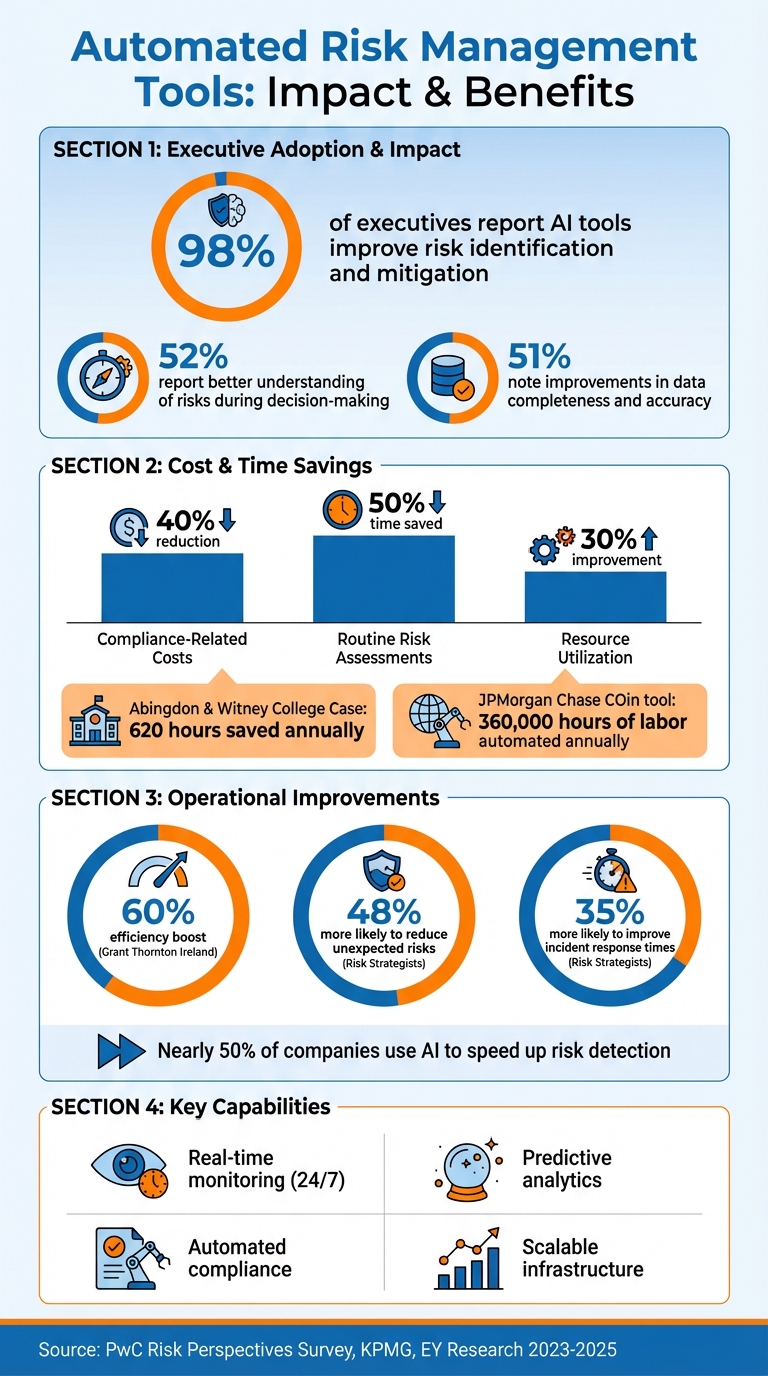
- 98% of executives report AI tools improve risk identification and mitigation.
- Automated systems reduce compliance costs by 40% and save 50% of time on routine assessments.
- Real-time monitoring catches threats early, while predictive analytics helps foresee risks before they escalate.
- Companies using these tools report faster decisions, fewer blind spots, and improved resource allocation.
Why It Matters:
With risks growing more unpredictable, relying on spreadsheets and manual processes is no longer feasible. Automated tools streamline risk management, allowing leaders to act quickly and confidently in a volatile world.
Automated Risk Management Tools: Key Statistics and Benefits
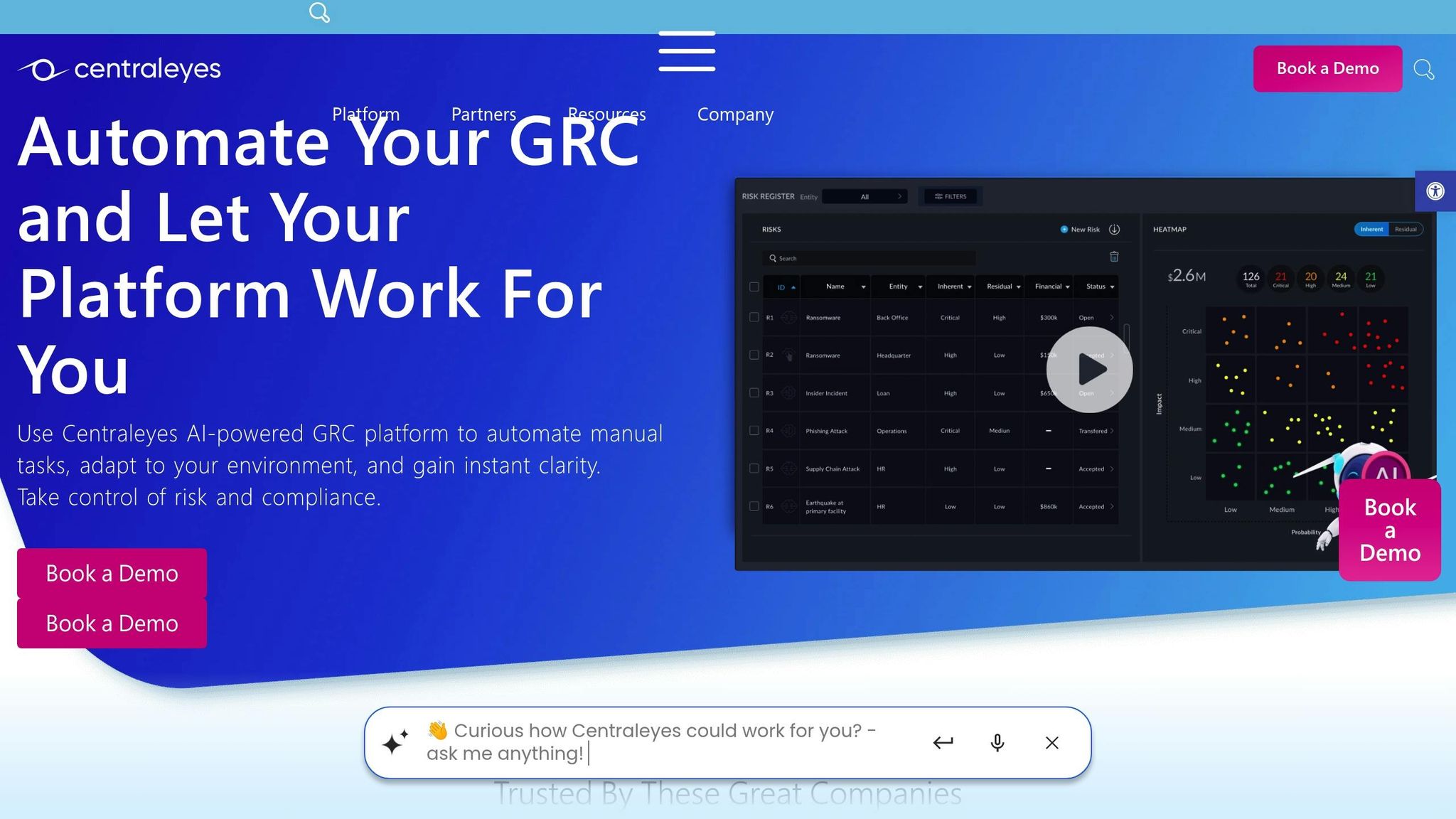
What is an Automated Risk Assessment | Centraleyes
Problems with Manual Risk Management
Manual risk management struggles with three main issues: human error and bias, sluggish threat detection, and the inability to scale alongside organizational growth. Let’s break down how these challenges weaken risk oversight.
Human Error and Bias in Risk Assessment
Relying on manual processes for risk assessment often leads to inconsistency. Cognitive biases play a big role here - confirmation bias pushes decision-makers to focus on information that aligns with their existing beliefs, while anchoring bias traps teams into relying too heavily on initial data points. Overconfidence can cause leaders to trust their instincts over solid evidence, and bandwagon bias encourages groupthink over objective analysis. Spreadsheets, a common tool for manual assessments, make things worse by introducing errors through data entry mistakes and inconsistent terminology.
The repetitive nature of manual data collection also adds to employee burnout, increasing the risk of oversight mistakes. Studies show that organizations transitioning away from manual processes experience a 40% drop in compliance-related costs and save 50% of the time spent on routine risk assessments [12]. Moreover, more than half of risk teams report substantial improvements in their ability to manage risks after adopting tools like advanced analytics and artificial intelligence [13].
"More than half of risk teams say they have seen 'significant improvement' in how they manage risks by using applications such as advanced analytics, automated workflow solutions, artificial intelligence/machine learning, and GRC platforms."
Slow Threat Detection and Response
Another major drawback of manual risk management is its reliance on outdated, point-in-time assessments. By the time a review is completed, the risk landscape may have already shifted. Fragmented data spread across departments and spreadsheets further delays responses, making it harder to get a clear picture of the risks involved. These delays often leave risk managers scrambling to catch up while threats escalate.
For instance, Abingdon & Witney College replaced its paper-based risk management system with automated workflows in 2021, saving 620 hours annually on task risk assessments [FlowForma Case Studies, 2021]. Similarly, Grant Thornton Ireland automated 20 critical workflows in 2022, achieving a 60% efficiency boost and enabling immediate access to risk data through digital dashboards [FlowForma Case Studies, 2022]. A striking example comes from JPMorgan Chase, which in 2024 used its AI tool COin to automate legal document reviews, cutting down work that previously required 360,000 hours of labor annually [FlowForma/JPMorgan Case Study, 2024].
"One of the significant drawbacks of manual risk management is its reliance on point-in-time assessments. In a rapidly changing business environment, data gathered during manual assessments can quickly become outdated, leading to significant blind spots."
- Emily Bonnie, Senior Content Marketing Manager, Secureframe [13]
Scalability and Compliance Difficulties
As organizations expand, manual risk management systems quickly become unmanageable. The growing complexity of tasks like data mapping, control monitoring, and coordinating across multiple stakeholders overwhelms these outdated processes. Teams end up spending countless hours on repetitive tasks - such as data collection and report generation - leaving little room for addressing strategic risks.
Modern regulatory requirements demand real-time data and audit readiness, areas where manual systems fall short. Without automated reminders or follow-up mechanisms, teams risk missing critical deadlines for assessments and control checks. This not only creates internal bottlenecks but also complicates compliance efforts, slowing down innovation and product approvals.
"In a time when risk is moving faster than ever, manual management seems laughable."
How Automated Risk Tools Solve These Problems
Automated risk tools replace outdated manual processes with continuous monitoring, predictive analytics, and streamlined compliance systems. These advancements lead to more accurate threat detection, smarter forecasting, and simplified regulatory adherence, as outlined below.
Real-Time Monitoring and Alerts
Automated tools offer round-the-clock monitoring of risk factors across an organization. Powered by AI, these tools scan internal and external data continuously, identifying unusual patterns - such as fraudulent transactions or cybersecurity breaches - as soon as they occur [6][9].
In fact, 98% of risk leaders say that digital acceleration, including AI and advanced analytics, has improved their risk identification and monitoring capabilities [1]. Real-time feedback loops help catch issues before they escalate into compliance problems. For example, AI can notify control owners immediately if a risk description lacks clarity, preventing potential gaps [4]. In industries like financial services, automated systems monitor customer interactions and transactions in real time, issuing alerts or even blocking actions that exceed defined risk thresholds [14].
"Financial risk management is not about avoiding risks, but about recognising them at an early stage and managing them in a targeted manner - AI can become a decisive factor here."
AI-Driven Predictive Analytics
Predictive analytics takes risk management a step further by identifying emerging threats before they escalate. AI tools continuously analyze external data sources and internal signals, flagging early indicators of potential risks. For example, machine learning models can detect unusual transaction patterns or shifts in media sentiment that suggest fraud or reputational harm [15][9].
Currently, nearly half of surveyed companies rely on AI specifically to speed up risk detection [2]. These systems don't just react to existing threats - they simulate future scenarios using synthetic data, testing how organizations might handle geopolitical changes, policy shifts, or supply chain disruptions [6]. Dynamic risk models adapt thresholds in real time, giving leaders up-to-date insights instead of relying on outdated, static reports [15].
| Risk Domain | Predictive AI Application | Benefit |
|---|---|---|
| Credit Risk | Analyzes real-time client cash flows to estimate default probabilities [14][15] | Enables faster, case-specific decisions |
| Cyber Risk | Detects behavior anomalies and simulates attack scenarios [14][9] | Improves detection of security breaches |
| Supply Chain | Evaluates weather, political events, and social media to predict disruptions [9] | Allows preemptive rerouting of shipments |
| Fraud Risk | Identifies unusual transaction patterns using unsupervised learning [15][9] | Reduces false positives and speeds up remediation |
Simplified Compliance and Reporting
Automated tools not only detect risks but also simplify compliance and reporting processes. They replace manual, paper-heavy workflows with efficient digital systems. AI-enabled platforms monitor regulatory changes in real time, automatically updating internal policies and controls as new requirements arise [6]. Some organizations even use "virtual regulators" - AI personas trained on agency guidelines and past decisions - to test compliance strategies before implementation, reducing the likelihood of expensive errors [6].
The benefits are substantial. Companies using automated compliance tools save hundreds of thousands of hours annually on manual reviews. These systems also create detailed audit trails with time-stamped documentation, making regulatory preparation seamless and defensible [6][3].
"AI is helping unlock entirely new ways of managing risk and compliance that, until recently, weren't feasible."
- PwC [6]
sbb-itb-8feac72
Main Benefits of Automated Risk Tools for Decision-Making
Automated risk tools go beyond solving basic challenges - they bring greater accuracy, faster execution, and seamless scalability to decision-making. These tools significantly improve how organizations operate by moving away from outdated manual processes.
Better Accuracy and Decision Confidence
Manual assessments often come with biases and errors, but automated systems eliminate these pitfalls. Instead of relying on human intuition or outdated data snapshots, AI evaluates patterns in real-time, offering continuous oversight that supports timely and informed decisions [9]. This shift enables leaders to act on current, reliable data rather than outdated assumptions.
According to recent data, 52% of leaders report a better understanding of risks during decision-making, and 51% note improvements in data completeness and accuracy [8]. AI’s ability to process enormous amounts of structured and unstructured data uncovers patterns and correlations that manual reviews frequently overlook [9]. For example, generative AI can assess risk control descriptions using frameworks like the "5 Ws" (who, what, when, where, why), ensuring documentation is thorough, objective, and easy to test [4].
Faster Response Times and Cost Savings
In risk management, speed matters. Automated tools can analyze and summarize complex documents in minutes rather than hours [17]. A notable example is Convex, an insurance provider that collaborated with Provectus in October 2025 to launch "AI Underwriter", a generative AI solution. This tool processes engineering reports exceeding 100 pages, extracting key performance indicators and flagging risk factors. What once took hours now takes minutes, allowing Convex to assess risks and issue policies quickly without compromising accuracy [17].
"With gen AI, risk management moves from slow, manual processing to faster, scalable, and more consistent workflows that let experts focus on decisions, not documents."
- Helen Johnson, Executive Director, Financial Services, Compliance and Technology Strategy, Provectus [17]
Organizations also save on costs by automating repetitive tasks. AI-powered "virtual auditors" and "virtual regulators" can evaluate compliance plans upfront, cutting down on external auditor fees and compliance expenses [6]. By shifting resources from routine data tasks to strategic initiatives, companies turn risk management into a driver of value rather than just a cost center [16].
Scalable and Adaptable Risk Management
As businesses grow, managing risks becomes more complex. Automated tools handle this complexity with ease. Centralized platforms replace fragmented spreadsheets, creating searchable risk registers that remain effective even for organizations with over 1,000 employees [11][10]. These platforms use API-driven integration to pull data from ERP, HR, and project management systems, ensuring risk monitoring evolves alongside the company’s infrastructure [11][10].
Regulatory compliance is another area where automated tools shine. They adapt quickly to changes in frameworks like SOC 2, ISO 27001, or GDPR, often pushing updates within days. Internal "super users" can modify menus, workflows, and reports without needing costly external support, allowing the tools to grow and change with the organization [10]. This flexibility ensures risk management aligns with business goals, no matter how rapidly the company expands.
| Feature | Manual (Spreadsheets) | Automated Risk Tools |
|---|---|---|
| Data Integrity | High risk of human error | Standardized taxonomy and validation rules |
| Reporting Speed | Days/weeks of manipulation | Real-time dashboards and instant exports |
| Regulatory Updates | Manual research and re-mapping | Automated framework updates and gap analysis |
| Scalability | Impractical at 1,000+ staff | Supports thousands of users via role-based access |
| System Integration | Fragmented data silos | API-driven connections to enterprise systems |
Results: Impact for Tech Leaders
Automated risk management tools are not just about efficiency - they're reshaping how technical leaders approach their roles. These tools provide engineering and tech leaders with measurable benefits as they navigate the shift from being hands-on experts to strategic decision-makers. By streamlining operations and integrating AI into everyday processes, they transform how leaders allocate resources and make critical decisions.
Smarter Resource Allocation
With automated tools, leaders can say goodbye to time-consuming manual data tasks. These tools result in a 30% improvement in resource utilization and cut the time spent on routine assessments by 50% [12].
Features like heat maps and relationship diagrams help leaders zero in on the most pressing risks - those with high severity and probability. By integrating with project management platforms like Jira, these tools embed risk management into existing workflows. They automatically assign and track mitigation tasks, ensuring everyone stays on the same page. This visibility breaks down communication barriers, aligning all stakeholders on resource priorities.
Leadership Growth and AI Integration
For technical leaders stepping into more strategic roles, automated risk tools are game-changers. Instead of focusing on compliance checklists, leaders can now manage a hybrid workforce of AI systems and human experts. This shift not only enhances decision-making but redefines what it means to lead in today’s tech-driven world. It equips leaders to confidently guide new product development and make strategic business decisions.
"AI offers a once-in-a-generation opportunity to transform risk management. When embedded into redesigned processes, it can dramatically expand risk coverage, elevate the experience of managing risk and enable faster, better-informed decisions." - Christopher Richardson, EY UK Financial Services Risk Consulting Leader [7]
Organizations identified as "Risk Strategists" - those adopting tech-enabled risk management - are 48% more likely to reduce unexpected risks and 35% more likely to improve incident response times [7]. These tools also enable advanced scenario planning, using synthetic data and "virtual regulators" to test strategies and simulate policy changes, speeding up strategic decision-making.
For professionals aiming to bridge the gap between technical skills and leadership capabilities, Tech Leaders (https://technical-leaders.com) offers specialized programs. Their engineering leadership training and AI-focused business strategy courses prepare individuals to transition into roles as independent consultants or strategic advisors.
Conclusion
Relying on manual risk management just doesn’t cut it anymore. The days of juggling chaotic spreadsheets are behind us. Modern challenges - like human error, slow threat detection, and compliance headaches - demand a smarter approach. That’s where centralized, AI-powered platforms step in, offering real-time insights, predictive analytics, and scalable solutions for even the most complex operations.
The numbers speak for themselves: automated risk tools reduce unexpected risks by 48% and improve incident response times by 35% [7]. These stats highlight why leaders are moving toward automation.
"The question is no longer whether to automate risk management, it's how soon you can begin." - Riskonnect [10]
For technical leaders, this shift means breaking free from time-consuming compliance tasks. Instead, they can focus on big-picture strategies like scenario planning, resource allocation, and managing hybrid teams of AI systems and human experts. Considering that the World Uncertainty Index is nearly nine times higher than it was two decades ago [5], automated tools are no longer optional - they’re essential for staying ahead in an unpredictable world.
Adopting automated risk management isn’t just about staying competitive - it’s about making faster, smarter decisions driven by data. Leaders who embrace these tools position themselves to thrive in today’s volatile environment.
FAQs
How do automated risk tools help reduce compliance costs and save time on assessments?
Automated risk tools simplify compliance tasks by efficiently analyzing massive datasets through consistent, rule-based evaluations. This approach cuts down on manual labor, reduces errors, and avoids redundant efforts.
With features like real-time risk scoring and automation of repetitive tasks, these tools help organizations save both time and money. They also enhance decision-making by delivering more precise results, while freeing up resources so teams can concentrate on more strategic, high-impact work.
How does AI help improve risk detection and decision-making?
AI plays a crucial role in improving risk detection by sifting through massive datasets to spot patterns, anomalies, and potential threats almost instantly. Whether it’s flagging unusual transactions, tracking market shifts, or identifying supply chain hiccups, AI works faster and with greater precision than traditional methods. This speed and accuracy empower organizations to take action before small issues escalate into major problems.
When it comes to decision-making, AI simplifies the process by automating routine tasks and delivering actionable, data-backed insights. Machine learning models can simulate various scenarios, continuously update risk evaluations, and fine-tune workflows. This means decisions are not only faster but also more consistent. With these tools, business leaders can confidently navigate complex challenges, striking the right balance between managing risks and achieving their objectives.
Why are traditional risk management methods less effective today?
Manual risk management methods are falling behind in addressing the pace and complexity of today’s challenges. These traditional approaches, often dependent on periodic reviews, struggle to keep up with fast-changing risks like cyber threats, shifting regulations, and supply chain disruptions. The result? Organizations are left exposed to risks that evolve faster than these outdated processes can track.
In a world where risks - whether operational, market-related, or credit-based - are deeply interconnected, the need for continuous monitoring of vast and varied data sets has become essential. Relying on manual tools like spreadsheets or static checklists isn’t just time-intensive; it’s also error-prone and influenced by human biases. These methods simply can’t provide the scalability or real-time insights that modern risk management demands. Automated risk tools fill these gaps by delivering quicker, more precise, and data-driven solutions, empowering leaders to make smarter decisions in an increasingly unpredictable landscape.