
10 Best Benchmarking Tools for Change Management
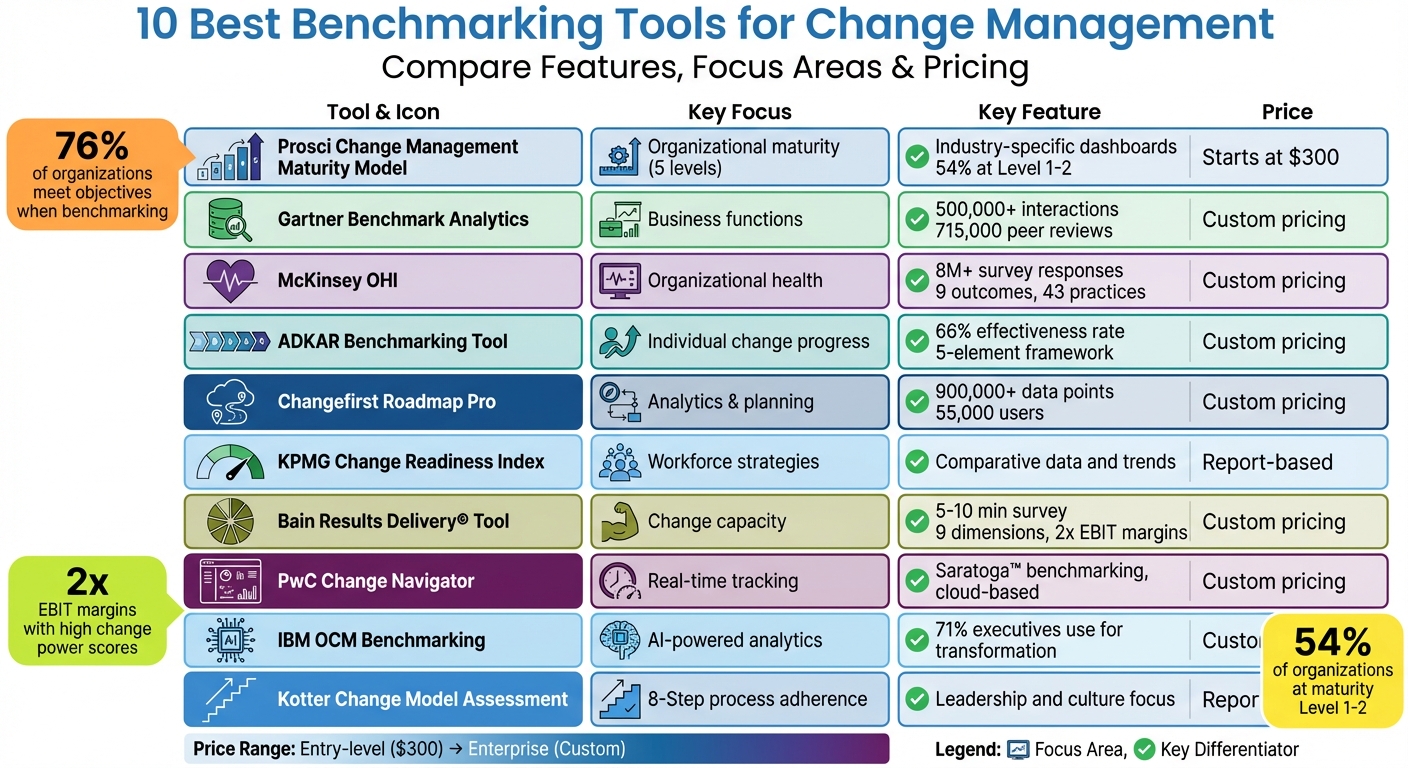
Looking for the best tools to measure and improve your organization's change management? Here's a quick rundown of the top 10 benchmarking tools designed to help you evaluate performance, identify improvement areas, and track progress against industry standards:
- Prosci Change Management Maturity Model: Categorizes organizations into five maturity levels, offering tailored insights and visual reporting. Starting at $300.
- Gartner Benchmark Analytics: Leverages data from over 500,000 interactions to benchmark performance across business functions.
- McKinsey Organizational Health Index (OHI): Uses a survey-based approach to evaluate health and change readiness across nine outcomes.
- ADKAR Benchmarking Tool: Focuses on individual change processes and integrates with broader organizational frameworks.
- Changefirst Roadmap Pro: Combines analytics, planning, and assessments within a cloud-based platform.
- KPMG Change Readiness Index: Provides detailed comparative data on change readiness and workforce strategies.
- Bain Results Delivery® Tool: Assesses capacity for change using a quick survey and benchmarks against industry data.
- PwC Change Navigator: Tracks multiple initiatives in real-time and benchmarks via the Saratoga™ platform.
- IBM Organizational Change Management Benchmarking: AI-powered tools for benchmarking performance and identifying gaps.
- Kotter Change Model Assessment: Evaluates adherence to the 8-Step Process for Leading Change.
Each tool offers unique features like real-time data, visual reporting, and industry-specific comparisons. Prices range from affordable entry-level options to enterprise-level solutions.
Quick Comparison
| Tool | Key Focus | Benchmarking Features | Price/Access |
|---|---|---|---|
| Prosci Maturity Model | Organizational maturity | Industry-specific dashboards | Starts at $300 |
| Gartner Benchmark Analytics | Business functions | Extensive dataset comparisons | Custom pricing |
| McKinsey OHI | Organizational health | Survey-based global benchmarks | Custom pricing |
| ADKAR Tool | Individual change progress | Tracks personal and organizational data | Custom pricing |
| Changefirst Roadmap Pro | Analytics & planning | Large change management database | Custom pricing |
| KPMG Readiness Index | Workforce strategies | Comparative data and trends | Report-based |
| Bain Results Delivery® Tool | Change capacity | Quick survey with industry benchmarks | Custom pricing |
| PwC Change Navigator | Real-time tracking | Saratoga™ benchmarking | Custom pricing |
| IBM Change Benchmarking | AI-powered analytics | Proprietary industry comparisons | Custom pricing |
| Kotter Model Assessment | 8-Step process adherence | Leadership and culture focus | Report-based |
These tools provide data-driven insights to help organizations improve change management processes, align strategies, and achieve better outcomes. Choose the one that best fits your needs and budget.
10 Best Change Management Benchmarking Tools Comparison Chart
1. Prosci Change Management Maturity Model
The Prosci Change Management Maturity Model categorizes organizations into five levels based on how effectively they manage change. These levels range from Level 1 (Ad Hoc or Absent), where change efforts are inconsistent or nonexistent, to Level 5 (Organizational Competency), where change management is fully integrated into the organization’s strategy. According to Prosci's Best Practices research, a striking 54% of organizations are still at Level 1 or Level 2, while only 11% have achieved the highest levels of maturity [7]. This model provides a clear framework for assessing and improving an organization's change management capabilities.
Insights into Organizational Change Maturity
The model evaluates maturity across five key areas: Leadership, Application, Competencies, Standardization, and Socialization [9]. Through an audit process, organizations are scored on 50 observable traits using a five-point scale [9].
"A Prosci license was critical to building enterprise-wide change capability... [it gave] us both the structure to standardize Prosci's change management approach and the flexibility to integrate change management into our established strategy."
– Carla Howard, Director of Change Management Centre of Excellence at Avnet [6]
Tailored Industry Comparisons
Prosci's platform includes customizable Power BI dashboards, allowing organizations to filter data by industry, size, and revenue [1]. For example, a mid-sized healthcare company can benchmark its maturity score against peers in the same sector, rather than relying on generalized averages. Backed by 25 years of research, this tool provides a reliable dataset for meaningful comparisons [6].
Visual Reporting and Actionable Insights
The audit results are presented through clear, visual reporting tools. These reports summarize both overall scores and scores for specific capabilities, offering actionable blueprints for improvement.
"The Prosci Maturity Model has enabled countless organizations to document their current level of maturity and develop actionable plans to increase their maturity."
– Tim Creasey, Chief Innovation Officer at Prosci [9]
Access to the online tool begins at $300.00 [8].
2. Gartner Benchmark Analytics
Gartner Benchmark Analytics is built on an impressive dataset that includes over 500,000 client interactions, 715,000 peer reviews, and insights from 2,500 business and technology experts [12]. This wealth of data enables organizations to measure their change management practices against industry standards, offering detailed benchmarks that span across various business functions.
Industry Comparison Capabilities
With its extensive dataset, the platform allows businesses to make meaningful comparisons in areas vital for successful change management. Organizations can evaluate their performance, digital IQ, and functional effectiveness against their industry peers [10][11]. These comparisons cover key functions like Human Resources, Information Technology, Strategy, Communications, and Sales [10]. Additionally, businesses can benchmark their budgets and team sizes against industry-specific metrics. This helps leaders make informed decisions about investing in team development and technology during transformation efforts [10].
Insights into Organizational Change Maturity
The "Gartner Score" tool offers functional assessments that identify performance gaps and establish baselines for improvement across areas such as structure, talent, technology, and processes [10][12].
"Do more than assess your function's maturity; focus your efforts to close performance gaps in areas that most impact business performance." - Gartner [10]
Data Visualization and Reporting
The platform also includes AskGartner, an AI-driven tool designed to deliver customized insights for executives [12]. Its diagnostic features provide a clear picture of an organization’s current standing and outline the steps needed for progress, simplifying communication about change initiatives with stakeholders [10]. For added support, leaders can collaborate with Gartner Executive Partners - seasoned former CxOs who help turn benchmarking data into actionable strategies [12].
3. McKinsey Organizational Health Index (OHI)
McKinsey's Organizational Health Index (OHI) is a powerful tool designed to measure and benchmark how effectively organizations manage change and maintain overall health. This data-driven framework has been built on insights from over 8 million survey responses collected from 2,600+ clients across more than 100 countries [13]. It uses a 100-question survey, which takes about 20–25 minutes to complete, to evaluate 9 key health outcomes and 43 management practices [14].
Industry Comparison Capabilities
One of the standout features of the OHI is its ability to offer detailed comparisons across industries, regions, and sectors (public vs. private) [15]. Instead of applying a generic approach, the tool categorizes organizations into four archetypes - Market Focus, Execution Edge, Talent/Knowledge Core, and Leadership-Driven - allowing for more meaningful benchmarking against similar peers [15]. For instance, a 2016 study conducted by the Korea Chamber of Commerce applied the OHI to assess leadership styles across 40,000 employees [17].
Insights into Organizational Change Maturity
The OHI framework evaluates an organization’s change maturity through three core dimensions: Alignment (shared vision and strategy), Execution (achieving objectives effectively), and Renewal (capacity for innovation and adaptability) [18]. According to McKinsey, companies in the top quartile for organizational health outperform those in the bottom quartile by delivering three times higher total shareholder returns [16]. For example, manufacturers and telecom companies have reported significant improvements in production and performance within just a few months of using the OHI [13].
"An organization's health... is the best predictor of its long-term financial and operational performance."
– McKinsey & Company [13]
Data Visualization and Reporting
The OHI delivers a comprehensive health score benchmarked against global data, enabling leaders to identify areas for improvement across specific business units or management levels [14]. Recent updates to the tool now include themes like tech enablement, diversity, equity, inclusion, and faster decision-making processes [13]. Organizations that actively worked to improve their health scores have seen an 18% boost in EBITDA within a year. Additionally, the detailed reporting sheds light on employee perceptions and behaviors, helping leaders implement targeted and effective change initiatives [13][16].
4. ADKAR Benchmarking Tool
The ADKAR Benchmarking Tool is built around five key elements of change: Awareness, Desire, Knowledge, Ability, and Reinforcement [19][20]. Developed after analyzing over 300 companies, this tool has become a go-to resource for managing change [20]. Its primary advantage lies in tracking individual progress through the change process, allowing for timely and customized interventions [19]. By focusing on individuals, it also lays the groundwork for evaluating organizational change as a whole.
Insights into Organizational Change Maturity
This tool works hand-in-hand with Prosci's five-level Change Management Maturity Model, shedding light on the common obstacles organizations face as they strive to improve their change management capabilities [7]. Companies can compare their maturity scores to Prosci's extensive global database, which includes insights from thousands of organizations [7].
Data Visualization and Reporting
The tool provides actionable insights through dashboards that capture both baseline data and progress throughout a project's lifecycle [19]. These dashboards help change teams identify specific problem areas, known as "barrier points", where individuals or groups may be struggling [19][21]. For instance, low scores in Knowledge and Ability might highlight training deficiencies, while low Desire scores could point to gaps in sponsorship or communication [19]. Notably, 66% of practitioners using the ADKAR framework report it as being highly effective [19].
Integration with Change Management Frameworks
While centered on individual change, the ADKAR tool meshes seamlessly with established organizational frameworks. It acts as a people-focused measurement layer that complements well-known methodologies like Kotter's 8-Step Model or Lewin's Change Model [22][23]. It also integrates directly with the Prosci 3-Phase Process and can be incorporated into project management plans, ensuring that change-related milestones are tracked alongside technical ones [21][7]. This alignment is especially valuable for organizations aiming for higher maturity levels, as it ensures that change management efforts are embedded into the planning phase, even before project kickoff [7].
5. Changefirst Roadmap Pro
As we continue exploring top benchmarking tools, Changefirst Roadmap Pro stands out with its integrated analytics and planning features designed to streamline change management. It’s the first digital tool to combine on-demand learning, assessments, and project planning in a cloud-based environment [4]. Built on the People-Centred Implementation (PCI®) methodology - one of just three globally recognized change management frameworks - it serves a community of over 55,000 users [25]. What makes this platform particularly effective is its ability to deliver detailed analytics while adapting to a wide range of organizational needs.
Industry Comparison Capabilities
Roadmap Pro shines in competitive benchmarking, leveraging one of the world’s largest change management databases with over 900,000 data points [25]. This allows users to measure their project performance and assess people-change risks against industry standards [4][5]. A notable example is Syngenta, which used the platform between 2021 and 2024 during a transformation involving 27,000 employees across 25 countries. This approach helped reduce change capability costs by 40% over three years [24][25][26]. Research further highlights that while 76% of employees feel overwhelmed by change, only about a third believe their organizations have adequate adaptive capacity [5].
Insights into Organizational Change Maturity
The platform includes a Current State Maturity Assessment, which benchmarks organizations across four levels of competency and mindset [24][25]. This feature helps identify where to prioritize investments before launching large-scale change initiatives. For example, Network Rail utilized these insights to manage a $37.5 billion investment budget, creating an internal Center of Excellence with over 800 Change and Project Managers [25][26]. These assessments complement the platform's broader analytics, offering a complete picture of organizational readiness.
Data Visualization and Reporting
With 10 multilingual assessment tools, Roadmap Pro captures critical data on people-change risks, impacts, and commitment levels [4][5]. HSBC demonstrated the power of these tools during the launch of a global HR portal for 250,000 employees. By targeting risk areas identified through data, they built a network of over 400 Change Champions [25][26].
"Diagnostics Pro helped us focus and direct our resources to where they would make the most difference. We were able to more than double engagement levels – making key decisions with local teams based on their actual data."
- Global Change Lead HR Transformation, Financial Services [5]
Integration with Change Management Frameworks
Although Roadmap Pro is powered by the PCI® methodology, it’s designed to work seamlessly with various organizational processes, including Agile and Project Management frameworks [4][5][26]. For instance, NATS used the platform during an $800 million transformation portfolio, employing it as a central productivity tool to deliver on-demand learning to thousands of employees [4][25][26]. The "Clone and Re-use" feature further enhances its utility by allowing organizations to replicate best practices from successful projects, ensuring alignment and consistency across different regions [4].
6. KPMG Change Readiness Index
The KPMG Global Mobility Benchmarking Report offers organizations a way to measure their progress in managing change effectively. While it’s not a standalone software tool, this methodology provides detailed comparative data that serves as a benchmark for evaluating an organization’s readiness for change [27].
Insights into Organizational Change Maturity
KPMG’s report highlights a shift in focus from merely managing costs to creating value through employee-centered strategies. Companies are now integrating specialized teams into areas like talent management to better align workforce planning with leadership development. It also points to evolving workplace policies - such as expanded remote work options and short-term assignments - that demonstrate how organizations are adapting to change [27].
Industry Comparison Capabilities
The report also underscores the growing influence of AI and automation in shaping organizational strategies. These tools enable companies to assess their technology adoption and ensure their change initiatives are aligned with broader industry trends. KPMG’s approach provides strategic insights that complement other benchmarking tools, particularly in understanding policy changes and technological advancements [27].
sbb-itb-8feac72
7. Bain & Company Results Delivery® Tool
Bain & Company's Results Delivery® Tool leverages the Change Power Index® to assess an organization's capacity for change. Through a quick 5–10 minute survey, it evaluates performance across nine critical dimensions and benchmarks the results against data from nearly 2,000 employees across various industries [2]. Let’s explore its key assessments and reporting features.
Understanding Organizational Change Readiness
The tool measures nine dimensions - Purpose, Direction, Connection, Capacity, Choreography, Scaling, Development, Action, and Flexibility. Based on these, it categorizes organizations into four archetypes: "In search of focus", "Stuck and skeptical", "Aligned but constrained," and "Struggling to keep up" [30]. It also analyzes the Sponsorship Spine, identifying potential weak points where change initiatives might lose momentum [31].
"Change Power is a powerful tool to help leaders become aware of both their strengths and weaknesses when it comes to the ability to change." – David Michels, Global Head of Change Management and Implementation, Bain & Company [30]
Benchmarking Across Industries
These insights into change maturity also allow organizations to compare their performance with peers. High Change Power scores are linked to impressive outcomes: companies with strong scores achieve twice the EBIT margins, a 25% increase in CEO approval, and double the level of employee inspiration. This helps leaders identify and address performance gaps effectively [2].
Advanced Data Visualization and Reporting
The ARC℠ (Action Results Collaboration®) tool provides cloud-based dashboards that offer a clear view of change progress, while the AI-powered Aura Platform generates polished visuals reflecting workforce sentiment and compensation trends [29][32]. Together, these tools create actionable roadmaps, making organizations twice as likely to hit their goals and three times more likely to sustain long-term results [2][28].
8. PwC Change Navigator
PwC Change Navigator is a powerful tool designed to monitor and analyze multiple change initiatives in real time. Whether it's a finance transformation or an ERP implementation, this platform provides clear visibility into projects and portfolios, helping organizations stay on top of their goals [33]. It goes beyond standard benchmarking by combining real-time insights with advanced reporting features. Let’s take a closer look at its benchmarking, maturity insights, and reporting capabilities.
Industry Comparison Capabilities
One standout feature of Change Navigator is its integration with PwC's Saratoga™ platform, which allows organizations to benchmark their change management efforts against industry peers [34]. This feature provides access to peer data, enabling change leaders to set realistic, data-driven targets based on how similar companies are managing their transformations.
"Our industry-leading benchmarking platform, Saratoga™ allows you to compare your organisation against competitors in your industry." – PwC [34]
Insights into Organizational Change Maturity
Beyond benchmarking, Change Navigator offers valuable insights into an organization's readiness for change. Using digitized assessments, the platform gathers stakeholder feedback on change readiness and adoption patterns [33]. It evaluates the current state of change within the organization and helps teams define their ideal future state before moving forward with execution. By automating data collection, the tool eliminates the need for manual spreadsheet management, giving change practitioners more time to focus on engaging stakeholders [33].
Data Visualization and Reporting
The platform also excels in reporting, offering real-time, cloud-based dashboards that connect workforce data directly to business outcomes [34]. Users can tailor reports with customizable demographic filters, such as by region or business unit, ensuring that insights are relevant to specific audiences. The tool continuously tracks rollout metrics, enabling teams to refine their engagement strategies well before critical deadlines [33].
"Our dashboard reporting links critical data and insightful analytics to business outcomes. We help you identify optimal demographic filters so you can view your data exactly the way you want." – PwC [34]
To ensure the highest level of accuracy and reliability, the platform is supported by a team of PhD-level organizational psychologists and statisticians, ensuring that every insight is backed by scientific rigor [34].
9. IBM Organizational Change Management Benchmarking
IBM has developed an asset-based consulting model that uses proprietary AI analytics and reusable tools to benchmark change management performance against industry norms [36]. By replacing traditional manual analysis with advanced technology, IBM delivers quicker and more consistent comparisons across various sectors. This approach is supported by the IBM Institute for Business Value (IBV) and collaborations with organizations like APQC, creating standardized evaluation criteria. These standards allow companies to use a shared framework when assessing the success of their transformation efforts [37].
Industry Comparison Capabilities
IBM's benchmarking tool stands out for its ability to provide direct industry comparisons. By leveraging proprietary databases, organizations can measure their performance against competitors and industry peers [36]. This process helps identify gaps in areas like efficiency, customer experience, and compliance relative to industry benchmarks. According to IBM's findings, 71% of executives believe benchmarking is a key driver of organizational transformation, while 90% consider it a strategic management tool they use quarterly [37]. For companies with around $10 billion in revenue, benchmarking contributes nearly 7% of their revenue - approximately $655 million - in business value [37].
"Benchmarking isn't just about cutting costs or increasing efficiency. It's a driver of business transformation. It improves innovation, enables collaboration, and provides the insights needed for successful change." – IBM Institute for Business Value [37]
Insights into Organizational Change Maturity
IBM's tools assess change maturity across critical areas like vision, governance, change management, and process design [38]. Beyond operational metrics, the platform evaluates strategic elements such as organizational learning rates and readiness for change. Research from IBM highlights that 80% of executives see accelerating innovations as one of the primary benefits of benchmarking [37]. The focus has shifted from traditional cost-cutting to fostering resilient cultures capable of adapting to AI-driven transformations, which demand entirely new approaches compared to past technological shifts [38].
Data Visualization and Reporting
IBM's AI-powered analytics generate real-time reports and actionable recommendations [36]. Features like AI assistants and agents provide executives with high-level insights into performance metrics, such as lead conversion and automation rates, benchmarked against industry standards [35]. Process mining tools enhance these insights by visualizing data, enabling teams to monitor the speed and value of their transformation efforts through the IBM Garage framework [38]. These visualization tools are instrumental in measuring the ROI of change initiatives and ensuring sustained adoption across all levels of the organization [38].
"Open standards can provide a shared language enabling collaboration and innovation at speed and scale - and lay a foundation for the ecosystem-based business models of the future." – IBM Institute for Business Value [37]
10. Kotter Change Model Assessment
The Kotter Change Model Assessment is a tool designed to evaluate how well an organization follows the 8-Step Process for Leading Change, developed by Dr. John Kotter. This framework highlights key stages in driving transformation and pinpoints areas where efforts might falter. The eight steps include: Create Urgency, Build a Guiding Coalition, Form a Strategic Vision, Enlist a Volunteer Army, Enable Action by Removing Barriers, Generate Short-Term Wins, Sustain Acceleration, and Institute Change [40].
Insights into Organizational Change Maturity
This assessment tracks an organization's progress through these eight steps, starting from the groundwork of preparation to the integration of new behaviors into the corporate culture. It also gauges readiness by focusing on the first step: Sense of Urgency. Here, stakeholders must acknowledge that maintaining the status quo is no longer viable. Additionally, the tool evaluates leadership capabilities, such as whether influential leaders have been empowered to drive the change through a guiding coalition. It also examines if the new practices are effectively embedded into the organization's norms, values, and reward systems [39].
By offering a structured way to measure maturity, this tool aligns with other benchmarking methods, giving organizations a comprehensive view of their readiness for change.
"Understanding Kotter's eight-step change model is a requirement for any leader who is serious about implementing change successfully." – Robert Tanner, MBA [39]
Integration with Change Management Frameworks
While the Kotter model provides a strong foundation, its linear approach can sometimes feel restrictive. To overcome this, many organizations pair it with other tools. For instance, Lewin's Force Field Analysis is often used alongside Kotter's model to identify factors that support or resist change throughout the process. Digital tools like The Change Shop further enhance insights by benchmarking team results against industry standards.
Although the Kotter model primarily emphasizes leadership behavior and organizational culture, it is frequently complemented with financial and political analysis tools to offer a more comprehensive perspective on change outcomes. Momentum can be sustained by quickly implementing visible improvements and embedding changes into HR systems, training programs, and ongoing development efforts [39].
Why Benchmarking Matters for Change Management
Benchmarking transforms change management from a guessing game into a structured, data-driven process. Organizations that actively measure compliance and performance against set benchmarks see a much higher success rate - 76% of them meet or exceed project objectives, compared to just 24% of those that skip measurement entirely [41]. This underscores how critical it is to track progress against industry standards.
The benefits of benchmarking extend far beyond simply finishing projects. Companies with strong adaptability report nearly double the EBIT margins, a 25% boost in CEO and senior leadership approval ratings, and twice as many employees feeling "very inspired" at work [2]. These financial and workplace morale gains make benchmarking not just a useful tool but a strategic necessity.
Another key advantage of benchmarking is its ability to uncover performance gaps before they escalate into larger problems. Tools like the Change Power Index provide baseline scores across areas such as leadership and teamwork, offering companies a way to measure themselves against data from thousands of employees across various industries [2]. This kind of detailed comparison helps identify where immediate improvements are needed and reveals opportunities for gaining a competitive edge. These insights are invaluable for addressing specific challenges in measurement.
"Prosci research shows a strong correlation between measuring compliance and overall performance with meeting and exceeding project objectives." – Andrew Horlick, Senior Principal, Prosci [41]
However, choosing the right metrics can be tricky. Dana Otto, Senior Manager of Change Management at Zendesk, highlights this complexity:
"Measuring change management is one of the most difficult parts of the process because you're measuring people and their emotions, which is hard to quantify" [3].
Benchmarking simplifies this challenge by focusing on three levels of measurement: organizational (achieving objectives), individual (adoption and skill proficiency), and change management (execution of strategies) [41]. This layered approach provides actionable insights throughout the project lifecycle, ensuring adjustments can be made as needed.
Conclusion
Choosing the right benchmarking tool comes down to identifying what aligns best with your organization's specific needs. Each of the ten tools we've discussed offers its own strengths - whether it's the research-driven ADKAR framework from Prosci, IBM's powerful enterprise analytics, or Kotter's method for evaluating transformation readiness.
Start by evaluating your organization's current maturity level to pinpoint gaps. This will help you decide whether a more technical solution or a people-focused approach fits your strategy better. It's also crucial to ensure the tool you choose complements your existing change management framework, whether you're working within a structured model like ADKAR or prefer a more flexible, methodology-neutral approach.
Look for a tool that integrates seamlessly with your existing technology stack and provides real-time analytics to identify key influencers and insights. Such integrations can simplify the process and make it easier to measure progress effectively.
The impact of strong change management is clear - it can double EBIT margins and cut the risk of failure by as much as 40% [2][42]. With pricing options ranging from $6 per user per month for basic solutions to over $1,000,000 annually for enterprise-level tools [42][43], there’s something available for organizations of all sizes and budgets.
FAQs
What are the main advantages of using benchmarking tools in change management?
Benchmarking tools serve as a powerful ally for organizations navigating change, turning abstract ideas into concrete, measurable progress. Instead of relying on guesswork, these tools provide data-backed metrics that help track the effectiveness of initiatives. With standardized KPIs and scorecards, they highlight the gap between current performance and desired outcomes, making it easier to adjust strategies and stay on course.
Another advantage is their ability to compare performance against industry standards or historical benchmarks. These comparisons not only reveal areas that need improvement but also shine a light on organizational strengths. Armed with this external perspective, companies can make smarter decisions, improve financial results, and even boost employee morale.
On top of that, benchmarking tools excel at simplifying complex data. By converting raw numbers into clear, actionable insights, they help teams stay aligned, demonstrate ROI effectively, and build trust with stakeholders - all of which are crucial for managing change successfully.
How can I select the best benchmarking tool for change management in my organization?
To pick the best benchmarking tool, start by pinpointing what you need to measure and why it matters. Focus on specific goals like improving employee engagement, tracking adoption rates, or cutting costs. Then, tie these goals to key performance indicators (KPIs) such as readiness scores, resistance levels, or benefit realization. Make sure the tool supports your preferred data collection methods - whether that’s surveys, interviews, or something else - and offers templates to simplify the process.
When comparing tools, keep these factors in mind:
- Features: Look for tools with dashboards, real-time analytics, and AI-powered insights that align with your KPIs.
- Integration: Check if the tool works seamlessly with your existing systems, like HR software or collaboration platforms, and can grow alongside your organization.
- Usability: Opt for a tool that’s easy to navigate for both leaders and employees.
- Cost: Review pricing in U.S. dollars, including any licensing fees and support packages.
Once you’ve narrowed it down, test 2–3 tools in a small pilot project. See which one delivers actionable insights while staying within your budget and working smoothly with your existing tech setup. The right choice will provide clear benchmarks to help your organization achieve meaningful change.
Can these benchmarking tools work with existing change management frameworks?
Yes, many of the benchmarking tools mentioned are built to work effortlessly with well-known change management frameworks. They often come with pre-built templates, API integrations, and support for widely-used methodologies. These features help align the tools with your organization’s current processes and goals.
Additionally, most tools offer flexible customization options, letting you adjust them to fit specific frameworks or workflows. This makes it easier to meet your unique change management requirements while delivering clear, measurable insights into your progress and outcomes.