
How Blockchain Meets GDPR and HIPAA Compliance
Blockchain technology offers promising solutions for managing sensitive data in regulated industries like healthcare. However, its core features - immutability, transparency, and decentralization - can conflict with strict data protection laws like GDPR (in the EU) and HIPAA (in the U.S.). These regulations demand robust safeguards for personal data, making compliance a mandatory, yet complex, challenge.
Key Takeaways:
- GDPR vs. Blockchain: GDPR’s “right to be forgotten” conflicts with blockchain’s immutability. Solutions include off-chain storage for sensitive data and cryptographic hashes on-chain.
- HIPAA Challenges: HIPAA focuses on protecting patient data (PHI) through access controls, encryption, and audit trails. Permissioned blockchains are better suited for these requirements.
- Solutions:
- Hybrid Storage Models: Store sensitive data off-chain; only keep verification hashes on-chain.
- Permissioned Networks: Use private blockchains like Hyperledger Fabric for stricter access control and data residency compliance.
- Smart Contracts: Automate consent management and access control while maintaining audit trails.
- Zero-Knowledge Proofs (ZKPs): Verify data without exposing sensitive details.
Blockchain systems can align with GDPR and HIPAA through thoughtful design choices, such as hybrid storage, permissioned frameworks, and automated compliance mechanisms. These strategies enable secure, compliant data management in healthcare and other regulated industries.
GDPR Compliance for Blockchain Applications in Healthcare
sbb-itb-8feac72
GDPR and HIPAA Requirements for Blockchain
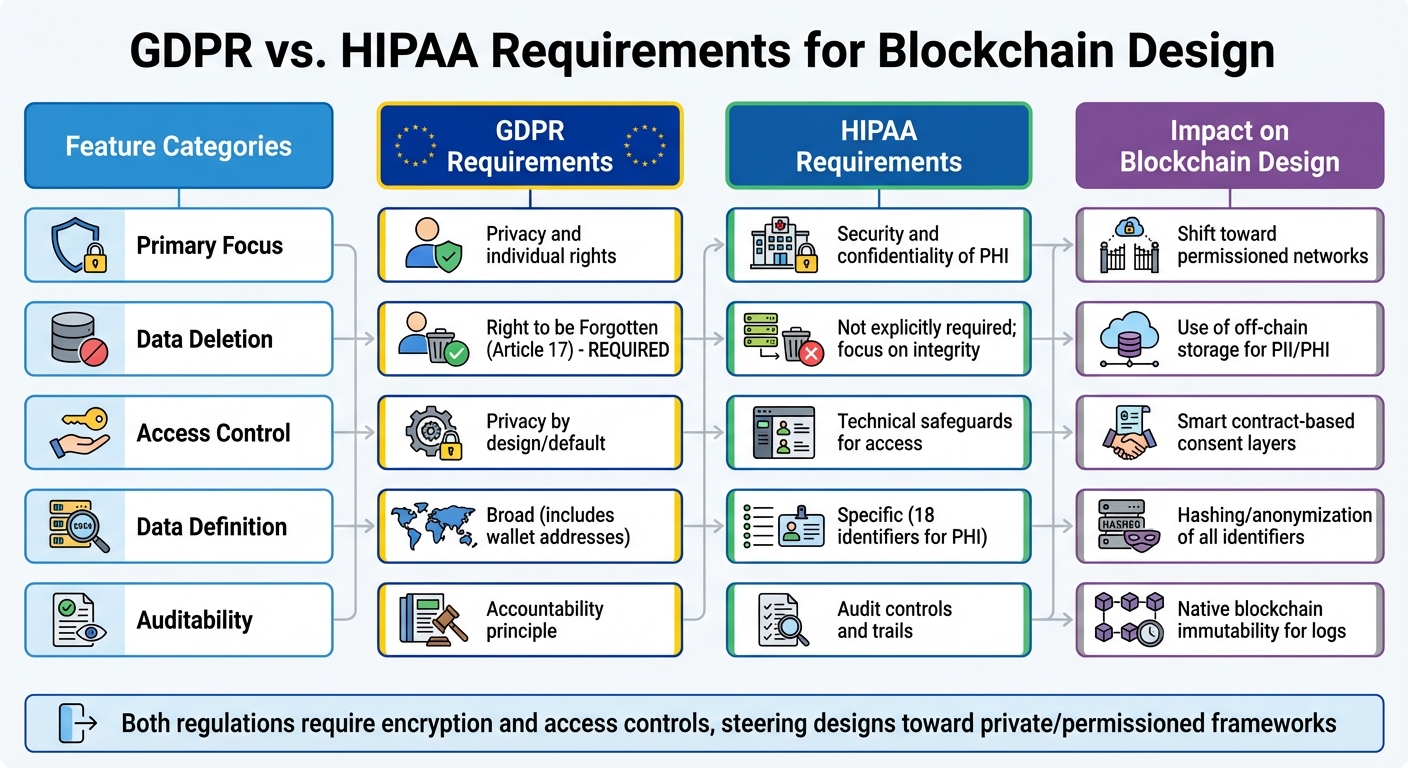
GDPR vs HIPAA Requirements for Blockchain Implementation
GDPR Requirements for Blockchain
The General Data Protection Regulation (GDPR) outlines seven key principles that directly influence how blockchain systems should operate. Lawfulness, fairness, and transparency require a valid legal basis - often consent - for processing personal data. In blockchain networks, the participant who decides to record data on the ledger typically acts as the data controller [5].
The principle of data minimization insists on collecting only the personal data absolutely necessary, while purpose limitation restricts the use of that data to its original purpose. To comply, the French Data Protection Authority (CNIL) advises developers to adopt "Privacy by Design" practices, such as avoiding the storage of sensitive data in cleartext on the blockchain [5]. Reusing on-chain data for other purposes without obtaining new consent violates this principle [6].
The accuracy principle, which requires keeping personal data current, clashes with blockchain's immutability. To address this, developers often use off-chain pointers that allow updates without altering the blockchain itself [6]. Similarly, storage limitation - which mandates data deletion when no longer needed - poses challenges since blockchain records are permanent. Many developers solve this by using hybrid models: sensitive data is stored off-chain, while only cryptographic hashes are kept on the blockchain [2][6].
"The immutability of actions carried out on blockchains have, in particular, allowed for the development of solutions that meet the requirement for traceability of consent and operations carried out on data." - CNIL (French Data Protection Authority) [5]
Integrity and confidentiality are also critical. Blockchain's immutability ensures data integrity, but confidentiality requires encryption and controlled access to prevent unauthorized data exposure [6]. Lastly, the accountability principle obligates data controllers to document and demonstrate compliance with all GDPR principles [6].
Next, let’s explore how HIPAA requirements interact with blockchain technology.
HIPAA Requirements for Blockchain
While GDPR prioritizes individual data rights, HIPAA enforces strict rules around the handling of Protected Health Information (PHI). Under HIPAA’s Privacy Rule, PHI must be de-identified by removing 18 specific identifiers, such as names, medical record numbers, and biometric data. To comply, PHI should be stored off-chain, with cryptographic hashes used on-chain to maintain pseudonymity [4].
The Security Rule mandates technical protections like access controls, encryption, and audit trails. Blockchain’s inherent immutability aligns well with audit trail requirements, as it creates a tamper-proof record of every access or modification [3][4][2]. However, HIPAA’s confidentiality standards mean public blockchains are unsuitable; instead, permissioned (private) blockchains are preferred, as they restrict access to authorized participants [4][2].
A practical example of HIPAA-compliant blockchain use is MedRec, developed by MIT and Beth Israel Deaconess Medical Center in 2016. This system used Ethereum-based smart contracts to track patient data and manage access permissions. Medical records and lab results were stored in off-chain "data lakes", while cryptographic hashes served as references on the blockchain, ensuring PHI remained secure [4].
HIPAA also emphasizes consent management. The Privacy Rule requires patient authorization for sharing PHI, and smart contracts can automate this process. For example, data can only be shared with third parties - like researchers or insurers - when predefined consent conditions are met and verified by network nodes [3][4]. A notable implementation is MediBloc's "Medipass" app, which has enabled over 600,000 patients across 14 hospitals to manage their medical records and insurance claims via blockchain [4].
"Blockchain can provide audit trails of AI models and improve data security and privacy of patient information." - IBM [4]
GDPR vs. HIPAA Requirements
Comparing GDPR and HIPAA highlights their distinct approaches to blockchain design. Both emphasize data protection, but their focus areas differ. GDPR governs all personal data within the EU, including online identifiers like cryptocurrency wallet addresses [7][8]. HIPAA, on the other hand, specifically targets PHI managed by "covered entities" and their business associates in the U.S. healthcare system [8].
The most striking difference lies in data deletion. GDPR’s "Right to be Forgotten" (Article 17) directly conflicts with blockchain’s immutability [7]. In contrast, HIPAA prioritizes data integrity and auditability, aligning naturally with blockchain’s permanent records [2][7]. A 2025 study involving 250 healthcare and IT experts found HIPAA to be more effective in blockchain environments compared to GDPR and ISO standards [1].
The table below summarizes these differences and their impact on blockchain design.
| Feature | GDPR Requirement | HIPAA Requirement | Impact on Blockchain Design |
|---|---|---|---|
| Primary Focus | Privacy and individual rights [8] | Security and confidentiality of PHI [8] | Shift toward permissioned networks |
| Data Deletion | Right to be Forgotten (Article 17) [7] | Not explicitly required; focus on integrity | Use of off-chain storage for PII/PHI |
| Access Control | Privacy by design/default [4] | Technical safeguards for access [8] | Smart contract-based consent layers |
| Data Definition | Broad (includes wallet addresses) [7] | Specific (18 identifiers for PHI) [8] | Hashing/anonymization of all identifiers |
| Auditability | Accountability principle [2] | Audit controls and trails [8] | Native blockchain immutability for logs |
Both GDPR and HIPAA require encryption and access controls, steering blockchain designs away from public, permissionless systems toward private or permissioned frameworks like Hyperledger Fabric [2][4]. GDPR emphasizes strict individual rights and explicit consent, while HIPAA provides a structured framework for PHI use in research, including allowances for "Waivers of Authorization" under specific conditions [8].
Technical Strategies for GDPR and HIPAA Compliance
The following approaches integrate blockchain's capabilities with GDPR and HIPAA requirements, addressing the regulatory challenges previously outlined.
On-Chain vs. Off-Chain Data Storage
A hybrid storage model balances blockchain's immutability with regulatory mandates by keeping sensitive PHI/PII off-chain in HIPAA-compliant databases or IPFS, while storing cryptographic hashes on-chain to verify data integrity [2][4]. These hashes act as tamper-proof markers that confirm data authenticity without exposing sensitive information.
When a patient invokes their GDPR right to erasure, the off-chain data is deleted, leaving the on-chain hash as an immutable audit trail. This hash essentially becomes a "pointer to nothing", effectively anonymizing the record since it no longer links to accessible information [4]. Systems like MedRec and Estonia's national e-Health platform utilize this method, securing sensitive records off-chain while using blockchain for access logs [2][4].
"Actual patient data was not directly stored on the blockchain since blockchains are energy-intensive, and because their speed of operation might be compromised." - Barry Solaiman, Research Handbook on Health, AI and the Law [4]
Zero-Knowledge Proofs (ZKPs) further enhance compliance by validating data (e.g., confirming a patient's age or trial eligibility) without revealing sensitive details [2]. This reduces the data footprint subject to erasure requests while preserving the ability to demonstrate compliance.
With storage strategies addressed, the next step is selecting a blockchain framework that supports regulatory needs.
Selecting a Blockchain Framework
After determining storage solutions, choosing the appropriate blockchain framework becomes critical for compliance. Permissioned blockchains like Hyperledger Fabric and Quorum are ideal for regulated industries. Unlike public blockchains, permissioned frameworks limit network access to authorized participants, enabling organizations to control who can view the ledger and enforce geographic data residency - key for GDPR compliance [2][3].
For example, Medicalchain leverages Hyperledger Fabric to allow patients to grant specific, time-bound access to their medical records. In collaboration with Leeds Teaching Hospital Trust and Queen Elizabeth Hospital, the platform enables secure data exchange while maintaining compliance through role-based permissions [2]. Additionally, these frameworks use local Certificate Authorities (CAs) to manage identities and issue TLS certificates for secure communication [3].
Public blockchains, on the other hand, fall short of regulatory requirements. They lack access controls, cannot guarantee jurisdictional data residency, and obscure roles necessary for GDPR compliance [2]. The French Data Protection Authority (CNIL) has explicitly warned against storing sensitive data in cleartext on any blockchain, emphasizing the importance of "Privacy by Design" practices [5].
| Feature | Public Blockchains | Permissioned Blockchains |
|---|---|---|
| Access Control | Open to anyone; no identity verification [2][3] | Restricted to authorized participants with verified identities [2][3] |
| Data Visibility | All transactions visible to all nodes [2] | Granular control over data access [2] |
| Geographic Compliance | Nodes distributed globally; no control over location [2] | Nodes restricted to specific jurisdictions (e.g., within the EU) [2] |
| Performance | Slower due to consensus overhead [3] | Faster; optimized for enterprise use cases [3] |
| GDPR/HIPAA Fit | Poor; conflicts with confidentiality and data residency [2] | Strong; designed for regulated environments [2][3] |
Consent and Access Controls
Implementing robust consent and access controls translates compliance strategies into actionable safeguards. Smart contracts automate patient consent verification and credential checks, meeting GDPR and HIPAA requirements for PHI access [3][4]. These contracts create an immutable audit trail of every consent decision and data access event, fulfilling HIPAA's technical safeguard standards [2][4].
Attribute-Based Access Control (ABAC) offers the precision needed to enforce HIPAA's "minimum necessary" rule. For instance, a billing clerk may only access payment details, while a radiologist can view diagnostic images. Smart contracts automatically enforce these access restrictions [3].
MediBloc's "Medipass" app, used by over 600,000 patients across 14 major hospitals in South Korea, showcases large-scale consent management. The blockchain-powered system lets patients manage their medical history and insurance claims, ensuring data is shared with third parties - like researchers or insurers - only under predefined consent conditions [4]. Multi-party validation adds another layer of security, requiring digital signatures from both the patient and the healthcare provider for record access [4].
"Smart contracts can ensure that such tools are only given access to relevant diagnostic data of patients that AI is evaluating, which can prevent overreach or misinterpretation." - Barry Solaiman and Georgios Dimitropoulos, Authors [4]
In cases where direct patient consent is unavailable for research, smart contracts can evaluate HIPAA's "Waiver of Authorization" criteria. This ensures the research poses minimal privacy risks and could not be conducted without the waiver [3]. By automating this process, organizations reduce administrative overhead while maintaining strict compliance.
Compliance Operations in Blockchain Systems
Operational frameworks play a critical role in maintaining ongoing compliance in blockchain systems. While technical strategies lay the foundation, they alone are not enough. To ensure continuous adherence to GDPR and HIPAA regulations, organizations must establish structured governance, implement constant monitoring, and prepare for potential security incidents.
Governance Models for Blockchain Consortia
Private and permissioned networks are essential for healthcare blockchain consortia aiming to meet regulatory requirements. Unlike public blockchains, these networks allow controlled membership, role-based permissions, and geographic restrictions on node distribution - key factors for complying with GDPR’s data residency rules [2][4].
Defining roles within multi-party networks is crucial. Specifically, consortium agreements should clearly separate responsibilities between data controllers and processors. For instance, a hospital registering a patient’s diagnostic results on a blockchain typically acts as the controller, while the node operators maintaining the ledger serve as processors [5].
"Blockchain's decentralized nature, especially in terms of governance, leads to potential conflicts with regulatory requirements over roles and responsibilities." - CertiK [2]
A practical example of this is Medicalchain, which leverages Hyperledger Fabric’s permissioned architecture. Patients can grant time-limited access to specific portions of their medical records, ensuring privacy and control. Each organization within the consortium manages its own Certificate Authority (CA) for identity management while collaborating on a shared network [2][3].
Another approach is seen in Estonia's national e-Health system, which uses KSI blockchain to secure access logs rather than storing patient data on-chain. In this model, the government acts as the primary data controller, while healthcare providers function as processors with defined access rights. Since 2012, this system has safeguarded Electronic Health Records (EHR) for Estonian citizens by maintaining a permanent record of every data access event [2][4].
Governance can also be automated through smart contracts. These self-executing agreements handle routine regulatory tasks like verifying patient consent, validating credentials, and enforcing privacy policies before data exchanges occur [3][4].
With governance in place, the next step is ensuring compliance through continuous monitoring.
Monitoring and Audit Requirements
Blockchain’s ability to create immutable audit trails is a game-changer for GDPR and HIPAA compliance. Every transaction - whether it’s a record update or an access request - is permanently logged with cryptographic timestamps, providing a reliable and tamper-proof audit log [3][4].
The MedRec system, developed by MIT researchers, highlights this capability. In a pilot project at Beth Israel Deaconess Medical Center, the platform tracked six months of inpatient and outpatient medication data across multiple hospital databases. Patients controlled access through smart contracts, and all interactions - like blood work requests or prescription updates - were recorded on a private Ethereum-based blockchain. Importantly, patient data remained off-chain in secure "data lakes", with only cryptographic hashes stored on-chain [10].
"The digital record in the blockchain can provide insight into the origin of data used by AI, which is important for trust in AI outputs." - IBM [4]
Real-time compliance monitoring is now possible with advanced platforms that analyze on-chain activity. These tools can detect unusual access patterns, flag potential privacy violations, and trigger alerts when consent periods expire. For example, South Korea’s MediBloc "Medipass" app uses this approach to manage medical history and insurance claims for over 600,000 patients across 14 major hospitals [4].
| Compliance Requirement | Traditional Systems | Blockchain Solution |
|---|---|---|
| Audit Trail Integrity | Logs can be altered or deleted | Immutable, cryptographically secured records [4][3] |
| Access Verification | Manual review of access logs | Automated smart contract validation [3][4] |
| Accountability | Centralized administrator controls | Distributed consensus with clear role assignment [2][5] |
| Real-Time Monitoring | Periodic audits (quarterly/annual) | Continuous, automated compliance checks [2] |
Effective monitoring is complemented by robust incident response strategies to handle breaches swiftly.
Incident Response and Breach Management
In the event of a breach, hybrid storage solutions help limit exposure. Sensitive PHI remains in off-chain databases, with only cryptographic hashes stored on-chain. If a breach occurs, compromised off-chain records can be destroyed, or access keys revoked, while the on-chain hash continues to serve as an unalterable audit trail [2][4].
Estonia's KSI blockchain offers an excellent example of breach detection. The system immediately flags unauthorized health data access and logs the intrusion permanently. This approach enables compliance with GDPR’s 72-hour notification requirement and HIPAA’s breach notification rule while supporting forensic analysis [4].
"Blockchain can ensure security compliance for AI medical devices by assisting with notification requirements, and verifying data integrity and accuracy." - Barry Solaiman, Editor, Research Handbook on Health, AI and the Law [4]
Smart contracts add another layer of automation by triggering alerts, notifying data protection officers, and initiating compliance protocols when suspicious activity is detected [3][4]. This is critical for meeting strict notification timelines - GDPR requires notification within 72 hours, while HIPAA mandates it without unreasonable delay and no later than 60 days after discovery.
For forensic investigations, blockchain’s immutable ledger provides a detailed timeline of events, including which nodes accessed data, when permissions were granted or revoked, and whether unauthorized modifications were attempted [3][4]. This level of transparency is hard to achieve with traditional systems, where logs are susceptible to tampering.
Attribute-Based Access Control (ABAC) further strengthens security by limiting data access during an incident. For example, only authorized personnel - such as security teams and compliance officers - can interact with PHI during a breach investigation. These access rights are enforced by smart contracts, preventing escalation due to improper access [3]. This ensures that the response remains controlled and compliant.
Key Takeaways for Technical Leaders
Blockchain technology is increasingly navigating complex regulatory landscapes, and technical leaders play a crucial role in translating these challenges into effective strategies. Successfully implementing compliant blockchain systems calls for both technical know-how and strategic planning. One practical approach is using hybrid storage architectures, where sensitive data like Protected Health Information (PHI) is stored off-chain (in systems like IPFS or traditional databases) while only cryptographic hashes are kept on-chain for security and efficiency [2].
Privacy-enhancing technologies such as Zero-Knowledge Proofs (ZKPs) allow data verification without revealing sensitive information. Meanwhile, permissioned frameworks like Hyperledger Fabric provide essential tools for managing data residency requirements, including granular access controls and geographically distributed nodes, ensuring compliance across different jurisdictions [2] [3].
Automation is another game-changer in compliance. By leveraging smart contracts, organizations can handle consent management, credential validation, and privacy enforcement automatically. This shifts compliance from periodic audits to continuous, real-time monitoring [3].
"Developing with compliance in mind from the start, rather than as an afterthought, should support the identification of suitable blockchain characteristics." - CertiK [2]
Technical leaders must also develop cross-disciplinary skills to stay ahead. For instance, initiating Data Protection Impact Assessments (DPIAs) early in the development process involves close collaboration with legal and compliance teams. This ensures that data flows, both on-chain and off-chain, are mapped accurately and align with regulatory requirements. Decisions like whether to use public or private blockchains should be made with compliance as a foundational consideration [9].
With the healthcare information technology market surpassing $350 billion [3], blending blockchain innovation with regulatory expertise is becoming a valuable asset for leaders. For those looking to refine these skills, Tech Leaders (https://technical-leaders.com) offers specialized training that bridges technical knowledge with regulatory strategy and business leadership, helping leaders excel in this challenging yet rewarding space.
FAQs
How does blockchain comply with GDPR's 'right to be forgotten' while ensuring data privacy?
Blockchain can tackle GDPR's 'right to be forgotten' by keeping sensitive personal data off the blockchain itself. Instead, it stores cryptographic references on-chain. When a deletion request is made, the off-chain data can be erased, or the encryption key tied to it can be revoked. This approach renders the on-chain reference useless while preserving the blockchain's integrity and its audit trail.
For added privacy, permissioned blockchains limit access to authorized users, ensuring that only designated individuals can handle data deletion or revoke encryption keys. Tools like zero-knowledge proofs enable verification of compliance without revealing sensitive information. Additionally, decentralized storage systems make it possible to securely delete personal data without undermining transparency.
By combining off-chain storage, encryption, and privacy-focused techniques, blockchain can align with GDPR requirements while still delivering its core strengths of security and immutability.
Why are permissioned blockchains better suited for HIPAA compliance than public blockchains?
Permissioned blockchains are built to restrict access, allowing only approved participants to interact with the network. They use role-based access controls and require explicit permissions to handle sensitive information, aligning perfectly with HIPAA’s strict guidelines for safeguarding patient data. On top of that, these blockchains create immutable audit trails, offering a transparent and secure record of every data interaction. This setup ensures compliance with HIPAA’s “minimum necessary” and security standards, providing a level of control that public blockchains, with their open and unrestricted access, simply cannot match.
How do smart contracts help manage patient consent in healthcare data systems?
Smart contracts are like digital agreements that enforce themselves, and they live on a blockchain. They’re designed to automatically uphold a patient’s consent preferences. When a patient gives consent, the details - such as the type of data, who’s allowed to access it, why it’s being used, and for how long - are encoded into the contract. These smart contracts take over from there, ensuring that any request to access or share health records is checked against those predefined rules. If the request doesn’t align, access is denied. This approach aligns with HIPAA’s minimum necessary principle and GDPR’s requirement for clear, purpose-specific consent.
What’s even better? Patients have the power to update or revoke their consent whenever they want. These changes are instantly reflected across every system connected to the blockchain, ensuring that healthcare providers always operate based on the latest permissions. On top of that, smart contracts maintain a detailed, auditable record of every consent-related action. This transparency not only simplifies compliance with regulations but also builds trust.
By combining automation, security, and transparency, smart contracts streamline administrative processes while prioritizing patient data privacy. It’s a modern solution to a complex challenge.