

Blockchain Governance: On-Chain vs. Off-Chain
Blockchain governance revolves around how decisions are made in decentralized networks. The two main approaches - on-chain and off-chain governance - offer distinct ways to manage upgrades, resolve disputes, and guide a blockchain's direction.
- On-Chain Governance: Decisions are automated through smart contracts. Token holders vote directly, and results are enforced by code. This ensures transparency and efficiency but risks concentrating power among wealthy participants.
- Off-Chain Governance: Relies on informal discussions and consensus among stakeholders like developers and users. Decisions require manual implementation, allowing for flexibility but often leading to slower processes and potential centralization among developers.
Key Takeaways:
- On-chain governance is transparent and automated but vulnerable to "whale" dominance and low voter participation.
- Off-chain governance allows broader input and human judgment but can be slower and less transparent.
- Hybrid models combine the strengths of both, using off-chain discussions for deliberation and on-chain mechanisms for execution.
Quick Comparison:
| Attribute | On-Chain Governance | Off-Chain Governance |
|---|---|---|
| Transparency | High; recorded on blockchain | Lower; scattered discussions |
| Decision Speed | Faster; automated execution | Slower; requires consensus |
| Enforceability | Automatic via smart contracts | Manual implementation |
| Participation | Token-based voting; risks plutocracy | Broader but less structured |
| Flexibility | Limited by code | Allows for human judgment |
Understanding these models is crucial for anyone involved in blockchain projects, as each has trade-offs that can impact a network's success.
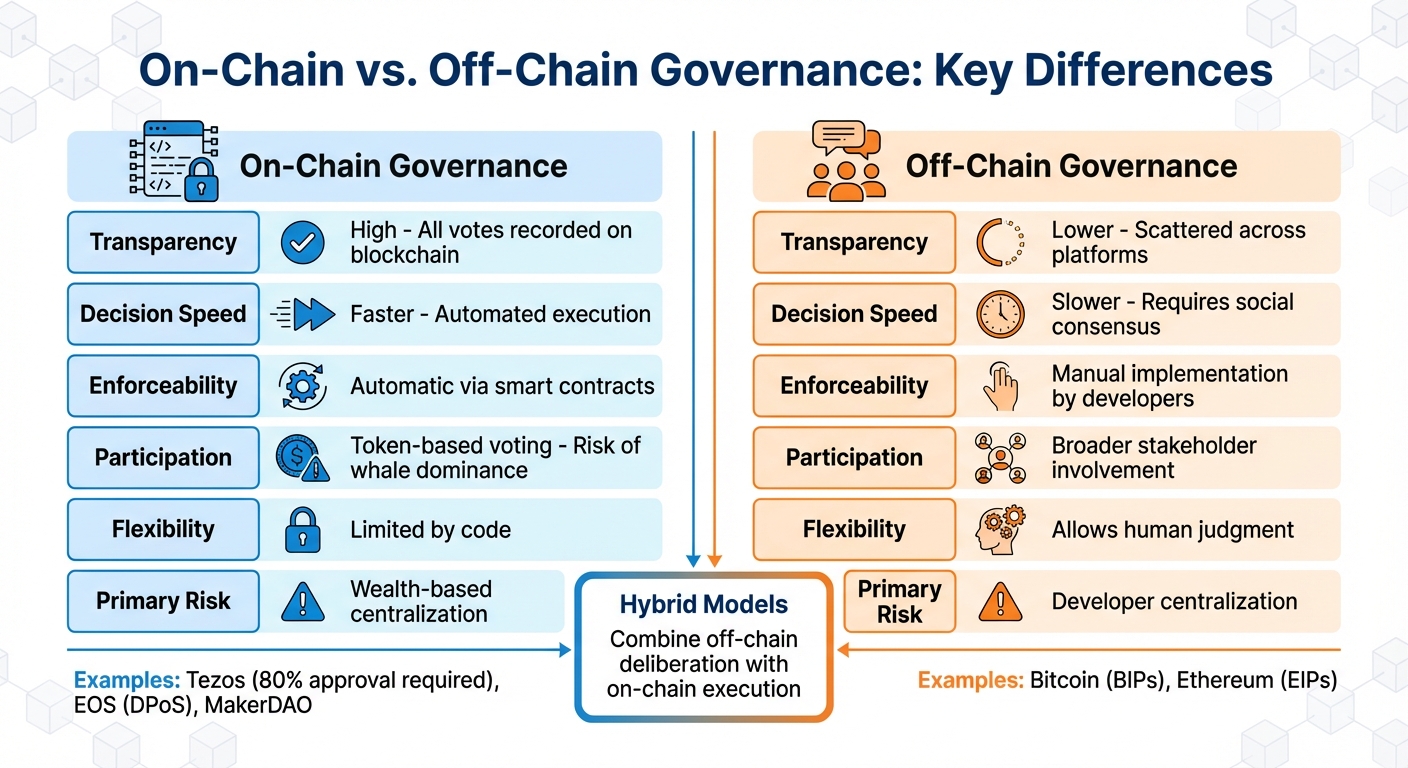
On-Chain vs Off-Chain Blockchain Governance Comparison
Blockchain Governance Models | Blockchain Central
What Is On-Chain Governance?
On-chain governance is a decentralized system where decisions about protocol changes are built directly into blockchain smart contracts. Instead of relying on a centralized team to make updates, token holders vote on proposals, and the blockchain automatically enforces the outcomes.
"On-chain governance is the process by which a blockchain protocol or application allows token holders (or their delegates) to make and execute binding decisions on-chain." – Cube Exchange [8]
Here’s how it works: someone submits a proposal, which might include code updates or parameter tweaks. Token holders then vote, often with one vote per token. If the proposal meets the required approval threshold and quorum, smart contracts execute it automatically. Many blockchains also use timelock contracts to queue approved proposals, giving the community time to review before changes take effect.
Various voting models exist, such as one-token–one-vote, delegated voting, and quadratic voting, which aims to balance influence across participants. Some platforms even reward voters to encourage participation and counteract apathy. These mechanisms ensure decisions are transparent, efficient, and community-driven.
Benefits of On-Chain Governance
On-chain governance has several strengths that make it appealing for decentralized networks. Transparency is a standout feature - every vote and decision is recorded on the blockchain, making the process fully auditable. Automated execution of proposals eliminates delays and reduces the risk of human interference or manipulation, ensuring that decisions are binding and implemented exactly as approved.
| Feature | On-Chain Governance | Off-Chain Governance |
|---|---|---|
| Execution | Automated via smart contracts | Manual implementation by developers |
| Transparency | High; all actions are recorded on-chain | Lower; involves informal coordination |
| Speed | Faster once voting concludes | Slower due to extensive social processes |
| Accessibility | Open to all token holders | Often limited to core developers or elites |
This system empowers token holders to directly shape the network. By following predefined rules, it also minimizes the risk of divisive forks, helping communities stay united even when disagreements arise.
Drawbacks of On-Chain Governance
Despite its advantages, on-chain governance comes with challenges. Voter apathy is a major issue - many token holders don’t participate, leaving decisions in the hands of a small, active minority. For example, during the 2016 DAO fork vote on Ethereum, over 85% of votes favored the proposal, but overall turnout was very low [9].
Another concern is the potential for plutocracy. Since voting power is often tied to token ownership, wealthy investors (or "whales") can dominate decisions, prioritizing profits over technical progress. Smaller stakeholders may feel excluded, especially when transaction fees (gas fees) discourage their participation. Additionally, while automated execution speeds up implementation, the voting process itself may lag when addressing urgent issues. Flash loan attacks, where someone temporarily borrows a large number of tokens to push malicious proposals, also pose a risk. Even timelock contracts, designed to add a layer of safety, can delay critical fixes when time is of the essence.
On-Chain Governance Examples
Tezos introduced the idea of a "self-amending ledger" in 2018. Its five-stage voting process starts with testing community-approved changes on a testnet before they’re automatically applied to the mainnet - no hard fork required. For changes to pass, 80% of delegated voting power must approve them. In 2019, this system successfully reduced transaction fees.
EOS uses a Delegated Proof of Stake (DPoS) model. Token holders elect 21 block producers who oversee network transactions and governance. Each EOS holder can vote for up to 30 candidates, with voting power tied to the number of tokens held. These block producers validate transactions and implement changes approved by the community.
MakerDAO takes a hybrid approach. MKR token holders vote on-chain to adjust key parameters like collateral factors and interest rates. However, much of the discussion and proposal refinement happens off-chain before the final vote, ensuring thorough deliberation before any changes are locked in.
Algorand runs a governance program where participants, called Governors, commit their ALGO tokens for three months to gain voting rights. If a Governor withdraws their tokens early, they lose their eligibility. This system ensures participants have a stake in the network and discourages short-term manipulation.
What Is Off-Chain Governance?
Off-chain governance is a way of making decisions for blockchain protocols that takes place outside the blockchain's code. Unlike on-chain governance, which relies on automated systems like smart contracts and voting mechanisms, off-chain governance depends on community discussions and coordination among developers. Essentially, it’s a process where various stakeholders - developers, miners, token holders, and users - work together to shape the future of the protocol, often resembling the dynamics of real-world politics. Once a decision is made, node operators must manually update their software for the changes to take effect.
The process typically starts with formal improvement proposals, such as Bitcoin Improvement Proposals (BIPs) or Ethereum Improvement Proposals (EIPs). These proposals are submitted on platforms like GitHub and spark debates across forums, social media, and other community spaces. Ultimately, the success of a proposal hinges on what’s known as "social consensus", where core developers gauge whether enough support exists among miners and node operators to implement the changes.
It’s worth noting that decisions made through off-chain governance are not technically binding. Instead, they reflect what stakeholders collectively believe is best for the protocol. If consensus can’t be reached, the community might choose to hard fork the blockchain, creating separate versions. A well-known example of this occurred in 2016, when Ethereum split into Ethereum and Ethereum Classic after disagreements over how to address The DAO Hack.
"Governance problems should not be thought of as design problems but rather applied social problems... governance is an unpredictable and emergent phenomenon." – Vlad Zamfir, Ethereum researcher [6]
This approach to governance offers both opportunities and challenges, shaping how it’s applied in practice.
Benefits of Off-Chain Governance
One of the biggest strengths of off-chain governance is its flexibility. Since decisions aren’t locked into code, communities can respond to unexpected challenges or address complex issues that require human judgment. This adaptability allows stakeholders to thoroughly discuss technical and social matters before committing to any changes.
Another advantage is its openness to a wide range of participants. Off-chain governance invites input from not just technical experts but also users, app developers, and community members who may not hold significant token balances. This inclusiveness ensures a variety of perspectives are considered.
| Feature | Off-Chain Governance | On-Chain Governance |
|---|---|---|
| Flexibility | High - can adapt to unforeseen challenges | Lower - limited by pre-written code |
| Inclusiveness | Welcomes diverse participants | Often favors large token holders |
| Decision Process | Informal discussions and consensus | Automated voting through smart contracts |
| Binding Nature | Non-binding; relies on voluntary updates | Automatically enforced by code |
This model also offers a "voice or exit" option. Stakeholders can either participate in discussions to influence changes or, if they disagree with the direction, fork the protocol to create an alternative version.
Drawbacks of Off-Chain Governance
While off-chain governance has its strengths, it’s not without challenges. Transparency is a major concern. Decisions often happen in private developer meetings, forums, or scattered across various social media platforms, making it hard for all community members to follow or contribute to the process.
Another issue is centralization. Power can become concentrated in the hands of core developers, influential miners, or prominent figures, sidelining those without technical expertise or significant resources.
Accountability is also a challenge. Unlike on-chain governance, where decisions are enforced automatically by smart contracts, off-chain governance relies on voluntary adoption by stakeholders. This can slow down the process, especially as networks grow and proposals become more frequent. In some cases, disagreements can lead to contentious hard forks, splitting the network.
Off-Chain Governance Examples
Real-world examples help illustrate both the potential and the risks of off-chain governance.
Bitcoin uses Bitcoin Improvement Proposals (BIPs) as its primary tool for off-chain governance. Proposals are submitted via mailing lists or GitHub, and the community debates their merits. Once consensus is achieved, the core development team integrates the changes, but node operators must manually update their software for implementation.
Ethereum employs Ethereum Improvement Proposals (EIPs) for managing off-chain governance. A famous example is the 2016 DAO Hack, where a vulnerability led to the theft of about 3.6 million ETH (worth roughly $50 million at the time). After intense off-chain discussions and a signaling vote, the community decided to hard fork the blockchain, resulting in the creation of Ethereum Classic.
Algorand introduced a hybrid approach in 2023 with its "xGov" program. This system blends off-chain and on-chain governance by allowing proposals to be discussed on GitHub. Expert governors review these proposals, such as grant applications, in a transparent and standardized way before they move to an on-chain vote.
sbb-itb-8feac72
On-Chain vs. Off-Chain Governance
When comparing on-chain and off-chain governance, their fundamental differences become clear. On-chain governance relies on smart contracts to manage the entire process - proposals are submitted, votes are cast, and decisions are executed automatically. Every vote and proposal is permanently recorded on the blockchain. In contrast, off-chain governance resembles traditional decision-making processes, where discussions take place across forums, social media, and developer meetings, with outcomes requiring manual implementation.
On-chain governance is known for its speed and transparency. Decisions are executed automatically once voting thresholds are met. For instance, the Tezos blockchain requires an 80% approval rate of delegated voting power for proposals to pass. In 2019, the Tezos community voted to lower transaction fees, and the change was implemented automatically after approval [10]. However, this system can be inflexible, particularly when dealing with complex social or legal issues that require human judgment. Off-chain governance, on the other hand, is better suited for addressing nuanced problems. A notable example is Ethereum's off-chain response to the 2016 DAO hack, which required deliberation and human intervention. However, this approach is often slower and less transparent, with discussions fragmented across various platforms.
"On-chain governance has the advantage of being completely transparent to all network participants. The rules are explicitly specified in the blockchain code and are completely free from subjective opinion or interpretation."
– Phemex Academy [2]
Participation in these models also varies significantly. On-chain governance allows token holders to vote directly, but this can lead to a "plutocracy", where wealthy token holders, or "whales", dominate decisions [1]. Off-chain governance involves a broader range of participants, including developers, miners, node operators, and users. However, individual voices can sometimes be drowned out in the broader debate. As Cryptopedia Staff from Gemini noted, "The protracted and inefficient debate over Bitcoin scaling reveals two downsides to off-chain governance: that it can be difficult to register your input as an individual user and that changes can take a long time to implement" [1].
Perhaps the most striking difference lies in enforceability. On-chain decisions are binding and carried out automatically via smart contracts, leaving no room for second-guessing once the vote concludes [10]. In off-chain systems, decisions depend on voluntary adoption. Developers must implement the changes, and node operators need to update their software. Without consensus, the network risks splitting, as seen when Ethereum forked into Ethereum (ETH) and Ethereum Classic [3].
The table below highlights these contrasts:
Side-by-Side Comparison
| Attribute | On-Chain Governance | Off-Chain Governance |
|---|---|---|
| Transparency | High; all votes and proposals recorded on blockchain [2] | Lower; discussions scattered across platforms [2] |
| Decision Speed | Faster; automated execution [4] | Slower; requires social consensus [1] |
| Enforceability | Automatic via smart contracts [10] | Manual; depends on developer and node updates [3] |
| Participation | Direct token-based voting; risk of "whale" dominance [1] | Broader stakeholder involvement [2] |
| Adaptability | Rigid; limited by code rules [2] | Flexible; allows human deliberation [7] |
| Primary Risk | Wealth-based centralization [1] | Centralized influence among core developers [2] |
This comparison sets the foundation for exploring hybrid governance models and identifying the best approach for specific use cases.
Hybrid Governance Models
Neither on-chain nor off-chain governance systems are perfect, which is why many projects now adopt hybrid models - a combination of off-chain deliberation and on-chain execution.
These models take advantage of off-chain discussions for more flexible and detailed debates, while using on-chain mechanisms for transparent records and automated implementation. As the Algorand Foundation explains:
"On-chain and off-chain governance go hand-in-hand: off-chain discussions vet proposals, while on-chain voting finalizes them." – Algorand Foundation [5]
This approach isn't just theoretical - it's already being applied in frameworks that balance the strengths and weaknesses of both governance systems.
Take MakerDAO (now Sky), for example. The project employs a hybrid process where proposals are first debated off-chain and then executed on-chain. Managing billions of dollars in assets, MakerDAO uses the Sky Governance Forum for off-chain discussions. Here, community members deliberate on critical topics like risk parameters, collateral types, and stability fees. Once consensus is reached, these proposals move to the Sky Governance Portal for on-chain voting. A prime example of this process is Poll ID 1611 (Atlas Edit Weekly Cycle), which passed on December 15, 2025, with over 5.8 billion SKY tokens in support. This vote followed extensive off-chain debates about risk frameworks [12]. By combining thorough off-chain review with on-chain execution, MakerDAO ensures that proposals are well-vetted before becoming part of the protocol.
Uniswap follows a similar model, where proposals are reviewed off-chain before advancing to on-chain voting. Meanwhile, Algorand's xGov program adds an expert review stage, providing an additional layer of scrutiny to proposals [5]. These processes help reduce the chances of failed or controversial votes by ensuring that only well-supported ideas make it to the final stages. This approach directly addresses the limitations of purely on-chain or off-chain governance systems.
Hybrid models also tackle one of the biggest challenges of on-chain governance: low voter turnout. By encouraging community engagement through social platforms and informal channels, these frameworks create opportunities for broader participation. Communities can organize and discuss proposals in ways that go beyond the rigid structures of on-chain mechanisms, fostering a more balanced power dynamic. As noted by Werbach et al., code and documentation alone can't fully capture the nuances of off-chain practices [11]. Hybrid systems take advantage of social norms and informal interactions to address issues that smart contracts can't handle on their own.
Choosing the Right Governance Model
Selecting the right governance model involves finding a balance between decentralization and effective decision-making while ensuring power is distributed appropriately. This decision often hinges on the distinctions between on-chain and off-chain governance systems.
Every stakeholder, from token holders to developers, brings different motivations to the table. On-chain governance links voting power directly to token ownership, offering transparency but risking an imbalance of power as those with more tokens hold greater influence. In contrast, off-chain governance allows for broader participation from various stakeholders but can slow down decision-making and lacks the formal transparency of its on-chain counterpart.
When evaluating these options, it’s important to weigh transparency and automation against flexibility and the ability to adapt. On-chain governance provides a permanent record and automated execution through smart contracts, but it can be exposed to vulnerabilities like coding errors. Off-chain governance, on the other hand, is more adaptable - critical for responding quickly to crises, such as security threats or evolving regulatory demands - but it may lead to lengthy debates and, in some cases, divisive forks within the community.
Your choice will also depend on the specific needs of your project. For instance, projects managing large assets might benefit from extensive off-chain reviews before initiating on-chain voting. Similarly, protocols requiring frequent upgrades may find strict on-chain thresholds, like Tezos's 80% approval requirement, too rigid to keep pace with their needs [2]. If operating within the United States, off-chain governance often provides greater legal flexibility, enabling compliance through foundations and smoother adaptation to regulatory changes [5].
Hybrid governance models have gained traction as a practical solution for many projects. These models combine the deliberative strengths of off-chain processes with the transparency and automation of on-chain execution. For example, discussions and consensus-building can occur in off-chain forums, while formal decisions are executed transparently through on-chain mechanisms. To make such systems effective, it’s essential to establish clear protocols: use off-chain channels for informal discussions, rely on on-chain voting for binding decisions, and design emergency procedures for situations where automated processes might lag - especially in cases requiring regulatory compliance or urgent crisis management.
FAQs
What are the key risks of on-chain governance in blockchain systems?
On-chain governance carries several risks that can affect both the security and decentralization of a blockchain. A key concern is the concentration of voting power. When large token holders, developers, or validators dominate decision-making, it can erode decentralization and give disproportionate influence to a few.
Another challenge is low voter participation. If only a small percentage of the community votes, decisions may not reflect the broader consensus. This opens the door to poorly thought-out changes being approved. Compounding this issue, protocol changes are executed automatically through smart contracts. This means that any coding mistakes or malicious proposals can be implemented immediately, leaving the system vulnerable to bugs, exploits, or even governance attacks.
Finally, the fast-paced nature of on-chain governance can lead to hasty or politically motivated decisions. When influential parties push their agendas without allowing for thorough community review, the risk of flawed outcomes increases. These challenges underscore the need to strike a careful balance between speed, security, and inclusivity in governance systems.
What is a hybrid governance model, and how does it combine on-chain and off-chain processes?
Hybrid governance models bring together the best of on-chain and off-chain processes, creating a well-rounded approach to decision-making.
On-chain mechanisms shine when it comes to transparency and enforceability. By using blockchain and smart contracts, proposals, votes, and decisions are recorded in a way that’s tamper-proof and fully auditable. This ensures that outcomes are trustworthy and immune to manipulation.
Off-chain processes, however, offer the flexibility needed for open discussions and collaborative problem-solving. Platforms like forums or community channels provide spaces for informal signaling, refining ideas, and negotiating compromises. These discussions are especially useful for tackling complex issues that can’t easily be translated into code.
When combined, these two approaches strike a balance. Off-chain deliberation helps shape well-thought-out proposals, while on-chain voting ensures decisions are finalized and enforced transparently. This hybrid system supports efficiency and trust, staying true to blockchain's core values of democracy and openness.
Why would a blockchain project choose off-chain governance instead of on-chain governance?
Blockchain projects may opt for off-chain governance due to its ability to offer more flexibility and quicker decision-making. This method proves especially valuable when dealing with intricate, strategic, or legal matters that aren't easily translated into a blockchain's protocol.
Another key advantage of off-chain governance is the inclusion of human judgment and collaboration. This approach becomes essential when navigating unexpected challenges or fast-changing situations. By handling certain decisions outside the blockchain, projects can sidestep the limitations of fixed, unchangeable rules while still preserving the core principles of governance.