

Checklist for Customizing Agile Frameworks
Agile frameworks aren't one-size-fits-all. To make Agile work for your team, you need to adjust it based on your organization's structure, project complexity, and goals. Many teams fail by blindly following Agile practices without understanding their purpose. This checklist breaks down how to evaluate your readiness, choose the right framework, secure leadership support, set clear goals, and fine-tune roles, ceremonies, and workflows.
Key Steps:
- Assess Readiness: Analyze team culture, governance, and capacity for Agile practices.
- Pick a Framework: Choose Scrum, Kanban, SAFe, or another model based on your team's needs.
- Secure Stakeholder Buy-In: Align leadership and teams with the Agile vision.
- Set Measurable Goals: Define success metrics like cycle time, defect rates, and team morale.
- Customize Practices: Adjust roles, meetings, and workflows to match your operations.
- Roll Out Gradually: Start small, gather feedback, and refine continuously.
Agile is about building a system that works for your team - not rigidly following a template. This guide helps you create a tailored approach for better project delivery and team performance.
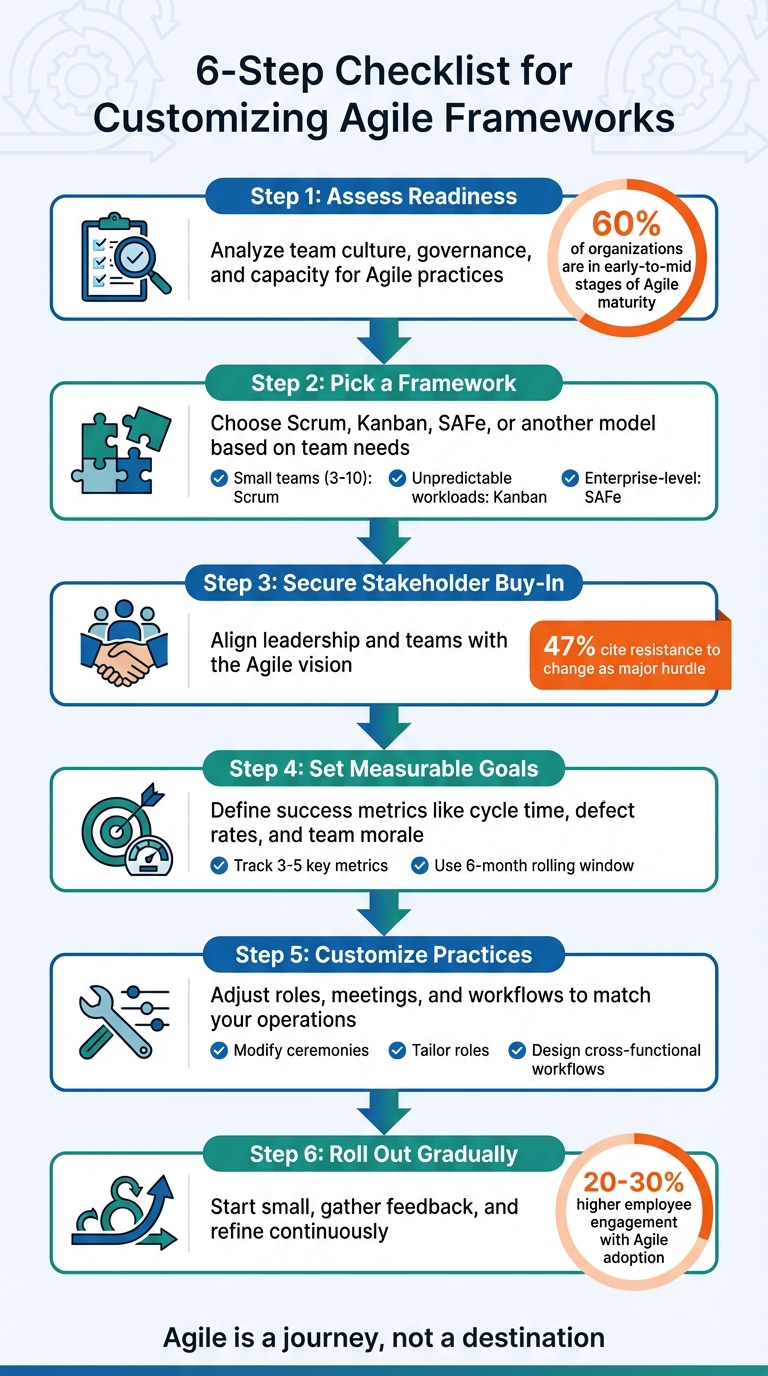
6-Step Process for Customizing Agile Frameworks
How to choose an Agile framework
1. Evaluate Your Organization and Pick a Framework
Before diving into Agile, take a step back and assess where your organization stands. Skipping this step can lead to structural problems down the line. Interestingly, about 60% of organizations are still in the early to mid-stages of Agile maturity, with only 15% considering themselves fully mature [8]. This means most teams are still experimenting to find the right approach.
1.1 Run an Agile Readiness Assessment
Start by analyzing six key areas: culture, Agile experience, tech setup, adaptability, training, and commitment to user research [7]. One of the most critical aspects to evaluate is whether leadership fully understands how their roles will shift in an Agile environment. As Agile Coach Drew Podwal explains:
"The thing that most people get wrong about Agile is that agile is nothing but a mindset" [8].
Next, take a hard look at your governance processes. In Agile, decisions tied to short iterations (typically 2–4 weeks) should happen within hours or days. If your current decision-making takes weeks, you'll need to streamline governance before adopting Agile [7]. Also, confirm whether you can assign a full-time Product Owner with the authority to make quick business decisions and a dedicated, cross-functional delivery team [6][1]. If your team members are juggling multiple projects, that's a red flag indicating you're not ready.
Be wary of falling into the trap of "Scrumbuts." This term refers to scenarios where teams claim to use Scrum but skip essential practices. For example, saying, "We use Scrum, but we don't do retrospectives" signals cultural resistance that could derail your Agile efforts [6]. Elizabeth Larson and Richard Larson from Watermark Learning emphasize:
"Agility is defined as 'nimbleness' and the 'power to move quickly and easily'... The opposite of agility, though, is clumsiness or stiffness, not slowness" [6].
If your organization struggles to adapt to changing requirements or reprioritize based on user feedback, tackle these cultural challenges first.
1.2 Select the Framework That Fits
Once you've assessed your readiness, it's time to pick a framework that aligns with your team's needs. For small teams (3–10 members) with clear, iterative goals, Scrum is often a good fit [10]. On the other hand, if your team deals with unpredictable workloads - like customer support or research - Kanban's continuous flow model might work better [10].
For larger, enterprise-level operations involving multiple teams, the Scaled Agile Framework (SAFe) offers structured options like Essential, Large Solution, or Portfolio SAFe [9]. If your team emphasizes technical practices like pair programming or test-driven development, Extreme Programming (XP) could be the way to go [10]. Alternatively, Disciplined Agile (DA) provides a flexible toolkit that lets you tailor your "Way of Working" to fit your specific situation [3].
If you're transitioning from a Waterfall approach, start small. Test Agile with a few Scrum teams - perhaps four - to see how it works before scaling up [1]. This lets you spot and address any gaps without causing widespread disruption. And remember, the framework you choose isn't set in stone. It's just a starting point, and you’ll refine it as you learn what works best for your teams. Once you've selected your framework, the next step is securing stakeholder buy-in.
2. Get Stakeholder Support
Selecting the right framework is just the beginning - gaining strong leadership support is essential for successfully customizing Agile. Vibhor Chandel, an Agile Leadership Specialist, highlights this perfectly:
"More than the capability of the team, it is the capability of the 'leadership' that determines the success of a product or a project." [14]
To move forward, it's important to address stakeholder concerns and clearly show how a tailored Agile approach can resolve them [11]. From there, aligning stakeholders with the Agile vision ensures everyone is on the same page.
2.1 Explain the Agile Vision
Start by organizing Agile Mindset Alignment sessions - these 1.5-hour meetings should include a mix of roles across the organization, from executives to individual contributors. For medium-sized organizations (150–450 employees), involving 20–30 participants is a good target [12]. These sessions help clarify what Agile is (and isn’t), dispel misconceptions, and create a shared understanding of its potential.
Bring the Agile vision to life with compelling real-world examples that connect Agile values to your company’s goals. Visual roadmaps outlining quarterly objectives can help solidify this vision. Use multiple communication channels - team meetings, posters, and informal discussions - to reinforce the message [12].
Anticipate objections such as "we tried this before and it failed" or "nothing useful can be built in two weeks." One way to address these concerns is by hosting "How Might We?" workshops. These sessions encourage teams to shift from focusing on current problems to imagining better future outcomes [11].
2.2 Secure Executive Commitment
A clear mandate from the executive team - preferably the CEO - is essential. Milo Hobsbawm, a Process & Methods Expert, underscores this point:
"Is there a top-down mandate? Has someone in the C-Suite (ideally the CEO) put their backing behind implementing agile methodology? This is mission critical!" [15]
Find a senior leader who can act as an internal champion for the Agile transformation [15]. Schedule regular leadership alignment meetings to discuss the progress, tackle high-level challenges, and connect the customization process to strategic goals like boosting revenue, cutting costs, and improving customer retention [11].
Launching a pilot project can demonstrate tangible benefits before scaling up [15]. To ensure clarity, formalize roles and responsibilities in a project charter and maintain transparency throughout the process [16]. This transparency helps build trust and keeps stakeholders engaged [13].
With full leadership commitment, Agile frameworks can enable organizations to move three to five times faster in decision-making and time-to-market. This strong backing is the cornerstone of a successful Agile transformation [15].
3. Set Customization Goals and Metrics
After selecting your framework and securing stakeholder support, the next step is to define what success looks like. This involves setting clear objectives and identifying measurable metrics. Before diving into solutions, take the time to understand your organization's specific challenges - this is especially critical for Agile customization. Rushing into changes without this understanding can lead to ineffective results [11].
3.1 Identify Problems and Set Objectives
Start with a gap analysis to pinpoint workflow inefficiencies [18]. Common red flags might include:
- Non-value adding ceremonies that waste time.
- Low Planned-to-Done ratios, where teams overcommit and underdeliver [19].
- High idle times, where tasks stall due to dependency bottlenecks [17].
- Escaped defects, or bugs discovered by users after release [17].
Don't ignore team dynamics. Warning signs like burnout, dominance of certain voices, or declining Team Happiness scores can indicate deeper issues. Rising turnover rates are another clue that something may be amiss [19]. Interestingly, 71% of project management practitioners in organizations without a defined methodology believe that implementing one would improve project delivery success [4]. Also, watch for unofficial workarounds - when teams bypass the framework, it often signals that the current approach isn't meeting their needs [4].
Before setting goals, categorize your projects by complexity. As the PMBOK Guide states:
"For any given project, the project manager, in collaboration with the project team, is always responsible for determining which processes are appropriate, and the appropriate degree of rigor for each process" [4].
This means simpler tasks should require less oversight than complex, high-stakes projects. Once your objectives are clear, you can move on to identifying metrics that measure progress.
3.2 Define Success Metrics
Choose metrics that directly address your challenges and avoid vanity metrics that look good but don't provide actionable insights [19]. A balanced approach works best, so track metrics like:
- Cycle Time to measure productivity.
- Escaped Defect Rate to monitor quality.
- Planned-to-Done Ratio to gauge predictability [19][21].
Using multiple metrics prevents teams from gaming the system. For instance, focusing only on cycle time might lead to rushed work and lower quality.
"The great thing about fact-based decisions is that they overrule the hierarchy" [22].
The Goal Question Metric (GQM) approach can help ensure each metric ties directly to specific decisions [20]. For example, if a team commits to 10 product backlog items but delivers 9, their predictability rate is 90% [19].
Don't overlook human factors. Include a Happiness Metric in retrospectives to detect burnout or hidden process issues early [19]. Since people can only process a handful of metrics effectively, keep your dashboard focused - three to five metrics at most [19][21]. Use a six-month rolling window for charts to maintain relevance [19], and automate data collection with Agile tools to reduce manual effort [17].
Finally, track both activity metrics and business outcomes. Completing tasks doesn’t always equate to delivering value. Use indicators like Net Promoter Score (NPS) or revenue to measure the real impact on customers [19][21]. A single metric rarely tells the whole story. For instance, if flow efficiency is just 20%, it means work items spend 80% of their time idle [17]. Combining metrics gives a fuller picture of both performance and value delivery.
sbb-itb-8feac72
4. Customize Roles, Ceremonies, and Workflows
Once you've assessed your needs and aligned with stakeholders, it's time to shape the core elements of your Agile framework to fit your operations. With clear goals and metrics in place, you can adapt roles, ceremonies, and workflows to reflect your team's structure and daily work habits. The idea is to create a system that works for your team, not to force a rigid, one-size-fits-all approach.
4.1 Adjust Roles for Your Team Structure
Standard Agile roles don't always fit every team perfectly. For instance, experienced teams might redefine the Scrum Master as more of a coach than a strict rule enforcer [1]. If your work involves specialized skills, like UX design or domain expertise, consider integrating these experts directly into your team instead of treating them as external resources [1].
For smaller teams, leaner practices can be more effective. Instead of committing to full-time Pair Programming, try "Ad Hoc Pairing", where team members collaborate only on particularly challenging tasks or critical code [1]. Some organizations go further by rebranding the "Development Team" as a "Crew", incorporating roles like data scientists, product managers, and dev leads to cover all delivery needs [5].
Decentralizing decision-making can also speed things up. Teams can handle daily decisions, leaving leaders to focus on broader strategy [9]. It's also helpful to clarify the distinction between a Product Owner and a Product Manager. While the Product Owner ensures the development team delivers business value, the Product Manager often focuses on market-level requirements [26].
"Amazon CEO Jeff Bezos coined the 'two pizza rule,' suggesting that a Scrum team should be small enough to share two pizzas - typically resulting in a team size of 5 to 7 members" [26].
The level of experience within your team should guide how you assign responsibilities. For junior teams, having the Dev Lead break down stories into tasks ahead of time can help improve clarity [24]. Once roles are aligned, you can turn your attention to fine-tuning Agile ceremonies.
4.2 Modify Agile Ceremonies
Your ceremonies should serve your team, not the other way around. For example, research teams often find fixed-length PI Planning sessions too rigid and may benefit from more flexible scheduling [1]. The length of ceremonies should align with sprint duration - planning sessions might take one hour per week of iteration, while retrospectives and reviews can be wrapped up in about 45 minutes per week [27][28].
For stand-ups, stick to a 15-minute time limit. Use a timer and a "parking lot" to table longer discussions [24][27]. If your team is distributed, video conferencing with cameras on ensures better engagement. For those in conflicting time zones, written updates submitted in advance can keep everyone in the loop [24]. A clear, bulleted Sprint Goal can serve as a helpful reference point during both stand-ups and reviews [24].
Keep retrospectives fresh by rotating formats. Instead of always using "Mad/Sad/Glad", try methods like "5 Whys", "Fishbone", or "Triple Nickels" to dig deeper into root causes. Make sure every retrospective results in actionable items with assigned owners [24]. If your team has just gone through a challenging period, consider bringing in a neutral facilitator to encourage objective feedback and accountability [24].
"The goal is to create an Agile environment that works for your team, so don't hesitate to iterate and experiment with different frameworks and practices until you find the best fit." - Morne Wiggins, agility at scale [1]
Move away from estimating in hours and adopt relative sizing techniques like T-shirt sizes (S, M, L, XL) or Planning Poker. This approach simplifies planning while improving predictability [24][28]. For sprint demos, don't limit presentations to just running code - include documentation or UX designs as well. While live demos are ideal for fostering interaction, recording the session ensures it's available for future reference [24].
A good example of tailoring Agile practices comes from a pharmaceutical company that combined Kanban for research with Scrum for development to better predict workloads [1].
Once roles and ceremonies are customized, the next step is designing workflows that support cross-functional collaboration.
4.3 Design Workflows for Cross-Functional Teams
For cross-functional teams, clear standards and visibility are essential. Establish shared agreements like a "Definition of Ready" (DoR), "Definition of Done" (DoD), and a formal "Team Agreement" to ensure everyone understands how to work together [5]. Use a shared backlog and a single sprint board as the go-to source for tracking progress [5].
To increase team autonomy and reduce risks, consider modular designs that allow code to be released in smaller, independent streams [23]. Many organizations mix methodologies - Scrum for software development and Kanban or Lean principles for tasks like research or content creation [1].
Timing also matters. Avoid starting or ending sprints on Mondays or Fridays to sidestep conflicts with holidays or standing meetings. A midweek schedule, like Wednesday-to-Tuesday, often works better [25]. At least one formal backlog refinement session per sprint can help identify dependencies and ensure your team has enough work lined up for the next two sprints [25].
For non-development work, create custom artifacts like "research hypotheses", "data analysis objectives", or "content briefs" to track progress effectively [1]. Larger initiatives involving multiple teams can benefit from themes that tie their efforts together while allowing them to maintain their individual workflows [23]. For distributed teams, invest in tools like video conferencing and shared workspaces to facilitate large-scale planning and synchronization [1].
"Highly aligned, loosely coupled" - Netflix [23]
AI tools like GitHub Copilot are increasingly being used to draft acceptance criteria, generate review drafts, and speed up planning. While these tools can save time, human oversight remains essential. The trend is shifting toward frequent, lightweight planning sessions to reduce cycle times and quickly incorporate feedback [5].
5. Roll Out and Refine Your Framework
After tailoring your Agile roles and workflows, it’s time to put your framework into action, evaluate its effectiveness, and make adjustments. This step is where theory meets practice. By rolling out your framework in stages, you can minimize disruptions and make room for learning. Think of your framework as a dynamic system - one that evolves with ongoing feedback and performance insights.
5.1 Introduce Changes in Phases
Rolling out changes gradually is key. Start with a proof of concept (POC) involving four to five teams to test your framework in a controlled environment [1][11]. If the POC is successful, expand to the Program level to align multiple teams around shared goals, and then scale up to the Portfolio level to manage resources, risks, and strategic priorities effectively. Use a selection matrix to categorize projects based on complexity and value - simple, medium, or complex - to determine the level of rigor needed at each stage [1][4].
Form a dedicated "A-team" of transformation leaders, blending internal champions with external experts. This group will spearhead the rollout, share lessons learned, and drive momentum across the organization [11].
"It isn't 10,000 hours that creates outliers, it's 10,000 iterations." - Naval Ravikant [11]
Here’s an eye-opening stat: 42% of organizations lack a defined project management methodology, and 71% of practitioners without one believe it would improve their project outcomes [4]. This highlights the importance of structured approaches during implementation.
Once the initial rollout is complete, ongoing feedback is critical to refining your framework.
5.2 Create Feedback Loops
Feedback loops are the backbone of continuous improvement. Use a mix of qualitative insights (like retrospectives and postmortems) and quantitative metrics (such as KPIs and business data) to identify areas for adjustment [1][29]. A simple yet effective cycle to follow is: Observe, Investigate, Act, Evaluate [11].
Run regular health checks using tools like the Transformation Compass [11]. Don’t limit sprint retrospectives to product discussions - use them to evaluate the effectiveness of your Agile ceremonies and roles as well [29][30].
Adopt a Lean Startup mindset, treating changes to your framework as experiments. Measure their impact and pivot quickly if needed [11]. Minimal upfront planning allows for faster iterations and quicker course corrections. When reporting progress to stakeholders, focus on change metrics - like adoption rates or incident frequency - rather than individual performance [29].
Keep in mind that 47% of organizations cite resistance to change as a major hurdle, and 41% struggle due to lack of leadership involvement [30]. Addressing these challenges proactively can make a big difference.
5.3 Track Framework Performance
To ensure your framework delivers lasting value, track its performance across three key areas: workflow efficiency, quality, and business agility.
- Workflow metrics: Monitor Cycle Time, Lead Time, Throughput, and Velocity to gauge speed and predictability [32][33].
- Quality metrics: Keep an eye on Defect Density, Escaped Defects, and test automation coverage to maintain high standards [31][33].
- Business agility: Measure Time-to-Market, Net Promoter Score (NPS), and revenue growth to confirm that your framework benefits both your organization and your customers [32][33].
Don’t overlook the human element. Track team health and morale using metrics like Employee Net Promoter Score (eNPS), team autonomy, and turnover rates [32][33].
To stay on track, create a Transformation Backlog with a clear "Definition of Done" for each task [32]. Conduct regular assessments - whether quarterly or annually - to celebrate achievements and identify areas for further growth [31].
Leverage tools like Jira, Azure Boards, or GitHub Projects to monitor workflows, and consider platforms like SAFe Studio or Comparative Agility for evaluating team and technical performance [29][31][32]. Visualization tools, including Transformation Dashboards and Burn-up/Burn-down charts, can provide transparency and keep stakeholders informed [32].
"It is not enough to do your best; you must know what to do, and then do your best." - W. Edwards Deming [32]
Conclusion
Customizing Agile frameworks isn't something you do once and forget about - it’s an ongoing process of trial, error, and adjustment. Factors like team size, project complexity, company dynamics, and regulations all play a role in shaping how you adapt the framework to your needs [1][34]. There’s no one-size-fits-all approach.
At the heart of it all, the core Agile values - collaboration, flexibility, and a focus on the customer - must remain intact. Without these, you risk falling into what’s often called "Cargo Cult Agile", where teams go through the motions without truly embracing the mindset [2]. As Morne Wiggins explains:
"Agile is more than just a set of practices and methodologies, it is a mindset encompassing values and principles" [1].
These values are the foundation for strong leadership and measurable progress in your Agile journey.
Executives play a critical role. They need to actively engage, clear roadblocks, and ensure Agile practices align with broader business goals. Companies that do this see tangible benefits. For example, organizations embracing Agile report 20–30% higher employee engagement. Adobe, in particular, reduced turnover by 30% and saved 80,000 management hours annually by adopting Agile principles [34][36][35].
To build on this, empower your teams to self-organize and create systems for regular feedback, like retrospectives and metrics. Striking a balance between flexibility and discipline helps maintain effective practices [1]. As Stefan Wolpers, a Professional Scrum Trainer, puts it:
"Agile is a journey, not a destination" [2].
As your organization grows, your framework will naturally evolve alongside it. Invest in coaching, keep an eye on key metrics, and treat every adjustment as an opportunity to learn. The goal isn’t to achieve perfection - it’s to continually improve so your teams stay adaptable, efficient, and aligned with delivering real business value.
FAQs
How can I choose the right Agile framework for my organization?
Choosing the right Agile framework means taking a close look at what your organization truly needs. Think about things like your team size, the complexity of your projects, and how ready your organization is to embrace change. For instance, Scrum often works well for smaller teams, while larger organizations dealing with more complex projects might find frameworks like SAFe or Disciplined Agile a better fit.
Once you’ve identified your needs, compare the features of different frameworks to find one that aligns with your goals. It’s not a one-size-fits-all process - experimenting with practices, providing team training, and making iterative adjustments can help fine-tune the framework to match your workflows and organizational style. The secret to success? Stay flexible and be willing to adapt as you go.
How can I get leadership support for an Agile transformation?
Securing leadership support for an Agile transformation begins with establishing a sense of urgency. Leaders need to understand that sticking with the current approach is no longer an option. The goal is to get most of the management team on board, fully convinced that change is necessary. This creates the momentum needed to move forward with confidence.
The next step is aligning leadership around a shared vision of what Agile can bring to the organization. This involves providing focused training to clear up any misconceptions, explain core Agile principles, and tie the transformation to measurable business results. Show how Agile practices align with the company’s goals and deliver real, measurable advantages.
Lastly, make sure leadership is actively involved from the start. Engage them in planning and decision-making to build a sense of ownership and accountability. Their participation is essential for driving the cultural shift needed to make the Agile transformation a success.
How do I measure the success of a customized Agile framework?
To gauge the success of a tailored Agile framework, focus on key performance indicators (KPIs) that tie directly to your organization’s objectives. These could include metrics like delivery speed, product quality, team collaboration, and customer satisfaction. Monitoring these over time helps uncover trends and pinpoint areas that need attention.
Another important aspect is evaluating Agile maturity - how effectively teams adapt to change, work together, and deliver value. Combining quantitative data (such as velocity or defect rates) with qualitative insights (like feedback from team retrospectives) provides a more complete picture of progress. Regularly analyzing this information helps ensure your framework continues to evolve in line with your organization’s goals.