
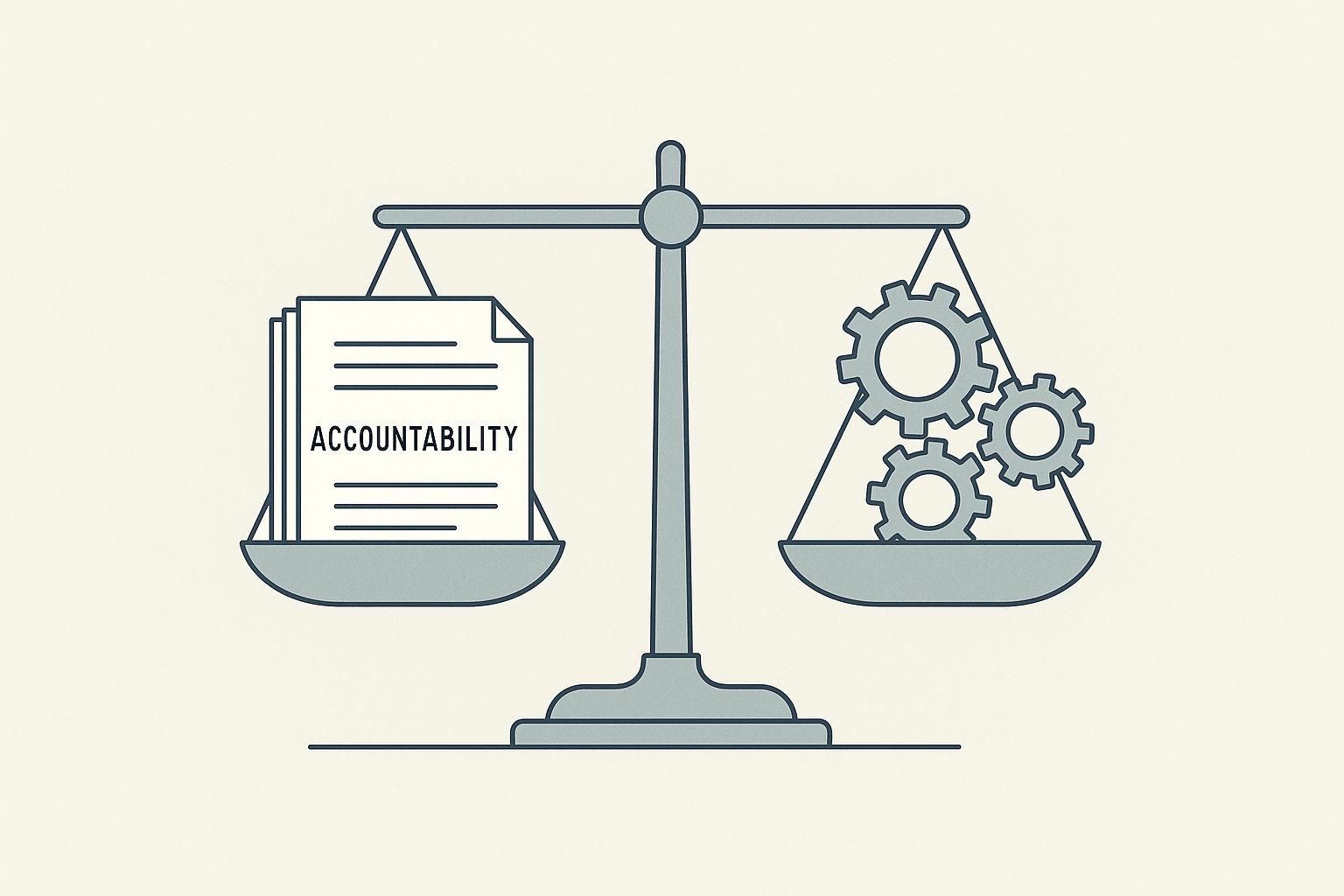
Checklist for Building Accountable AI Systems
Accountable AI systems ensure that responsibility for AI decisions can be clearly assigned to specific individuals or teams. This is crucial in areas like finance, healthcare, and hiring, where AI impacts people's lives. The article outlines practical steps to create and maintain accountability throughout an AI system's lifecycle:
- Human Oversight: Assign clear roles (monitoring, evaluation, decision-making) and establish structured review processes.
- User Appeal Channels: Provide clear ways for users to contest AI decisions, with independent reviewers and escalation paths.
- Performance Tracking: Regularly test for accuracy and bias, monitor for model drift, and use dashboards to track metrics.
- Legal Compliance: Follow U.S. laws (e.g., FCRA, HIPAA), manage third-party vendor compliance, and use detailed compliance checklists.
- Audit Records: Log AI decisions with detailed records and plan for system failures with clear response strategies.
- Training: Educate teams on ethical principles and their responsibilities in managing AI.
These measures help organizations meet regulatory standards and build trust in their AI systems. Start by defining oversight roles, testing for bias, and ensuring compliance with laws like the CCPA and FCRA.
AI Accountability: Responsibility When AI Goes Wrong
Setting Up Human Oversight
Incorporating human oversight into AI systems is essential to ensure decisions are made with proper context, empathy, and ethical considerations. Without it, AI may operate in ways that overlook these critical elements.
Assign Clear Roles and Responsibilities
To maintain accountability, it's important to designate specific roles across various departments like executive, legal, business, HR, and tech teams to oversee AI outputs [1]. These roles can be grouped into three main areas:
- Monitoring Team: Responsible for reviewing AI outputs and flagging issues as they arise.
- Evaluation Team: Conducts deeper analysis of performance data to identify biases or errors.
- Decision-Makers: Typically from management or executive levels, they decide when updates or corrections to the system are needed.
| Role | Responsibilities |
|---|---|
| Monitoring Team | Review outputs and identify potential problems |
| Evaluation Team | Analyze data to detect biases or performance gaps |
| Decision-Makers | Approve system updates or corrections |
Once roles are defined, structured review processes should be put in place to integrate human judgment more effectively into the system's operations.
Create Review Processes
Regular and structured reviews ensure that human judgment remains central to AI decision-making. The frequency and depth of these reviews should align with the risk level associated with the AI's application. For instance, financial systems may require fairness-focused reviews, while healthcare systems demand clinical oversight. High-risk systems might need real-time monitoring, whereas lower-risk systems can rely on periodic checks.
It's also critical to document all findings, decisions, and rationales. This creates a clear audit trail, aiding in issue resolution and ensuring compliance with regulatory standards.
Build User Appeal Channels
To empower users, establish clear and accessible channels for contesting AI decisions. A robust appeal process starts with clear instructions on how users can challenge decisions, including what information they need to provide and the expected timeline for a response.
Independent reviewers, equipped with both the data behind the original decision and any additional user-provided information, should handle appeals. These reviewers must have the authority to override the AI's decisions when necessary.
For systemic issues, escalation procedures should be in place to address recurring problems. A defined chain of command ensures that individual appeals can lead to broader reviews when patterns of concern emerge [1].
| Issue Severity | Escalation Path |
|---|---|
| Low | Team Lead → Manager → Director |
| Medium | Director → VP → Legal/Compliance |
| High | Executive Leadership → Board |
Tracking AI Performance and Bias
Maintaining accountability in AI systems goes beyond initial oversight - it requires constant tracking of performance and bias. This ongoing process helps prevent issues from spiraling out of control and ensures the system remains reliable and fair.
Test for Accuracy and Bias
Regular testing is essential to ensure an AI system's accuracy and to identify potential biases. This involves setting baseline metrics and conducting thorough audits across various user groups. For example, demographic parity measures whether AI decisions impact different groups at similar rates, while equalized odds evaluates whether the system maintains consistent accuracy across these groups.
Testing should occur both before deployment to catch early biases and after deployment to monitor how the system performs in real-world scenarios. Using statistical significance testing helps distinguish between random variations and actual bias patterns that need addressing.
Bias testing protocols must consider outcomes across protected characteristics such as race, gender, age, and socioeconomic status. These protocols should also account for intersectionality, as individuals often belong to multiple protected groups. The frequency of testing depends on the system's risk level and usage volume - high-stakes systems demand more frequent evaluations.
The choice of fairness metrics depends on the specific application. For instance, credit scoring systems may prioritize metrics that ensure equal opportunities for qualified applicants, healthcare AI models focus on maintaining clinical accuracy across demographics, and hiring tools aim for balanced representation in candidate selection.
Watch for Model Changes and Problems
One of the biggest challenges in maintaining AI accountability is model drift. This occurs when a system's reliability or fairness is compromised due to changes in input data patterns (data drift) or shifts in the relationship between inputs and outputs (concept drift).
To address this, organizations should implement real-time monitoring that tracks key performance indicators. Threshold-based alerts can signal immediate deviations, while trend analysis can reveal gradual shifts over time. For example, alerts might trigger if accuracy falls below 95% of baseline performance or if bias metrics exceed acceptable limits.
Using A/B testing frameworks allows teams to compare new model versions against existing baselines. This approach helps identify unintended consequences before full deployment, especially when models are updated or trained with new data.
Performance dashboards play a crucial role in monitoring. These dashboards provide visual representations of metrics like accuracy trends, bias measurements, prediction volume, and response times. They make it easier for teams to quickly spot anomalies or patterns that might not be obvious in raw data. Such tools are critical for building an AI system that remains accountable over time.
Keep Monitoring Methods Current
As regulations evolve, organizations must adapt their monitoring strategies to stay compliant. Compliance tracking systems help manage requirements across different regions, such as the European Union's AI Act, California's privacy laws, and federal guidelines.
Keeping up with industry best practices is equally important. Regular benchmarking against updated standards from professional associations, regulatory bodies, and research institutions can highlight gaps in current monitoring approaches.
Emerging tools in MLOps (machine learning operations) also offer new ways to improve monitoring. For instance, when retraining models with fresh data, organizations should verify that their monitoring systems remain effective. New data sources might introduce different bias patterns or alter statistical properties, requiring adjustments to detection methods.
| Monitoring Component | Update Frequency | Key Considerations |
|---|---|---|
| Bias Detection Metrics | Quarterly | Regulatory updates, new protected groups |
| Performance Thresholds | Monthly | Seasonal trends, changing usage patterns |
| Alert Systems | Bi-weekly | Minimizing false positives, quick response |
| Compliance Frameworks | As regulations change | Meeting legal and industry-specific requirements |
Meeting Legal and Compliance Requirements
To ensure accountability, AI systems must operate within the boundaries of federal, state, and industry regulations. This requires establishing clear compliance frameworks that align with legal standards. These frameworks not only support ongoing performance and bias monitoring but also ensure that every decision adheres to U.S. laws.
Follow U.S. Laws and Standards
AI regulations in the U.S. are constantly evolving, with federal and state laws playing a significant role. At the federal level, Section 508 of the Rehabilitation Act mandates that technology used by federal agencies and contractors be accessible to all, including individuals with disabilities. Similarly, the Fair Credit Reporting Act (FCRA) applies to AI used in employment, credit, or insurance decisions, requiring proper disclosure and dispute resolution processes.
State laws, such as California's CCPA/CPRA, emphasize transparency in automated decision-making. Industry-specific rules add another layer of complexity. For instance, healthcare AI systems must comply with HIPAA to safeguard patient data, while financial services AI must adhere to fair lending laws under the Equal Credit Opportunity Act. Many of these laws demand explainable AI to demonstrate unbiased decision-making.
Frameworks like the NIST AI Risk Management Framework (AI RMF 1.0) provide a structured approach to managing AI risks, focusing on governance, risk identification, performance metrics, and risk control. Additionally, the ISO/IEC 23053:2022 standard offers guidance on maintaining continuous risk management throughout an AI system’s lifecycle.
Control Third-Party Vendor Compliance
When working with third-party AI vendors, accountability starts with strict compliance management. Contracts should clearly outline responsibilities, audit rights, and reporting obligations, assigning specific accountability for AI-related risks.
Before engaging a vendor, conduct thorough due diligence to verify their compliance frameworks, certifications, and incident response plans. Ongoing monitoring is essential. Service-level agreements (SLAs) can include compliance metrics like accuracy benchmarks, regular bias testing, and prompt incident reporting to ensure standards are consistently met.
If vendors handle sensitive data, data processing agreements must specify how data is handled, stored, and deleted. Under laws like the CCPA, organizations remain responsible for their vendors' data practices, making oversight critical. Including audit rights in vendor contracts - such as periodic security reviews or compliance certifications - can further strengthen risk management efforts.
Apply Compliance Checklists
A structured approach to compliance involves using detailed checklists to verify adherence to legal and operational requirements. Pre-deployment checklists can confirm compliance with mandates like consent, disclosures, and documentation. Meanwhile, operational checklists should be applied regularly to evaluate ongoing practices, such as data handling, bias assessments, and compliance audits. The frequency of these reviews should match the system’s risk level and regulatory obligations.
Keep thorough records of system design, data sources, performance metrics, and incident responses. Maintaining an audit trail of testing, monitoring, and remediation activities is crucial for demonstrating accountability and transparency.
Cross-functional teams, including legal, technical, and business experts, should collaborate to identify compliance challenges and improvement opportunities. Regular gap analyses can highlight areas where current practices may not meet evolving standards or industry expectations.
| Compliance Area | Key Requirements | Review Frequency |
|---|---|---|
| Data Privacy | Consent, data minimization, user rights | Monthly |
| Algorithmic Fairness | Bias testing, demographic parity, equitable outcomes | Quarterly |
| Transparency | Explainability, disclosure requirements, user notifications | Bi-annually |
| Security | Access controls, data protection, incident response | Continuously |
Effective compliance reporting requires a combination of automated monitoring and manual assessments. This approach helps track trends, document remediation efforts, and provide clear accountability to regulators and stakeholders.
sbb-itb-8feac72
Creating Audit Records and Response Plans
Accountability in AI systems hinges on thorough documentation and proactive preparation. By establishing clear audit trails and robust response plans, organizations can track system decisions, address potential issues, and continuously refine their AI processes.
Keep AI Decision Records
Every decision made by an AI system should be recorded, capturing details like input data, timing, and reasoning. These records are essential for reviewing decisions, spotting trends, and meeting compliance requirements.
Start by logging the basics: input data, model version, decision outcomes, and confidence scores. For critical applications - like loan approvals or hiring decisions - go further. Include details about influencing factors, human interventions, and any applied rules. The level of detail should match the system's risk profile. For example:
- A recommendation engine for streaming content might only need basic logs of user interactions and suggested content.
- An AI system used in medical diagnostics requires far more detail, such as patient data inputs, diagnostic reasoning, confidence levels, and any clinician overrides.
Retention policies for these records must align with legal and business needs. For instance, financial AI systems often follow strict banking regulations, while healthcare systems may need to retain data longer for patient care and research.
From a technical perspective, structured logging systems should capture metadata without slowing down the system. Real-time logging ensures no decisions are missed, while batch processing can handle deeper analysis and reporting. Automated alerts can flag unusual patterns, like deviations in decision trends or confidence scores falling below acceptable thresholds.
Once solid records are in place, organizations must prepare for the unexpected.
Plan for AI System Failures
AI systems fail in ways that are often distinct from traditional software. Issues like algorithmic bias, model drift, adversarial attacks, or corrupted training data require tailored response strategies.
A strong AI incident response plan starts with clear escalation paths. These should involve both technical and business teams. For example, if an AI system displays biased behavior, the response team might include data scientists to evaluate the model, legal experts to assess compliance risks, and business leaders to gauge operational impacts. Define specific triggers - such as accuracy drops or spikes in bias metrics - that activate different response levels.
Containment measures might involve reverting to manual processes or backup models. For this to work, organizations need fallback procedures capable of managing decision volumes without the AI system. For customer-facing systems, prepare clear communication templates to explain any disruptions.
Recovery efforts should address immediate fixes and long-term improvements. Short-term actions could include retraining models with corrected data, tweaking decision thresholds, or increasing human oversight. Long-term steps involve understanding why the failure occurred and implementing safeguards to prevent it from happening again.
Regularly testing your response plan is critical. Tabletop exercises can simulate scenarios like bias detection, while technical drills ensure backup systems and data recovery processes work as intended. These tests can uncover gaps in communication, unclear roles, or missing technical capabilities before a real incident occurs.
After resolving an incident, the focus should shift to learning and improving.
Learn from Incidents
Every failure or close call is an opportunity to strengthen accountability. Post-incident analysis should explore what went wrong, why safeguards failed, and how to prevent similar issues in the future.
Conduct structured reviews with cross-functional teams to analyze the timeline of events, identify contributing factors, and create actionable improvement steps. The goal is to address systemic problems, not assign individual blame. For instance, if a hiring AI system showed bias, examine whether the training data was representative, if testing procedures were rigorous enough, and whether monitoring systems were effective.
Root cause analysis often uncovers interconnected issues, such as poor data quality, flaws in model design, or gaps in oversight. For example, a failure might reveal unreliable vendor data, insufficient diversity in testing scenarios, or inadequate monitoring practices. Addressing these issues enhances the overall reliability of your AI systems.
Document the lessons learned in a way that’s easy to understand and apply. Summarize incidents by detailing what happened, why it occurred, and what corrective actions were taken. Sharing these insights across teams helps prevent similar mistakes in future projects.
Encourage teams to report near-misses and potential issues early. Regular reviews of incident trends can highlight recurring patterns, signaling deeper systemic challenges. These insights complement ongoing monitoring and compliance efforts.
| Incident Type | Key Learning Areas | Improvement Actions |
|---|---|---|
| Bias Detection | Training data quality, testing diversity | Enhanced data audits, expanded test scenarios |
| Model Drift | Performance monitoring, retraining triggers | Automated drift detection, proactive retraining schedules |
| Security Breach | Access controls, data protection | Stronger authentication, encryption upgrades |
Working with Stakeholders and Training Teams
After establishing strong audit records and incident response plans, the next step is to engage stakeholders through focused training. This approach strengthens AI accountability across your organization.
Train Employees on AI Ethics
It's crucial that every team member understands their ethical responsibilities when working with AI. Training should address key areas like fairness, accountability, transparency, privacy, reliability, safety, and inclusiveness [2][3]. These principles should be woven into every stage of the AI lifecycle - from data collection to deployment and ongoing monitoring [2][4].
Conclusion: Your Next Steps for AI Accountability
Building accountable AI systems isn’t just a nice-to-have - it’s a necessity that requires commitment across your entire organization. The checklist you've reviewed provides a solid starting point, but success hinges on how well you turn these principles into action.
Begin by focusing on AI governance fundamentals that align technology with your business goals, regulatory requirements, and ethical standards [5]. These core principles act as safeguards, helping your organization avoid missteps and navigate compliance challenges effectively.
From there, adopt a structured approach. This means keeping track of your AI inventory, conducting risk assessments, defining clear roles, rigorously testing your models, staying updated on legal changes, documenting processes, managing vendor risks, and ensuring your teams are well-trained [6].
The time to act is now. Organizations generating $1 billion or more in annual revenue are already making moves - 60% have either established or are planning to establish AI governance functions [5]. This growing trend underscores the critical importance of AI accountability in today’s regulatory landscape.
Take immediate steps by selecting checklist items that align with where your organization stands today. If you’re just starting out, focus on building human oversight and achieving basic compliance. For more mature organizations, prioritize advanced monitoring systems and engaging key stakeholders.
Remember, AI accountability isn’t a one-and-done task. It’s an ongoing process that requires regular reviews, updates, and learning - both from successes and challenges. This continuous effort ensures your systems remain strong and compliant as your organization evolves alongside the regulatory environment.
For technical leaders moving into strategic roles, mastering these frameworks is key to bridging the gap between AI innovation and business leadership. Resources like Tech Leaders (https://technical-leaders.com) can help you balance cutting-edge technology with ethical responsibility, positioning you as a leader in AI accountability.
FAQs
What steps can organizations take to ensure their AI systems remain accountable as regulations and technology evolve?
To keep AI systems accountable as technology evolves and regulations shift, organizations need to emphasize ongoing monitoring, clear reporting, and flexible governance. Regular audits paired with thorough documentation help meet changing standards while building trust with users and stakeholders.
Involving stakeholders and assigning specific responsibilities across the AI lifecycle - like identifying who owns the model and ensuring decisions can be traced - positions organizations to stay aligned with new regulations and advancements. By focusing on these strategies, businesses can manage AI responsibly and adjust to changes with confidence.
How can organizations reduce biases in AI decision-making?
To tackle biases in AI decision-making, organizations should begin by utilizing diverse and representative datasets that reflect a wide range of perspectives. This helps create systems that are more inclusive and equitable. It's equally important to regularly audit and review training data to spot and address any hidden biases.
Practical techniques can also play a big role. For example, data preprocessing methods like normalization and anonymization help clean and prepare data for unbiased analysis. Tools like causal modeling can adjust for underlying biases, while algorithmic fairness methods, such as counterfactual fairness, work to ensure fair outcomes across different groups.
However, identifying bias is just the start. Maintaining fairness requires ongoing monitoring and a commitment to responsible AI practices to ensure accountability over time.
How can organizations ensure ethical and compliant AI innovation in industries like healthcare and finance?
Organizations can encourage responsible AI development in critical industries by establishing strong governance frameworks and aligning their AI initiatives with ethical principles like transparency, fairness, and accountability. This means setting up oversight processes, performing regular audits, and ensuring compliance with all applicable regulations.
To reduce risks, organizations should also embrace strategies such as risk assessments, gathering input from stakeholders, and thorough testing of AI systems. Striking the right balance between innovation and responsibility allows companies to advance technology while maintaining public trust and prioritizing safety.