
Checklist for Leveraging Informal Networks at Work
Want to excel at work beyond the org chart? Informal networks - those behind-the-scenes connections - often determine how decisions are made, problems are solved, and initiatives succeed. Studies show that 83% of top executives attribute career milestones to relationships, not just skills. This guide breaks down how to identify key players, strengthen your network, and use it to drive results.
Key Takeaways:
- Spot informal influencers: Look for those who shape decisions and connect teams, even without formal authority.
- Assess your role: Are you a central hub, broker, or on the sidelines? Map your connections to find gaps.
- Build relationships: Engage meaningfully through casual interactions, shared interests, and mutual support.
- Leverage your network: Focus on top connectors to amplify initiatives and solve cross-team challenges.
- Maintain and measure: Regularly nurture ties and track how your network impacts outcomes.
Start small - identify one action from this checklist and apply it today. Your network could be the key to your next big opportunity.
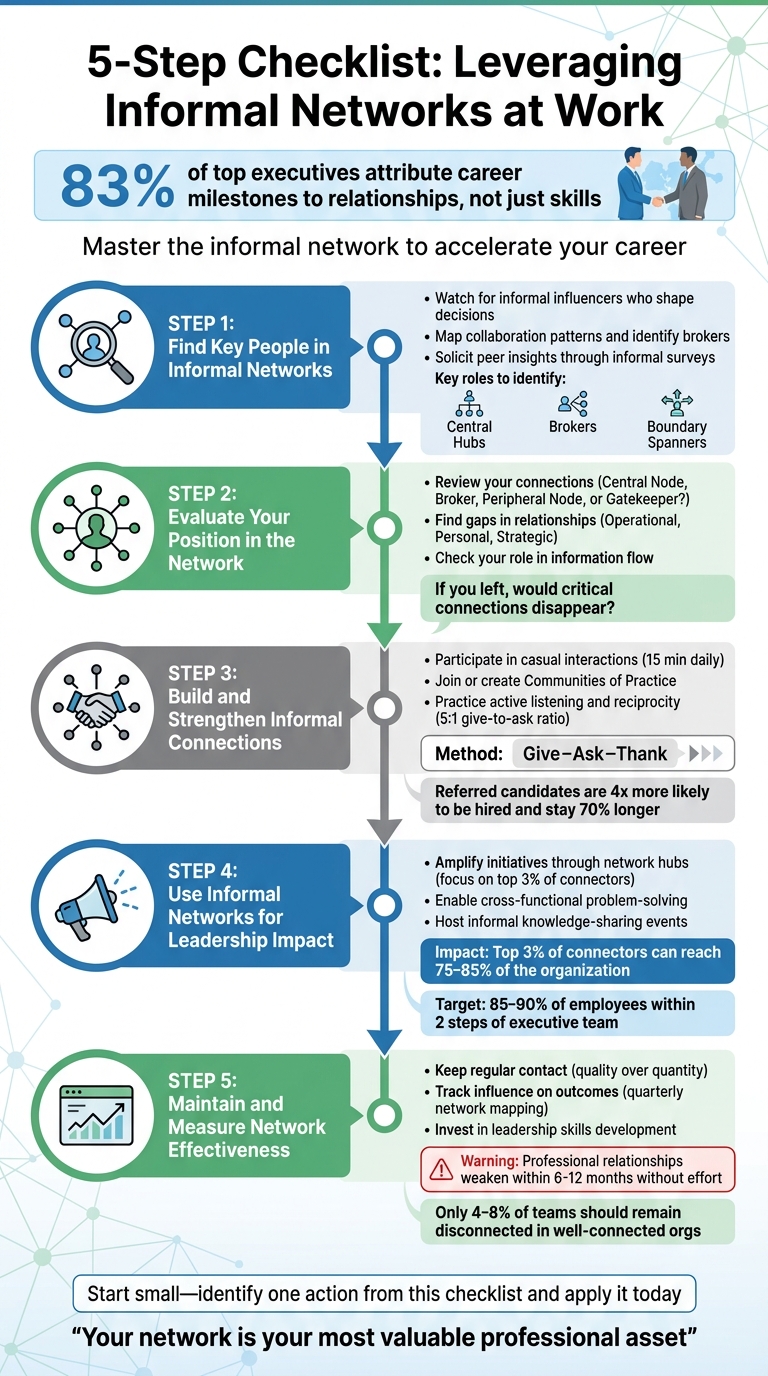
5-Step Process for Leveraging Informal Networks at Work
Good Morning, HR #116: Using Informal Networks to Implement Change
sbb-itb-8feac72
Step 1: Find Key People in Informal Networks
To tap into informal networks, you first need to identify the individuals who hold real sway within the organization. While organizational charts outline hierarchy and reporting lines, they often miss the mark when it comes to highlighting those who are truly trusted and relied upon in day-to-day operations. The first step is to carefully observe and identify these influential players.
Watch for Informal Influencers
Pay attention to who naturally takes charge during meetings or informal conversations. These are the people who resolve disputes, shape decisions, and share critical updates - even if they don’t hold formal authority. Often, these individuals occupy central roles within the network, offering a unique view of the organization’s inner workings.
Look for clues like who gets cc’d on important emails across various departments or who regularly joins meetings outside their immediate team. These individuals act as central hubs, staying in the loop on emerging patterns and accessing key information early. They might include executive assistants, long-tenured employees, or project managers who interact with multiple teams on a regular basis [1].
Map Collaboration Patterns
Take a closer look at who frequently collaborates across teams and departments, especially in ways that aren’t reflected on the official org chart. Focus on identifying brokers - those who bridge gaps between groups that don’t typically communicate. These individuals play a pivotal role in connecting otherwise isolated teams and controlling the flow of information.
"People who span structural holes get promoted faster, have higher compensation, and are more likely to generate valuable ideas." - Cole Sperry, Margin [1]
Career rotators, or employees who have worked in multiple departments, often serve as these critical brokers. Their broad experience and diverse relationships make them invaluable for connecting different areas of the organization. A helpful question to consider is: "If this person left, would it disrupt the connection between two specific teams?" [1]
Solicit Peer Insights
Once you’ve started mapping these interactions, validate your observations by reaching out to colleagues for their input. Conduct informal surveys and ask specific questions like "Who do you rely on for advice to meet your goals?" or "Who provides the most energizing and productive interactions?" [3].
Talk to team members about who they turn to for help with tough challenges or strategic advice. Pay close attention to names that come up repeatedly across different teams and conversations. These individuals often act as boundary spanners, breaking down silos and fostering innovation by integrating ideas from across the organization [3]. By piecing together these patterns, you’ll uncover the true connectors who quietly keep things running smoothly behind the scenes.
Step 2: Evaluate Your Position in the Network
Now that you've pinpointed the influential players in your organization's informal network, it's time to focus on yourself. Understanding your place in this web of connections can uncover both your current influence and untapped opportunities. The key? Focus on the relationships that drive results and assess your role within the network.
Review Your Connections
Take a closer look at your communication habits to figure out if you're acting as a central node, broker, peripheral node, or gatekeeper [1]. Here's a quick breakdown:
- Central nodes: These are the key information hubs. They're the ones cc'd on every important email and invited to cross-departmental meetings.
- Brokers: They connect otherwise separate groups, like bridging communication between engineering and sales teams.
- Peripheral nodes: These individuals work more independently and have fewer connections.
- Gatekeepers: They control access to vital resources or information.
"If you're connected to many people, you see patterns others miss. You hear about problems early. You know who's working on what, where resources are, what projects are struggling."
– Cole Sperry [1]
If people frequently ask you to make introductions, it’s a good sign you’re acting as a broker [1]. Also, think about your career history - moving across different functions often builds these brokerage connections that can set you apart.
Find Gaps in Relationships
Take stock of your relationships by sorting them into three categories: operational, personal, and strategic [6].
- Operational ties: These are your day-to-day coworkers who help with immediate tasks and projects.
- Personal ties: Mentors and peers who provide guidance and emotional support.
- Strategic ties: Cross-industry or external contacts who bring fresh ideas and opportunities.
Relying too much on operational ties can narrow your perspective [6].
"Over-dependence on operational ties, for example, may limit broader perspectives, while excessive focus on strategic networks may weaken day-to-day effectiveness."
– Holistique Training [6]
Also, assess the diversity of your network. If most of your contacts come from the same department, background, or perspective, you're likely missing out on critical insights. Seek out connections in departments or teams you rarely interact with, especially those that could benefit from your expertise - or vice versa.
Check Your Role in Information Flow
Ask yourself: Are you actively helping information flow across the organization, or are you sitting on the sidelines? If colleagues often come to you to connect different business units or collaborate on solutions, you're likely serving as an effective bridge [5]. On the other hand, if you're not part of these exchanges, you might be missing out on key opportunities.
"Your value should not be defined by your formal organizational role. Informal power can help you mobilize resources, drive change, and create value for the organization as well as yourself."
– Maxim Sytch [4]
Try the "departure test" to evaluate your importance: If you left the organization tomorrow, would any critical connections between teams disappear? If the answer is yes, you're playing a crucial bridging role. If not, you may be more on the periphery than you realize [1]. Look for ways to connect customer insights with technical solutions - this is often where the most value is created [1].
Step 3: Build and Strengthen Informal Connections
Now that you've analyzed your network and identified key players, it’s time to take action. Strengthening informal connections requires intentional, genuine efforts that go beyond surface-level interactions. These relationships thrive on consistent, meaningful engagement.
Participate in Casual Interactions
Think of yourself as a host in social or professional settings. At events, look for individuals who seem disconnected and make an effort to include them. In virtual meetings, joining a few minutes early or staying a bit later can create opportunities for informal chats that often lead to stronger bonds.
Make networking a daily habit. Spend 15 minutes each day leaving thoughtful comments on internal communication platforms or professional networks. A well-crafted comment carries more weight than generic likes or reactions. If you admire someone’s work, send a brief, focused message - 1–2 paragraphs at most - with a clear question or compliment. If they don’t respond, move on gracefully.
Join or Create Communities of Practice
Communities of practice (CoPs) are internal groups where employees collaborate to solve problems and share ideas. These groups, once informal, are now increasingly integrated into formal management structures.
"Though in-house networks of experts - or 'communities of practice' - were once entirely unofficial, today they are increasingly integrated into companies' formal management structures."
– Richard McDermott and Douglas Archibald [9]
If you can’t find an existing group that aligns with your interests, consider starting one. Focus on a shared topic or challenge, such as AI adoption, improving customer experiences, or fostering cross-department collaboration. For long-term success, align the group’s goals with your company’s objectives while maintaining enough flexibility for creativity and autonomy. These communities work best when members actively listen and support each other.
Practice Active Listening and Reciprocity
Networking isn’t about collecting contacts - it’s about creating a community of mutual support. Shift your mindset from “What can I gain?” to “What can I offer?” Studies show that referred candidates are four times more likely to be hired and tend to stay with their organizations 70% longer than non-referrals [10]. The secret is to give more than you ask - aim for a 5:1 ratio of giving to asking [10].
Use the Give–Ask–Thank method: start by offering help or insights, then make your request, and always express gratitude. Ways to give include sharing useful articles, connecting people who could benefit from knowing each other, offering your expertise, celebrating others’ achievements, or providing feedback when asked. When engaging with others, ask open-ended questions like, “What exciting projects are you working on?” or “What do you wish you’d known when you started?” and focus on listening rather than talking.
To keep your network active, send brief, friendly messages every few months without asking for anything in return. You can also request short informational interviews - 15 to 20 minutes - to learn from someone’s expertise. Come prepared with specific questions that highlight their knowledge. These small but intentional actions will solidify your informal network and enhance your influence as a leader.
Step 4: Use Informal Networks for Leadership Impact
Now that you've established strong informal connections, it's time to leverage them for impactful leadership. These relationships aren't just for show - they're powerful tools for driving change, solving challenges, and advancing your initiatives. The key lies in tapping into the natural flow of influence within your network.
Amplify Initiatives through Network Hubs
Instead of addressing everyone individually, focus your efforts on the top 3% of connectors - those super-connectors who can influence 75% to 85% of the organization [7]. These individuals might not hold senior titles, but they have a unique ability to bridge gaps across teams and levels.
"If you focus on the 3% of individuals with the most connections, you can typically reach 75% to 85% of the entire organization through that small group." – Teamspective [7]
Tools like Organizational Network Analysis (ONA) can help identify these central influencers. By involving them early in your plans, their support can often carry more weight than formal announcements. Combine this with strategies like the Give–Ask–Thank method to strengthen engagement.
Another important factor to track is leadership distance - how close employees are to decision-makers within the network. Ideally, 85% to 90% of employees should be within two steps of the executive team [7]. If your initiative requires leadership backing, work to close this gap. The farther employees are from leadership, the harder it is to gain momentum.
Enable Cross-Functional Problem-Solving
Cross-functional teams often struggle with unclear roles and accountability, with 75% of such structures labeled as dysfunctional [11]. Informal networks can step in where formal systems fall short. When teams work in silos, information stalls, and problems linger.
A practical solution is assigning a Single Point of Contact (SPOC) for each function - someone who serves as the go-to person for cross-departmental communication. These mid-level connectors act as bridges, helping to keep information flowing smoothly. Before starting any cross-functional project, map your network to identify gaps in alliances and focus on those areas.
Take a proactive approach by conducting short, 15–20 minute informational interviews with peers from other departments. This "give first" strategy helps build trust and fosters collaboration. To ensure your messages stick, reinforce them across multiple interactions - typically around six times [12].
Host Informal Knowledge-Sharing Events
Events like lunch-and-learns, workshops, or casual discussions can be excellent opportunities to share ideas and spark innovation. Pay special attention to bottleneck connectors - those individuals who link different groups. If these connectors are overburdened (engaging with 44 or more people regularly), they risk burnout [7]. Offer them support or redistribute their responsibilities to prevent overload.
Before planning these events, use network mapping to identify isolated groups or "silos." In well-connected organizations, only 4% to 8% of teams remain disconnected [7]. Invite members from these isolated groups to help break down barriers and create a more collaborative environment. Communities of practice, which were once informal, are now often integrated into formal management structures and serve as excellent platforms for sharing knowledge [9].
Make these events a regular part of your leadership strategy rather than optional extras. Focus on fostering reciprocity: share meaningful stories, offer genuine help, and create opportunities for others to contribute. By involving the right people - those who align with your organization's values and hold critical expertise - these informal gatherings can drive both innovation and engagement.
For more tips on how to use informal networks to boost your leadership, check out additional resources on Tech Leaders (https://technical-leaders.com).
Step 5: Maintain and Measure Network Effectiveness
Building a strong informal network is just the beginning. The real challenge lies in maintaining those connections and measuring their impact. Research shows that executives with well-developed strategic networks are more likely to earn promotions, drive innovation, and achieve long-term success [6]. But to truly benefit, networking must be a consistent habit - not something you turn to only in moments of need.
Keep Regular Contact
Think of networking as a leadership skill that requires regular practice. Set aside time in your schedule for follow-ups and check-ins, just like you would for any other important task. Avoid sending generic messages; instead, share meaningful insights, suggest collaborations, or make introductions that show you're genuinely engaged.
A helpful approach is using the Give–Ask–Thank model to cultivate strong, balanced relationships. Focus on quality over quantity - deep, meaningful connections will always outweigh a long list of superficial ones.
Digital platforms like LinkedIn can also help you stay visible without taking up too much of your time. Sharing thoughtful content and joining discussions within your industry not only keeps you connected but also reinforces your professional credibility. This is especially important as networking increasingly shifts to virtual and value-driven spaces.
Along with maintaining regular contact, it's important to evaluate how your network contributes to your goals.
Track Influence on Outcomes
You don’t need complex tools to measure your network’s impact. Start by observing how your connections influence tangible results. For instance, has a key contact helped you gain support for a project or resolved a challenge faster than traditional methods could?
Network mapping can be a practical way to assess these contributions. Revisit your network quarterly to identify gaps and ensure you're connected with a mix of collaborators, mentors, peers, and strategic contacts across different industries and departments [6]. If you notice that you’re leaning too heavily on one type of relationship, it might be time to diversify. Studies, including research by McKinsey, show that diverse networks often lead to more creative and effective outcomes [6].
When leading change initiatives, focus on the "critical 3%" - those super-connectors who can accelerate buy-in and spread ideas quickly [7]. Additionally, tracking metrics like the speed of information sharing and the frequency of successful outcomes can provide valuable insights into how well your network is functioning.
Invest in Leadership Skills Development
Maintaining and measuring your network is only part of the equation. To truly maximize its potential, you need to continuously enhance your leadership skills.
Skills like authenticity, active listening, cultural intelligence, and digital literacy are essential for building trust and fostering collaboration within diverse teams. Yet, 75% of HR leaders report that many managers feel overwhelmed and unprepared to lead in areas like change management, employee engagement, and culture [7]. Bridging this gap requires intentional development.
Programs like those offered by Tech Leaders (https://technical-leaders.com) can help. They provide training that blends technical expertise with leadership essentials, such as AI business strategy and team management - ideal for professionals transitioning into leadership roles.
To strengthen your influence, apply principles like social proof and authority. At the same time, practice empathy and inclusivity by building diverse networks and supporting underrepresented groups. These aren't just "soft skills"; they’re the foundation of networks that can create meaningful organizational change.
Conclusion
By applying these steps, your informal networks can become a powerful driver for leadership growth. These networks aren't just casual connections - they're an essential resource that can significantly influence your career path. In fact, most C-suite executives attribute their career-defining opportunities more to strategic relationships than to technical expertise [2].
The checklist outlined here serves as a guide to transform random contacts into a purposeful network. By identifying key players, assessing your current standing, fostering genuine connections, using your network to create impact, and nurturing those relationships consistently, you build a system that provides both stability and opportunity.
"Your network is your most valuable professional asset, your safety net in times of uncertainty, and your primary engine for creating unforeseen opportunities."
– James E., Skillhub [8]
The shift from a transactional approach to a relational one is crucial. Adopting a "give first" mindset and focusing on building a network of allies who share mutual goals ensures that your connections remain active and beneficial. Research shows that professional relationships can weaken within 6–12 months without intentional effort [2], making regular engagement a necessity.
Start by taking just one step from this checklist today. Whether it’s evaluating your current network, reconnecting with someone you’ve lost touch with, or offering help without expecting anything in return, even small actions can lead to meaningful progress. Over time, these efforts multiply, ensuring your network remains a source of influence and opportunity. Remember, your leadership success hinges not only on your expertise but on who knows you and how well you've cultivated those relationships.
FAQs
How can I find informal influencers fast?
To spot informal influencers within your organization, pay attention to those who naturally sway opinions and foster connections. These are the advocates, connectors, and individuals who frequently share insights or link people together. Watching how people interact socially can offer valuable clues, and tools like LinkedIn can provide additional insights. Identifying and engaging with these key players allows you to tap into their influence and strengthen your informal network.
What if I’m on the network’s sidelines?
If you’re feeling disconnected, start by joining informal networks through casual connections with peers and mentors. Simple actions like grabbing coffee, sharing lunch, or participating in casual conversations around the office can make a big difference. These moments not only help you gather feedback and stay in the loop but also allow you to rebuild your presence. Take the initiative to cultivate these relationships and expand your network - it can greatly enhance your ability to stay engaged and influential.
How do I measure networking impact at work?
Measuring the impact of networking goes beyond simply counting your contacts. What truly matters is the quality and influence of the relationships you’ve built. Take a closer look at how your network contributes to your success - whether through career advancements, collaborative opportunities, or access to essential resources. Think about tangible outcomes, like landing a promotion, taking on exciting projects, or receiving crucial support, that stem from these connections. By focusing on building meaningful and strategic relationships, you ensure that your network remains a source of mutual growth and benefit.