
Cloud Ethics: Lessons from Security Breaches
Cloud security isn't just technical - it's a matter of responsibility and trust. Recent breaches highlight how unclear roles between providers and customers lead to security gaps. Here's what you need to know:
- The shared responsibility model divides security tasks between providers (infrastructure) and customers (data, applications). Misunderstandings here often result in breaches.
- Providers like Microsoft and Snowflake faced criticism for design flaws and optional security features, exposing users to risks.
- Customers frequently misconfigure storage or fail to implement access controls, causing preventable breaches like the Tea App and Capital One incidents.
- Ethical accountability means going beyond compliance. Providers must simplify security for users, while customers must actively manage configurations and permissions.
Key takeaway: Both sides must prioritize transparency, secure defaults, and continuous monitoring to protect sensitive data and maintain trust. Ethical cloud practices aren't optional - they're essential.
Full SANS Webcast | Decoding the Shared Responsibility Model: Securing Cloud Environments Together
The Shared Responsibility Model: Where Ethics and Practice Meet
Cloud Security Shared Responsibility Model: Provider vs Customer Duties
Provider vs. Customer Responsibilities
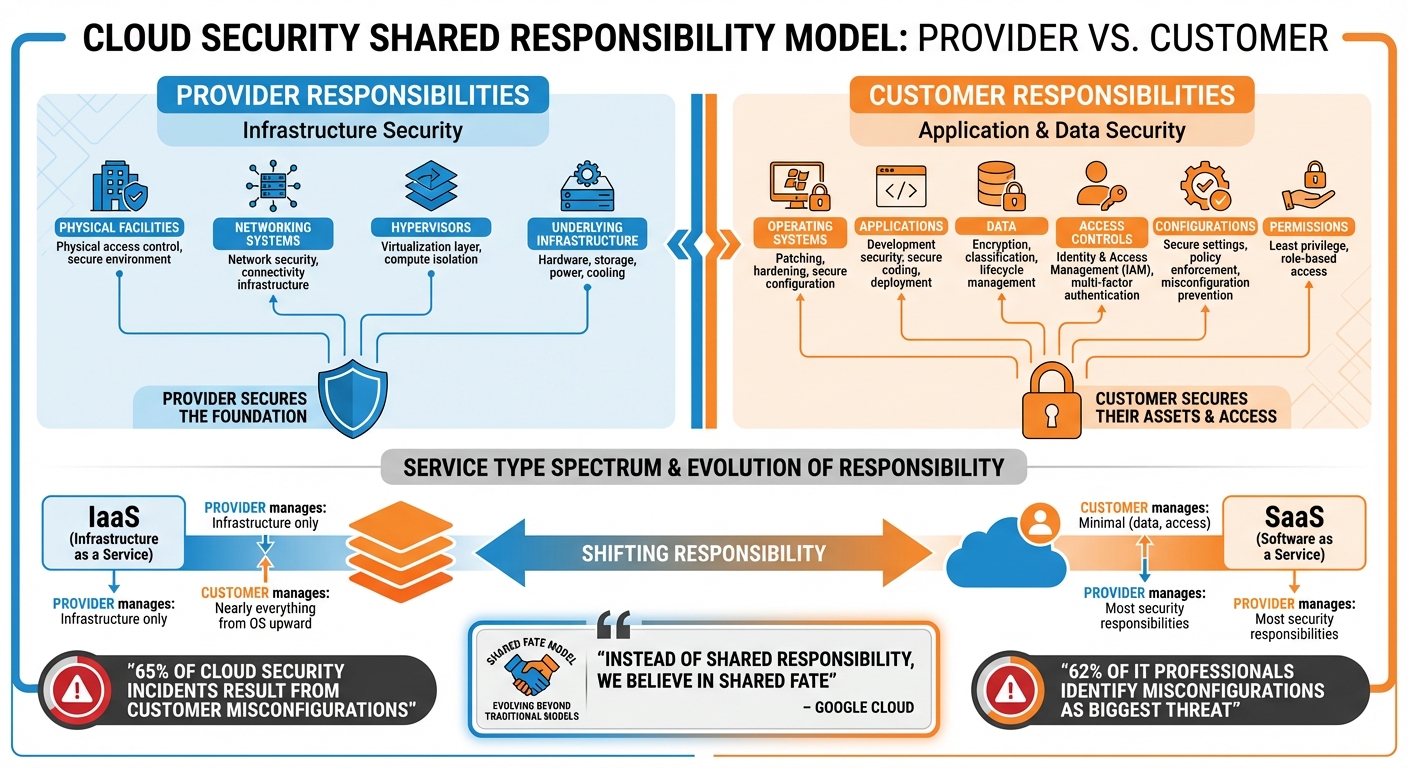
When it comes to ethical accountability in cloud security, the division of responsibilities between providers and customers plays a critical role. Cloud providers take charge of securing the underlying infrastructure - such as physical facilities, networking systems, and hypervisors. Meanwhile, customers are responsible for securing everything built on top of that infrastructure, including operating systems, applications, data, and access controls [1]. This division, however, often creates gray areas in determining who is accountable for what.
The balance of responsibility shifts depending on the type of cloud service. In Infrastructure as a Service (IaaS), customers are tasked with managing nearly everything from the operating system upward. In contrast, Software as a Service (SaaS) places most of the security responsibilities on the provider. These differences highlight ethical challenges, particularly when it comes to ensuring proper security configurations.
Interestingly, many cloud breaches result from customer misconfigurations. Yet, providers have traditionally viewed these issues as solely the customer’s responsibility [6]. Google Cloud has pointed out a flaw in this approach, stating: "The shared responsibility model stops short of helping cloud customers achieve better security outcomes. Instead of shared responsibility, we believe in shared fate" [6]. The complexity of cloud services often leaves organizations without the necessary expertise to navigate security effectively, exposing ethical gaps.
To address this, some providers are adopting a "Shared Fate" model. This approach goes beyond the traditional shared responsibility framework, offering secure-by-default settings and risk-reduction tools to help customers succeed [6]. Even in cases where providers cannot access customer data - such as with encrypted, "no-view" services - they still bear ethical and legal responsibilities for maintaining the availability and integrity of that data. For instance, under HIPAA guidelines, the Department of Health and Human Services has clarified:
"Lacking an encryption key does not exempt a CSP from business associate status and obligations under the HIPAA Rules" [8].
This underscores the ethical duty providers have, even when direct access to data is not possible.
Why Ethics Matters in Cloud Security
The conversation about provider-customer roles naturally leads to a broader discussion about ethics in cloud security. Ethical practices in this space go beyond merely meeting legal obligations - they’re about preventing avoidable harm. When providers offer complex configuration options without secure defaults, they unintentionally increase the likelihood of customer errors. The UK's National Cyber Security Centre advises organizations to "delegate as much responsibility for security to your hyperscale cloud platform as you can" [7], emphasizing the importance of simplifying security for customers.
Transparency is another cornerstone of ethical cloud practices. Providers must offer third-party audit reports and compliance documentation to demonstrate their controls [1]. However, transparency on its own isn’t enough - it needs to be paired with active collaboration. Effective partnerships between providers and customers can reinforce accountability. For example, in the event of a security breach, successful incident response requires close coordination between all parties, including Managed Service Providers. Contracts should include clauses that ensure this level of cooperation [6][7].
At its core, ethical cloud security is about a duty of care. Providers and customers alike should view regulatory standards as a starting point, not the end goal. By adopting the mindset that "security is a process, not a product" [9], both parties can move beyond liability-driven models toward trust-based partnerships that prioritize user protection.
Case Studies: Cloud Provider Security Failures
When cloud providers falter in security, the consequences go beyond technical breaches - they also undermine ethical accountability.
Microsoft Cloud: Token Validation and Key Management
In May and June 2023, a China-based hacking group known as Storm-0558 exploited flaws in Microsoft’s cloud systems to infiltrate 22 organizations, including the U.S. Departments of State and Commerce. The attackers used a compromised 2016 MSA consumer signing key to breach enterprise-grade Exchange Online accounts. A critical validation flaw in Microsoft’s mail system allowed consumer-grade tokens to access enterprise accounts, resulting in the theft of approximately 60,000 unclassified emails from the State Department alone[11].
Adding to the fallout, Microsoft’s public responses were misleading for months. The company refrained from labeling evident code flaws as "vulnerabilities", which further eroded trust[11]. Even nine months after the breach, the origins of the key compromise remained unresolved[12]. The Cyber Safety Review Board (CSRB) highlighted these failures, stating:
"Individually, any one of the failings described above might be understandable. Taken together, they point to a failure of Microsoft's organizational controls and governance, and of its corporate culture around security."[11]
The breach was initially detected because the State Department had premium "G5" licenses, which included advanced logging capabilities. At the time, these features were unavailable to lower-tier customers[11]. Following the CSRB investigation, Microsoft began offering these critical audit logs free of charge in September 2023[11]. However, the impact of the breach was worsened by persistent failures in key rotation processes[11]. Former NSA hacker Jake Williams likened the situation to:
"We put trust in passports, and someone stole a passport-printing machine."[10]
The takeaway for engineering leaders is straightforward: automate essential security processes like key rotation to reduce human error, and prioritize a strong security framework over the rush to release new features. This incident underscores how design flaws and provider oversights can amplify risks - a recurring theme in cloud security failures.
Snowflake Breach: MFA Defaults
The Snowflake breach in May 2024 revealed another critical gap in cloud security design. Hackers from the "ShinyHunters" group exploited stolen credentials to target Snowflake accounts lacking multi-factor authentication (MFA). This attack compromised 165 customer accounts, with 80% of the breaches stemming from exposed credentials dating back to 2020[13][16].
High-profile victims included Ticketmaster and Santander Bank, both of which suffered significant data exposures[13][14][15]. A glaring issue was the absence of enforced MFA, which left accounts vulnerable. Following the breach, Snowflake’s Chief Information Security Officer, Brad Jones, commented:
"We'll be looking in the future to [make the] default MFA."[13]
This incident highlights an important point: when providers make critical security features like MFA optional instead of mandatory, they leave room for preventable breaches. Much like the Microsoft case, this breach underscores the need for cloud providers to embed security into the core design of their services, rather than treating it as an optional feature. For technical leaders, especially those moving into consulting roles, understanding the shift from a shared responsibility model to a secure-by-default approach is becoming increasingly critical.
sbb-itb-8feac72
Case Studies: Customer-Side Security Failures
While cloud providers are responsible for securing the infrastructure, customers must properly configure and maintain access controls. When these safeguards break down, the ethical responsibility lies squarely with the organization.
Misconfigurations in Cloud Storage
The Tea App breach in July 2025 is a glaring example of how misconfigured storage can lead to disaster. Over 72,000 images, including ID verification selfies, and 1.1 million private messages were exposed due to a Firebase bucket left without authentication. Although the company claimed the breach involved a "legacy system", leaked internal messages suggested otherwise[18].
This incident underscores how cloud security failures aren't just technical - they're organizational. As B. Cowley of Dragonbyte aptly put it:
"If you're claiming a system is dead, prove it. If you're telling users their data is deleted - it better be."[18]
Such lapses highlight a deeper ethical failure: neglecting the duty to safeguard sensitive data. Shockingly, 65% of all cloud security incidents are tied to customer misconfigurations[17].
Another example occurred in January 2022, when Microsoft AI Research accidentally exposed 38 terabytes of confidential data on GitHub. The issue? A SAS token with "full control" access instead of "read-only."[23] Similarly, Pegasus Airlines left an S3 bucket unprotected, exposing 6.5 terabytes of data, including flight charts and sensitive crew information[20].
The takeaway? Misconfigurations remain a top concern, with 62% of IT professionals identifying them as the biggest threat to cloud security[19]. Regular configuration audits, staff training, and automated monitoring tools are essential to address these risks. Equally critical are failures in identity and access management, which compound these vulnerabilities.
Identity and Access Management Failures
Beyond misconfigurations, poor identity and access management (IAM) practices create significant security gaps. The Capital One breach in July 2019 is a textbook example. An attacker exploited a misconfigured Web Application Firewall (WAF) through a server-side request forgery (SSRF) attack. Due to excessive permissions in the WAF's IAM role, the attacker accessed 100 million customer records, including Social Security numbers, names, and addresses. This breach led to an $80 million federal fine and a $190 million settlement with customers[3].
Shai Morag, CEO of Ermetic, commented on the incident:
"The incident could have been prevented by periodic reviews of user configurations to ensure that access controls were using the principle of least privilege correctly."[3]
Research shows that 99% of cloud identities are granted excessive permissions, many of which go unused[21]. Machine identities, such as service accounts, API keys, and IAM roles, are particularly vulnerable. For instance, 83% of organizations using AWS and 73% using Google Cloud fail to rotate access keys every 90 days[22]. Even more concerning, there was a 42% rise in organizations neglecting to enable MFA for AWS root accounts between October 2020 and June 2021[22].
These failures don’t just expose sensitive data - they represent a breach of the ethical responsibilities outlined in the shared responsibility model. For organizations, adhering to the principle of least privilege is not just a technical necessity - it’s an ethical obligation. Excessive permissions amplify risks and betray the trust of customers who rely on organizations to protect their data. For those looking to bridge technical expertise with ethical leadership, resources like Tech Leaders (https://technical-leaders.com) offer valuable guidance.
Leadership Playbook: Building Ethical Cloud Practices
Ethical Governance in Cloud Security
Recent security breaches have made one thing clear: technical leaders must adopt governance models that turn ethical principles into actionable practices. One effective approach is establishing a Data Ethics Board. This board, which includes representatives from legal, compliance, IT, business units, and the C-suite, can help identify and address issues early. Yet, only 17% of companies currently integrate risk and legal roles into their governance structures - a gap that needs urgent attention [2].
Consider the October 2025 AWS outage that disrupted services for ten NHS trusts in the UK. This incident highlighted the risks of over-reliance on a single provider and the importance of fallback plans and outage simulations [24]. Around the same time, the fraud-prevention organization Cifas exposed dozens of email addresses by mistakenly using visible "To" and "CC" fields in a calendar invite. This simple error underscores the importance of data hygiene as a core ethical responsibility. To enhance accountability, boards should include supplier and cloud-resilience risks in their reporting [24].
By implementing these governance measures, organizations can lay a solid foundation for ethical and balanced decision-making.
Decision-Making Frameworks for Ethical Cloud Use
Structured frameworks are essential for leaders tasked with balancing cost, speed, and security in cloud operations. For example, the AWS Well-Architected Framework evaluates decisions through six key pillars: security, cost, reliability, performance, operations, and sustainability [25]. But technical considerations alone aren’t enough. Leaders must also tackle the more challenging "should we" questions. This means asking who might be negatively affected by a decision, whether it benefits the consumer, and whether any biases are unintentionally being introduced into new projects [2].
The urgency is clear: 90% of organizational data is unstructured, and 48% of global CISOs have flagged growing AI-related security risks [26]. To handle this complexity, many organizations are turning to Data Security Posture Management (DSPM). DSPM helps identify shadow data and classify assets across cloud environments. Pairing this with AI Trust, Risk, and Security Management (TRiSM) playbooks allows companies to innovate quickly while keeping ethical risks in check [26].
These frameworks not only guide decision-making but also prepare leaders for the skills needed to navigate ethical challenges in cloud practices.
Developing Ethical Leadership Skills
Ethical leadership in cloud security requires a mix of technical expertise and organizational influence. One critical skill is cross-functional communication. Leaders must use clear, non-technical language to ensure transparency and understanding across all departments [2].
Forensic transparency is another key element. This involves implementing centralized logging across multi-cloud environments and deploying automated playbooks to capture vital data before temporary resources disappear [27]. Regular tabletop exercises also play a crucial role in improving incident response. Research shows that organizations with updated incident response plans and trained teams can reduce data breach costs by an average of $2.6 million [28].
Transitioning from a technical role to an ethical leadership position requires continuous learning. Resources like Tech Leaders (https://technical-leaders.com) offer programs to build leadership and AI strategy skills. As Steve Durbin aptly noted:
"We can't outpace the adversary by trying to stop every attack, but we can outlast them by engineering systems and culture to take a punch and try to quickly rebound." [4]
Combining technical expertise with ethical foresight is essential for fostering shared accountability and resilience in cloud security practices.
Conclusion: Key Takeaways for Ethical Cloud Responsibility
Looking back at the cases we’ve explored, one thing becomes obvious: cloud security is not just a technical requirement - it’s an ethical responsibility. Take the Zestix breach of Iberia in late 2024 as an example. Using stolen credentials, Zestix managed to exfiltrate 77 GB of data valued at $150,000. What enabled this breach wasn’t some advanced hacking technique but the absence of multi-factor authentication (MFA) on critical file-transfer services [4]. This case, like others, highlights the pressing need to define and uphold ethical standards in cloud security.
The shared responsibility model often complicates matters, creating a gray area where the burden is unevenly distributed between providers and customers [29]. To navigate this, technical leaders need to clearly outline responsibilities and ensure both parties are held accountable. As the Atlantic Council put it:
"Trust is no longer optional. Cloud computing is essential to critical infrastructure, commercial, and government operations" [5].
This trust hinges on providers offering secure-by-default configurations and being transparent about how data is handled. On the flip side, customers must actively manage their cloud environments by implementing MFA, continuously monitoring systems, and ensuring configurations are secure.
The urgency is underscored by alarming trends. In 2024, the average time between vulnerability disclosure and exploitation plummeted to just 5 days, a stark drop from 32 days in 2023 [5]. Even more troubling, research from 2023 found that AWS encryption keys exposed on GitHub were exploited by attackers in as little as 2 minutes [5]. These shrinking windows leave no room for hesitation or delayed responses.
Effective ethical leadership in cloud security requires integrating principles like Zero Trust, continuous monitoring, and a commitment to protecting stakeholder trust. A May 2023 report from the U.S. Government Accountability Office revealed that federal agencies often failed to implement continuous monitoring plans, even when they were documented [30]. However, by July 2025, the USDA demonstrated what’s possible with dedicated leadership, successfully closing several gaps by establishing proper access controls and reviewing audit logs [30]. Programs like Tech Leaders (https://technical-leaders.com) are helping bridge the gap between technical expertise and the strategic leadership skills needed in today’s cloud landscape.
Ultimately, leaders must pair technical precision with a strong ethical foundation. Adopting Zero Trust architectures, enforcing continuous verification, and recognizing the broader impact of every decision are crucial steps. Cloud security isn’t just about stopping breaches - it’s about respecting the responsibility of safeguarding data and maintaining the trust that fuels digital transformation.
FAQs
What is the 'Shared Fate' model in cloud security, and how is it different from the shared responsibility model?
Google Cloud's Shared Fate model takes a fresh approach to security by promoting collaboration between the provider and the customer. Rather than just splitting responsibilities, this model encourages both parties to work together to tackle security challenges and share accountability for safeguarding workloads.
This differs from the traditional shared responsibility model, where roles are clearly divided: the cloud provider handles infrastructure security, while the customer is responsible for configurations, data, and access controls. The Shared Fate model builds on this by creating a partnership that aims to improve security outcomes through a more cooperative and integrated effort.
Why is it important to prioritize ethics in cloud security beyond just meeting legal requirements?
Ethical practices in cloud security go beyond just meeting compliance standards - they’re about maintaining trust, protecting the greater good, and ensuring a business’s long-term stability. Treating data as a responsibility rather than merely a regulatory checkbox helps organizations avoid causing harm to customers, partners, and society at large. While breaking the law might result in fines, losing public trust can lead to even more severe consequences, like identity theft, fraud, or risks to national security.
Real-world incidents show just how high the stakes can be. Take the Microsoft cloud vulnerability exploited by a China-based group, for example. This breach exposed sensitive data from U.S. government agencies, proving how a single flaw can ripple into national security concerns. Another case is the Capital One breach, where poorly configured cloud settings not only led to hefty financial penalties but also eroded customer trust. Ethical decision-making pushes organizations to minimize harm, embrace transparency, and proactively manage risks - safeguarding both their users and their reputation.
What steps can organizations take to prevent cloud security misconfigurations and IAM failures?
To avoid cloud security missteps and Identity and Access Management (IAM) failures, organizations should prioritize proactive monitoring and automation. Tools like Cloud Security Posture Management (CSPM) allow businesses to continuously scan their infrastructure configurations and permissions. This helps identify and fix risks - like over-privileged roles or exposed storage buckets - before they can be exploited. By integrating these scans into CI/CD pipelines, potential security issues can be caught early in the development process. Additionally, conducting regular audits to compare actual permissions against the principle of least privilege adds another layer of protection.
Equally critical is strong governance and capable leadership. Embedding security-first practices - such as quarterly permission reviews, mandatory multi-factor authentication for sensitive accounts, and role-based access controls - creates a layered defense strategy. Leadership training programs, such as those offered by Tech Leaders, can help senior technologists acquire the skills needed to enforce these measures effectively. Viewing IAM as an ongoing effort, rather than a one-time setup, can significantly reduce the risk of costly breaches. For instance, Capital One faced an $80 million fine in 2022 due to security oversights - a stark reminder of the importance of consistent vigilance.