
Collective Code Ownership: Best Practices
Collective code ownership means the entire team is responsible for the codebase. Instead of assigning specific sections to individuals, anyone can modify any part of the code. This approach reduces bottlenecks, improves team collaboration, and prevents knowledge silos. However, it requires clear coding standards, strong processes like continuous integration, and an environment where team members feel comfortable sharing feedback.
Key Takeaways:
- Shared Responsibility: Everyone can fix bugs, improve design, or make changes as needed.
- Avoid Silos: Knowledge is spread across the team, reducing reliance on specific individuals.
- Best Practices: Use automated tools for code quality, pair programming, and regular task planning.
- Critical Elements: Psychological safety is essential for open communication and effective teamwork.
While collective ownership has many benefits, it demands discipline, clear guidelines, and a commitment to continuous improvement.
XP in the 21st Century • Rachel Davies • GOTO 2015

sbb-itb-8feac72
Prerequisites for Collective Code Ownership
Before your team can effectively share ownership of the entire codebase, certain groundwork needs to be laid. Without these measures, attempting collective ownership could lead to chaos.
Establish Team Alignment
Start by holding a team alignment session to agree on key practices like coding standards, design principles, and architectural guidelines [2]. This shared understanding should cover naming conventions, formatting, commenting, and file structure. To keep things consistent and avoid subjective debates during code reviews, use automation tools like linters, formatters, and code analyzers [9]. These tools ensure uniformity across the codebase without relying on manual enforcement.
Once these standards are in place, your next step is to implement systems that maintain code quality automatically.
Implement Continuous Integration and Testing
Aligned standards need robust technical processes to back them up. Continuous integration (CI) is a must for teams practicing collective ownership. As James Shore explains:
Continuous integration will prevent painful merge conflicts and keep everyone's code in sync [2].
When multiple developers are working on the same files, CI acts as a safeguard, catching integration issues early.
An automated test suite is equally important. It serves as both documentation and a safety net. Shore highlights its value:
Well-written tests also act as documentation and a safety net. ... If you're not sure how something works, change it anyway and see what the tests say. An effective test suite will tell you when your assumptions are wrong [2].
To further ensure quality, implement branch protection rules that require pull request reviews and successful CI builds before merging [8][10].
Build a Culture of Psychological Safety
Technical tools and processes alone won't make collective ownership successful. It's equally important to create an environment where team members feel safe sharing ideas and receiving feedback [12]. Shore underscores this:
Safety is critical. If team members don't feel safe expressing and receiving criticism, or if they fear being attacked when they raise ideas or concerns, they won't be able to share ownership of code [2].
This requires a shift in communication style. Instead of fear-based comments like, "Did you even test this?" aim for constructive feedback such as, "I noticed a potential issue with error handling - can you walk me through your testing process?" [12]. Teams that foster emotional intelligence tend to perform 20% better than those that don't [11], making this cultural shift a strategic advantage.
Best Practices Checklist
With the groundwork established, it's time to put actionable strategies into play. These steps aren't just theory - they're practical methods to help your team stay coordinated and effective.
Encourage Pair Programming and Mob Programming
Collaborating in real time is a powerful way to break down knowledge silos. Pair programming allows developers to share ideas naturally as they tackle complex tasks together, while mob programming brings the entire team into the process, ensuring everyone is aligned on design and implementation [2].
Both methods help spread expertise and reduce risks [3][14]. To maximize their benefits, rotate pairs every 2–4 weeks so knowledge flows across the team [14]. When working on unfamiliar code, let the less-experienced developer take the "driver" role (handling the keyboard) while the expert acts as the "navigator", offering guidance [2][7]. For remote teams, tools like Visual Studio Code Live Share can replicate the ease of face-to-face collaboration [2][9].
Focus these practices on the right tasks. Pair programming and mobbing work best for production code that requires long-term upkeep. Skip them for simpler tasks, like minor bug fixes, where the additional time investment isn't justified [13]. Mob programming is especially useful during the early stages of a project to align everyone on architectural standards [2].
Hold Regular Task Planning Meetings
Task planning ensures that collective ownership runs smoothly by aligning the team before any code gets written. These meetings help avoid overlapping efforts and identify potential conflicts early [2].
Define tasks with clear, specific goals. For example, instead of saying "Update contact feature", opt for something like "Add columns to GdprConsent database table" [2]. This level of detail clarifies the scope of work and makes it easier for any team member to jump in.
For tasks that involve multiple areas - like frontend and backend coordination - discuss API details upfront [2]. This preparation lays the groundwork for effective daily updates during stand-ups.
Conduct Daily Stand-Ups
Daily stand-ups are a quick way to prevent duplicated efforts and share new insights about the design [2]. They provide an opportunity for team members to sync up and discuss overlapping work.
Keep these meetings short and focused on coordination. Use them to encourage team members to pull the latest changes before starting their tasks [15]. Promote a shared ownership mindset by having everyone choose tasks from a communal board, rather than sticking to "their" specific area of the codebase [2].
Enforce Coding Standards
A consistent set of coding standards ensures that any team member can confidently work on any part of the codebase. These standards should cover a range of practices:
- Naming conventions: Use descriptive, meaningful names.
- Logic structure: Prioritize simplicity over cleverness.
- Design principles: Follow guidelines like SOLID.
- Security practices: Include input validation and protect sensitive data.
- Testing requirements: Cover success, failure, and edge cases [16][3].
Automate the enforcement of these standards during reviews to maintain consistency [16][9]. Include links to your team's coding guidelines in pull request templates, so expectations are clear from the start [16]. Build these standards collaboratively with the team to encourage buy-in [16].
Follow the "Boy Scout Rule" - leave the code better than you found it. As James Shore puts it, "Fix problems no matter where you find them" [2][7].
Run Retrospectives on Disagreements
Even with the best practices in place, disagreements about coding approaches are inevitable. Regular retrospectives provide a structured way to handle these conflicts and improve teamwork [2].
Use these sessions to evaluate what's working and what needs improvement in your collective ownership efforts. When disputes arise - whether about architecture, code style, or workflows - address them in a safe, open environment. Update your coding standards during these discussions to reflect the team's evolving needs and the project's growth [16]. This ensures your practices stay relevant and effective over time.
Comparing Code Ownership Models
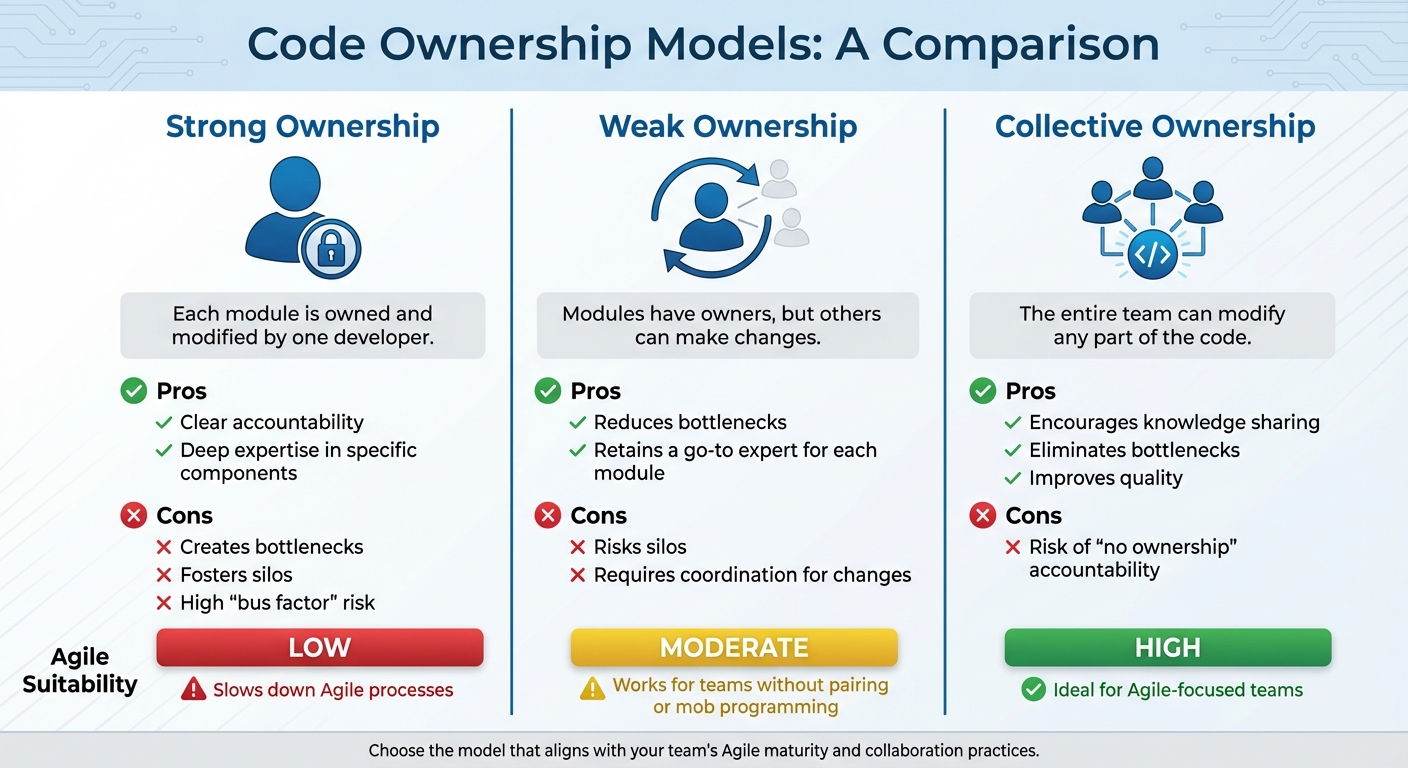
Code Ownership Models Comparison: Strong vs Weak vs Collective
To understand why collective ownership often works better for Agile teams, it's helpful to compare different code ownership models. Each model shapes team dynamics, agility, and overall effectiveness in unique ways.
Strong code ownership assigns specific modules exclusively to individual developers, who are the only ones allowed to make changes to their designated parts of the codebase [4][17]. While this approach ensures accountability and deep expertise in specific areas, it often creates bottlenecks. As Martin Fowler explains:
There are just too many situations where something you need to do needs changes to other people's code. Persuading them to make the change and waiting for the change often takes so long that it leads to delays and deeper problems [4].
These bottlenecks and the resulting knowledge silos make strong ownership a poor fit for Agile environments, where speed and adaptability are key.
Weak code ownership offers a compromise. While modules still have designated owners, other team members can make changes - usually after consulting with the owner [4][5]. This reduces delays while keeping a layer of quality control. It’s a practical choice for teams easing into more collaborative practices, though it doesn’t entirely eliminate knowledge silos [2].
Collective code ownership, on the other hand, allows any team member to modify any part of the codebase. This approach encourages shared responsibility for bugs, design improvements, and overall code quality [2][6]. However, as Deepak Karanth cautions:
When everyone is responsible, no one is responsible [6].
Despite this potential drawback, collective ownership supports practices like continuous integration and pair programming, creating an environment where team-wide learning and adaptability thrive. To succeed, this model demands strong coding standards, disciplined practices, and a culture of trust and safety.
Comparison Table
| Model | Definition | Pros | Cons | Agile Suitability |
|---|---|---|---|---|
| Strong Ownership | Each module is owned and modified by one developer [4]. | Clear accountability; deep expertise in specific components [18][10]. | Creates bottlenecks; fosters silos; high "bus factor" risk [4][18]. | Low: Slows down Agile processes [2][4]. |
| Weak Ownership | Modules have owners, but others can make changes [4]. | Reduces bottlenecks; retains a go-to expert for each module [4]. | Risks silos; requires coordination for changes [2]. | Moderate: Works for teams without pairing or mob programming [2]. |
| Collective Ownership | The entire team can modify any part of the code [2][6]. | Encourages knowledge sharing; eliminates bottlenecks; improves quality [18][6]. | Risk of "no ownership" accountability [18][6]. | High: Ideal for Agile-focused teams [2][18]. |
This breakdown shows why collective ownership is often the best fit for Agile teams. It aligns with Agile principles by promoting flexibility, collaboration, and shared responsibility, while reducing the risks of bottlenecks and silos.
Signs of Effective Implementation
When collective ownership is working well, it’s clear in how the team operates. Team members actively improve the entire codebase, prioritizing tasks based on importance rather than sticking to what they know best. Over time, the code itself becomes so consistent that it’s impossible to tell who wrote what. This ties back to the goal of breaking down silos. As Britton Broderick, an engineering leader, wisely states:
If the code only makes sense to you, it's not good enough [19].
Here are some key indicators that show collective ownership is thriving.
Teamwide Code Contributions
A healthy sign of shared ownership is when multiple team members contribute to the same parts of the codebase. For example, a module is considered well-shared when 3–4 or more developers have worked on it within a 90-day period [14]. In such environments, no one feels the need to "own" a specific section - everyone is comfortable modifying any part of the code. Teams that collaborate effectively average about 4 commits per developer daily. Additionally, teams using automated linters see a 32% drop in the number of review cycles needed [20].
Uninterrupted Progress During Absences
Another strong indicator is when the team continues to make progress even if someone is out of the office. For critical parts of the system, a bus factor of 3–4 is a sign of resilience [14]. This means at least three or four people are familiar enough with the code to step in and handle any issues. Critical bugs are addressed by whoever spots them, avoiding delays caused by waiting for a specific person. As James Shore, author of The Art of Agile Development, explains:
When a team member leaves or takes a vacation, the rest of the team handles their work without interruption [2].
Improved Code Quality Over Time
As collective ownership takes root, the quality of the codebase improves noticeably. A clear sign of success is revisiting your own code and seeing thoughtful refactoring done by others [2] [7]. Code reviews become more meaningful, with team members providing technical and constructive feedback because they’re familiar with multiple parts of the system [18]. Over time, the design of the system reflects well-thought-out technical decisions and a shared understanding, rather than being shaped by any one person’s preferences. Redundancies decrease as everyone feels empowered to fix issues as they arise [1] [7].
Conclusion
Collective code ownership transforms the way teams work by spreading knowledge, improving code quality, and removing bottlenecks. It increases the "bus factor", ensuring progress continues smoothly even during absences, and allows teams to tackle problems as they arise. As James Shore, author of The Art of Agile Development, explains:
Collective ownership allows - no, expects - everyone to fix the problems they find. If you encounter duplication, unclear names, poor automation, or even poorly designed code, it matters not who wrote it - if you spot an issue, fix it!
But success with collective ownership doesn't stop at open access. It thrives on strong safeguards like continuous integration and automated testing, collaborative approaches such as pair programming, and adherence to strict coding standards. Most importantly, fostering psychological safety is key. Developers need to feel confident stepping out of their comfort zones and giving or receiving constructive feedback.
At its core, the real strength of collective ownership lies in continuous improvement. When every team member takes responsibility for the entire codebase and follows the Boy Scout Rule - leaving the code cleaner than they found it - technical debt shrinks, and the overall design gets better over time. This shift from individual brilliance to team-driven excellence enhances both resilience and development speed.
FAQs
How do we stop “everyone owns it” from becoming “no one owns it”?
To prevent the problem of "everyone owns it" turning into "no one owns it", it's crucial to define clear ownership roles and foster team accountability. Tools like CODEOWNERS files can help by documenting who is responsible for specific areas. Additionally, setting review requirements that mandate owner approval for changes ensures transparency and avoids any lapses in responsibility.
What’s the minimum CI and test setup we need before doing this?
To establish collective code ownership, you need a solid foundation of automated testing and a continuous integration (CI) process. Here's how to get started:
- Use automated tests, such as unit and integration tests, to catch issues early.
- Set up a CI pipeline to run these tests every time code is updated.
- Apply branch protections so that only code passing all tests can be merged.
This approach makes it possible for everyone to contribute while maintaining high code quality and stability.
When should we avoid pair or mob programming?
When a team struggles with coordination, planning, or shared understanding, it's best to steer clear of pair or mob programming. While mob programming encourages teamwork by design, avoiding it means you'll need to put in extra effort to keep everyone aligned and working effectively together. Since collective code ownership hinges on strong collaboration, tackling these challenges head-on is essential for achieving success.