

How to Combine Agile Frameworks
Combining Scrum and Kanban creates a balanced Agile framework that provides structure while allowing flexibility. This hybrid approach, often called "Scrumban", helps teams manage shifting priorities, urgent tasks, and complex workflows without losing focus or efficiency. Here's why it works:
- Structure from Scrum: Fixed-length sprints, roles (Product Owner, Scrum Master), and events (Daily Standups, Retrospectives) ensure alignment and predictability.
- Flexibility from Kanban: Continuous flow, Work-in-Progress (WIP) limits, and real-time adaptability make it easier to handle unplanned tasks.
- Proven Results: Teams using hybrid methods report up to 50% productivity increases and improved delivery times.
By combining the strengths of both frameworks, you can maintain focus on planned work while addressing unexpected challenges. The key is to start small, adjust based on team needs, and track metrics like cycle time and throughput to measure success.
Quick Overview:
- Scrum Strengths: Structure, predictability, team roles, and sprint planning.
- Kanban Strengths: Immediate task prioritization, WIP limits, and continuous delivery.
- Hybrid Benefits: Better visibility, streamlined workflows, and improved task management.
This article outlines how to build and optimize your hybrid Agile framework step by step, from setting up a Kanban board to integrating Scrum ceremonies effectively.
Scrumban Explained: The Agile Hybrid of Scrum and Kanban
Understanding Scrum and Kanban: Core Principles and Key Differences
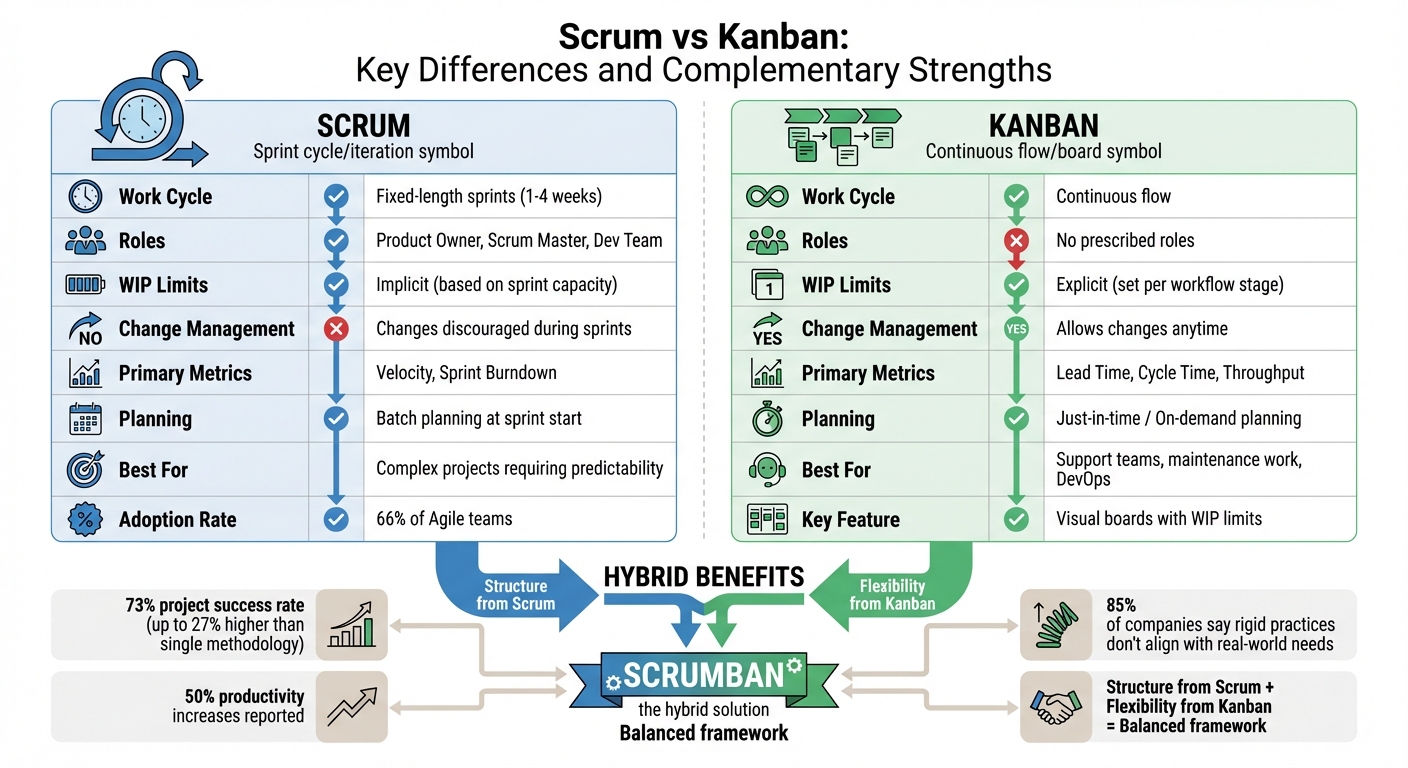
Scrum vs Kanban: Key Differences and How They Complement Each Other
Scrum Basics
Scrum revolves around fixed-length iterations known as sprints, which typically last two weeks [1]. The goal of each sprint is to deliver a "Done", usable product increment that could be released to customers. The framework is built around three core roles:
- Product Owner: Manages the Product Backlog and prioritizes tasks.
- Scrum Master: Ensures the team understands Scrum principles and removes obstacles.
- Development Team: Focuses on creating the product increment [3].
Scrum includes five key events: Sprint, Sprint Planning, Daily Scrum, Sprint Review, and Sprint Retrospective [1][3]. Its foundation lies in empiricism, which emphasizes transparency, inspection, and adaptation to guide decisions [2]. As Dimitri Ponomareff, Founder and CEO of Kanban Zone, puts it:
"it's easy to implement, but very difficult to get good at" [1].
With 66% of Agile teams using Scrum [3], it remains the most widely adopted Agile framework. However, its time-boxed structure can sometimes feel restrictive, especially when priorities shift mid-sprint.
Kanban Basics
Kanban takes a different route by focusing on continuous flow rather than fixed iterations. Tasks move through a visual board with columns like "To Do", "In Progress", "Testing", and "Done", eliminating the need for sprint resets [4][5]. A key feature of Kanban is Work-in-Progress (WIP) limits, which cap the number of tasks allowed in each column. For instance, if the "Testing" column has a WIP limit of three, no new tasks can enter until one of the existing tasks is completed [5].
Unlike Scrum, Kanban doesn’t introduce new team roles. Teams maintain their current structure [6][11]. It also skips mandatory ceremonies, although on-demand planning sessions are common when the backlog grows too large. Success in Kanban is measured through metrics like:
- Lead Time: Total time from request to delivery.
- Cycle Time: Time taken to complete a single task.
This focus on flow efficiency, rather than Scrum’s Velocity metric, makes Kanban ideal for support teams, maintenance work, or DevOps, where unexpected tasks often arise [4][5].
With these distinct workflows clarified, let’s examine how these methodologies complement each other.
Key Differences and How They Work Together
Scrum and Kanban each bring unique strengths to the table, and combining them can create a balanced framework.
At their core, the difference lies in structure versus flexibility. Scrum provides predictability with its fixed cadence and clearly defined roles [4][5]. Meanwhile, Kanban thrives on real-time adaptability, allowing new tasks to be added or reprioritized immediately when capacity opens up - no need to wait for a sprint to end [6].
| Aspect | Scrum | Kanban |
|---|---|---|
| Work Cycle | Fixed-length sprints (1–4 weeks) | Continuous flow |
| Roles | Product Owner, Scrum Master, Dev Team | No prescribed roles |
| WIP Limits | Implicit (based on sprint capacity) | Explicit (set per workflow stage) |
| Change Management | Changes discouraged during sprints | Allows changes anytime |
| Primary Metrics | Velocity, Sprint Burndown | Lead Time, Cycle Time, Throughput |
| Planning | Batch planning at sprint start | Just-in-time / On-demand planning |
These differences highlight why Scrum and Kanban work so well together. Scrum’s structured events and roles bring the discipline needed for complex projects, while Kanban’s WIP limits and flexibility help teams handle urgent issues - like critical bugs or production incidents - without disrupting the entire sprint [4][6]. In fact, organizations that use hybrid approaches report project success rates of 73%, which is up to 27% higher than using a single methodology alone [9].
This blend of structure and adaptability lays the groundwork for the hybrid frameworks discussed later.
Benefits of Combining Scrum and Kanban
Better Flexibility and Visibility
Blending Scrum’s structured events with Kanban’s flow-focused approach offers teams greater adaptability and clarity. This hybrid framework sidesteps the limitations of rigid sprint boundaries. For instance, in a pure Scrum setup, encountering a critical bug mid-sprint often forces teams to choose between breaking their sprint commitment or delaying customer satisfaction. A combined method solves this by allowing urgent issues to be handled immediately using a pull-based system - without derailing planned work [4].
The visual board becomes a key tool, acting as a real-time snapshot of the team’s progress and exposing hidden bottlenecks. For example, instead of discovering midway through a sprint that QA is overwhelmed while developers have idle time, implementing WIP (Work In Progress) limits highlights these imbalances early. This kind of transparency is crucial: 85% of companies admit their agile practices fall short because rigid techniques don’t align with real-world project demands [4].
This level of visibility not only minimizes delays but also simplifies task management, keeping the workflow on track.
Streamlined Workflow
Scrum, on its own, doesn’t strictly control how much work team members take on simultaneously. Introducing Kanban’s WIP limits - such as capping "In Progress" tasks at 1.5 times the team size - helps avoid productivity loss caused by multitasking and frequent context-switching. For example, in 2025, a B2B company improved its conversion rate from 18% to 31% and cut its time-to-market by 61% by implementing such practices [14].
Additionally, Kanban’s on-demand planning replaces fixed planning ceremonies, reducing unnecessary overhead. Instead of dedicating two hours every Monday morning to planning - regardless of need - teams plan only when their "To Do" column reaches a predefined threshold. This approach minimizes meeting fatigue and keeps developers focused on actual work rather than lengthy estimation sessions [6].
These workflow adjustments create room for more efficient operations and continuous growth.
More Opportunities for Improvement
A hybrid approach combines Scrum’s velocity tracking with Kanban’s cycle time metrics, offering a comprehensive view of performance. Teams that balance metrics across business value, agility, efficiency, and team culture report a 31% higher project success rate [14].
Scrum’s retrospectives remain intact in this model, ensuring teams reflect not just on the product but also on their processes. As the Scrum Alliance highlights, “Scrumban emerged as a flexible alternative that allows teams to blend Scrum’s iterative approach with Kanban’s visual and flow-based techniques” [13]. This adaptability ensures the framework evolves based on your team’s real-world needs rather than forcing the team into a rigid methodology.
Step-by-Step Guide to Building Your Hybrid Agile Framework
Step 1: Review Your Team's Current Process
Start by taking a close look at your team's existing workflow. Identify the pain points - are sprints frequently disrupted, or are meetings failing to yield results? According to a survey, 85% of companies feel their agile capabilities fall short, often due to rigid practices that don’t align with real-world projects [4].
Track how often urgent issues force you to choose between meeting sprint goals or addressing critical problems. Use metrics like Cycle Time and Throughput to find bottlenecks [2]. For example, in September 2025, JetBrains YouTrack transitioned to a Scrumban model, replacing a fixed backlog with a pull system that allowed tasks to be created directly on the board as needed [16].
Clarify your goals. Are you looking to improve transparency, reduce the time spent in meetings, or balance planned development with unplanned maintenance? As Dave Ross, Agile Product Evangelist at Miro, wisely puts it:
"Any methodology should support your team, not stifle them" [12].
With these insights in hand, you can start defining the elements that will shape your hybrid framework.
Step 2: Define Your Hybrid Model
Using your process audit, decide which Scrum elements to keep and which Kanban practices to adopt. For instance, Scrum’s sprint planning and retrospectives can provide structure and alignment, while Kanban’s visual boards and WIP (Work In Progress) limits can help manage daily tasks and prevent overload [4][6].
Make changes gradually. If unplanned work is a challenge, add a "maintenance" swimlane to your board while keeping sprint boundaries. If sprint deadlines feel arbitrary, consider switching to on-demand planning that activates when your "To Do" column reaches a specific threshold [6].
The best hybrid frameworks align with the type of work your team handles. Teams juggling both creative development and routine maintenance often benefit the most, while teams focused solely on predictable tasks may not need the added complexity [10].
Step 3: Set Up Your Kanban Board with Scrum Integration
Turn your sprint backlog into a visual Kanban board. Define workflow states that mirror how tasks move through your team, such as "In Progress", "In Review", "Waiting for Reply", and "Ready" [16].
Use swimlanes to organize tasks by priority, Epic, or type. This setup highlights where work is piling up and where team members have bandwidth. Retain key Scrum rituals like Sprint Planning, Daily Scrums, and Retrospectives, but use your Kanban board to manage the continuous flow of work within those cycles [7][4].
Choose tools that support both sprint structures and Kanban features, such as WIP limits and pull-based workflows [4][12]. Start by visualizing your current process, then refine it step by step [7].
Step 4: Set WIP Limits and Pull Systems
After setting up your board, focus on managing capacity. WIP limits are essential - they encourage a "stop starting, start finishing" mindset. In a hybrid setup, the sprint acts as a broad timebox, while WIP limits provide fine-tuned control over task flow [17][21].
A good starting point is the 80% rule: Monitor the average number of items in each column for two to three weeks, then set the limit at 80% of that average [19]. Begin with downstream columns (closer to "Done") to avoid bottlenecks at the finish line [19].
For example, in July 2025, a six-person software team introduced phased WIP limits over four weeks. They started by capping "Testing" tasks at three items in Week 1, then optimized all columns by Week 4. The results? Their average cycle time dropped from 18 days to 12 days - a 33% improvement - and their defect rate fell from 15% to 8% [19].
When a WIP limit is reached, the team should focus on clearing blocked tasks instead of starting new ones [18][19]. As Atlassian advises:
"Resist the temptation to raise a WIP limit just because the team keeps hitting it. Seize that opportunity to increase capacity - ideally, by educating the team" [18].
| Observation | Recommended Action |
|---|---|
| Limits are never reached | Lower the limit by 1 to increase flow pressure [19] |
| Constant limit violations | Raise the limit by 1 or investigate inefficiencies [19] |
| Items sit unworked for days | Identify bottlenecks; WIP limits might be too high [20] |
| Team is idle | Encourage members to assist with upstream/downstream tasks or pair programming [18] |
Step 5: Adjust Scrum Ceremonies for Continuous Flow
Don’t create extra meetings for Kanban - integrate flow discussions into your existing Scrum ceremonies [7]. During Daily Scrums, shift the focus to questions like “What’s blocking flow?” and “Where can we collaborate to finish tasks?”
Revamp Sprint Planning to include more flexibility. Instead of committing to a fixed set of tasks, use a pull system where team members take on new tasks as they have capacity [16][4]. This approach avoids the common issue of tasks piling up near the end of a sprint [18].
Keep retrospectives focused on both the product and the process. Use them to evaluate whether your WIP limits are effective, if your board accurately reflects your workflow, and whether your ceremonies still add value [15].
Step 6: Track Metrics and Iterate
Combine Scrum’s velocity tracking with Kanban’s flow metrics to get a complete picture of your team’s performance. Keep an eye on Cycle Time (how long tasks take from start to finish), Throughput (tasks completed in a given time), and Work Item Age (how long tasks have been in progress). Use Cumulative Flow Diagrams (CFDs) to spot workflow imbalances and areas where work is stuck [16][2].
Aim for WIP limits to be hit about 20–30% of the time. This helps highlight bottlenecks without overwhelming the team [19]. Adjust limits based on observations: lower them if they’re never reached, or raise them slightly if they’re constantly exceeded. If tasks seem too large, break them into smaller pieces, ideally under 16 hours of effort [18][19].
Done right, WIP limits can boost throughput by 40% and cut delivery times by up to 60% [19].
sbb-itb-8feac72
Common Challenges and Practical Solutions
Balancing Structure and Flexibility
One common pitfall in hybrid Agile approaches is the overloading of ceremonies, which can lead to unnecessary meetings and team fatigue [7]. A practical way to tackle this is by incorporating Kanban's visual flow tracking into your Daily Stand-ups. A simple question like, "What's blocking flow?" can keep the team focused while avoiding extra meetings.
Scope creep is another hurdle - teams often get caught up in adding new tasks continuously. To counter this, enforce strict Work-In-Progress (WIP) limits [6]. This helps maintain focus and ensures tasks are completed before new ones are added.
Switching from fixed sprints to a continuous flow model can also create challenges with predictability. To address this, shift your focus to tracking cycle time metrics. Consistent cycle times make delivery dates predictable, even without the traditional sprint framework [22].
Once these workflow changes are in place, it’s crucial to address deeper challenges like cultural resistance and tool inflexibility.
Mindset Transition and Tool Selection
Operational tweaks alone aren’t enough; cultural shifts and the right tools play an equally important role in overcoming challenges.
Cultural resistance is a significant barrier, contributing to 64% of agile transformation failures. To ease this resistance, start with pilot projects that deliver quick wins. These small victories can reduce fears and build confidence. Additionally, train key team members as "Hybrid Champions" who can bridge gaps between departments and advocate for change [14]. Leadership also plays a critical role - leaders who foster trust and empower teams can drive performance gains up to 10x higher compared to team-focused efforts alone [23].
When it comes to tools, flexibility is key. Choose platforms that are method-agnostic and configurable. These tools should support both Kanban boards and sprint tracking to accommodate the hybrid nature of your processes [4][12].
Comparison Table: Challenges vs. Solutions
| Common Challenge | Practical Solution |
|---|---|
| Ceremony Compounding | Integrate Kanban reviews into existing Scrum stand-ups to avoid additional meetings [7] |
| Scope Creep | Enforce strict WIP limits to prevent overloading tasks [6] |
| Loss of Predictability | Use cycle time metrics instead of burndown charts; consistent cycle times ensure predictability [22] |
| Tool Rigidity | Opt for configurable tools that support both Kanban boards and sprint tracking [14] |
| Cultural Resistance | Run pilot projects for quick wins and train "Hybrid Champions" to lead change [12][14] |
| Communication Silos | Adopt unified communication and visual collaboration tools [23][24] |
Best Practices for a Successful Hybrid Agile Framework
Focus on Visualization and Communication
Creating clear visual workflows is key to making a hybrid model work effectively. Start by mapping out your current processes to uncover any hidden dependencies or bottlenecks that might slow things down.
Using Kanban boards as a central tool can help unify different frameworks within your organization. Customize the board’s columns - think "Backlog", "Sprint Planning", "In Progress", "Review", and "Done" - to accommodate both iterative and continuous workflows. Add swimlanes or use color-coding to organize tasks by project, priority, or team member for even greater clarity.
Another useful tool is information radiators - these display real-time updates for everyone involved, boosting transparency and keeping all stakeholders informed. Together, these visualization techniques create a strong foundation for gathering feedback and using data to keep improving your processes.
Use Feedback and Data to Adapt
Pair regular retrospectives with key metrics like cycle time and throughput to continually refine your approach. Research shows that organizations tracking metrics across areas like Business Value, Agility, Efficiency, and Team performance achieve a 31% higher project success rate [14].
Focus on outcome-based metrics instead of process metrics. For example, measure the Value Delivery Rate or Time-to-Value rather than just tallying story points. This ensures that teams stay aligned with broader strategic goals.
Create a feedback loop that evaluates not just the product but the process itself. Tailor your reports to suit different audiences: executives need insights into business outcomes, managers track risks and milestones, while teams monitor their progress and challenges. This layered reporting approach ensures that everyone gets the right level of information without feeling overwhelmed.
Finally, adjust your methods to match the size of your team and the complexity of your projects.
Scale for Team Size and Project Complexity
Once you’ve established strong communication and feedback systems, you can scale your hybrid approach to suit different team sizes. For smaller teams (3–5 members), lightweight frameworks work best. Medium teams (6–10 members) often thrive with Scrumban, while larger teams (10+ members) require sub-teams and coordinated planning efforts.
For example, a mid-sized B2B company adopted a hybrid model across various departments and saw noticeable improvements in both lead generation and time-to-market [14].
When scaling for larger organizations, tools like Big Room Planning or Agile Release Trains can help synchronize efforts across multiple teams. This approach can be especially effective, as 88% of organizations using hybrid methods report better resource management [25]. Investing in proper scaling practices ensures smoother operations and better outcomes, no matter the project size.
Conclusion
Hybrid frameworks combine the structure of Scrum with the adaptability of Kanban, creating a system that can be molded to fit your team's specific needs. Dimitri Ponomareff, CEO of Kanban Zone, explains it well:
"Scrum and Kanban can work as individual methodologies and produce great results. Investing in Scrumban must be a natural progression or a conscious decision to solve a specific problem that your current methodology is not solving" [1].
The data supports this blended approach. 74% of organizations adopt Agile to speed up software delivery, and 62% highlight improved ability to handle shifting priorities [8]. Hybrid frameworks offer the best of both worlds: time-boxed planning for structured execution, continuous flow to address evolving priorities, and WIP limits to help prevent burnout. Together, these elements create an Agile process tailored to your team's operational needs.
To make this work for your team, start by analyzing your current workflow. Use metrics like cycle time, lead time, and throughput to guide small, incremental changes. Keep the ceremonies that provide value and let go of those that don’t. Remember, your framework should evolve alongside your team’s growth and the shifting demands of your projects.
Customizing Agile practices pays off - 52% of organizations report higher productivity when they adapt methods to their unique situations [8]. This approach bridges the gap between structure and flexibility. Whether you’re managing a tight-knit team of 3–5 or coordinating across multiple teams of 10 or more, the key is to stay curious, experiment with new ideas, and adjust based on what works. Think of your framework as a living system, always ready to adapt and improve.
FAQs
How can I create a hybrid Agile approach using Scrum and Kanban?
To craft a hybrid Agile approach, begin by closely examining your team’s workflow, delivery requirements, and any challenges they face. If your team benefits from the structure of Scrum - like time-boxed sprints and regular ceremonies - but also requires the adaptability of Kanban for handling unexpected tasks, blending elements from both can strike the right balance.
For instance, you might retain Scrum practices such as short sprints, clearly defined roles (like Scrum Master and Product Owner), and retrospectives to promote accountability and continuous improvement. At the same time, you could introduce Kanban features like a visual board to track progress, work-in-progress (WIP) limits to avoid overloading the team, and a pull-based system to manage capacity more effectively.
The key is to align each practice with your team’s unique needs. For example, stick with Scrum’s sprint cadence for predictable releases, but use Kanban to handle tasks with high variability. Start with small adjustments, keep an eye on metrics like cycle time or velocity, and refine your approach as your team gets comfortable. This iterative process allows you to build a customized framework that combines the strengths of both Scrum and Kanban.
What challenges might teams face when adopting a Scrumban framework?
Switching to a Scrumban framework isn't always a smooth ride. One of the biggest hurdles teams face is misunderstanding how this hybrid approach works. Sometimes, teams mistakenly try to stack Kanban on top of Scrum without actually blending the two. This can create confusion over priorities - should they stick to Scrum's fixed sprints or follow Kanban's work-in-progress (WIP) limits? When this happens, workflows can get messy, and productivity takes a hit.
Another tricky part is shifting the team's mindset. Scrumban asks for a balance between Scrum’s structured routines and Kanban’s continuous flow, which can feel like a big leap for teams used to just one of these frameworks. Adjustments like redefining roles, setting WIP limits, and tweaking ceremonies such as planning and retrospectives take time and effort to get everyone on the same page.
On top of that, keeping track of performance can get complicated. Metrics like cycle time, sprint velocity, or bottlenecks might lose clarity without a consistent way to measure them. To make Scrumban work, teams need to carefully pick the best practices from both frameworks and keep refining their approach to see real progress.
How do you evaluate the success of a hybrid Agile framework?
Evaluating how well a hybrid Agile framework performs means focusing on metrics that highlight both delivery efficiency and the broader impact on the business. A good starting point is delivery predictability - compare planned completion dates with actual outcomes and track on-time delivery rates. Many teams using hybrid Agile report success rates exceeding 75% in meeting goals for scope, schedule, budget, and quality.
It's also essential to keep an eye on team-level metrics like velocity, cycle time, and lead time to measure how smoothly workflows are running. Combine these with quality indicators such as defect density and escaped defects, as well as business outcomes like customer satisfaction, revenue growth, or cost savings directly linked to the features delivered.
Don’t overlook the importance of team morale and stakeholder alignment. Regular surveys can gauge team satisfaction, stakeholder trust, and the adoption of Agile principles over time. Leadership development programs, such as Tech Leaders’ training, can further support teams in fine-tuning these metrics and striking the right balance between flexibility and predictability in their hybrid approach.