
Common Challenges in Real-Time Personalization
Real-time personalization is about delivering tailored experiences instantly based on a user’s behavior or context. While it can boost revenue and customer engagement, it’s not without challenges. Businesses often face issues like fragmented data, scalability limits, system integration hurdles, privacy compliance, and organizational misalignment. For instance:
- Data Fragmentation: Disconnected systems lead to incomplete customer profiles.
- Scalability: Handling high data volumes in milliseconds is tough.
- Integration Complexity: Siloed systems fail to sync effectively.
- Privacy Compliance: Regulations like GDPR and CCPA demand strict data handling.
- Team Alignment: Poor collaboration between IT, marketing, and leadership slows progress.
Solutions include using Customer Data Platforms (CDPs), event-driven architectures, unified APIs, consent management tools, and fostering cross-department collaboration. Businesses that tackle these challenges see up to 40% more revenue from personalization and higher ROI on marketing efforts. Start small, focus on measurable outcomes, and scale from there.
Challenge 1: Data Fragmentation and Quality Issues
The Impact of Scattered Data Sources
When customer data is scattered across CRMs, social platforms, and e-commerce systems, it creates a host of problems. Outdated or conflicting insights can lead to misaligned offers and inconsistent messaging. In fact, 75% of marketers admit that fragmented data makes it harder to engage with customers effectively [5]. Each system holds only a piece of the puzzle, and without integration, achieving a complete customer view is impossible.
Take this scenario: your team sends a "buy now" offer for a product a customer has already purchased because the data between platforms isn’t synced. Even worse, fragmented data can result in conflicting messages across touchpoints - a frustration reported by 72% of marketers [5]. This lack of cohesion often produces inaccurate data that’s outdated, irrelevant, or just plain wrong. And when you’re trying to deliver real-time personalization, relying on poor-quality data can backfire, leading to irrelevant content that misses the mark. To overcome these challenges, integrating data through a unified platform is key.
Solutions: Unifying Data with Customer Data Platforms (CDPs)
The answer lies in creating a single source of truth for your customer data. Customer Data Platforms (CDPs) serve as centralized hubs, pulling in information from sources like web analytics, mobile apps, CRMs, and even offline stores. These platforms combine and organize the data into unified, real-time customer profiles.
For example, in August 2025, Australian broadcaster SBS used Adobe Real-Time CDP to consolidate fragmented first-party data, which led to a 93% improvement in advertising cost efficiency [5]. Similarly, TSB Bank in the UK unified data for over 5 million customers while adhering to GDPR regulations. This enabled them to gain a comprehensive customer view and activate insights instantly [5].
"The ability to bring all of our consumer information together, in real time, is critical to helping us engage with billions of Coca-Cola consumers around the globe."
– Keith Bartig, Director of Precision Marketing Technologies, The Coca-Cola Company [5]
A key part of this process is identity resolution, which combines deterministic (exact identifiers) and probabilistic (AI-based) matching. This creates what’s often called a "golden record" for each customer. Brands that implement real-time personalization using this approach can see a 10% or greater boost in sales and achieve five to eight times the ROI on their marketing spend [4].
Real-Time Personalization at Scale | Vedant Agarwal | Conf42 Chaos Engineering 2025
Challenge 2: Scalability and Infrastructure Limitations
After tackling data quality issues, the next major obstacle in real-time personalization is scalability.
Real-Time Data Processing Demands
Real-time personalization hinges on delivering responses in under 100 milliseconds. That’s not just a goal - it’s a necessity. If your system takes even a fraction longer, users might lose interest and move on. To meet this demand, your infrastructure must process massive data streams at lightning speed.
The stakes are high. During events like Black Friday, traffic can spike by 10x, and your system has to keep up without breaking a sweat. It also needs to juggle multiple interconnected services without sacrificing speed. Consider this: Google found that increasing web search latency from 100ms to 400ms led to a 0.2% to 0.6% drop in daily searches per user. Meanwhile, Booking.com discovered that just a 30% increase in latency resulted in a 0.5% dip in conversion rates [9].
"No matter how great your Machine Learning models are, if they take just milliseconds too long to make predictions, users are going to click on something else."
– Target [9]
Speed isn’t the only challenge. Your infrastructure must ensure data freshness and consistency across all touchpoints while staying computationally efficient. Real-time feature computation directly impacts user-facing latency, unlike batch processing that happens offline. Cache management adds another layer of complexity - if thousands of requests hit an expired cache simultaneously, your backend could buckle under the pressure.
Solutions: Using Event-Driven Architectures
One effective way to tackle these issues is by adopting event-driven architectures (EDA). This approach shifts system communications from synchronous to asynchronous, allowing components to react to events in real time. Tools like Apache Kafka, AWS Kinesis, or GCP Pub/Sub make it possible to handle millions of events per second with sub-second latency [10].
Companies like Target have turned these infrastructure challenges into opportunities. In 2022, Target's Personalization team moved from batch predictions to a real-time microservices framework. They used Java microservices to handle high-throughput traffic (thousands of transactions per second) and Python microservices to deploy machine learning models. By integrating gRPC for seamless communication, they achieved impressive results: 169 billion recommendations served and over $4 billion in attributable demand, all while maintaining a strict 50ms latency SLA [9].
Salesforce also embraced this strategy with its Decisioning Pipeline and Recommendations Services (DPRS). Under the leadership of Logan Goulett, the team introduced parallel processing and a two-layer caching system to meet sub-100ms response requirements. Instead of fetching user profiles and ML rankings sequentially, they process them concurrently. Kubernetes auto-scaling ensures the system handles traffic surges without slowing down [11].
"Achieving sub-100ms response times is our biggest challenge, especially in a multi-service architecture where each API call adds milliseconds."
– Logan Goulett, Director of Software Engineering, Salesforce [11]
A key tactic is separating write operations (recording user actions) from read operations (delivering recommendations) using CQRS (Command Query Responsibility Segregation). This allows each function to scale independently based on traffic demands. For cache management, a "stale-while-revalidate" pattern helps prevent overloads by serving existing cached data while asynchronously updating it. These event-driven methods ensure scalable, low-latency performance while supporting unified data strategies.
Challenge 3: Integration Complexity Across Systems
After setting up a scalable infrastructure, another hurdle emerges: getting your systems to communicate effectively. Even with well-designed data pipelines, personalization efforts fall apart if systems fail to sync. This challenge builds on earlier issues like data fragmentation and infrastructure limitations, focusing on the critical need for systems to work together seamlessly. Without this integration, real-time personalization becomes an uphill battle.
The Struggle to Synchronize Systems
A staggering 75% of companies either can't use their data in real time or face significant obstacles trying to do so [6]. Customer data often remains siloed in ERPs, CRMs, POS systems, and commerce platforms. Picture this: a customer browses your mobile app, makes an in-store purchase, and later visits your website. These systems frequently fail to recognize that it's the same person across these interactions.
This lack of synchronization leads to profile inconsistencies that derail personalization efforts. For instance, your email team might promote items a customer already bought in-store yesterday, or your website might treat a loyal customer like a first-time visitor. The impact is clear: 56% of customers report having to repeat information to different representatives because departments don't share data [7]. Even worse, 55% of consumers feel like they're interacting with separate companies rather than a single, unified business [7].
"If you're not aligned, the result is that customers get a very siloed experience."
– Leigh Price, Senior Director of Product Marketing, Salesforce [7]
Legacy systems often lack the APIs or processing power needed for real-time responsiveness. This forces teams to rely on manual workarounds that are not scalable. The result? Only 19% of marketers feel confident they have the right technology to execute their personalization strategies [3]. Meanwhile, 58% of companies admit their current tech stack can't support their personalization goals [6].
Bridging the Gap: Unified APIs and Headless CMS
To tackle these integration challenges, decouple content management from display and enable smooth data flows between systems. Unified APIs and headless CMS platforms allow content to be managed separately from its presentation, enabling real-time data exchange across web, mobile, wearables, and even future channels - all from a single source [3].
Instead of relying on custom-built integration layers, opt for out-of-the-box connectors to speed up the process and minimize the need for extensive development work [6]. When evaluating new tools, prioritize those that come with these prebuilt connectors [6].
"In order to drive connected experiences, it's important to consider all of the data we have on that individual... As marketers, we often don't have access to all of this data because it may live in other parts of an organization."
– Victoria Calkins, Product Marketing Manager, Salesforce [7]
The key is creating a single source of truth, often through a CDP (Customer Data Platform), that provides addressable customer identities with low latency across all channels [6][8].
Start small instead of trying to integrate everything at once. Focus first on high-impact areas, like your website or email program, and then expand to other channels as your integration capabilities grow [7]. Assigning a technical lead to bridge the gap between IT and marketing teams ensures that technical integrations align with your personalization goals [7]. By taking a step-by-step approach, you can turn integration complexity into a manageable process rather than an overwhelming challenge.
Challenge 4: Organizational Alignment and Buy-In
After integrating your systems, the next challenge is aligning your teams. Real-time personalization often falters, not because of technical hurdles, but because of human ones. Even with unified data and integrated systems, getting everyone in your organization to work together can feel like an uphill battle.
Barriers to Cross-Department Collaboration
42% of marketers point to a lack of organizational alignment as one of their biggest struggles with personalization [7]. And it’s not just about poor communication - it's about deeper issues like siloed tech stacks and conflicting priorities. Teams in Marketing, IT, Sales, and Data Science often operate in isolation, guarding their domains instead of collaborating to create a unified customer view [3][7].
Incentive structures can make this even worse. When channel owners are rewarded solely for their specific channel’s performance, there’s little motivation to share data or coordinate efforts. For example, why would an email marketer care about mobile app engagement if their bonus is tied exclusively to email click-through rates [8]?
"There are no technology issues, only people issues. People are the gatekeepers of data. People get into routines that are uncomfortable to break." – Sean Flavin and Jason Heller, McKinsey [8]
Leadership challenges also play a major role. Without high-level sponsors like a CMO or VP of Marketing to champion the cause and remove obstacles, personalization efforts often stall [7][13]. Internal resistance to change - whether it’s defending legacy systems or sticking to entrenched routines - can further derail progress [8]. Adding to the complexity, 43% of marketers cite a lack of internal knowledge and technical skills as a significant roadblock [7].
Then there’s the ROI problem. Benefits like "customer trust" or "attachment" are difficult to measure, and without clear metrics, it’s tough to convince executives to invest in personalization initiatives [3]. If leadership can’t see the numbers, they’re less likely to commit resources to something that feels intangible.
Solutions: Setting Clear Goals and Metrics
To overcome these barriers, redefine roles and focus on measurable outcomes. Start by assigning clear responsibilities to key stakeholders. A successful personalization program needs structure:
- An Executive Sponsor to champion the initiative and remove obstacles.
- A Program Manager to coordinate schedules across departments.
- A Tech Lead to oversee IT integration.
- An Analytics Lead to track progress and synthesize data [7].
This kind of role clarity ensures accountability and prevents tasks from slipping through the cracks.
Address ROI concerns with standard performance metrics like click-through rates, conversion rates, bounce rates, and time-on-page [3]. These metrics provide leadership with tangible proof of success. And the numbers are compelling: personalization can boost revenues by 5% to 15% and improve marketing spend efficiency by 10% to 30% [13]. Faster-growing companies, in fact, generate 40% more revenue from personalization than their slower-growing counterparts [1].
Start small and build momentum with quick wins. Instead of trying to personalize every channel at once, focus on areas with the most impact, such as your website or email campaigns [7][13]. Small successes demonstrate value and can help secure broader funding. Some companies even form "War Room" teams - small, cross-functional groups of 8 to 15 people dedicated to rapid personalization pilots [13].
"The most successful companies have leaders who know and talk about personalization as a really high priority and encourage their teams to try and fail and succeed." – Kelsey Robinson, Partner, McKinsey [12]
Finally, align the C-suite early on. The CMO and CTO must collaborate to develop a unified business case and roadmap for integrating data across the organization [8]. When leadership speaks with one voice about personalization priorities, it sets the tone for the rest of the organization. This top-down alignment helps break down silos and shifts the focus from channel-specific metrics to cross-functional goals that prioritize the entire customer journey.
sbb-itb-8feac72
Challenge 5: Privacy Compliance and Real-Time Delivery
Once your team is aligned, the next hurdle is delivering personalized experiences while staying within the bounds of privacy laws. The stakes are high: GDPR fines can climb to €20 million or 4% of global annual revenue, whichever is greater [14][16]. Meanwhile, under the CCPA, each non-intentional violation costs $2,500, and intentional ones rack up $7,500 per instance [14][16]. By 2025, over 75% of the global population was expected to fall under comprehensive privacy regulations [14]. These laws push organizations to rethink how they approach personalization - especially in real time.
Balancing Compliance with Real-Time Personalization
The tension between personalization and privacy is real. On one hand, 91% of consumers want offers tailored to their preferences, but 86% are uneasy about how their personal data is used [14]. Personalization depends on data, but collecting and using that data comes with strict legal requirements.
Real-time processing of behavioral data leaves no room for manual checks. If a user revokes consent, data usage must stop immediately. 69% of consumers value personalization, but only when it’s based on data they’ve explicitly shared [3]. This means relying solely on inferred behavior isn’t enough - you need clear, direct permission.
Adding to the complexity, privacy laws differ by region. For example, GDPR mandates "opt-in" consent for processing non-essential data, while CCPA allows data collection as long as users are notified and can opt out [14][16]. GDPR also limits automated decision-making that has significant effects on individuals (Article 22), which can restrict certain personalization techniques [14]. For companies operating across multiple jurisdictions, managing these differences in real time without disrupting the user experience is a critical challenge.
Solutions: Consent Management and Regular Audits
To tackle these challenges, start by integrating Consent Management Platforms (CMPs) into your systems. CMPs distribute consent updates across your tech stack in milliseconds, ensuring your algorithms only use authorized data [14][17]. This real-time compliance mechanism helps prevent violations before they happen.
Build systems with consent-conditional logic that automatically switch to fallback experiences if users opt out of tracking [14]. These fallback experiences rely on contextual data - like the current page, time of day, or general location - to deliver relevant content without personal data [14]. This way, you can maintain a tailored experience without crossing privacy lines.
Focus on first-party and zero-party data. First-party data comes from direct interactions, like website visits or purchases, while zero-party data is intentionally shared by customers through tools like preference centers or surveys [14][3]. These data types carry clearer consent trails, reducing your compliance risk. Offer granular consent options, allowing users to enable specific personalization features instead of forcing them into an "all or nothing" decision [14].
"Personalization privacy compliance isn't about choosing between customization and privacy - it's about designing intelligent systems that achieve both objectives simultaneously." – Secure Privacy [14]
Regular audits are essential to stay compliant. Conduct quarterly reviews to identify technical gaps and annual assessments to ensure alignment with regulatory changes [14]. Automate processes like Data Subject Access Requests (DSAR) and data deletion to meet deadlines more efficiently - manual workflows are too slow and prone to errors [14][15]. Privacy-focused Customer Data Platforms (CDPs) can also help by logging all personalization activities and tracking data to confirm it was collected legally [14].
Emerging tools are making it easier to balance privacy and personalization. Federated learning trains algorithms on distributed data, keeping sensitive information on user devices rather than centralizing it [14]. Differential privacy introduces statistical "noise" to datasets, protecting individual identities while still allowing useful insights [14]. On-device processing enables personalization directly on user hardware, eliminating the need to transmit data to servers [14]. These technologies point to a future where privacy and personalization coexist seamlessly.
Summary Table: Challenges and Solutions
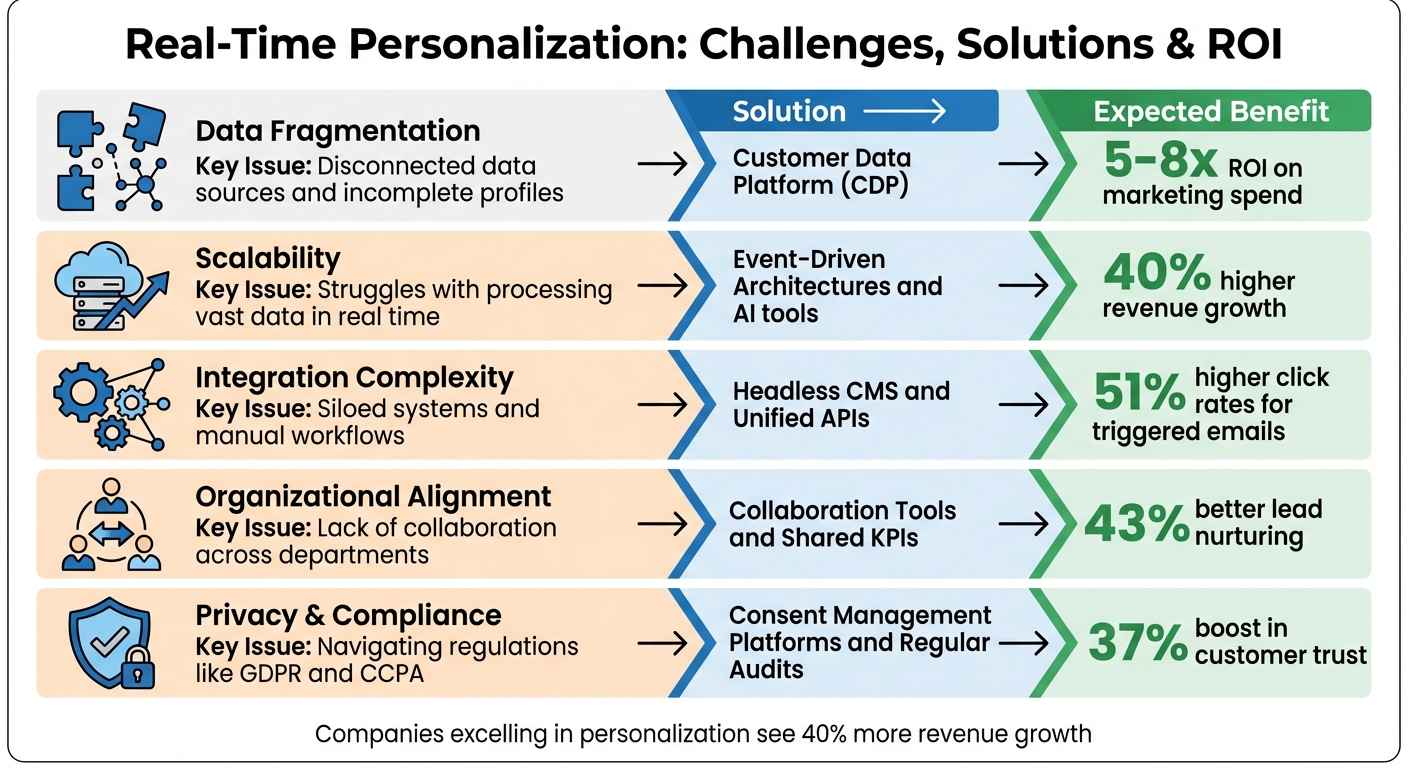
5 Real-Time Personalization Challenges and Solutions with ROI Benefits
Here’s a quick overview of five common challenges in personalization, the core issues they present, recommended solutions, and the measurable benefits they offer:
| Challenge | Key Issue | Solution | Expected Benefit |
|---|---|---|---|
| Data Fragmentation | Disconnected data sources and incomplete profiles | Use a Customer Data Platform (CDP) | 5-8x ROI on marketing spend [4] |
| Scalability | Struggles with processing vast data in real time | Leverage Event-Driven Architectures and AI tools | 40% higher revenue growth [1] |
| Integration Complexity | Siloed systems and manual workflows | Implement Headless CMS and Unified APIs | 51% higher click rates for triggered emails [2] |
| Organizational Alignment | Lack of collaboration across departments | Invest in Collaboration Tools and Shared KPIs | Faster campaigns and 43% better lead nurturing [1] |
| Privacy & Compliance | Navigating regulations like GDPR and CCPA | Use Consent Management Platforms and Regular Audits | 37% boost in customer trust [1] |
Companies that excel in personalization consistently see 40% more revenue growth and achieve impressive ROI [1][2]. The secret lies in tackling these challenges step by step, focusing on one area at a time. A structured approach ensures steady progress in building effective personalization strategies.
Tech Leaders' Role in Addressing Personalization Challenges
Did you know that 86% of executives feel their personalized marketing efforts fall short? [22]. This highlights a pressing need for leaders who can blend technical know-how with managerial expertise. The challenge isn’t just about having the right tools - it’s about connecting technical skills with leadership to bring teams together and align them with broader business goals.
At Tech Leaders, we focus on equipping engineers and technical professionals to tackle real-time personalization challenges head-on. One of the key areas we address is breaking down organizational silos that often block effective personalization. For instance, disconnected tech stacks can lead to fragmented knowledge. By helping organizations form agile, cross-functional teams, we’ve seen real results. A North American retailer, for example, improved its profit margins by 3% in just three months by using targeted offers - a direct result of our training programs [20].
Industry leaders emphasize this dual focus on technology and collaboration:
"The companies that overcome the barriers to personalization at scale are those that tackle both technology and business challenges in tandem, starting with the CMO and CTO/CIO working together closely."
– Sean Flavin and Jason Heller, McKinsey [8]
Our training incorporates an AI-driven personalization approach built on a "4D" framework - Data, Decisioning, Design, and Distribution - along with measurement strategies to meet real-time demands [18]. Participants learn how to navigate critical decisions, such as whether to build or buy AI decisioning engines [8], and how to deploy AI systems capable of making instant decisions without constant manual input [21].
Privacy and trust are also central to our programs. We teach Data Protection by Design principles, ensuring privacy features are integrated early in project development [19]. By leveraging first-party data and strong consent management practices, companies can deliver personalized experiences without eroding customer trust. This balance is crucial, especially since 71% of consumers expect personalized interactions, while 76% feel frustrated when their expectations aren’t met [20][21]. Our approach ensures compliance with regulations like GDPR and CCPA while meeting these consumer demands.
Tech Leaders bridges the gap between technical execution and strategic leadership, empowering organizations to overcome personalization hurdles and achieve tangible, measurable outcomes.
Conclusion
Real-time personalization has become a cornerstone for staying competitive in today’s digital landscape. The hurdles - like fragmented data, scalability concerns, integration headaches, organizational silos, and privacy regulations - are very real, but they’re far from insurmountable. For every obstacle, there’s a practical path forward.
The numbers speak for themselves: companies that embrace real-time personalization often see a 5–8x return on marketing investments and increase sales by over 10% [4]. Faster-growing businesses, in particular, report generating 40% more revenue from personalization efforts [1]. And let’s not forget the consumer side - 80% of customers prefer brands that tailor their experiences to individual needs [2].
To tackle these challenges, businesses need a balanced strategy. This means adopting the right tools - like Customer Data Platforms, event-driven systems, and AI-powered decision engines - while also fostering cross-department collaboration and maintaining transparent data practices. The key? Start small. Focus on a single, impactful use case, such as personalized emails or dynamic website content. Prove its value with measurable results, then scale up from there.
When done right, real-time personalization shifts the dynamic from one-off interactions to meaningful customer relationships. It drives retention, boosts conversions, and builds loyalty that lasts. The real question isn’t whether to address these challenges - it’s how soon you can get started.
FAQs
What’s the best way to handle data fragmentation in real-time personalization?
Data fragmentation occurs when customer information is scattered across various systems, making it difficult to form a complete picture of the customer. To solve this issue, businesses can turn to a Customer Data Platform (CDP). A CDP brings together data from multiple sources - such as CRM systems, analytics tools, and social media - into one continuously updated customer profile. This unified profile allows for accurate, real-time personalization.
To keep this data current, businesses can use real-time data streaming pipelines, which instantly feed new information into the CDP. Additionally, establishing clear data governance practices - like standardized schemas and consent management - ensures the data remains clean, organized, and compliant. By connecting fragmented data, businesses can create seamless, tailored experiences that drive stronger engagement and increased revenue.
How can scalability challenges in real-time personalization systems be addressed effectively?
Scalability in real-time personalization hinges on handling massive amounts of rapidly changing data while keeping response times within just a few hundred milliseconds. To achieve this, start by centralizing and pre-processing data using a Customer Data Platform (CDP). This creates a unified view of user information, reducing data silos and boosting efficiency.
Incorporate low-latency data-streaming tools like Apache Kafka or AWS Kinesis to handle real-time event processing. Combine these with in-memory databases such as Redis for instant access to user profiles. To keep things running smoothly, design lightweight, stateless APIs that can scale horizontally and use efficient serialization techniques to cut down on latency. Additionally, breaking down monolithic systems into microservices or event-driven components allows for independent scaling and better fault isolation, ensuring the system stays robust even under heavy traffic.
For further optimization, consider auto-scaling compute clusters to match demand, partition data to avoid bottlenecks, and use edge servers or CDNs to cache predictions closer to users. Monitoring end-to-end latency with proactive alerts ensures performance thresholds are consistently met. Engineers looking to master these strategies can explore training programs like those from Tech Leaders, which blend technical expertise with leadership development for successful execution.
How can companies balance real-time personalization with privacy regulations?
To navigate the challenge of real-time personalization while respecting privacy regulations, companies need to place user consent at the forefront. This means getting clear, explicit permission before collecting data, using only the information that's truly needed, and being upfront about how that data will be handled.
Frequent data audits and compliance reviews are crucial for staying aligned with laws like GDPR and CCPA. On top of that, using secure systems to process data in real time ensures businesses can deliver personalized experiences without compromising privacy. By weaving privacy protections directly into their operations, companies can not only meet legal requirements but also foster trust with their users.