

Core Principles of Transactional Leadership
Transactional leadership is a structured approach to managing teams, focusing on clear goals, rewards, and accountability. It's built around three core principles:
- Contingent Rewards: Employees are rewarded for meeting specific goals with bonuses, recognition, or promotions. Transparency and consistency are key.
- Management by Exception: Leaders address performance deviations. This can be active (constant monitoring) or passive (intervening only when issues arise).
- Clear Roles and Responsibilities: Every team member understands their duties, expectations, and reporting structure, reducing confusion and ensuring accountability.
This leadership style works well in technical fields where measurable results and structure are valued. It uses tools like SMART goals and Key Performance Indicators (KPIs) to track progress, ensuring fairness and clarity in rewards and feedback. Whether managing high-stakes projects or routine tasks, transactional leadership provides a straightforward framework to achieve results.
What Are The Principles Of Transactional Leadership?
Core Principles of Transactional Leadership
Transactional leadership is built on three key principles that shape performance, enforce accountability, and maintain order. Each principle plays a specific role in creating a structured environment where goals are met and expectations are clear. Let’s break down how rewards, oversight, and defined roles work together to achieve results.
Contingent Reward System
At the heart of transactional leadership is the contingent reward system, which operates on a straightforward exchange: team members achieve agreed-upon goals, and in return, they receive rewards. These rewards might include bonuses, promotions, public recognition, or other incentives.
Bass et al. [5] explain:
"Transactional leaders clarify to their followers what is expected and provide recognition when followers achieve the goals."
The system thrives on transparency. Team members must clearly understand what behaviors and results will earn rewards, and leaders must deliver those rewards consistently. For instance, if a manager promises a bonus for hitting quarterly sales targets but fails to follow through, trust is eroded, and the system loses credibility.
Studies back up its effectiveness. Research shows that transactional contingent reward leadership has a validity coefficient of 0.39 for organizational outcomes. It even outperforms transformational leadership in certain areas, such as follower job satisfaction (0.64 versus 0.58) and leader job performance (0.45 versus 0.27) [5]. The success lies in setting clear, measurable goals - like SMART goals (Specific, Measurable, Achievable, Realistic, Time-bound) - so team members know exactly what’s expected and how to succeed.
Management by Exception
Management by exception is all about identifying and addressing deviations from established standards. Leaders monitor performance and step in when something veers off course. This approach comes in two forms: active and passive.
- Active management by exception involves constant oversight. Leaders actively monitor work, looking for issues before they escalate. For example, a manufacturing supervisor might conduct frequent quality checks on a production line to catch defects early and avoid larger problems.
- Passive management by exception is more hands-off. Leaders intervene only when standards are not met or when problems become significant. This approach allows experienced teams more autonomy but risks delayed responses to issues.
Choosing between active and passive methods depends on the situation. High-stakes environments like emergency response or military operations benefit from active monitoring, while routine tasks handled by skilled teams often align better with passive oversight. Either way, this principle ensures that deviations are corrected promptly, complementing the other aspects of transactional leadership.
Clear Roles and Responsibilities
A defining feature of transactional leadership is its emphasis on well-defined roles and a clear chain of command. Every team member must understand their responsibilities, performance expectations, and reporting structure. By eliminating ambiguity, this principle ensures accountability and smooth operations.
Clear roles are especially crucial in high-pressure settings. Take a software development team, for example. Frontend developers, backend engineers, and QA testers each have specific responsibilities, deliverables, and quality benchmarks. These clearly defined roles help establish measurable standards from the start, making it easier to evaluate success and avoid disputes over rewards or promotions.
Management by Exception: Active vs. Passive
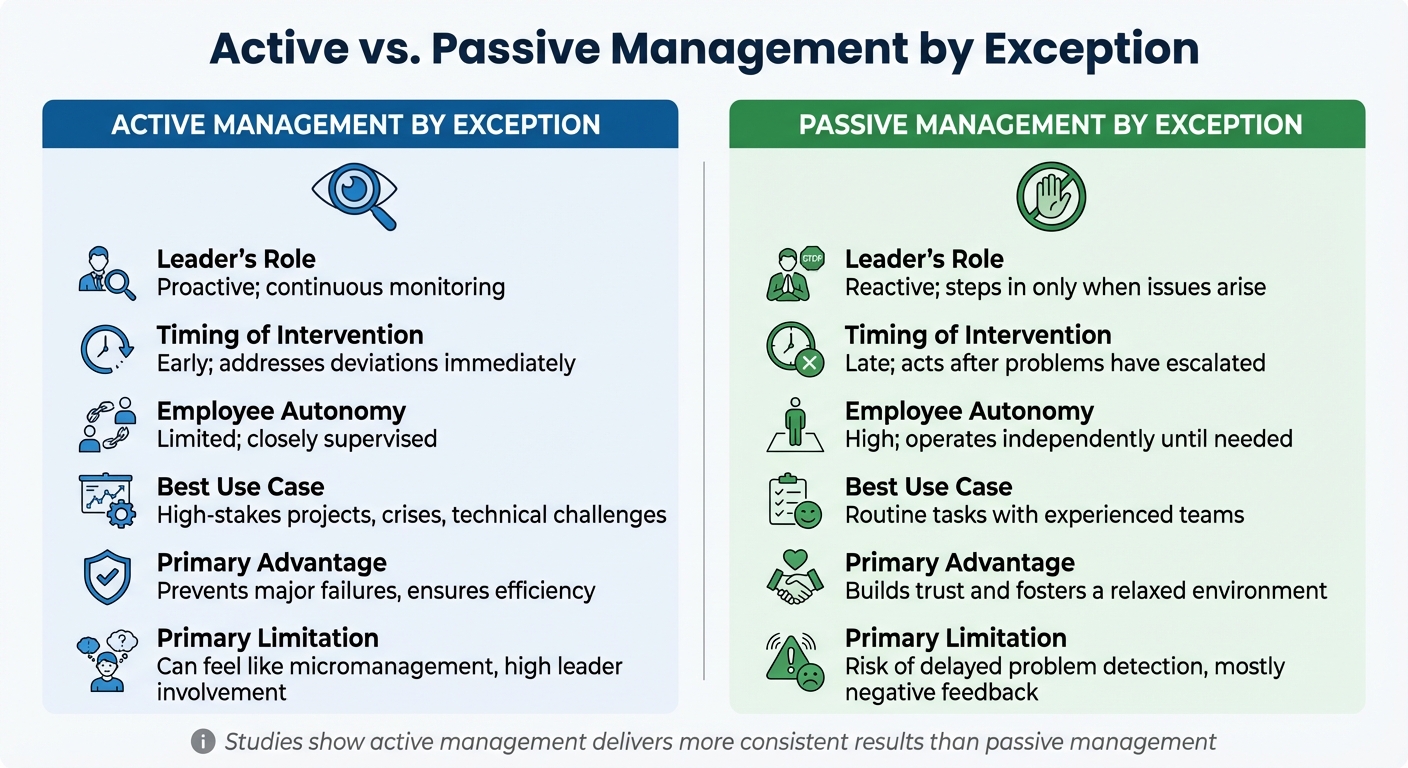
Active vs Passive Management by Exception in Transactional Leadership
Active Management by Exception
Active management by exception involves keeping a close watch on operations and stepping in immediately when something veers off course. This approach is particularly useful in high-pressure settings where mistakes can lead to serious consequences. For instance, during Microsoft's early years (1975–1985), Bill Gates practiced active management by regularly visiting product teams and asking tough questions to ensure everyone was aligned and making progress. This hands-on strategy paid off - by 1978, Microsoft had generated $2.5 million in revenue, and Gates was only 23 years old [7]. Similarly, General Norman Schwarzkopf applied active management during Operation Desert Storm (1991), ensuring strict adherence to protocols to achieve mission accuracy [7].
That said, overusing this method can sometimes feel like micromanagement, which may stifle team morale.
Passive Management by Exception
In contrast, passive management by exception takes a step back, intervening only after a significant issue or performance breach occurs. This style works well with seasoned teams handling routine responsibilities where the risk of major setbacks is minimal. For example, when managing a group of senior engineers with strong track records, passive management allows them the freedom to operate without constant supervision. However, the drawback is that problems might only be addressed after they've escalated, and feedback tends to focus on mistakes rather than successes [6].
Studies indicate that active management generally delivers more consistent results compared to passive management. However, both approaches outperform laissez-faire leadership styles [6].
Comparison Table: Active vs. Passive
Here’s a quick breakdown of how active and passive management by exception differ:
| Feature | Active Management by Exception | Passive Management by Exception |
|---|---|---|
| Leader's Role | Proactive; continuous monitoring | Reactive; steps in only when issues arise |
| Timing of Intervention | Early; addresses deviations immediately | Late; acts after problems have escalated |
| Employee Autonomy | Limited; closely supervised | High; operates independently until needed |
| Best Use Case | High-stakes projects, crises, technical challenges | Routine tasks with experienced teams |
| Primary Advantage | Prevents major failures, ensures efficiency | Builds trust and fosters a relaxed environment |
| Primary Limitation | Can feel like micromanagement, high leader involvement | Risk of delayed problem detection, mostly negative feedback |
Choosing between these methods depends on the situation. Active management suits scenarios where precision is essential and errors are costly, while passive management works better for routine processes managed by skilled, independent teams.
sbb-itb-8feac72
Performance Monitoring and Feedback
Using Key Performance Indicators (KPIs)
Transactional leadership thrives on measurable metrics to track progress and achieve goals. One effective way to do this is by setting SMART goals - Specific, Measurable, Achievable, Realistic, and Time-bound - which provide a clear picture of success for everyone involved [1]. By focusing on objective and quantifiable Key Performance Indicators (KPIs), evaluations become less prone to personal bias.
Some common KPIs include sales targets, production levels, error rates, and meeting deadlines [3][10][11]. For example, having clear and measurable metrics ensures that individual efforts align with broader organizational objectives.
To make performance tracking effective, it's essential to tie KPIs directly to the reward system. Define the metrics first - before introducing incentives - so that bonuses, promotions, or recognition are transparently linked to specific achievements [8]. Additionally, tools that integrate spending and effort with milestones can help maintain focus on measurable goals. These clearly defined targets form the foundation for a balanced approach to both rewards and corrective actions.
Balancing Rewards and Corrections
Once measurable performance is established, delivering effective feedback becomes crucial. Recognizing successes and addressing areas for improvement are equally important. Research shows that well-structured rewards not only enhance satisfaction but also drive better performance.
Consistency plays a vital role here. Rewards - whether financial bonuses, public acknowledgment, or extra vacation days - should be just as clearly outlined and consistently applied as any corrective measures for underperformance [9][2]. When someone falls short of expectations, provide straightforward corrective guidance [4]. Regularly scheduled feedback sessions ensure evaluations happen on time [8], and involving team members in setting goals can encourage ownership and make rewards even more motivating [8].
Conclusion
Key Takeaways
Transactional leadership provides a straightforward framework that drives measurable outcomes. Its key principles - like contingent rewards, management by exception, and clearly defined roles - promote transparency and accountability. Research even highlights its effectiveness, showing a .64 validity coefficient for follower job satisfaction [5]. By linking specific achievements to tangible rewards and tracking progress with well-defined KPIs, team members gain a clear understanding of what success looks like and how their contributions align with organizational goals.
This approach thrives on clarity and fairness. Using SMART goals and consistent feedback, it removes ambiguity and favoritism, ensuring everyone operates under the same objective standards. Whether you're managing software development sprints, deploying infrastructure, or tackling technical troubleshooting, transactional leadership offers a reliable way to break down complex projects into manageable milestones while rewarding progress along the way.
These principles lay a solid foundation for actionable leadership growth.
Next Steps for Aspiring Leaders
Shifting from a technical role to a leadership position requires intentional skill-building. Start small: focus on one principle, such as setting clear performance metrics, creating a transparent reward system, or scheduling regular feedback sessions. For high-stakes tasks, active monitoring can help minimize costly mistakes.
Structured training can make this transition smoother. Tech Leaders (https://technical-leaders.com) offers programs tailored for engineering professionals, blending technical expertise with essential leadership skills. These courses emphasize practical application, helping you strike the right balance between structure and motivation while building the confidence to make quick decisions under pressure. With targeted leadership training, you can effectively manage teams and set yourself up for long-term success.
FAQs
What is the difference between transactional and transformational leadership?
Transactional and transformational leadership take distinct paths when it comes to motivating and guiding teams. Transactional leadership is all about structure, with leaders setting clear goals, expectations, and tying performance to rewards or penalties. This approach zeroes in on short-term objectives, ensuring tasks are completed efficiently through close supervision and external motivators.
In contrast, transformational leadership focuses on inspiration and empowerment. Leaders in this style work to unlock their team's potential by fostering a shared vision and encouraging both personal and professional growth. Rather than relying on external rewards, they tap into intrinsic motivation to drive long-term success and adaptability. While transactional leadership delivers immediate results, transformational leadership is geared toward creating lasting growth and meaningful change.
How do SMART goals benefit transactional leadership?
SMART goals fit perfectly within the framework of transactional leadership, offering a straightforward and measurable way to set expectations and reward performance. When goals are Specific and Measurable, employees gain a clear understanding of what’s expected, minimizing confusion and promoting accountability. The Achievable and Relevant aspects ensure that objectives are realistic and in line with organizational priorities, while the Timely component introduces deadlines that enable leaders to track progress effectively.
Incorporating SMART goals allows transactional leaders to:
- Enhance accountability: Clearly defined objectives make it easier to evaluate performance and administer rewards or corrective actions.
- Drive motivation: Tracking progress toward milestones reinforces the reward system, keeping employees engaged and focused.
- Strengthen alignment: Goals that are relevant ensure that individual contributions directly support larger organizational goals.
Tech Leaders’ training programs empower technical managers to use SMART goals as a tool to boost efficiency and tackle challenges in an AI-driven landscape, transforming structured goal-setting into an essential leadership strategy.
When should a leader use active versus passive management by exception?
Active management by exception is best used when quick identification and resolution of problems is crucial. It’s particularly effective in high-stakes projects, industries with strict regulations, or when working with new team members who need guidance on specific standards. By keeping a close eye on performance, leaders can step in to fix issues early, avoid expensive errors, and give timely feedback to support learning. This approach is especially useful in situations where precision and compliance are non-negotiable.
On the other hand, passive management by exception works well for routine tasks managed by skilled and self-sufficient employees. Here, leaders only step in for major issues, giving team members more freedom and reducing unnecessary oversight. This approach not only saves time for focusing on strategic goals but also builds trust within the team. It’s ideal when small missteps won’t have a big impact or when promoting accountability and independence is the goal.