

Cross-Cultural Collaboration in Tech: Key Insights
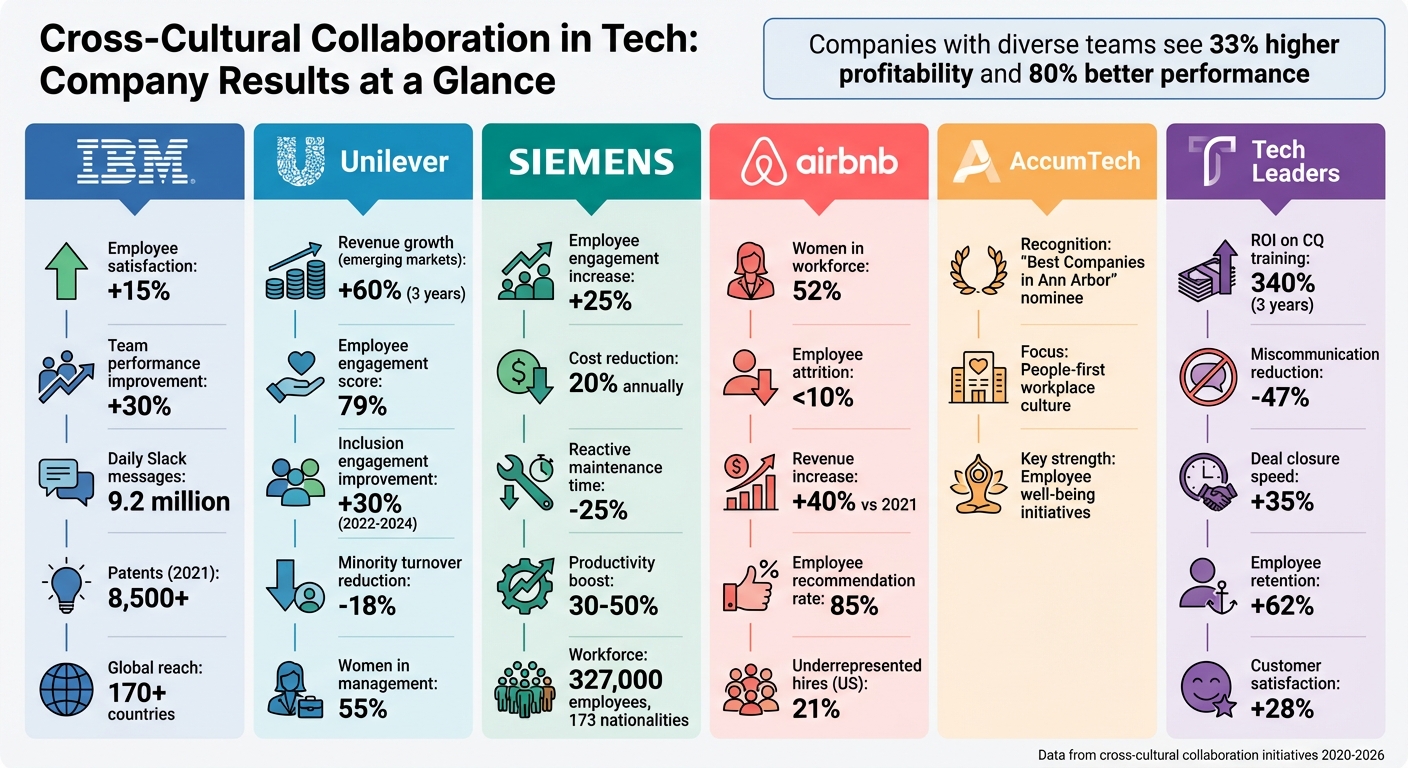
Cross-cultural collaboration in the tech industry isn't just about diversity; it's a proven driver of success. Companies that embrace diverse teams see up to 33% higher profitability and 80% better performance. This article explores how six major companies - IBM, Unilever, Siemens, Airbnb, AccumTech, and Tech Leaders - use tools, strategies, and technology to bridge cultural gaps and achieve measurable results.
Key Takeaways:
- IBM: Boosted employee satisfaction by 15% through training and tools like Slack and multilingual AI systems.
- Unilever: Achieved a 60% revenue increase in emerging markets using AI-driven solutions and regional customization.
- Siemens: Improved engagement by 25% through global collaboration platforms and AI-powered tools.
- Airbnb: Increased workforce diversity to 52% women and reduced attrition below 10% with policies like "Live and Work Anywhere."
- AccumTech: Focused on employee well-being, earning recognition for its supportive workplace culture.
- Tech Leaders: Delivered a 340% ROI on cultural intelligence training, reducing miscommunication incidents by 47%.
By combining cultural awareness with advanced technologies, these organizations demonstrate how diversity fuels innovation and business growth. Read on to discover the strategies behind their success.
Cross-Cultural Collaboration Results: 6 Tech Companies Compared
1. IBM
Cultural Tools Used
IBM, with operations spanning over 170 countries and a workforce exceeding 250,000, relies on tools and training to foster cross-cultural collaboration. The company offers Cultural Intelligence (CQ) Training tailored for regions like Asia, Africa, and Latin America. These modules cover local customs, business etiquette, and communication styles to improve collaboration and understanding across different cultures [5]. To address language challenges, IBM provides both online and in-person training in languages such as Mandarin, Spanish, Portuguese, and Arabic. This helps build stronger connections with international clients [5].
To improve communication, IBM transitioned from internal email to Slack, a channel-based messaging platform. By 2018, Slack usage grew from 70 engineers in 2016 to more than 100,000 employees, with an impressive 9.2 million Slack messages exchanged daily [6]. Slack also facilitates "Ask Me Anything" (AMA) sessions, allowing leadership to engage directly with global staff. Additionally, teams employ "swarming", a method that brings experts from various regions and product areas together in real-time to address critical service issues [6]. These tools have significantly enhanced collaboration and efficiency.
Quantified Impact
IBM's focus on cultural awareness and open communication has yielded measurable results. The company reported a 15% boost in employee satisfaction due to its efforts to embrace cultural diversity [8]. Moreover, businesses that prioritize cross-cultural training, a key aspect of IBM's strategy, typically experience a 30% improvement in team performance [8]. Nickle LaMoreaux, IBM's Senior Vice President & Chief Human Resources Officer, highlighted the importance of these initiatives:
"These communities have become a vibrant part of IBM culture. And it's something that has reinforced our inclusive nature" [6].
Tech Application
IBM's emphasis on cross-cultural collaboration extends into its technological advancements. The company developed Language Adversarial Training, a tool that creates multilingual AI embeddings by translating English datasets into languages like Arabic, Spanish, German, Hindi, Vietnamese, Chinese, and Japanese. These embeddings are designed to be indistinguishable to AI systems, ensuring consistency across languages [9]. Additionally, IBM introduced a Language Arbitration Framework to maintain semantic alignment between English and translated content. This framework uses Produce Same Answer (PSA) and Question Similarity (QS) tasks to validate translations [9].
Innovation Outcomes
IBM's investment in cross-cultural collaboration has driven success in global markets like China, Brazil, and the Middle East [5]. In 2021 alone, IBM's collaborative research efforts resulted in over 8,500 patents, marking the company's 29th consecutive year as a U.S. patent leader [7]. A notable example of its global teamwork is the partnership with Cleveland Clinic to establish the "Discovery Accelerator." This initiative combines hybrid cloud, AI, and quantum computing to advance pathogen research and required seamless coordination among global research teams [7].
sbb-itb-8feac72
2. Unilever

Tools for Inclusion and Diversity
Unilever has embraced a decentralized approach to diversity, inspired by IBM's integrated strategies. Their Agile Inclusion model allows regional teams to adjust diversity goals to fit local needs. Key initiatives include Inclusive Leadership Certification, reverse mentoring programs, UniVoice surveys, Peer Ambassador Networks, and Cultural Immersion Programs. These tools collectively aim to foster a more inclusive and adaptable workplace environment [10][11].
Measurable Results
Unilever's efforts have shown tangible progress. In 2024, the company achieved a 79% global Employee Engagement Score, with inclusion-related engagement improving by 30% between 2022 and 2024. Teams with leaders exhibiting inclusive behaviors reported 20% higher collaboration. Additionally, targeted strategies reduced minority employee turnover by 18% in select European markets [10].
Beyond internal metrics, Unilever has leveraged technology for operational efficiency. For example, an AI and IoT-enabled sensor at its Poznan, Poland, foods factory reduced cleaning times by 20% and cut water and energy usage by 10%, saving approximately $110,000 annually [10][14]. On a larger scale, revenue from emerging markets surged by 60% over three years, thanks to data-driven product customization for local preferences [2][14].
Leveraging Technology
Unilever uses AI to connect authentically with local communities. For example, the company analyzed 3.5 million social media posts for its #VaselineHacks Campaign, verifying community-generated ideas with the "#VaselineVerified" status. This campaign earned a Titanium award at Cannes in 2025 [13].
In February 2026, Unilever partnered with Google Cloud for a five-year collaboration to build an AI-focused digital infrastructure. Using tools like Vertex AI and Gemini models, the company streamlined workflows across global operations for brands like Dove and Hellmann's. Additionally, Digital Twin Technology has allowed Unilever to create product visuals twice as fast as traditional methods, enabling swift adaptations for regional packaging and languages [12][13].
Innovation Through Collaboration
Cross-cultural teamwork has fueled key innovations at Unilever. For instance, Dove's limited-edition body care range became a bestseller at Walmart, while the Hefei factory's autonomous operations earned recognition in Gartner's 2025 Supply Chain Top 25 Report. Through its 100+ Accelerator, Unilever has not only advanced sustainability but also increased the global representation of women in management to 55% by 2023 [10][13][14].
As Charlotte Ward, Global Head of Unilever's Climate & Nature Fund, noted:
"Open innovation can be tricky when you're sitting across the table from your competitors... To solve the world's greatest challenges, collaboration is essential" [14].
These examples highlight how Unilever's adaptability and cultural awareness have fueled technological advancements and global success.
3. Siemens
Cultural Tools Used
Siemens, with its workforce of 327,000 employees representing 173 nationalities, has developed focused strategies to bridge cultural differences. Among these efforts are Belonging Day Events, which are internal forums featuring experts and advocates aimed at increasing awareness around ethnicity, culture, and intersectionality. Additionally, Siemens supports global Employee Resource Groups (ERGs) that serve as open-access platforms for underrepresented voices. A standout initiative is Cultural Storytelling, where employees share their heritage through personal narratives, food, and art. ERG America highlighted the value of these exchanges:
"These exchanges not only educate colleagues about different cultures but also build empathy and understanding, helping to break down barriers."
In the UK, Siemens introduced a 5-Day Race Equality Challenge during Race Equality Week. This initiative encouraged colleagues to share cultural insights, fostering dialogue and driving tangible change for BAME employees [15]. These programs not only promote inclusivity but also create a foundation for operational and technological advancements.
Quantified Impact
Siemens has demonstrated measurable success through initiatives like Voice25, a project executed between 2020 and September 2025 in collaboration with NTT DATA. This effort migrated 290,000 users to a unified Microsoft Teams telephony system, streamlining workflows and reducing annual costs by over 20% across 44 countries spanning Latin America, Asia Pacific, Europe, the Middle East, Africa, and North America.
In 2018, Siemens launched Siemens Connect, a collaborative platform designed to enhance communication across diverse cultural backgrounds following several regional acquisitions. Within its first year, Siemens Connect increased employee engagement by 20%. The platform’s agile adoption further resulted in 80% of employees reporting higher engagement levels [19].
Tech Application
Siemens has embraced cutting-edge technology to enhance productivity and efficiency. Partnering with Microsoft and NVIDIA, the company developed the Industrial Copilot, a generative AI assistant that helps shop floor workers troubleshoot machinery using natural language. Early trials showed a 25% reduction in reactive maintenance time and a productivity boost of 30%–50%. Another innovation, the Digital Twin Composer, integrates 2D, 3D, and real-time data. Early adopters, such as PepsiCo, reported a 20% increase in throughput and a 10%–15% reduction in capital expenditure by virtually validating investments [18].
Additionally, Siemens worked with NTT DATA’s AI Factory to deploy AI agents that optimize communications and standardize workflows. NTT DATA commented on the impact:
"The AI-driven solutions have helped streamline operations across global Microsoft Teams Services, leading to standardized workflows and sustainable cost reductions" [16].
Innovation Outcomes
Siemens underscores the value of cross-cultural collaboration, championing the idea that diverse perspectives lead to better solutions. The company’s Inventors of the Year program celebrates international research collaborations, including an Open Innovation category. Meanwhile, the Siemens Innovation Ecosystem, a digital platform linking employees, startups, and external partners, has shifted the company’s focus from isolated R&D to a globally connected network [17].
By using high-fidelity 3D digital twins, Siemens can identify 90% of potential issues before making physical changes. Enzo Krka, Senior Product Manager at Siemens, emphasized the benefits:
"NVIDIA Omniverse integration enables Siemens to increase product efficiencies and productivity, allowing our customers to save time on product development and design. By approximating real-world behavior in a digital twin, our customers can draw conclusions and optimize product design faster" [18].
4. Airbnb
Cultural Tools Used
Airbnb has implemented creative programs to bridge cultural gaps and unify its global workforce. Initiatives like "One Airbnb" and "Night At The Airbnb Office" are designed to encourage collaboration and reinforce core company values such as "Be a host" and "Embrace the adventure" [20]. Through "One Airbnb", employees from various offices and teams come together for week-long collaborative projects, breaking down barriers and fostering a sense of shared ownership. Meanwhile, "Night At The Airbnb Office" allows employees to stay overnight in the office, giving them firsthand experience of what guests encounter [20]. Todd Gagne, Founder of Wildfire Labs, highlights Airbnb's mission to "create a world where anyone can belong anywhere", supported by values like "champion the mission" and "embrace the adventure" [20]. These principles create a consistent framework while leaving room for local adaptation.
Quantified Impact
Airbnb’s "Live and Work Anywhere" policy, introduced in June 2023 under CFO Dave Stephenson, has delivered impressive results. The policy led to the company’s highest-ever global hiring rate for women, reaching 52%, while attrition fell below 10%. Additionally, Airbnb achieved a 40% revenue increase compared to 2021 [23].
The company also transitioned to a functional organizational structure during the pandemic, creating a unified roadmap that improved operational efficiency. As a result, more than 85% of employees now say they would recommend Airbnb as a workplace. Furthermore, 21% of new U.S. hires are from underrepresented groups, reflecting the company’s commitment to diversity [23].
Tech Application
Airbnb’s Internationalization (I18n) Platform plays a key role in supporting global collaboration. Developed in October 2020 by engineers Hua Zheng and Jad Abi-Samra, the platform uses tools like Snapshotter and I18n Agents to manage and cache over 1 million pieces of content across 62 languages. With microsecond response times, it handles more than 100 billion daily requests [21]. Hua Zheng described the platform’s purpose:
"Bridging the language gap between people is fundamental in helping to create a world where we can all feel belonging no matter where we are" [21].
The system also includes Content Analytics, which tracks phrase usage to prioritize translations, ensuring resources are allocated efficiently for new language rollouts. This technology has been instrumental in Airbnb’s international growth, demonstrating how technical solutions can strengthen cultural collaboration.
Innovation Outcomes
Airbnb’s focus on cultural understanding and technical innovation has driven its success in localized markets. For example, between 2015 and 2022, the company executed a tailored strategy in China under Tao Peng, the President of Airbnb China. They rebranded to "Aibiying", meaning "welcome each other with love", and integrated popular local platforms like WeChat and Alipay for seamless transactions [22]. This approach highlights the importance of understanding regional consumer behavior, beyond simple translation.
To maintain alignment across its global teams, Airbnb uses structured collaboration tools like a unified company calendar and a multi-year roadmap. These tools revolve around two major annual product launches in May and November. CEO Brian Chesky explained this approach:
"The world is becoming more flexible about where people can work... The best people live everywhere, not concentrated in one area" [24].
This deliberate structure enables teams to work asynchronously while staying aligned on shared objectives.
Cross Cultural Communication and Global Tech Teams
5. AccumTech
AccumTech shows how putting people first can spark innovation and strengthen global teamwork, aligning with approaches used by some of the biggest names in tech.
Tools for Building Culture
Headquartered in Ann Arbor, Michigan, AccumTech focuses on creating a "people-first" workplace. The company prioritizes a supportive environment where every team member feels valued. This approach not only lifts employee morale but also fuels creative thinking - an essential ingredient for innovation in tech. To strengthen bonds across its diverse workforce, AccumTech organizes team events, offers flexible work schedules, and provides extra leave to help employees maintain a healthy work-life balance [25].
Measurable Results
These efforts have earned AccumTech recognition, including being nominated as one of the "Best Companies in Ann Arbor" for its workplace culture and leadership. Employees credit the inclusive atmosphere with improving their learning opportunities, career growth, and collaborative problem-solving skills. All of this contributes to the company’s success [25]. By focusing on cross-cultural collaboration, AccumTech highlights the importance of teamwork in driving innovation, whether at a local business or a global enterprise.
6. Tech Leaders
Cultural Tools Used
Tech Leaders takes a page from the playbook of companies like IBM and Airbnb by focusing on cultural insight as a core element of professional growth. Their mission? To equip technical professionals with the cultural skills they need to thrive. By integrating cultural intelligence (CQ) into their leadership and entrepreneurship training, they address a major gap in cross-cultural business - nearly 60% of such failures are tied to communication mismatches [27].
Their training highlights the difference between high-context cultures (like Japan and China), where non-verbal cues are crucial, and low-context cultures (like the U.S. and Germany), which rely on clear, direct communication [4]. Dr. Liesel Brinkerhoff, a Hofstede Cultural Dimensions Analyst, sums it up perfectly:
"Cultural intelligence is not about memorizing customs or etiquette rules. It's about developing the cognitive flexibility to interpret and respond to cultural signals you've never encountered before" [27].
This focus on CQ not only fills a critical need but also reflects a broader industry trend: using cultural understanding to fuel technical innovation.
Quantified Impact
The results of Tech Leaders' CQ programs speak for themselves. Companies that adopt these strategies see a 340% return on investment (ROI) over three years and cut cross-cultural miscommunication incidents by 47% [27]. The benefits don’t stop there:
- International deals close 35% faster.
- Employee retention improves by 62%.
- Customer satisfaction across diverse markets jumps by 28% [27].
Additionally, teams trained in cultural intelligence are 1.8 times more likely to innovate and adapt effectively to change [4].
Tech Application
Tech Leaders doesn’t just stop at training - they bring CQ into tech development itself. By weaving cultural intelligence into diverse training data, tailoring user experiences for global audiences, and aligning ethical frameworks with varied cultural values, they ensure their programs resonate on a deeper level [27]. This approach also prepares technical professionals for independent consultancy roles - something that 67% of job seekers prioritize [4].
Advantages and Disadvantages
Cross-cultural collaboration in the tech world brings both measurable successes and notable challenges. Each approach comes with its own set of trade-offs, as illustrated by these examples that highlight the benefits and compromises of various strategies.
IBM's AI-powered "Cognitive Workplace" uses sentiment analysis to identify cultural gaps, resulting in a 30% boost in engagement [3]. However, implementing this solution requires a hefty investment in AI and analytics.
Unilever combines cultural intelligence with tools like Microsoft Teams and Trello, driving a 60% revenue growth in emerging markets over three years [2]. Yet, their initial rollout faced difficulties in coordinating product launches across over 10 countries [2].
Siemens opted for standardized digital collaboration tools, achieving a 20% increase in project efficiency and a 25% improvement in employee engagement [2].
PwC uses Virtual Reality (VR) training to provide immersive cross-cultural simulations, which increased employee confidence by 76% [3].
Airbnb focuses on cultural storytelling through its local "Experiences" platform, improving cross-functional collaborations by 40% [28].
Accenture leverages digital onboarding and integration tools to enhance new hire retention by 20% [3].
Here’s a breakdown of the tools, impacts, and tech applications these companies employ:
| Company | Cultural Tools Used | Quantified Impact | Tech Application | Outcomes |
|---|---|---|---|---|
| IBM | AI "Cognitive Workplace" | 30% engagement increase [3] | AI sentiment analysis | Improved inclusion strategies |
| Unilever | Cultural Intelligence Platforms | 60% revenue growth in emerging markets [2] | Data analytics + Teams/Trello | Localized product innovation |
| Siemens | MS Teams & Virtual Team-building | 20% efficiency increase; 25% engagement boost [2] | Standardized collaboration tools | Streamlined global operations |
| Airbnb | Cultural storytelling initiatives | 40% collaboration improvement [28] | Community-driven software | Enhanced cross-functional synergy |
| Accenture | Digital Onboarding Tools | 20% retention improvement [3] | Digital onboarding software | Better cultural integration |
| PwC | Virtual Reality (VR) | 76% confidence increase [3] | Immersive simulations | Strengthened global negotiation skills |
These examples highlight the delicate balance between the rewards and challenges of fostering cross-cultural collaboration in tech, offering insights into how companies are navigating this complex landscape.
Conclusion
Cross-cultural collaboration can lead to measurable success when companies take deliberate steps to make it work. Studies show that teams embracing diverse cultural perspectives are 1.8 times more likely to innovate and adapt, while gender-diverse executive teams report 25% higher profitability [4]. But simply assembling diverse teams isn’t enough - it’s about creating systems that allow them to thrive together.
The most effective strategies align company values with an understanding of individual cultural nuances. Organizations operating across multiple regions demonstrate that shared values can bridge cultural gaps and prevent misunderstandings [26]. As Roy Y.J. Chua, an expert in organizational behavior, puts it:
"It's this kind of heightened awareness and reflection about what I think about other cultures and how other cultures think about me that helps cross-cultural creative collaboration" [1].
To make this happen, tech leaders need clear, actionable strategies. Here are three key steps to consider:
- Develop Cultural Intelligence (CQ): Use assessment tools to evaluate and improve how teams adapt to diverse environments [4].
- Standardize Communication: Decide on low-context (direct, clear) or high-context approaches to avoid miscommunication during tasks like code reviews and sprint planning [26].
- Set Clear Expectations: Establish guidelines around time management, feedback styles, and leadership roles to prevent conflicts before they arise [26].
One particularly effective approach for remote teams is the "user manual" method. Each team member documents their communication preferences, feedback styles, and time zone details. Replace vague questions like “Does everyone understand?” with a requirement for team members to summarize their next steps, ensuring alignment [26].
Diversity isn’t just a moral imperative - it’s a business advantage. With 67% of job seekers factoring diversity into their job decisions [4], companies that master cross-cultural collaboration gain a clear edge in attracting top talent and expanding into new markets. The examples in this article show that investing in cultural awareness pays off, driving both innovation and long-term success in today’s global tech industry.
FAQs
What’s the fastest way to build cultural intelligence (CQ) in a tech team?
To strengthen cultural intelligence (CQ) within a tech team, prioritize understanding different cultural norms, values, and communication styles. Start with targeted training sessions on cultural awareness to help team members recognize and respect differences. Encourage open discussions where everyone can share their perspectives and experiences - this builds empathy and trust. Finally, embrace hands-on experiences like international collaborations or cross-cultural projects, which allow team members to learn directly from diverse interactions. These steps not only improve understanding but also minimize miscommunication and encourage fresh ideas by tapping into a variety of viewpoints.
What collaboration tools help reduce cross-cultural miscommunication?
Tools like Pebb are designed to adjust to different communication styles, helping reduce misunderstandings in diverse settings. By accounting for variations in how people communicate, these tools make it easier for teams from different backgrounds to work together more effectively.
How do you standardize communication without losing local culture?
Standardizing communication across global teams while respecting local traditions requires a thoughtful approach. One key strategy is to blend asynchronous feedback with real-time discussions, ensuring that diverse communication styles are accommodated. It's also essential to remain conscious of time zone differences and language barriers, allowing for smoother interactions.
Striking a balance between a company’s core values and the unique cultural elements of individual team members fosters a shared understanding. This approach not only maintains authenticity but also encourages collaboration, helping global tech teams work together more effectively.