

Why Cultural Competence Matters in Facilitator Training
Facilitators often lead discussions on sensitive topics like race, ethnicity, and systemic issues. Without the right skills, they risk alienating participants or reinforcing biases. Training in cultural competence helps facilitators navigate these challenges effectively, creating spaces where participants feel respected and heard.
Key Takeaways:
- Definition: Cultural competence is the ability to work respectfully and effectively with diverse groups.
- Why It’s Needed: Facilitators often face resistance or silence in discussions about race and bias. Skills in this area improve trust and engagement.
- Research Insights: Programs like the Inclusive STEM Teaching Project show that hands-on, long-term training significantly improves facilitation outcomes.
- Challenges: Barriers include short, ineffective trainings and ingrained biases.
- Solutions: Self-assessment, role-playing, and continuous learning are essential for improving facilitation skills.
Facilitators trained in these methods are better equipped to lead meaningful discussions and promote understanding across diverse groups.
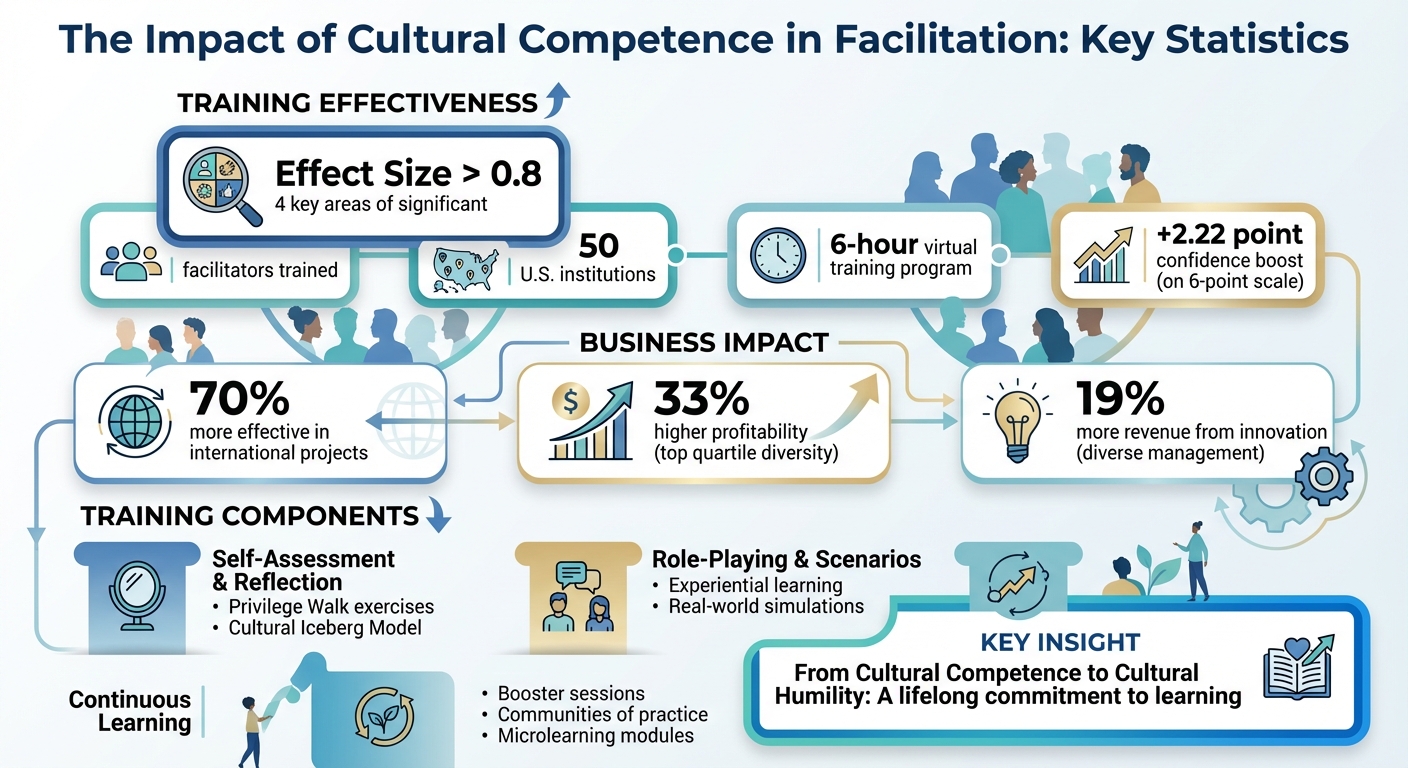
Cultural Competence Training Impact: Key Statistics and Benefits
ATTC - Cultural Humility and Cultural Competency: A Journey to Improved Outcomes - Part One
Research Findings on Cultural Competence in Facilitation
Research highlights that cultural competence is essential for effective facilitation and creating meaningful workshop experiences.
Better Workshop Results
Data shows that cultural competence training leads to stronger outcomes compared to traditional lecture-based approaches. Between Summer 2021 and Fall 2022, the Inclusive STEM Teaching Project (ISTP) conducted a six-hour virtual training for 71 facilitators across 50 U.S. institutions. The results were impressive: facilitators demonstrated effect sizes above 0.8 across four key areas - facilitating DEI conversations, fostering open dialogue, leading identity-focused discussions, and handling challenging moments [6].
The success stems from the training's approach. Research suggests that knowledge-based models, which assume bias comes from ignorance, often fall short - or even backfire [2]. On the other hand, empowerment-based methods, which treat bias as a "habit of mind" to be broken, lead to lasting behavioral changes [2]. Facilitators reported a 2.22-point boost in confidence on a 6-point scale, with the most significant gains seen among those with 1–3 years of DEI experience [6].
"Inclusive teaching requires more than good intentions; it is an ongoing commitment to learning, reflecting, and implementing equitable and inclusive pedagogical practices to support all students." - Diane Codding, Northwestern University [6]
These improved facilitation skills also enhance participants' trust and engagement, as explored below.
Increased Participant Trust and Safety
Enhanced facilitation techniques also play a critical role in building trust among participants. Cultural competence training helps create environments where participants feel both safe and valued. Instead of focusing on traditional "safe spaces", trained facilitators establish "brave spaces" where discomfort is reframed as an opportunity for growth [1]. This shift is transformative - studies show that equitable facilitation practices boost participants' sense of belonging, motivation, and engagement [6].
"Holding space... is to 'hold both the people in, and the dynamic energy of the room' in a nonjudgmental way that affords grace and promotes growth and understanding." - Stephanie C. House, University of Wisconsin-Madison [1]
Research also underscores that facilitators trained in somatic awareness and emotional regulation are better equipped to navigate tense moments. By staying composed during difficult discussions, they help reduce the "fight, freeze, or flee" response that can derail conversations [1]. This calm presence ensures participants feel heard and respected, fostering deeper understanding and connection.
Common Barriers to Developing Cultural Competence
Even with the clear advantages of cultural competence training, facilitators often face challenges that can hinder their efforts. Recognizing these obstacles is essential to achieving the positive outcomes discussed earlier. However, these benefits can be difficult to realize when facilitators encounter hurdles like limited resources and ingrained biases.
Limited Access to Training Resources
One significant issue is the prevalence of short, one-off training sessions that last only 1–2 hours. These brief sessions fail to capture the complexity of cultural competence or provide the ongoing support facilitators need [4][5]. Many programs rely on an "information deficit model" - the assumption that simply providing facts will lead to behavioral change. Research has shown this method to be ineffective [2].
"DEI training is estimated to be an $8 billion industry, and some have gone so far as to declare it a failed industry." – Newkirk [2]
Another problem is the narrow focus of some programs, which emphasize cultural artifacts rather than practical skills [4]. Without consistent guidance or institutional backing, facilitators often struggle to put their training into practice. On the other hand, evidence from initiatives like the Inclusive STEM Teaching Project shows that extended, well-supported programs can significantly boost facilitator confidence [6].
Addressing Implicit Biases
Beyond resource limitations, tackling implicit bias is crucial to ensuring workshops achieve meaningful results. Facilitators must confront unconscious biases, which can subtly shape their actions without them realizing it [8][9]. These biases often conflict with a person’s stated values and tend to become more pronounced under stress or multitasking. Studies even show that children as young as 4 years old begin to exhibit biases based on stereotypes they’ve absorbed [7][2]. Recognizing the impact of these hidden preferences, the California Medical Association mandated implicit bias training for healthcare professionals starting January 1, 2022 [8].
"Bias is woven through culture like a silver cord woven through cloth. In some lights, it's brightly visible. In others, it's hard to distinguish." – NC Department of Health and Human Services [9]
The difficulty lies in the fact that biases are ingrained habits, not simple knowledge gaps [2]. Facilitators also face resistance from participants who might prioritize their own comfort over the discomfort required for growth. This dynamic, often referred to as the "right to comfort" barrier, can undermine progress [2]. In STEMM fields, a "culture of silence" surrounding race and culture - rooted in color-evasive ideologies - further complicates efforts to address these biases [2].
sbb-itb-8feac72
How to Train Facilitators in Cultural Competence
Addressing barriers to cultural competence requires training programs to treat it as an ongoing process. This journey involves self-awareness, hands-on practice, and continuous growth.
Self-Assessment and Reflection
The first step in effective training is helping facilitators examine their own cultural backgrounds and biases. Training programs should include activities that encourage participants to explore how their personal experiences shape their perspectives [10][3].
"Self-assessment makes participants realize the pervasive role culture plays in their lives. It also makes people aware of their own biases while sparking open-minded curiosity about other cultures." - Robert C. Weigl, PhD [10]
One impactful activity is the Privilege Walk, which highlights how societal advantages and disadvantages influence career paths and workplace interactions [11][3]. For virtual sessions, digital tools can replicate this exercise, allowing participants to anonymously track privilege through virtual grids [11]. Another valuable tool is the Cultural Iceberg Model, where participants first identify visible cultural elements like food and language, then explore deeper aspects such as attitudes toward authority and time perceptions [11]. These exercises build the self-awareness and mental flexibility facilitators need to effectively manage diverse groups [3].
Once a foundation of self-awareness is established, experiential learning can further develop these skills.
Role-Playing and Scenario-Based Training
Training programs should include experiential learning through role-playing and scenario-based exercises that mimic real-life challenges [11][12]. Research shows that these methods consistently improve cultural competence skills [13].
Role-playing allows facilitators to practice navigating situations like addressing discrimination or overcoming language barriers in a safe, controlled environment [14]. After each exercise, a reflective discussion helps participants connect their learning to real-world applications [16]. Trainers should also focus on communication styles, exploring differences such as high-context versus low-context communication, direct versus indirect feedback, and the importance of nonverbal cues [11][12]. Combining role-playing with expert demonstrations provides a clear model for culturally competent behavior [13].
These hands-on exercises create a strong foundation for ongoing learning and improvement.
Continuous Learning and Feedback
Pamela A. Hays, PhD, emphasizes that cultural competence should be viewed as a lifelong commitment rather than a skill with a fixed endpoint [10]. This shift toward cultural humility - a dedication to continuous self-evaluation and learning - is essential [17].
Practical approaches for ongoing learning include booster sessions, such as a one-hour webinar held several weeks after initial training to reinforce key concepts [17]. For example, the New York State Cultural and Structural Competence training program pairs a 6.5-hour in-person session with a mandatory follow-up webinar four weeks later [17]. Organizations can also establish communities of practice, where facilitators engage in regular discussions and receive ongoing support [15]. Short, focused microlearning modules - just a few minutes long - can fit into busy schedules and provide daily reinforcement [3]. Facilitators should also use tools like the Harvard Implicit Association Test (IAT) to regularly assess their biases [17], while training programs should gather participant feedback to address recurring stereotypes or assumptions [17].
Conclusion: Moving Forward with Cultural Competence
Key Takeaways
At its core, cultural competence involves a commitment to ongoing learning and self-awareness. Studies highlight its impact: facilitators trained in cultural competence are 70% more effective in international projects, organizations in the top quartile for diversity report 33% higher profitability, and diverse management teams generate 19 percentage points more revenue from innovation [19][20][18].
The shift from "cultural competence" to cultural humility marks a meaningful evolution in how we approach diversity efforts. Helen-Maria Lekas, PhD, describes cultural humility as:
"An orientation towards caring for one's patients that is based on: self-reflexivity and assessment, appreciation of patients' expertise on the social and cultural context of their lives, openness to establishing power-balanced relationships with patients, and a lifelong dedication to learning" [17].
This approach recognizes that culture is not something to "master" but something facilitators must continuously learn from, guided by participants' lived experiences.
However, individual growth alone won't suffice. Organizations need to go beyond isolated training sessions and invest in long-term strategies. Programs that track measurable outcomes - like retention rates and employee engagement - are essential for fostering lasting change [14].
These principles lay the groundwork for sustainable diversity, equity, and inclusion (DEI) practices in facilitation.
Next Steps
To create meaningful change, facilitators and organizations must embrace actionable strategies that prioritize cultural competence. Whether you're looking to refine your facilitation skills or step into a leadership role, comprehensive training programs can provide the tools you need. For example, Tech Leaders offers specialized programs in engineering leadership and entrepreneurship, bridging technical expertise with critical non-technical skills like communication and team management. These programs are designed to help professionals lead diverse teams with confidence and empathy.
Start by identifying your knowledge gaps and committing to continuous learning. Whether you're facilitating a diversity workshop or managing cross-functional teams, adopting cultural humility fosters inclusive spaces where every voice is valued.
FAQs
What makes cultural competence training essential for facilitators, and what are its key components?
Cultural competence training plays a key role in preparing facilitators to create learning environments that are inclusive and respectful of diversity. This type of training typically emphasizes four main areas: self-awareness, knowledge, skills, and practice.
The process begins with facilitators examining their own cultural biases and assumptions, fostering greater self-awareness. From there, they explore various cultural values, norms, and perspectives, gaining the knowledge needed to interact with diverse groups thoughtfully. Skill-building sessions provide practical tools for effective communication, addressing microaggressions, and adapting to different cultural contexts. Finally, hands-on activities like role-playing or simulations allow facilitators to put these lessons into action, helping them grow more confident in navigating cross-cultural interactions.
At Tech Leaders, these elements are woven into the training for engineering leaders. By combining technical expertise with cultural competence, the program ensures leaders are equipped to manage diverse teams and create a sense of belonging in today’s rapidly evolving, AI-driven work environment.
How does cultural competence training build trust and encourage engagement in workshops?
Cultural competence training arms facilitators with the tools to identify and address their own biases, appreciate different perspectives, and communicate effectively across cultural boundaries. This kind of training promotes an inclusive atmosphere, reducing misunderstandings and fostering a space where everyone feels respected and valued. As a result, trust grows, and workplace tension or conflicts are less likely to arise.
When facilitators demonstrate cultural awareness and a commitment to inclusivity, participants are more inclined to share their thoughts and engage fully. Workshops led by culturally aware facilitators can strengthen a sense of belonging, spark collaboration, and even drive creativity. By incorporating mindfulness, empathy, and flexibility into their approach, facilitators can adapt sessions to better connect with their audience, keeping participants engaged and motivated throughout.
What challenges do facilitators face when building cultural competence, and how can they address them?
Facilitators often face challenges when trying to move from basic cultural awareness to deeper cultural understanding. Some of the most common hurdles include low self-awareness, which can unintentionally result in biases or microaggressions, and uncertainty in handling unfamiliar cultural norms, leading to hesitation or reliance on stereotypes. Another significant obstacle is applying abstract ideas in real-life scenarios, especially when training programs lack interactive, hands-on components.
To address these issues, facilitators can focus on building key skills. Mindfulness helps them stay aware of their communication patterns and how they might be perceived. Cognitive flexibility allows them to rethink assumptions and approach situations from different angles. Developing a tolerance for ambiguity is critical for staying composed in uncertain or complex cultural interactions. Additionally, behavioral flexibility - adjusting actions to fit various cultural settings - and cross-cultural empathy - intellectually and emotionally understanding others' perspectives - are invaluable tools. Embracing cultural humility, which involves recognizing that learning is a continuous process, also keeps facilitators open to feedback and prevents overconfidence.
Practical methods to build these skills include reflective journaling to uncover biases, role-playing exercises to practice real-world scenarios, and structured debriefs to refine inclusive behaviors. Tech Leaders integrates these approaches into its programs, combining technical expertise with essential interpersonal skills like cultural humility and empathy. This equips facilitators to lead impactful diversity and inclusion workshops with confidence and sensitivity.