

Cultural Intelligence for Emerging Markets: Checklist
Cultural intelligence (CQ) is your ability to effectively interact in different cultural settings, and it’s critical for success in emerging markets like India, Brazil, and Southeast Asia. Leaders with high CQ perform 40% better in global environments and reduce failed international assignments by 35%. This guide offers actionable steps to evaluate and strengthen CQ across four areas: Drive (motivation), Knowledge (understanding differences), Strategy (planning and awareness), and Action (behavioral adaptation).
Key highlights:
- Self-assessment: Rate your motivation, cultural understanding, planning, and behavior.
- Preparation: Research cultural norms, business etiquette, and local preferences.
- Team readiness: Audit and train teams for cross-cultural collaboration.
- Execution: Tailor communication styles and decision-making approaches.
- Continuous improvement: Reflect, gather feedback, and track progress.
The ability to navigate cultural differences can improve team performance by 25%, boost innovation by 30%, and significantly increase success in international markets. Let’s break down how to build this essential skill step by step.
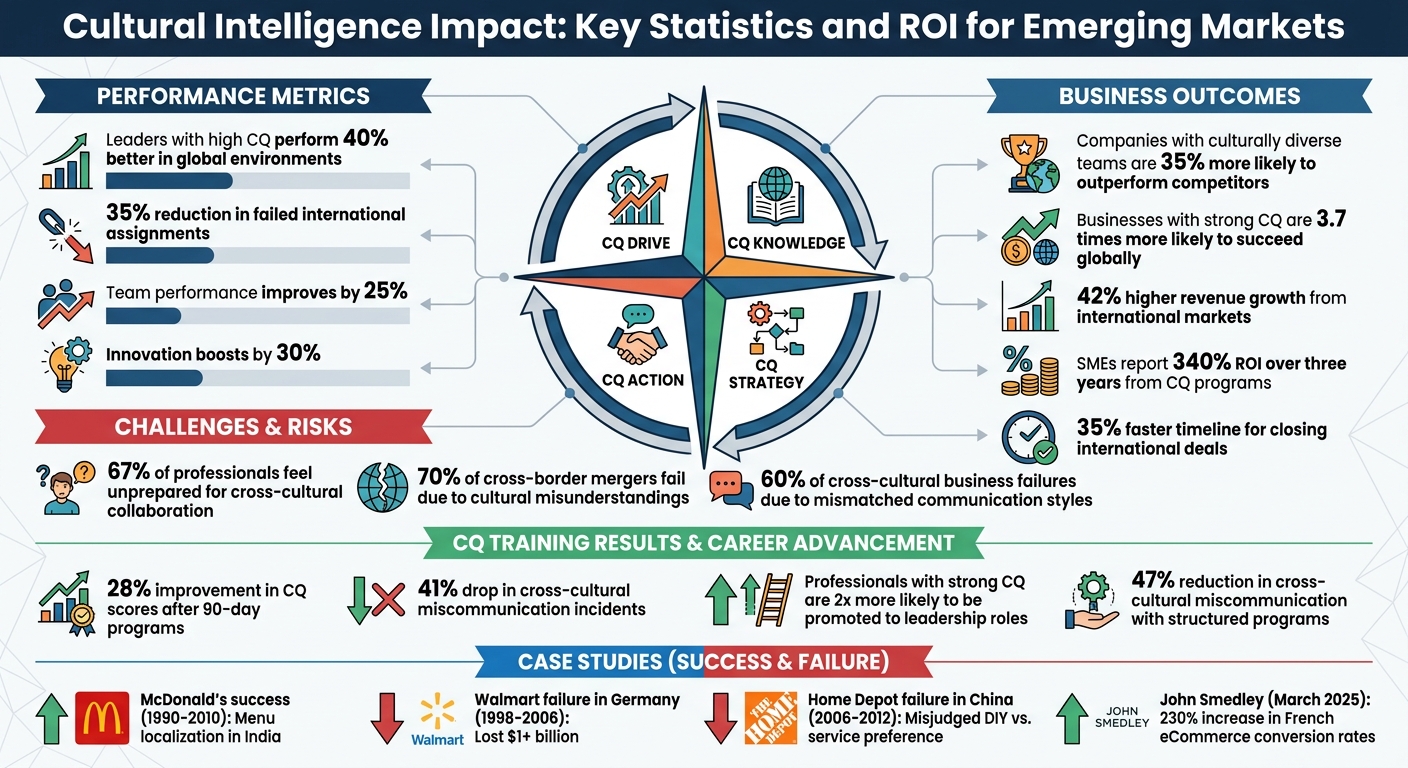
Cultural Intelligence Impact: Key Statistics and ROI for Emerging Markets
How Does Cultural Intelligence Help In Global Business? - Admin Career Guide
sbb-itb-8feac72
Self-Assessment Checklist: Measure Your Current CQ
To effectively navigate emerging markets, it's essential to assess all four dimensions of cultural intelligence (CQ). This self-assessment helps you identify your strengths and pinpoint gaps that could hinder your efforts. Here's how you can evaluate each CQ component.
Evaluate Your CQ Drive
CQ Drive is the cornerstone of cultural intelligence. Without genuine motivation to engage with different cultures, even the best knowledge and strategies won't lead to meaningful action. This dimension includes three key areas: intrinsic interest (enjoyment of cultural learning), extrinsic interest (recognition of professional benefits), and self-efficacy (confidence in adapting successfully).
"Motivation is the foundation of cultural intelligence. Without the drive to engage, no amount of knowledge or strategy will be effective." – EuroMaTech [2]
Rate yourself on a 1–5 scale in areas like curiosity versus resistance, seeking feedback proactively, and confidence in cross-cultural environments. Pay attention to your emotional reactions during intercultural interactions. When faced with cultural confusion, do you lean toward exploring or avoiding?
It can also be helpful to ask colleagues from different cultural backgrounds for feedback on your openness and ability to build trust. Their perspectives might uncover blind spots you're unaware of.
Once you've assessed your motivation, it's time to examine your understanding of cultural differences.
Examine Your CQ Knowledge
CQ Knowledge is more than memorizing cultural facts - it's about grasping how cultural differences influence behavior, values, and expectations. This includes frameworks like Hofstede's Cultural Dimensions, which cover concepts such as Power Distance (the role of hierarchy in decision-making), Individualism vs. Collectivism (personal autonomy versus group loyalty), and Time Orientation (attitudes toward deadlines).
Consider this: Companies with culturally diverse teams are 35% more likely to outperform competitors, yet 67% of professionals feel unprepared for cross-cultural collaboration [5]. Tools like the Cultural Intelligence Center's CQ Assessment can provide a benchmark for your skills and compare them to others in similar roles.
To deepen your knowledge, keep a journal to document cultural observations. Record differences in email tone, meeting etiquette, or decision-making approaches. Ask yourself: Can I anticipate cultural conflicts before they arise? Do I understand the underlying values behind a colleague's actions, or am I only noticing surface-level behaviors? Even something as simple as how "yes" or "no" is communicated can vary widely across cultures.
With a solid knowledge base, you can shift focus to strategic planning.
Analyze Your CQ Strategy
CQ Strategy revolves around three pillars: planning (preparing for cultural interactions), awareness (noticing differences in real time), and checking (comparing assumptions with actual experiences). This dimension helps you think critically about cultural situations before, during, and after they occur.
Start by creating concise cultural briefings and use intentional pauses during interactions to observe and interpret local cues. After key interactions, reflect in a journal. Document what went well, what cultural differences you noticed, and what you’d handle differently in the future. Questions to consider include: Did I prepare adequately? Did I notice cultural cues as they happened? Were my assumptions accurate? These reflections will sharpen your strategic CQ over time.
Assess Your CQ Action
CQ Action is where your cultural intelligence becomes visible. It measures your ability to adapt behaviors, including your verbal communication (tone and pace), non-verbal cues (gestures and expressions), and speech acts (how you phrase requests or apologies).
To build rapport, align your formality, body language, and communication pace with local norms. Ask colleagues for feedback on how well you adapt your communication and behavior across cultural contexts. Pay attention to your emotional responses during unfamiliar situations - feelings like frustration or discomfort could highlight areas for improvement.
Use a 1–5 scale to rate yourself: How easily do you adapt your communication style? How comfortable are you adjusting your behavior to align with cultural expectations? These ratings can serve as a baseline to track your progress over time.
Pre-Entry Preparation Checklist
Once you've assessed your CQ (Cultural Intelligence), it's time to dig deeper with targeted research. This preparation phase is all about gathering actionable insights that will guide every decision you make as you enter a new market. Think of it as laying a solid foundation using structured research, specialized tools, and insights tailored to your target market.
Research Key Cultural Orientations
Start by identifying the cultural values that shape business practices in your chosen market. Ask questions like: How do people perceive time - are they strict about punctuality, or is there more flexibility? Are decisions made by a single leader, or is consensus the norm? Is individual success prioritized, or does the culture emphasize group harmony?
Frameworks like Hofstede's Cultural Dimensions are incredibly helpful here. For instance, understanding a market's Power Distance can prevent missteps, like unintentionally bypassing key decision-makers. Similarly, knowing whether a culture values Individualism or Collectivism can influence everything from team management to how you structure employee incentives. Businesses with strong cultural intelligence are 3.7 times more likely to succeed globally and report 42% higher revenue growth from international markets [8].
Don’t overlook the finer details, either. Pay attention to linguistic nuances and consumer behaviors. Research local shopping habits, preferred payment methods, and even technical specifics like date formats or how names are ordered [7]. These small adjustments show respect and professionalism.
Once you've gathered this data, translate it into actionable norms for doing business in your target market. Keep in mind that even within emerging markets, these norms can vary widely.
Understand Market-Specific Norms
While broad cultural insights are helpful, they won't carry you all the way. To truly succeed, you'll need to understand the specific business etiquette and communication styles in your target market. For example, in Latin America, building relationships often comes before formal business talks. In East Asia, initial meetings tend to follow a more hierarchical and formal structure.
Learning from past successes and failures can be invaluable. Take McDonald's as an example: between 1990 and 2010, they thrived internationally by localizing their menu - offering vegetarian options in India - and adapting restaurant designs to fit local tastes [8]. On the flip side, Walmart struggled in Germany, losing over $1 billion from 1998 to 2006 due to a lack of understanding of local retail customs, such as resistance to greeters and bagging practices [8]. Similarly, Home Depot failed in China between 2006 and 2012 because they underestimated the preference for a "Do-It-For-Me" service model over their DIY-focused approach [8].
"Cultural intelligence (CQ) refers to the ability to understand and adapt to different cultures. Just as emotional intelligence helps us understand people's feelings, cultural intelligence helps us navigate cultural differences." – Dr. Suzanna Windon, Aastha Adhikari, and Grant Monroe [1]
To refine your understanding, collaborate with native speakers and local experts. Conduct focus groups or distribute questionnaires to gather feedback directly from local consumers. This hands-on research will help you uncover challenges and opportunities that you might miss with desk research alone.
With these insights in hand, you can use technology to fine-tune your strategy even further.
Use Cultural Assessment Tools
Digital tools can make your preparation faster and more precise by offering structured assessments and market-specific simulations. Tools like GlobeSmart, Country Navigator, and Culture Compass can measure both individual and organizational cultural intelligence, giving you a clear starting point [8]. Many of these tools include scenario-based exercises that test how you’d handle real-world cross-cultural business situations - far more practical than just theoretical knowledge.
For a quick readiness check, try tools like the Global Cultural Intelligence Assessment (GCI) by GoKulturely. In just 3 minutes, it evaluates your preparedness using 8 cross-cultural business scenarios [9]. Some platforms even incorporate AI-driven cultural coaching. For example, KIRA (Kulturely Intelligent Response Assistant) offers real-time advice on business etiquette and communication norms across 56+ countries [9]. This kind of on-demand support can be a game-changer, especially when you're preparing for high-stakes meetings.
Keep an eye on measurable outcomes to track your progress. For instance, in March 2025, the clothing brand John Smedley boosted their French eCommerce conversion rates by 230% after partnering with BLEND to localize their content. They focused on aligning their messaging with local cultural expectations [7]. Metrics like conversion rates, Net Promoter Score (NPS), and average time spent on your site can help you gauge the effectiveness of your cultural adaptation strategies [7].
Team Readiness: Organizational CQ Audit
Individual cultural intelligence (CQ) is important, but when entering emerging markets, team-level cultural competence becomes a necessity. To ensure success, organizations must go beyond personal CQ and conduct a thorough audit to determine if the entire team is equipped for cross-cultural challenges. This means assessing every team member’s cultural intelligence and identifying areas that could hinder your expansion efforts.
Evaluate Team Members' CQ Levels
Start by assessing team performance across the four CQ dimensions: CQ Drive, CQ Knowledge, CQ Strategy, and CQ Action. Tools like the Cultural Intelligence Center's CQ Assessment use scenario-based questions to provide benchmark comparisons in these areas [2][4].
Pair self-assessments with 360-degree feedback. Engage colleagues from diverse backgrounds to evaluate team members on their communication styles, openness to different perspectives, and ability to build trust across cultures [2]. This feedback often reveals blind spots. For instance, someone might view themselves as culturally flexible, but external feedback could highlight patterns of interrupting colleagues from cultures that value indirect communication.
Another critical area to observe is how team members handle ambiguity in unfamiliar cultural settings. Do they approach these situations with curiosity and a willingness to learn, or do they default to familiar behaviors? Research shows that organizations with high cultural intelligence see a 35% reduction in failed international assignments [3].
| CQ Dimension | Focus Area | Assessment Indicator |
|---|---|---|
| CQ Drive | Motivation | Interest in engaging with diverse groups |
| CQ Knowledge | Cognition | Understanding of cultural norms and values |
| CQ Strategy | Meta-cognition | Planning for culturally diverse interactions |
| CQ Action | Behavior | Ability to adapt behaviors effectively |
After identifying gaps, create tailored action plans for each individual. For example, if someone scores low in CQ Knowledge, assign them to study cultural frameworks like Hofstede’s Cultural Dimensions. If CQ Action is the weak spot, focus on practical behavioral training and real-world application.
"The magic happens in the reflection. Without guided reflection, experiences remain isolated events rather than building blocks of development." – Dr. Tami Moser, Organizational Development Expert [3]
Once individual gaps are addressed, shift focus to building practical skills through immersive training.
Conduct Scenario-Based Training
Theory alone won’t prepare teams for real-world challenges. To bridge the gap, incorporate experiential learning through simulations, role-plays, and scenario-based exercises that reflect actual cross-cultural situations [10]. For example, set up a negotiation simulation where team members work with partners from a high-context culture, where indirect communication and non-verbal cues play a significant role.
Design exercises that test the team’s ability to navigate specific challenges, such as dealing with hierarchical decision-making, adapting to different attitudes toward punctuality, or resolving conflicts in cultures that avoid direct confrontation. After each exercise, debrief with the team to identify biases and areas for improvement [10].
Introduce "cultural pauses" as a key training technique. This involves encouraging team members to take a moment to observe and process cultural cues before reacting in unfamiliar situations [2]. This simple practice not only prevents costly missteps but also shows respect for local customs.
The stakes are high: 67% of professionals report feeling unprepared for cross-cultural collaboration, and 70% of cross-border mergers fail due to cultural misunderstandings [5]. However, the benefits are clear - professionals with strong cultural intelligence are twice as likely to be promoted to leadership roles [5].
For technical leaders transitioning into independent consulting, this preparation becomes even more crucial. Programs like Tech Leaders provide engineering leadership training that bridges technical expertise with essential non-technical skills, such as cross-cultural communication and AI business strategy. As the demand for consulting expertise grows in the AI-driven world, mastering the art of assessing and developing cultural intelligence - both within your own team and for your clients - can give you a competitive edge in emerging markets.
Market Entry Execution: Apply CQ in Practice
Now that you've assessed your team and prepared for market entry, it's time to refine how you communicate and apply cultural intelligence (CQ) in your operations.
Adapt Communication Strategies
Tailoring your communication style to local norms is critical. In high-context cultures like Japan or Saudi Arabia, much of the meaning is tied to relationships and context, while in low-context cultures like the United States or Germany, messages are more explicit and direct [5].
In regions with high power distance, such as Malaysia or Mexico, it’s essential to respect hierarchy. Team members may defer to senior leaders or avoid directly challenging authority [2]. Meanwhile, egalitarian cultures like Denmark or New Zealand encourage open and collaborative discussions. Pay attention to non-verbal cues - gestures, facial expressions, and body language - as they can mean vastly different things across cultures [1][2].
Mastering culturally specific "speech acts" is just as important. This includes how you express gratitude, make requests, or apologize [1]. When giving feedback, consider whether you’re in a culture that values blunt honesty or one that prefers indirect communication to maintain harmony and "save face" [2][5].
For virtual teams, over-communicate to ensure clarity. Use video calls to pick up on non-verbal cues that might be missed in text-based communication [5]. Set clear norms around response times, communication platforms, and meeting etiquette to avoid misunderstandings [5].
"Cultural intelligence is more than cultural awareness; it is the ability to adapt your thinking, motivation, knowledge, and behavior to succeed across cultural boundaries." – Penn State Extension [1]
When words fail, lean on multi-modal communication. If sports analogies don’t land, try hands-on demonstrations, visual aids, or detailed written explanations to bridge gaps [1][5].
These communication skills lay the groundwork for fostering innovation in cross-cultural environments.
Enable Cross-Cultural Innovation
With strong communication practices in place, you can tap into the creativity of diverse teams. Research shows companies with culturally diverse teams are 35% more likely to outperform competitors [5]. The key is creating an environment where everyone feels their input is valued.
Flexibility in leadership is essential. Some cultures thrive on open debate during brainstorming, while others prefer structured and methodical discussions. Written brainstorming can be a great way to gather ideas from all team members before diving into verbal discussions [5]. Breaking larger groups into smaller ones can also encourage quieter voices to share their thoughts.
Show genuine interest in local practices by asking questions like, "What approach works best for you?" or "Can you explain how this is typically handled here?" [1]. This builds trust and often uncovers creative solutions that may reshape your strategy.
Align your products and services with local values and traditions. This isn’t just about translation - it’s about understanding what resonates emotionally and practically with your audience. A business model that thrives in the U.S. may need major adjustments for markets with different expectations around privacy, customer service, or quality.
For technical professionals transitioning to consulting, these skills are invaluable. Programs like Tech Leaders, which blend technical expertise with non-technical skills like cross-cultural communication and AI strategy, can help you stand out in the global market.
Monitor and Adjust Continuously
Cultural intelligence is not a one-and-done skill - it requires constant fine-tuning. Effective leaders regularly compare their initial cultural assumptions with real-world experiences, updating their strategies as they go [1].
Incorporate "cultural pauses" into your routine to observe, reflect, and recalibrate your approach. Keeping a journal of observations and lessons learned can help identify patterns and areas for improvement [2][5][6].
Ask for honest feedback from local team members and partners about your communication, decisions, and leadership style [2][11]. Regular check-ins can uncover blind spots that self-assessment might miss.
Pay close attention to real-time cues during meetings, negotiations, or customer interactions. If you sense confusion or disengagement, adapt your approach - whether by slowing down, using visuals, or rephrasing your message [1][2].
Track your CQ effectiveness with measurable data. Monitor trust levels within diverse teams, measure customer satisfaction across different cultural segments, and assess the diversity of your professional network [5]. For virtual teams, where 67% of professionals report feeling unprepared for cross-cultural work, these metrics are even more critical [5]. Make sure communication norms are being followed and adjusted as necessary [5].
Be cautious with AI tools for translation and communication. These tools can reflect cultural biases embedded in their training data [5]. Always cross-check their outputs with your own knowledge and input from local partners to ensure they’re appropriate.
Continuous Development: Build and Maintain CQ
Developing cultural intelligence (CQ) isn't a one-time effort - it’s an ongoing process. Leaders with high CQ are shown to perform 40% better than their peers in multicultural environments [3].
Implement the T.E.A.M. Approach
The T.E.A.M. framework - Teach, Expect, Anchor, and Model - offers a practical way to embed CQ into everyday leadership:
- Teach: Organize opportunities for team members to share their cultural traditions and norms [2][6].
- Expect: Set clear objectives for multicultural interactions while anticipating and addressing potential misunderstandings [2].
- Anchor: Prepare cultural briefings before engaging with global partners to outline differences in decision-making and communication styles [2].
- Model: Lead by example. Adjust your tone, adapt levels of formality, and avoid idioms or slang that could confuse international colleagues [2][6].
Collaborating with colleagues from diverse backgrounds can provide valuable insights. Consider mutual coaching or seeking guidance from seasoned global leaders who have faced similar challenges [6][12].
Integrate CQ into Leadership Training
Beyond daily habits, structured training can accelerate CQ growth. Organizations that prioritize formal CQ training report a 35% decrease in failed international assignments and a 25% boost in multicultural team performance [3]. Incorporating CQ assessments and hands-on learning into leadership programs ensures long-term benefits [3][12].
For technical professionals stepping into leadership or consulting roles in emerging markets, specialized programs like Tech Leaders can bridge the gap. These initiatives combine technical expertise with skills like cultural intelligence, AI business strategy, and cross-cultural communication, preparing participants to thrive in global contexts.
"The most impactful leaders are those who can effectively transcend cultural, geographic, and perceptual boundaries." – Dr. Michael Williams, MBA, PhD [3]
Track and Measure Progress
To make CQ development stick, it’s essential to measure progress. Establish clear metrics to track growth and identify areas for improvement. A five-stage model - Reactivity, Awareness, Accommodation, Assimilation, and Mastery - provides a roadmap for CQ development. Organizations using structured 90-day CQ programs report a 28% improvement in CQ scores and a 41% drop in cross-cultural miscommunication incidents [12].
Start by assessing CQ at the beginning and then re-evaluate after 90 days to measure growth [12]. Feedback from culturally diverse colleagues can offer insights into your communication, openness, and ability to build trust [2]. Additionally, track qualitative indicators like the frequency of cross-cultural misunderstandings and satisfaction levels in international projects to evaluate the tangible effects of your CQ efforts.
Conclusion
Cultural intelligence isn't just a nice-to-have skill - it’s a game-changer for anyone venturing into or scaling within emerging markets. Companies that emphasize cross-cultural competence have seen impressive returns, with SMEs reporting a 340% ROI over three years. On the flip side, mismatched communication styles are responsible for 60% of cross-cultural business failures [13]. Clearly, CQ (Cultural Intelligence) delivers measurable results.
Developing cultural intelligence involves more than memorizing etiquette or customs. It’s about cultivating the ability to interpret unfamiliar cultural cues and respond effectively. As Dr. Liesel Brinkerhoff explains:
"Cultural intelligence is not about memorizing customs or etiquette rules. It's about developing the cognitive flexibility to interpret and respond to cultural signals you've never encountered before" [13].
The evidence is clear: succeeding in emerging markets requires more than surface-level knowledge of local traditions. It calls for leaders who can adjust their leadership style without losing their authenticity. Companies that invest in structured CQ programs report tangible benefits, including a 47% drop in cross-cultural miscommunication and a 35% faster timeline for closing international deals [13]. These results highlight the value of treating CQ as a core business strategy.
For technical professionals moving into leadership or consulting roles, bridging the gap between technical know-how and cultural intelligence is essential. Programs like Tech Leaders are designed to help professionals master this balance, combining AI-driven business strategies with the cross-cultural communication skills needed to thrive on a global scale.
The future of global business will belong to leaders who prioritize CQ development - those who measure their progress, seek feedback, and evolve their approach as markets shift. In today’s interconnected world, your ability to navigate cultural dynamics will ultimately shape your success and growth.
FAQs
How can I measure my CQ quickly?
To get a quick sense of your cultural intelligence (CQ), focus on these key areas: adjusting your behavior (CQ Action), preparing for cultural interactions (CQ Strategy), grasping cultural differences (CQ Knowledge), and your willingness to adapt (CQ Drive). You can use self-assessment tools or checklists to evaluate these aspects. Taking time to reflect on how confident and effective you feel in cross-cultural situations can also give you a clear snapshot of your CQ.
What should I research before entering an emerging market?
When stepping into an emerging market, preparation is everything. Start by diving into the local culture. Learn about customs, communication styles, and what drives consumer preferences. Understanding these nuances can make or break your approach.
Next, craft a market entry strategy tailored to the region. This means analyzing the current market conditions, evaluating supply chains, and paying attention to digital trends and behaviors. A strategy that aligns with local dynamics is far more likely to gain traction.
Finally, conduct thorough market screening. This involves assessing market size, understanding the competitive landscape, reviewing regulations, and evaluating operational requirements. This step helps you set realistic goals and identify potential risks before they become obstacles.
How can I train my team for cross-cultural work?
To get your team ready for working across cultures, start by focusing on their cultural intelligence (CQ). Begin with an assessment to understand their current CQ levels. Then, provide training that boosts awareness of cultural differences, improves flexibility in communication, and strengthens their willingness to engage with people from different backgrounds.
Incorporate tools like role-playing exercises and real-life scenarios to make the training practical and relatable. Encourage your team to embrace ongoing learning to keep their skills sharp. Regularly review their progress and update the training as needed to ensure they stay equipped for cross-cultural collaboration.