
How Cybersecurity Supports Change Management Goals
Cybersecurity is no longer just an IT issue - it’s a key player in driving successful organizational changes. Here's why:
- The average cost of a data breach hit $4.45 million in 2023, and by 2026, attackers using AI may extract sensitive data in just 72 minutes.
- Embedding cybersecurity into change management prevents disruptions, protects data, and ensures smooth transitions.
- Cyber Management of Change (MOC) offers a structured way to manage security risks during transitions, addressing technical, operational, and business risks.
- Using the ADKAR model builds employee awareness, motivation, and skills for secure behavior.
- Risk assessments, zero-trust principles, and gamification ensure both technical and human factors are covered.
Organizations that integrate cybersecurity into their transformation efforts can reduce incidents, improve adoption of new tools, and protect against evolving threats.
Holly Sorce: Change Management For Cyber Security – HuFiCon 2024

sbb-itb-8feac72
Cyber Management of Change (MOC)
Expanding on the idea of integrating security into change processes, Cyber Management of Change (MOC) offers a structured approach to managing security transitions effectively.
At its core, Cyber MOC ensures that every security-related change is documented, reviewed, tested, approved, communicated, monitored, and recorded[3]. Unlike traditional change management, this framework also takes into account human behavior and organizational dynamics[1][3]. It broadens the scope to include human factors and a more thorough approach to risk reduction.
This shift addresses a pressing issue: cybercriminals are now targeting people more than machines[1]. As Indu Krishna from Security Quotient puts it:
"A cyber security change management plan isn't about making things complicated - it's about making changes safely"[3].
Cyber MOC moves security beyond just being an IT concern, transforming it into a shared responsibility across the organization. It evaluates changes through the lens of technical risks (like system incompatibilities), operational risks (such as productivity impacts), and business risks (including compliance violations or revenue loss)[3].
Updates to Standard MOC Processes
Traditional MOC tools require updates to meet the specific demands of cybersecurity. Modern Cyber MOC frameworks should include fields such as "Urgency Level," "Compliance/Audit Requirement ID," and "Rollback/Fallback Plan"[3]. When submitting change requests, teams must also outline the potential business consequences of inaction, like jeopardizing certifications or losing revenue[3].
To streamline decision-making, implement risk-based approval tiers. High-risk changes should go through executive approval, while lower-risk changes can be reviewed by peers[3]. Before rolling out a change broadly, test it with a small group of 3–5 users to identify potential issues, such as blocked one-time passwords[3]. Once implemented, monitor the systems for 24–48 hours to catch any lingering problems[3].
RACI Matrix for Cybersecurity Roles
A refined RACI (Responsible, Accountable, Consulted, Informed) matrix helps clarify who does what during cybersecurity-related change management. Here's how the roles break down:
- Responsible: IT staff or security engineers who execute the change.
- Accountable: Typically a department head or the CISO, this person approves the risks and takes ownership of the outcome. Only one person should be accountable for each task to prevent confusion[4][5].
- Consulted: This group includes the Change Advisory Board (CAB), peer reviewers, and relevant departments like HR or Finance that provide input and technical validation[3].
- Informed: All employees affected by the change, such as those needing to install an authenticator app in advance[3].
Molly Beran, President and Founder of Projects by Molly, LLC, highlights the importance of this structure:
"RACIs are a great way to help keep your project team and stakeholders accountable to what they should be doing. Sometimes people forget things like who makes decisions or who is in charge of setting agendas, especially over the course of a long project"[5].
This clarity is vital, especially when nearly 50% of all project spending risks being wasted due to poor communication within teams[5].
Using the ADKAR Model for Cybersecurity Programs

The ADKAR model offers a structured way to address the human and cultural challenges of cybersecurity changes, complementing the Cyber MOC process that tackles technical and operational risks.
Developed by Prosci, the ADKAR model serves as a framework for managing the people side of cybersecurity transitions. Unlike traditional awareness programs, which often focus solely on technical training, this approach emphasizes changing behaviors and fostering a culture of security awareness. It shifts cybersecurity from being just an IT responsibility to a shared duty across the organization. Importantly, it helps identify where adoption may falter - whether due to leadership gaps, unclear risks, or low compliance with protocols [1][7]. Steve Green, Director of Business Programs at Microsoft, highlights the value of this approach:
"We weren't unsuccessful before - we were very successful. But we always wanted to accelerate how quickly we can achieve success. Having access to research... has made a big difference." [7]
Building Awareness and Desire for Cybersecurity
The ADKAR model starts with Awareness, which involves clearly communicating why security changes are necessary. This means explaining the risks of inaction, such as malware attacks, data leaks, federal fines, or reputational damage [6]. The delivery of this message is critical: security announcements should come from senior business leaders, while messages about personal impacts are most effective when delivered by direct supervisors [6].
Creating Desire involves showing employees the personal benefits of adopting new security practices. For example, demonstrating how secure file-sharing tools can save time and reduce frustrations can make a strong case [6]. Organizations are also using creative methods like USB amnesty events and data breach simulations to make cyber threats feel real and relatable [1]. Encouraging employees to apply cybersecurity principles in their personal lives can further strengthen their sense of responsibility at work [1].
One common misstep is jumping straight to training without first building awareness and desire. As Prosci points out:
"Note that it's a common mistake for organizations to start the change journey with training, effectively skipping Awareness and Desire. But those arriving at training without Awareness and Desire are unlikely to have a learning mindset." [6]
By focusing on these foundational steps, organizations can set the stage for effective training and skill development.
Developing Knowledge and Ability for Cybersecurity
Once employees understand the importance of cybersecurity and are motivated to participate, the next step is building Knowledge. This involves training on specific tools and technologies, such as secure file transfer platforms and collaboration software [1]. Conducting skill gap assessments can help measure current competencies and track progress over time [6].
For Ability, hands-on practice is key. Role-playing exercises and breach simulations allow employees to practice and refine their skills in a controlled environment [6]. These exercises help build confidence and ensure employees are prepared to apply security measures effectively in real-world scenarios.
Reinforcing Cybersecurity Practices Over Time
After employees gain the necessary skills, ongoing reinforcement ensures they don’t revert to insecure habits. Reinforcement is critical for maintaining long-term adherence to cybersecurity protocols [6]. Carol Lee, CISM, CRISC, CDPSE, emphasizes the collective effort required:
"The fight against cybercrime, like the fight in an ancient castle, won't be won by just the king but by everyone willing to take up arms." [1]
Organizations can track progress using metrics like reductions in data breaches, training engagement rates, unauthorized USB collections during amnesty events, and overall incident trends [6]. Gamification and recognition programs can also motivate teams to maintain high compliance levels. Finally, visible leadership support reinforces the message that cybersecurity is a permanent priority, not just a temporary project [6].
Risk Assessment and Mitigation in Cybersecurity
Building on the importance of integrating security from the start, thorough risk assessments are essential for identifying vulnerabilities before they escalate. In cybersecurity, especially during change management, the ability to spot risks early is crucial. Every IT change - whether it's a minor user interface tweak or a significant firewall update - can have security implications. The challenge lies in determining which changes require rigorous review and which can proceed with minimal oversight.
Conducting Risk Assessments
Risk assessments begin with change classification. This involves categorizing changes based on their potential risk. For example, low-risk changes like UI updates might follow a streamlined approval process, while high-risk changes, such as firewall adjustments, demand detailed security reviews [8]. Each change is assigned a numerical risk score, factoring in potential data exposure, system sensitivity, and user impact. These scores guide the escalation process [8].
Assessments evaluate risks across three key areas:
- Technical: Risks like system incompatibility or data corruption.
- Operational: Concerns about productivity loss or service interruptions.
- Business: Potential revenue losses or compliance issues [3].
Dependency mapping is a critical part of this process. Visual diagrams help pinpoint all affected systems, users, and applications, minimizing the risk of unforeseen complications [3]. As Indu Krishna from Security Quotient points out:
"In cyber security, even a tiny change can create big consequences." [3]
Every change plan includes a rollback strategy to revert the system to its secure state if issues arise. Post-implementation monitoring, typically lasting 24–48 hours, ensures vulnerabilities are quickly identified and resolved [3][8]. This level of diligence is vital: in 2023, the average cost of a data breach hit $4.45 million [1], with many incidents linked to poorly managed IT changes [8].
To strengthen these assessments, zero-trust principles offer a structured approach to mitigation planning.
Zero-Trust Principles and Mitigation Planning
Zero-trust architecture is built on the assumption that breaches have already occurred and vulnerabilities persist. This perspective shapes how organizations approach mitigation [9]. Instead of granting default trust to users or devices, zero-trust requires continuous verification through measures like role-based access controls and limited administrative privileges during changes [8].
Escalation decisions under zero-trust rely on precise risk metrics. High-risk changes need executive-level approval and review by a Change Advisory Board (CAB), while lower-risk changes might only require peer review or agile stand-up approval [3]. A phased approach to validation is key - security updates, such as multi-factor authentication, are tested with a small pilot group before wider implementation. This step-by-step rollout helps identify potential issues without disrupting the entire organization [9][3].
Zero-trust strategies are never static. As Andy Ruth from Sustainable Evolution explains:
"Zero Trust and cybersecurity are ongoing efforts that will always require change management so closing the effort might never occur." [9]
This means organizations must embed permanent change management practices, like incorporating "security moments" into sprint reviews and planning sessions, to ensure cybersecurity remains a consistent priority [9].
Cold Eye Reviews for Validation
Even the most thorough internal assessments can miss issues due to biases or time pressures. Cold eye reviews - independent evaluations by third parties or Managed Service Providers (MSPs) - offer impartial oversight and fresh insights [8]. These reviews ensure that security-related changes are fully documented, justified, and approved with clear accountability [3].
In addition, peer review models allow IT team members to validate changes, ensuring technical soundness and catching errors early [3]. For more critical changes, a formal Change Advisory Board, comprising IT, security, and compliance leaders, reviews whether proposed changes align with the organization's risk tolerance [3][8]. As thirtyone3 technology highlights:
"The lack of oversight isn't just an operational gap. It's a direct security risk." [8]
Success Factors and Evaluation Metrics
Once risk assessments are complete, the next step is to gauge the success of cybersecurity change management using clear, measurable metrics. Achieving effective change management requires strong leadership and shared accountability. Research highlights this connection: 76% of organizations that tracked compliance and performance metrics met or exceeded project goals, compared to just 24% of those that didn’t measure these factors [12].
One key challenge is choosing the right metrics. Many organizations struggle here - 40% of respondents pointed to a lack of goal alignment as the main reason for unclear success definitions in their projects, while 29% cited difficulty identifying appropriate KPIs [12]. To address this, organizations should combine metrics across three levels:
- Change management activity: Measuring the execution of change-related tasks.
- Individual ADKAR transitions: Tracking employee progress through Awareness, Desire, Knowledge, Ability, and Reinforcement stages.
- Organizational outcomes: Metrics like incident reduction that reflect broader results [12].
These metrics should balance technical performance with employee engagement to create a comprehensive evaluation framework.
Incident Rate Reduction and Engagement Metrics
Cybersecurity effectiveness hinges on monitoring both system defenses and employee behavior. On the technical side, incident reduction metrics focus on operational KPIs like:
- Mean Time to Detect (MTTD): How quickly threats are identified.
- Mean Time to Respond (MTTR): The speed at which incidents are addressed.
- Phishing click rates: A measure of employee susceptibility to threats [11].
These indicators help determine whether security controls are successfully mitigating risks.
On the human side, employee engagement metrics reveal workforce readiness. Examples include:
- Training completion rates.
- Security quiz scores.
- Video view counts [11].
These metrics expose gaps between knowledge and action - the "knowing-doing gap" where employees understand security protocols but may not consistently follow them [10].
Individual performance metrics further refine this analysis by focusing on three key behaviors:
- Speed of adoption: How quickly employees embrace new practices.
- Ultimate utilization: The proportion of employees actively using the new system.
- Proficiency: How effectively employees implement new practices [12].
To ensure continuous improvement, organizations should monitor these KPIs throughout the project lifecycle, rather than waiting until the end for evaluation [12]. This approach aligns with the risk management and ADKAR strategies discussed earlier, ensuring that both technical controls and behavioral shifts work together to enhance resilience.
Gamification for Sustained Adoption
Building on individual performance insights, gamification turns engagement into actionable outcomes. Traditional training focuses on delivering knowledge, but gamification goes further by actively shaping behavior. By incorporating elements like leaderboards, points, and simulations, employees become participants rather than passive learners, fostering a culture of vigilance [14].
Consider these results:
- Cisco achieved a 50% increase in employee participation in security awareness courses and reduced breach risks by 40% through gamified training simulations.
- Deloitte’s "Cyber Challenge" improved knowledge retention by 50% [14].
Gamification also boosts security self-efficacy - employees' confidence in their ability to perform security tasks correctly [13]. Interactive activities like data breach simulations or "USB amnesty events" make cybersecurity concepts memorable and relevant [1]. For example, IBM saw a 30% increase in training participation with game mechanics, while AIG reduced phishing susceptibility by 20% [14].
The best programs combine intrinsic motivators, such as personal responsibility, with extrinsic rewards like recognition and bonuses. Google’s "Security Champions" initiative, for instance, rewards employees who report vulnerabilities with both recognition and financial incentives [14].
To measure gamification's impact, organizations can track metrics like participation rates, incident response times, phishing simulation success, and employee satisfaction scores [14]. Beyond engagement, gamification offers financial benefits: companies with robust training programs save an average of $1.7 million per averted breach [14]. This makes gamification not just a tool for engagement but also a strategic investment in long-term resilience.
Comparing Standard MOC and Cyber MOC
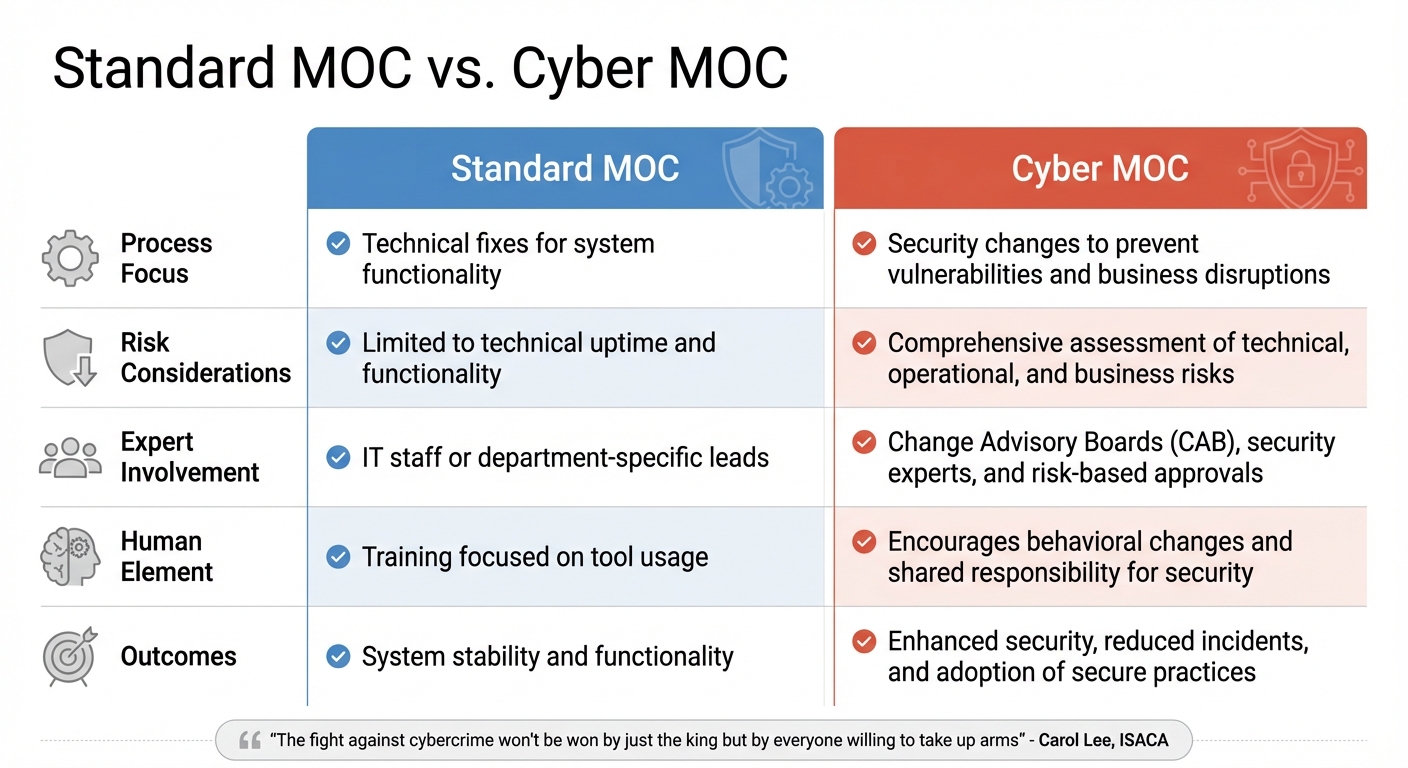
Standard MOC vs Cyber MOC: Key Differences in Change Management
This section delves into how Cyber MOC differs from standard MOC, particularly in how each manages risks and assigns responsibilities.
The core distinction between standard Management of Change (MOC) and Cyber MOC lies in their focus areas. Traditional MOC prioritizes technical fixes to maintain system stability and meet functional needs. Cyber MOC, however, goes beyond this by addressing security changes to ensure they don’t introduce vulnerabilities or disrupt business operations [3].
This evolution reflects the growing complexity of today’s threat landscape, which traditional MOC processes weren’t designed to handle. Carol Lee, CISM, CRISC, CDPSE at ISACA, highlights this shift:
"Taking a behavior/culture change program approach rather than a traditional awareness program, we can more effectively address the human-related factors of cyber threats" [1].
Cyber MOC also brings additional layers of accountability, such as risk-based approval tiers and rollback procedures - elements often absent from standard MOC [3]. Moreover, Cyber MOC includes a monitoring phase lasting 24–48 hours post-implementation to identify and resolve any underlying issues [3].
Comparison Table
| Category | Standard MOC | Cyber MOC |
|---|---|---|
| Process Focus | Technical fixes for system functionality [3] | Security changes to prevent vulnerabilities and business disruptions [3] |
| Risk Considerations | Limited to technical uptime and functionality [3] | Comprehensive assessment of technical, operational, and business risks [3] |
| Expert Involvement | IT staff or department-specific leads [3] | Change Advisory Boards (CAB), security experts, and risk-based approvals [3] |
| Human Element | Training focused on tool usage [1] | Encourages behavioral changes and shared responsibility for security [1] |
| Outcomes | System stability and functionality [3] | Enhanced security, reduced incidents, and adoption of secure practices [1][3] |
This comparison highlights the shift toward a collaborative approach in Cyber MOC, emphasizing shared responsibility for cybersecurity. As Carol Lee insightfully puts it:
"The fight against cybercrime, like the fight in an ancient castle, won't be won by just the king but by everyone willing to take up arms" [1].
Conclusion
Blending cybersecurity with change management has become essential for businesses to stay afloat. With the average data breach costing a staggering $4.45 million in 2023 [1] and global cybercrime expected to hit $10 trillion by 2025 [2], companies simply can’t afford to treat security as an afterthought.
The key is to embed security into the process from the very beginning - not as a last-minute addition [2]. When cybersecurity is integrated early, it becomes a tool for smoother transitions, reducing resistance, avoiding costly rework, and building systems that can withstand threats.
The move from traditional Management of Change (MOC) to Cyber MOC marks a significant shift in how organizations view security. Using frameworks like ADKAR and emphasizing security as a shared responsibility - not just an IT issue - helps address the human challenges that technology alone can’t solve. This is especially important since cybercriminals now target people more often than machines [1]. By reframing security in this way, companies can foster collaboration across departments and teams.
Cross-functional teamwork is the backbone of success. Steering committees that include both cybersecurity and change management experts create shared accountability for risks. Engaging employees through creative approaches - like gamification, breach simulations, and ongoing feedback - helps cement secure behaviors and reinforces the idea that everyone plays a role in protecting the organization.
Aligning cybersecurity with transformation goals doesn’t just protect your workforce - it ensures your business thrives in the digital age. When security and change management work hand in hand, organizations can navigate digital transformation with confidence and success.
Tech Leaders supports technical leaders in weaving cybersecurity into change management strategies, driving forward bold and secure transformations.
FAQs
When should cybersecurity be involved in a change initiative?
Incorporating cybersecurity from the very beginning of any change initiative is crucial. By addressing security risks early, organizations can implement changes in a way that minimizes vulnerabilities and prevents disruptions. Even seemingly minor adjustments can lead to significant security challenges if not handled carefully. Proactive planning ensures that safety and operational stability remain intact throughout the process.
How is Cyber MOC different from standard change management?
Cyber MOC (Cybersecurity Management of Change) takes a distinct approach by weaving cybersecurity measures directly into the change management process. Unlike traditional change management, which focuses on ensuring seamless transitions within an organization, Cyber MOC zeroes in on identifying and mitigating security risks that arise during changes to systems, processes, or policies. By embedding security controls, conducting risk assessments, and ensuring compliance at every step, it helps minimize vulnerabilities that might otherwise go unnoticed in standard change management practices.
What metrics prove a security-focused change was successful?
Metrics that show whether a security-focused change is working include the success rate of implemented changes and the change failure rate. These metrics highlight how smoothly security measures are incorporated into workflows and how consistently they perform over time, giving insight into their overall effectiveness.