

Data-Driven vs. Intuition-Based Leadership
Leaders often face a choice: rely on data or trust their instincts. Both approaches have strengths and weaknesses, and the best decisions often combine the two. Here's a quick breakdown:
- Data-Driven Leadership: Focuses on facts, analytics, and measurable insights. It's objective, scalable, and reduces bias but can lead to overanalysis or fail in unpredictable scenarios.
- Intuition-Based Leadership: Relies on experience and gut feeling. It's quick and effective in uncertain situations but risks bias, emotional interference, and inconsistency.
Key Insight: The most effective leaders blend both approaches - using data for clarity and intuition for context. For example, Netflix combines viewer analytics with creative instincts to make decisions.
Quick Comparison:
| Aspect | Data-Driven Leadership | Intuition-Based Leadership |
|---|---|---|
| Strengths | Objective, measurable, risk-reducing | Fast, flexible, works in uncertainty |
| Weaknesses | Overanalysis, outdated data | Bias, emotional clouding |
| Best For | Structured, repeatable decisions | Ambiguous, fast-moving situations |
Leaders thrive by balancing both methods, ensuring decisions are informed yet flexible.
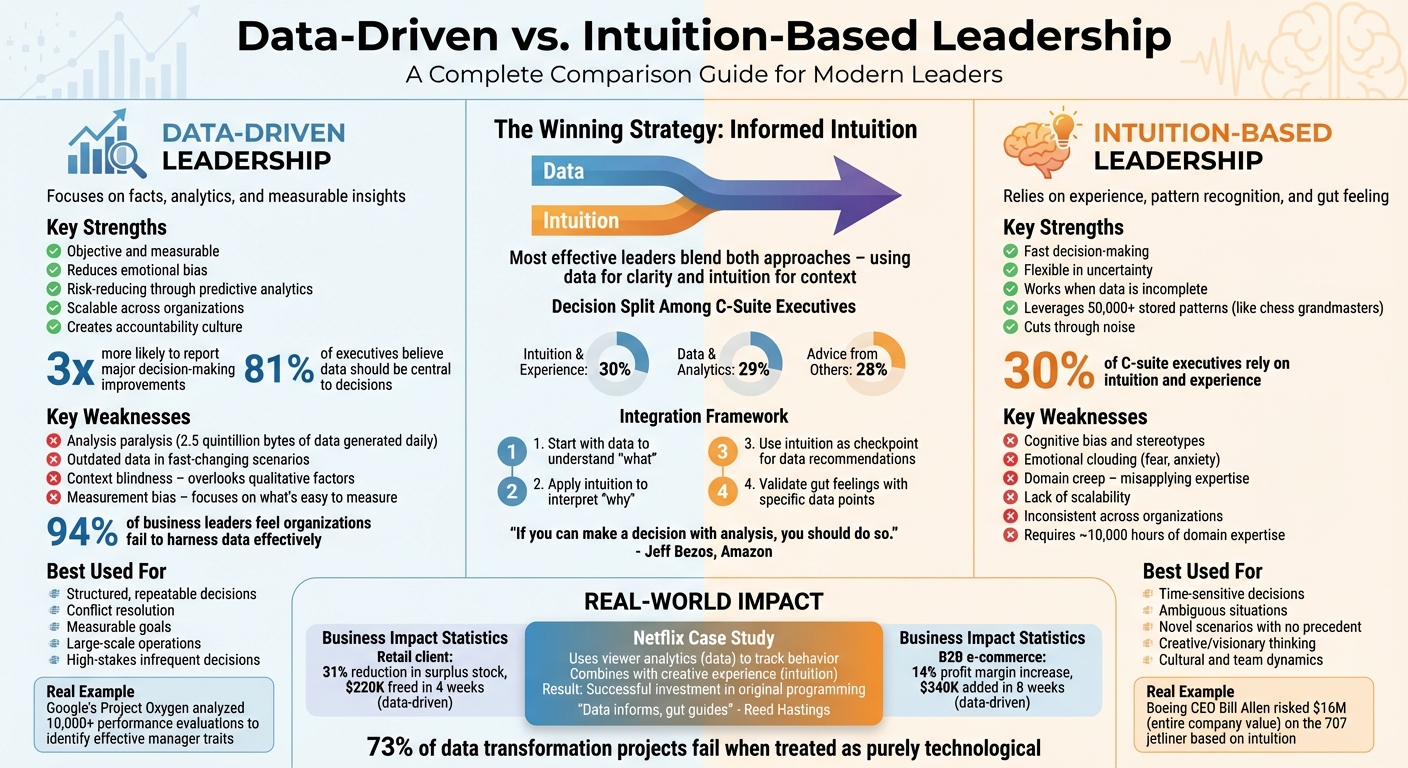
Data-Driven vs Intuition-Based Leadership: Complete Comparison Guide
Data-Driven Leadership: Pros and Cons
Benefits of Data-Driven Leadership
Relying on data removes emotional bias from decision-making. When leaders base their choices on measurable facts and verified metrics, they avoid personal judgments that could cloud their reasoning [3].
Organizations that embrace data-driven strategies often outperform their competitors in both productivity and profitability [7]. In fact, these organizations are three times more likely to report major improvements in decision-making [1].
Predictive analytics is another advantage, allowing leaders to spot potential problems early and adjust strategies to minimize risks [4]. Take Google's Project Oxygen, for example - it reviewed over 10,000 performance evaluations to identify traits of effective managers [1].
Data-driven methods also grow with the organization. Consider a retail client with 12 locations and $28 million in revenue. By leveraging data analytics, they tackled seasonal inventory issues, cutting surplus stock by 31% and freeing up $220,000 in working capital in just four weeks [7]. Similarly, a B2B e-commerce company used pricing data to increase profit margins by 14%, adding $340,000 in profit within eight weeks [7].
This approach also fosters accountability. Leaders shift from saying, "I think", to "the data shows", creating a culture of evidence-based decision-making. It's no wonder that 81% of executives believe data should be central to all decisions [10].
However, while the benefits are clear, data-driven leadership is not without its challenges.
Drawbacks of Data-Driven Leadership
Data-driven strategies can struggle in unpredictable situations. In rapidly changing environments - what Nassim Taleb describes as "black swan" events - historical data can quickly lose relevance [8]. For instance, the COVID-19 pandemic rendered pre-2020 consumer behavior data ineffective in predicting lockdown shopping habits or the sudden shift to remote work.
Another issue is analysis paralysis. With 2.5 quintillion bytes of data generated daily, it’s easy for leaders to feel overwhelmed [1]. When faced with conflicting datasets or unclear evidence, decision-making can stall - a costly delay in fast-moving industries.
The infamous "New Coke" fiasco highlights the risks of focusing on the wrong metrics. Coca-Cola relied heavily on taste-test data, which showed a preference for the new formula. However, they overlooked customers' emotional attachment to the original product, resulting in a major backlash [12]. This demonstrates the danger of prioritizing what’s easy to measure over what truly matters, like brand loyalty.
Data-driven methods can also create tunnel vision. Leaders might fixate on internal metrics, missing broader trends or qualitative insights, such as employee morale or customer sentiment [1]. A stark example is the May 2010 flash crash on Wall Street, where automated systems - operating without human oversight - turned a small market anomaly into a massive disruption within minutes [12].
Finally, poor data quality can derail decisions. Flawed or manipulated data leads to incorrect conclusions. Despite the potential of data-driven decision-making, 94% of business leaders feel their organizations fail to harness data effectively, and 78% of analytics leaders report difficulties in aligning data with business priorities [12].
Data-Driven Leadership Comparison Table
| Advantage | Limitation |
|---|---|
| Objectivity: Reduces emotional bias and avoids false assumptions [3] | Obsolescence: Historical data can lose relevance in fast-changing scenarios [8] |
| Risk Mitigation: Predictive analytics help address problems early [4] | Analysis Paralysis: Too much data can slow decisions [1] |
| Scalability: Supports growth with consistent processes [4] | Context Blindness: Overlooks emotional and qualitative factors [12] |
| Accountability: Decisions are based on evidence, not intuition [7] | Measurement Bias: Focus on quantifiable metrics can miss critical elements [11] |
| Pattern Recognition: Identifies trends in complex data [4] | Data Quality Issues: Poor or manipulated data leads to flawed outcomes [12] |
Intuition-Based Leadership: Pros and Cons
Benefits of Intuition-Based Leadership
Intuition allows leaders to act decisively when time is short and waiting for complete data could mean missing critical opportunities [4][3]. In fast-paced environments, this ability to make quick decisions can be a game-changer.
Our brains process intuition through advanced pattern recognition, drawing on countless stored experiences to navigate complex situations. Chess grandmasters, for instance, can rely on as many as 50,000 stored patterns in their long-term memory to make moves without overanalyzing [1][9]. Similarly, seasoned leaders use this same mechanism to handle intricate business challenges.
Take Boeing CEO Bill Allen in the 1950s. He risked $16 million - essentially the entire value of the company at the time - on the 707 jetliner, betting on the growth of commercial air travel despite Boeing's defense-only background. His intuition paid off, reshaping the aviation industry [3]. Decades later, Jeff Bezos trusted his gut when approving Amazon Prime. A junior engineer pitched the idea of fast, free shipping, and Bezos’s instinctive decision created one of the most successful loyalty programs ever [9].
Intuition also proves invaluable in uncertain and volatile conditions where historical data is incomplete, contradictory, or nonexistent [9][5]. It helps leaders cut through the noise, using a form of unconscious intelligence to push organizations forward despite conflicting evidence [1][3].
"Intuition is a form of unconscious intelligence that is as needed as conscious intelligence." - Gerd Gigerenzer, Psychologist, Max Planck Institute for Human Development [1]
Even today, intuition plays a key role in decision-making at the highest levels. A 2014 survey of C-suite executives found that decisions are nearly equally split among intuition and experience (30%), data and analytics (29%), and advice from others (28%) [9]. This highlights how, even in a data-driven world, intuition remains a vital tool for leaders.
While these strengths make intuition a powerful asset, it's not without its risks, which must be carefully managed.
Drawbacks of Intuition-Based Leadership
Despite its advantages, intuition-based leadership has notable challenges. One of the biggest concerns is bias - both conscious and unconscious - which can distort judgment. This might lead to decisions based on stereotypes or personal prejudices rather than sound reasoning [1][3][9].
"Intuition may pose a significant risk if the leader's conscious and unconscious biases adversely impact decision making." - Amit Choudhary, Expert in Change Management, Capgemini [3]
Another pitfall is domain creep, where leaders mistakenly apply intuition honed in one field to a completely different one. For example, strategies that work in manufacturing might fail in software development, yet leaders often assume their instincts transfer seamlessly [3].
Emotions can also muddy intuition. Feelings like fear, anxiety, or frustration might masquerade as "gut instincts", leading to reactive rather than thoughtful decisions [1]. This emotional interference can result in oversimplified views of complex situations, particularly when data is abundant but not fully understood [1].
"When not managed well, pattern recognition and trusting one's gut may lead to bias and incomplete or overly simplistic thinking, both of which are detrimental to making sound decisions." - Marcy Farrell, Insights Author, Harvard Business Publishing [1]
Relying solely on one leader's intuition can also be risky. Unlike data-driven approaches, which are replicable and scalable, intuition-based decisions are inherently subjective and inconsistent. This lack of structure makes it challenging to apply such decisions across a growing organization [4][3].
Finally, intuition without deep expertise - often requiring around 10,000 hours of practice in a specific field - can devolve into guesswork rather than informed judgment [9]. Balancing intuition with other decision-making tools is crucial for effective leadership.
Intuition-Based Leadership Comparison Table
| Advantage | Limitation |
|---|---|
| Speed: Enables quick decisions when time is limited [4][3] | Cognitive Bias: Can lead to decisions influenced by stereotypes or prejudices [1][3][9] |
| Pattern Recognition: Matches current situations to stored experiences [1][9] | False Patterns: May lead to acting on trends that don’t exist [1][9] |
| VUCA Navigation: Helps in volatile, uncertain, complex, and ambiguous environments [9][5] | Domain Creep: Poor outcomes when expertise is misapplied to unfamiliar fields [3] |
| Cuts Through Noise: Filters out irrelevant data and drives action [1][3] | Emotional Clouding: Decisions can be driven by stress or reaction rather than insight [1] |
| Human Context: Considers dynamics, sentiment, and relationships [4] | Lack of Scalability: Subjective decisions are harder to replicate as organizations grow [4] |
When to Use Each Leadership Approach
Best Situations for Data-Driven Leadership
Data-driven leadership shines when dealing with structured problems and reliable data. It's particularly effective in scenarios like resolving conflicts, setting measurable goals, or managing repetitive tasks - situations where objectivity is crucial. For instance, in high-stakes decisions that don’t come around often, data acts as a guiding light, helping leaders avoid biases and misplaced assumptions.
"If you can make a decision with analysis, you should do so." – Jeff Bezos, Founder, Amazon
This approach is also ideal when scalability and consistency are priorities. Organizations that base decisions on data report improvements three times more often than those that don’t [1]. Industries like e-commerce and digital marketing thrive on this method, as constant monitoring allows for quick adjustments in response to shifting market trends.
However, in situations where data is limited or rapidly changing, relying solely on this method may not be effective.
Best Situations for Intuition-Based Leadership
Intuition takes center stage when uncertainty is high, and data is either incomplete or unavailable. This is often the case when exploring new markets, experimenting with cutting-edge technologies, or navigating unpredictable events like the COVID-19 pandemic.
In fast-paced, time-sensitive scenarios - whether during emergencies or routine decisions - intuition can simplify complexity and help avoid the trap of overanalyzing. It’s also indispensable for the human aspects of leadership, like shaping company culture, managing team dynamics, or making moral judgments. Numbers alone can’t capture the subtleties of these areas. Interestingly, a survey of C-suite executives revealed that 30% rely on intuition and experience for decision-making, nearly matching the 29% who depend on data and analytics [9].
"Intuition is a form of wisdom, the gift of knowing without reasoning. When you're not forced to overthink things, it's amazing the clarity that emerges." – Dame Angela Ahrendts, Former CEO, Burberry
Intuition also plays a key role in fostering creativity and visionary thinking. When leaders need to look ahead and imagine possibilities beyond existing trends, intuitive insights can spark ideas that challenge conventional industry norms and lead to transformative innovations.
The table below highlights the key differences between the two approaches:
| Data-Driven Approach | Intuition-Based Approach |
|---|---|
| Conflict resolution | Quick, time-sensitive decisions |
| Clearly defined, measurable goals | Ambiguous or abstract situations |
| Structured, processed problems | Unstructured problem solving |
| Infrequent, unfamiliar "big-bet" decisions | Ad-hoc and daily decisions |
| Large-scale, repetitive tasks | Novel scenarios with no precedent |
Combining Data-Driven and Intuition-Based Leadership
Blended Decision-Making Methods
Leaders today are realizing that relying solely on data or intuition has its limits. The most effective decision-makers combine the two, creating what’s often referred to as "informed intuition." Netflix CEO Reed Hastings captures this idea perfectly, stating that while data informs decisions, it’s the gut that often guides them [3].
Data provides a clear picture of what’s happening - highlighting trends and patterns. Intuition, on the other hand, adds depth by interpreting the "why" behind the numbers, factoring in elements like company culture, team dynamics, and market sentiment. Together, they create a more complete framework for decision-making.
A practical way to apply this is by starting with a clear question and gathering only the data directly relevant to it [2]. Another approach is to use intuition as a checkpoint. If a data-driven suggestion doesn’t align with your experience, it could signal missing variables or potential biases that need further exploration.
When intuition and data seem to clash, labeling your emotions - like noting "anxiety despite positive metrics" - can help you determine whether there’s a genuine reason for caution or if bias is clouding your judgment. Techniques like pre-mortems, where you imagine a decision has failed and work backward to uncover potential pitfalls, can also reveal blind spots in both your data and your instincts.
This balanced approach is a hallmark of leadership at companies like Netflix, where blending analytics with creativity has proven to be a winning strategy.
Case Study: Netflix's Data and Creative Balance

Netflix offers a prime example of how combining data and intuition can lead to success. The company uses advanced viewer analytics to track behaviors - like what people watch, when they pause, and how they interact with content. But the final creative decisions aren’t left to algorithms alone. Reed Hastings and his team draw on their extensive creative experience to complement the data. This thoughtful balance allowed Netflix to confidently invest in original programming, even when traditional models failed to capture the changing demands of modern viewers.
Integration Scenarios Table
| Scenario | Data's Role | Intuition's Role | Example Outcome |
|---|---|---|---|
| New Product Launch | Analyzes market size and competitor pricing | Envisions creative possibilities and trends | Combines market potential with fresh ideas |
| Hiring Decisions | Verifies qualifications and test scores | Evaluates cultural alignment and "gut feel" | Attracts skilled candidates who fit the team |
| Crisis Management | Tracks real-time metrics and impact | Enables quick decisions in uncertain moments | Balances speed with calculated risk-taking |
| Strategic Pivots | Identifies declining trends in current models | Charts a course for unexplored opportunities | Merges evidence with forward-thinking vision |
sbb-itb-8feac72
How Tech Leaders Develop Both Leadership Styles
Building Technical and Leadership Skills Together
Tech Leaders helps engineers hone both analytical precision and intuitive decision-making through what they call "informed intuition." This concept blends data-driven analysis with the wisdom gained from experience, ensuring that while data forms the backbone of decisions, instincts play an equally important role in guiding the outcome [6][3]. Engineers, who often excel at crunching numbers, are encouraged to trust and refine their instincts alongside their analytical skills.
The training incorporates a mix of System 1 and System 2 thinking. System 1, or intuitive thinking, helps generate ideas quickly, while System 2, the analytical side, validates those ideas with data [9]. For example, when considering a major strategic shift, intuition might highlight an opportunity, but structured analysis ensures the decision is sound. This balance prevents overanalyzing situations while avoiding rash, uninformed choices.
Another key component is diagnostic filtering - using intuition as a first pass to evaluate AI-generated insights. If something feels off about an algorithm's recommendation, it prompts a deeper dive into the data [9]. Additionally, the program emphasizes building "experiential intelligence", which encourages professionals to draw on their past successes and failures to interpret data in a more creative and meaningful way [4].
Leadership Training for AI-Driven Industries
This technical foundation transitions seamlessly into leadership strategies designed for industries shaped by AI. Tech Leaders provides frameworks like the 3Q Method - centered on Quick diagnostics, Quantified ROI, and Qualified success metrics - to help professionals move from relying solely on gut instincts to fostering a culture grounded in data-based decision-making [7]. This is crucial, particularly when considering that 73% of data transformation projects fail because they are treated as purely technological shifts rather than changes in organizational behavior [7].
The program also focuses on developing quantitative intuition (QI) - a skill that combines numerical analysis with human judgment refined through experience and observation [2]. Participants learn practical techniques like back-of-the-envelope calculations to check the plausibility of data and use "IWIK" (I Wish I Knew) questions to identify the most critical metrics [2]. These abilities are vital for technical professionals stepping into leadership or independent consulting roles, where they must make strategic decisions that go beyond what algorithms can determine.
How to Make Data-Driven Business Decisions | Jacob Morgan
Conclusion
The best leaders don’t see data and intuition as opposing forces - they use both to make well-rounded decisions. Data brings clarity, reduces risks, and highlights patterns critical for crafting strategies. On the other hand, intuition delivers speed, creativity, and the ability to navigate situations where uncertainty reigns. Studies show that successful leaders rely almost equally on both approaches, emphasizing the importance of finding the right balance.
The trick lies in knowing when to lean on each. Data works well in conflict resolution, high-stakes decisions, and cases with a clear historical precedent. Intuition, however, shines in fast-paced, ambiguous, or entirely new scenarios where data may not be available or sufficient [3]. As Jeff Bezos famously said:
"If you can make a decision with analysis, you should do so. But it turns out in life that your most important decisions are always made with instinct and intuition, taste, and heart" [9].
The key is developing what some call “informed intuition.” This means letting data guide you but making the final call with insight and experience. For instance, intuition might help you identify questionable AI recommendations, which you can then validate with specific data points [4][9]. This method avoids both overanalyzing and impulsive decision-making.
As discussed earlier, successful leaders adjust their approach based on the situation. They use data for precision and rely on intuition when facing uncertainty. Those who excel at blending these methods often develop a skill called quantitative intuition - combining numerical know-how with the wisdom gained through experience [2]. This is especially vital in AI-driven industries, where data is plentiful but human judgment and contextual understanding remain irreplaceable. The ultimate goal is to leverage the strengths of both approaches for smarter, more effective decisions.
FAQs
How can leaders balance data-driven decisions with intuition effectively?
To make well-rounded decisions, leaders should rely on data as the backbone of their strategy while using intuition to interpret the subtleties that numbers might miss. Start by collecting relevant metrics, analyzing trends, and spotting patterns - this minimizes bias and creates a factual framework for action. Then, layer in personal experience, industry expertise, and team insights to address gray areas where data alone may not provide clarity, such as shifts in workplace dynamics or unpredictable customer behavior.
One effective method is to use decision-making checklists that combine a thorough data review with a qualitative "gut-check" comment. Another is to encourage team discussions where analysts and seasoned professionals collaborate to align data findings with practical intuition. This blend of approaches equips leaders to make sharper, more adaptive decisions, especially in fast-moving or uncertain scenarios.
Programs like Tech Leaders help professionals master these skills, teaching them how to turn analytics into actionable strategies while honing their ability to spot patterns and adjust quickly in today’s AI-focused landscape.
What are the risks of relying only on data or intuition when making decisions?
Relying entirely on data might seem like a safe bet, but it can create blind spots. While numbers give an impression of precision, they often lack the context and subtlety needed for well-rounded decisions. Incomplete or low-quality data can skew perspectives, amplifying biases and leading to shallow conclusions. Plus, leaning too heavily on data can slow down decision-making or make it overly rigid by sidelining human judgment.
On the flip side, relying purely on intuition has its pitfalls. Intuition is shaped by personal experiences and biases, which can make decisions overly subjective and less adaptable to new trends or patterns. Without data to back it up, intuition risks missing key insights, especially in situations where rapid changes demand a broader perspective.
The sweet spot lies in combining the two. When leaders balance data-driven insights with intuition, they create a decision-making process that’s both grounded in measurable facts and enriched by creativity and context - something numbers alone can't achieve.
When is intuition-based leadership more effective than data-driven decision-making?
Intuition-based leadership shines in scenarios where data is scarce, incomplete, or simply too slow to gather. Think about high-stakes moments - like managing a crisis, making split-second decisions, or responding to sudden market changes. In these situations, leaders often don’t have the luxury of waiting for detailed analysis. Instead, they rely on their experience and gut instinct to act quickly and decisively. This approach is equally useful when facing ambiguous challenges, such as breaking into new markets or navigating large-scale organizational shifts, where numbers alone might not tell the whole story.
There are also times when data itself can be misleading - whether it’s noisy, biased, or overly tied to past trends. Overanalyzing in such cases can lead to analysis paralysis, delaying decisions that need to happen fast. Seasoned leaders know how to balance the tangible and intangible, factoring in elements like team morale, brand reputation, or subtle emerging trends that are hard to measure. By combining intuition with data-driven insights, leaders can adapt more effectively to fast-changing environments, especially as AI continues to reshape how decisions are made.