
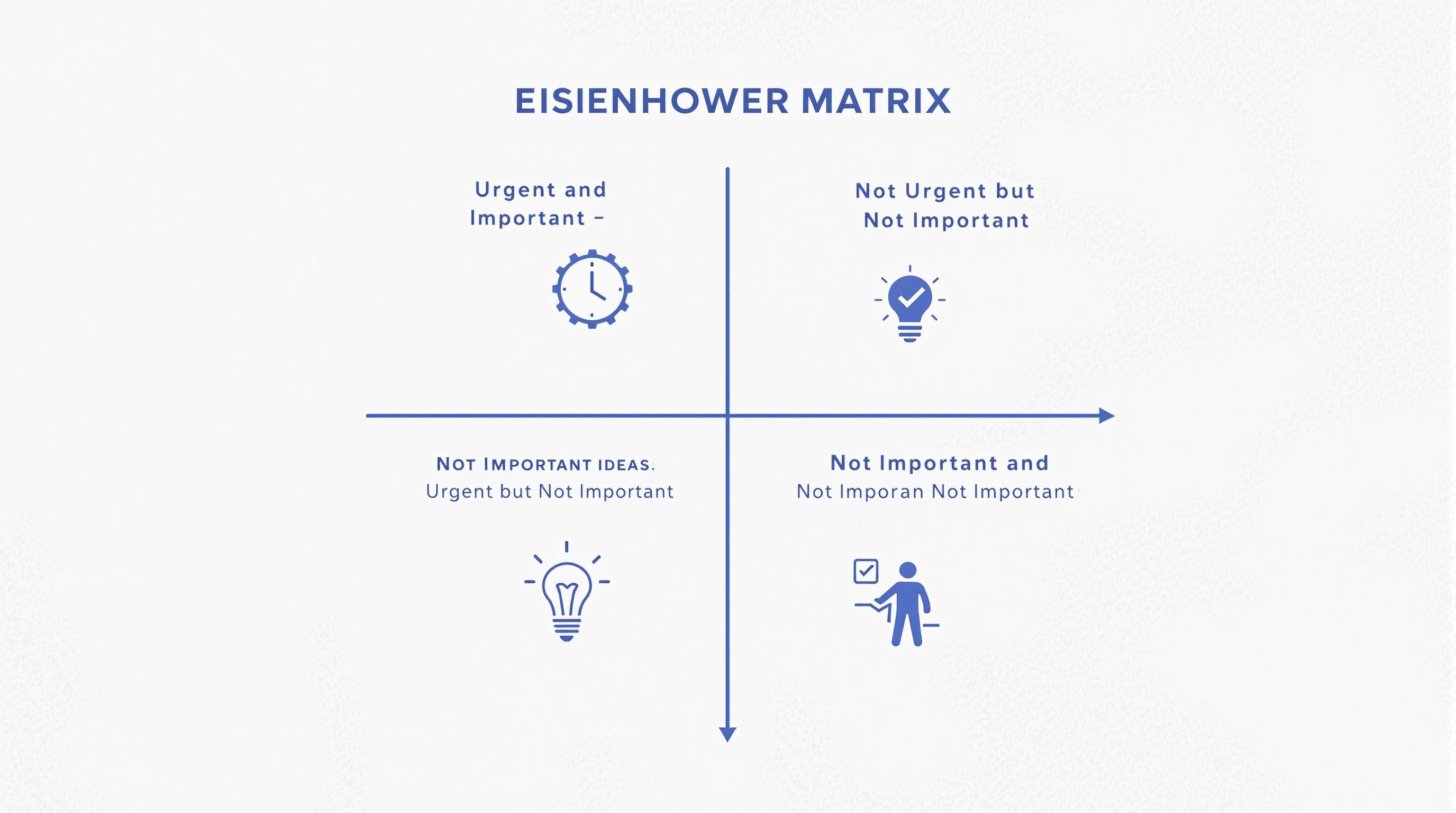
Eisenhower Matrix for Engineers in Leadership
The Eisenhower Matrix is a simple tool to help engineering leaders prioritize tasks by urgency and importance. It’s perfect for balancing technical responsibilities with leadership duties, especially when transitioning from an individual contributor role. Here’s how it works:
- Quadrant 1 (Important & Urgent): Handle immediately (e.g., system outages, security risks).
- Quadrant 2 (Important & Not Urgent): Schedule and plan (e.g., team development, architecture improvements).
- Quadrant 3 (Not Important & Urgent): Delegate (e.g., routine updates, minor bugs).
- Quadrant 4 (Not Important & Not Urgent): Eliminate or minimize (e.g., unnecessary meetings).
Key Benefits for Leaders:
- Streamlined Decision-Making: Focus on what matters most.
- Better Delegation: Empower your team by assigning tasks.
- Balanced Focus: Manage technical and leadership priorities effectively.
Use tools like Trello, Notion, or Asana to create your matrix and adapt it to your workflow. Regular updates and integration with agile methods ensure it remains effective. Start using the Eisenhower Matrix today to improve productivity and lead with clarity.
The Eisenhower Matrix Basics
Matrix Definition and History
The Eisenhower Matrix, inspired by President Dwight D. Eisenhower's method for prioritizing military and presidential decisions, helps organize tasks based on their urgency and importance. This structured approach aligns with the analytical mindset engineers often use in problem-solving, making it particularly useful for engineering leaders. Its lasting appeal lies in turning complex decision-making into a simple, actionable framework [2].
4 Matrix Quadrants
The matrix splits tasks into four categories, each requiring a different approach:
| Quadrant | Category | Action Required | Engineering Leadership Examples |
|---|---|---|---|
| Q1 | Important & Urgent | Act immediately | Critical system outages, immediate security risks |
| Q2 | Important & Not Urgent | Plan and schedule | Team development, architecture improvements |
| Q3 | Not Important & Urgent | Delegate to others | Routine updates, non-critical bug fixes |
| Q4 | Not Important & Not Urgent | Eliminate or minimize | Unnecessary meetings, low-priority admin tasks |
Benefits for Engineering Leaders
For engineering leaders moving from technical roles to leadership, the Eisenhower Matrix provides practical advantages [1][4]:
- Simplifies Prioritization: Reduces decision fatigue by offering clear criteria.
- Encourages Delegation: Helps leaders assign tasks to team members for growth.
- Balances Roles: Supports managing technical work alongside leadership duties.
- Supports Strategic Focus: Keeps attention on long-term, impactful goals.
By limiting tasks to 10 per quadrant, leaders can avoid feeling overwhelmed and maintain focus on what truly matters [2].
Tech Leaders, a provider of engineering leadership training, highlights that using the Eisenhower Matrix effectively can ease the shift from individual contributor to leader. It bridges the gap between technical skills and leadership responsibilities during this critical career transition [4].
Now equipped with its structure and benefits, engineering leaders can begin applying the Eisenhower Matrix to their specific challenges and responsibilities.
Using the Matrix in Engineering Leadership
Engineering Leadership Task Examples
The Eisenhower Matrix is a powerful tool for organizing leadership tasks. Here's how you can map common engineering leadership responsibilities into its four quadrants:
| Quadrant | Task Examples | Recommended Action | Time Allocation |
|---|---|---|---|
| Q1: Important & Urgent | • Production outages • Security incidents • Critical project deadlines |
Address immediately | 15-20% |
| Q2: Important & Not Urgent | • Team skill development • Architecture planning • Performance reviews |
Block out dedicated time | 40-50% |
| Q3: Urgent & Not Important | • Routine maintenance • Non-critical emails • Status updates |
Assign to team members | 25-30% |
| Q4: Not Important & Not Urgent | • Redundant processes • Low-impact meetings • Non-essential admin work |
Minimize or remove | 5-10% |
These percentages are flexible and serve as a guide to help you manage your time effectively.
After categorizing tasks, the next step is personalizing the matrix to match your specific leadership style and responsibilities.
Creating Your Matrix
Organizing and Prioritizing Tasks
Begin by listing all your tasks, covering both technical and leadership aspects. Assess each task based on its impact on system stability, team efficiency, alignment with business goals, and resource use. Use these factors to place tasks into the appropriate quadrants and outline actions for each.
With the Eisenhower Matrix, you can find the right balance between managing technical issues and focusing on leadership priorities.
Digital Matrix Tools
Digital tools can simplify managing your Eisenhower Matrix and keep your team aligned:
| Tool | Key Features | Best For |
|---|---|---|
| Trello | • Custom boards • Automation • Team collaboration |
Visual task tracking |
| Notion | • Databases • Integration with dev tools • Custom views |
Centralized documentation |
| Asana | • Timelines • Workload insights • Reporting tools |
Organizing project workflows |
Notion, for instance, allows automation with platforms like GitHub and Jira, making it easier to integrate your matrix with ongoing development tasks.
Improving Leadership with the Matrix
Focus on Long-term Tasks
Quadrant 2 tasks, while not urgent, play a key role in driving team growth and achieving long-term success for engineering leaders. Studies reveal that leaders who prioritize these tasks see better team performance and experience less stress [2].
Set aside dedicated time each day for Q2 tasks, and review progress monthly. This approach ensures that strategic projects remain on track and that long-term goals are not overlooked. Consistently working on these tasks builds accountability and keeps big-picture initiatives moving forward.
At the same time, effective delegation is critical. It allows leaders to focus on these long-term objectives without getting bogged down by day-to-day operational demands.
Delegation Methods
Delegating Q3 tasks is a smart way for leaders to free up their time for more impactful Q1 and Q2 priorities. Here's a quick breakdown of delegation strategies:
| Delegation Level | Task Type | Expected Outcome |
|---|---|---|
| Full Autonomy | Operational Tasks | Team member takes ownership with leader's guidance |
| Collaborative | Strategic Planning | Leader and team member collaborate on decisions |
"Delegation involves relinquishing control without relinquishing responsibility." [1]
To delegate effectively, define clear outcomes, communicate expectations, and set up feedback systems. Create an environment where team members feel safe to learn and grow. By doing so, leaders can strike a balance between their technical expertise and broader leadership duties.
Technical and Leadership Balance
Using the Eisenhower Matrix can significantly improve productivity and job satisfaction [2][3]. It helps leaders prioritize leadership tasks while allowing them to stay involved in critical technical decisions.
To achieve this balance:
- Devote most of your time to leadership tasks (60-70%)
- Stay technically engaged by focusing 20-30% of your time on key decisions
- Minimize administrative work (10-20%) through delegation and automation
This structured time allocation helps engineering leaders maintain their technical credibility while focusing on the leadership responsibilities that drive team success [1].
sbb-itb-8feac72
Common Matrix Implementation Issues
Handling Priority Changes
In fast-moving tech environments, engineering leaders often struggle to keep their Eisenhower Matrix effective. Balancing shifting technical and team priorities with long-term goals can be tricky.
To stay on top of changing priorities, try these strategies: set up a weekly review system, use a digital matrix for quick updates, and create a buffer zone for unexpected tasks. These steps can help you adjust without losing sight of your main objectives.
When new urgent tasks come up, don’t automatically assign them to the "Do First" quadrant. Instead, compare them to your current priorities. This helps avoid the common mistake of overloading the urgent category.
Matrix Use in Agile Teams
Combining the Eisenhower Matrix with agile workflows takes careful planning. The secret is linking matrix quadrants with sprint phases while staying flexible for changes [1][3].
| Sprint Phase | Matrix Integration |
|---|---|
| Planning | Match Q1 tasks with sprint objectives |
| Execution | Flag Q2 tasks for potential next sprint |
| Retrospective | Check if task categorization worked well |
| Backlog Refinement | Sort new backlog items into matrix quadrants |
By syncing the matrix with sprint cycles, leaders can balance pressing needs with broader goals. Many organizations using two-week sprints have found this approach effective [1].
Matrix Maintenance
A common issue is treating the matrix as static instead of updating it regularly [1][5]. To keep it useful, schedule weekly reviews to adjust task categories, monitor quadrant completion rates to improve categorization, and meet with team leads monthly to validate workloads.
For extra help, consider training programs like those offered by Tech Leaders. They provide tailored guidance on integrating tools like the Eisenhower Matrix into leadership workflows, making adoption smoother.
A well-maintained matrix sets the stage for exploring other tools and strategies to boost leadership skills further.
Leadership Support Resources
Leadership Training Options
Tech Leaders offers programs that combine technical expertise with leadership development. These include modules on using the Eisenhower Matrix effectively, blending peer mastermind sessions with one-on-one coaching for practical application.
For those looking to master the matrix through hands-on training, here are some popular options:
| Training Type | Focus Area | Time Commitment |
|---|---|---|
| Individual Coaching | Tailored matrix strategies | 2-3 hours weekly |
| Team Workshops | Integrating the matrix with agile methods | 4-6 hours monthly |
| Leadership Masterminds | Peer-driven learning and insights | 2 hours bi-weekly |
In addition to structured programs, self-paced resources can help deepen your understanding of the Eisenhower Matrix.
Learning Materials
The platform Eisenhower.me offers tutorials and examples designed to meet the needs of technical leaders.
Here’s a quick look at what’s available:
| Resource Type | Purpose | Key Benefits |
|---|---|---|
| Video Tutorials and Case Studies | Real-world matrix applications | Engaging and practical insights |
| Digital Tools | Automating the matrix process | Streamlined tracking |
Even though self-learning is helpful, interacting with others can provide new ideas and practical advice.
Leadership Networks
Connecting with engineering leadership communities can sharpen your matrix skills and improve time management techniques.
| Network Type | Value | Suggested Involvement |
|---|---|---|
| Professional Forums | Share and discuss best practices | Weekly participation |
| Mentorship Programs | One-on-one guidance | Monthly sessions |
| Industry Groups | Tailored sector-specific advice | Quarterly meetups |
Participating in these groups not only strengthens your matrix approach but also introduces you to diverse leadership insights.
Beginner's Guide to the Eisenhower Matrix
Conclusion
The Eisenhower Matrix is a practical tool for engineering leaders to prioritize tasks based on urgency and importance. It helps streamline time and resource management, especially for those transitioning into leadership roles. This framework offers a clear method to handle competing priorities effectively.
By using the matrix, leaders can find a balance between overseeing technical work and managing leadership responsibilities. When applied thoughtfully, it can lead to sharper strategic focus, stronger team management, personal development, and better project outcomes [1].
Consistently applying the matrix while staying flexible to evolving priorities and team needs allows leaders to make smarter decisions and support team growth [1][3]. It equips leaders to juggle technical oversight and leadership roles, driving both innovation and operational success.
For additional leadership development, explore the training programs and tools highlighted in this guide.