

Ethical Leadership in AI: Transparency Guide
AI is reshaping industries, but without transparency, trust erodes. Here's why transparency is critical and how leaders can implement it effectively:
- Transparency builds trust: It ensures AI decisions are understandable, reducing risks of bias and errors.
- Key principles: Equity (fair decision-making), accountability (clear responsibility for outcomes), and privacy (data protection).
- Actionable strategies: Ethics impact assessments, explainable AI techniques, and detailed documentation like model cards.
- Leadership's role: Prioritize transparency through governance, clear accountability, and user-centered communication.
- Measuring success: Use metrics like documentation quality, user comprehension, and audit outcomes to track progress.
Transparency isn’t optional - it’s essential for ethical AI. Leaders must integrate it into every stage of AI system development to build trust and meet growing regulatory demands.
Transparency, Explainability, and Accountability in AI | Exclusive Lesson
Core Principles of AI Transparency
Creating transparent AI systems hinges on three key principles: equity, accountability, and privacy. These principles are the backbone of building trust in AI systems. While transparency provides a broad understanding of how a system is designed, explainability focuses on clarifying individual decisions to ensure trust in specific outcomes [4].
"Transparency is focused on promoting trust in the system, while explainability is concerned with establishing trust in specific outputs." - Lori Mac Vittie, Distinguished Engineer and Chief Evangelist, F5 [4]
These principles work together as a unified framework. Transparency lays the groundwork for accountability by revealing how decisions are made, while equity ensures fairness in the process. When these principles align, stakeholders can better understand, evaluate, and trust the outcomes of AI systems. Let’s take a closer look at how each principle supports transparency in AI.
Equity in Algorithmic Decisions
For an AI system to be trustworthy, fairness must be at the forefront. Equity means ensuring decisions are made without bias or discrimination based on race, gender, age, or other protected characteristics. It’s not just about treating everyone the same - it’s about providing what individuals need to engage fairly with the system [11]. Addressing equity requires tackling three sources of bias: data bias (flawed or unrepresentative training data), development bias (issues in algorithm design), and interaction bias (problems arising from user engagement) [12].
The risks are real. A study of 8,579 digital slides from The Cancer Genome Atlas revealed that AI systems could identify the submitting medical institution with 70% to 86% accuracy. This means that site-specific patterns, not medical data, were influencing outcomes [12]. Similarly, in laboratory medicine, roughly 20% of coagulation and cardiac tests had incorrect Logical Observation Identifiers, Names, and Codes (LOINC), leading to biased results [12].
To address these challenges, diversify datasets by including underrepresented groups and conduct subgroup validation tests to measure performance across different demographics [12]. Microsoft’s Phi model team offers an example of this in practice. Between 2024 and early 2025, they implemented a "break-fix" framework, conducting rigorous pre-deployment reviews through their Responsible AI Community. This process helped identify and mitigate risks before releasing three collections of small language models [2].
Transparency in equity also involves explaining the reasoning behind decisions. For example, if a hiring algorithm gives more weight to certain qualifications to promote diversity, disclose that reasoning clearly. Providing "truthful and meaningful" explanations about input features, correlations, and technical logic builds trust [1].
Accountability Mechanisms
Accountability ensures that clear responsibility is assigned for AI outcomes, keeping humans in control of automated decisions. Every AI system must have a designated human contact - someone users can approach to question or challenge decisions [1]. This creates a "chain of accountability", supported by documentation, audits, and actionable follow-ups [5].
"Accountability means taking responsibility for complying with the other data protection principles, and being able to demonstrate that compliance." - Information Commissioner's Office (ICO) [1]
The challenge is significant. In 2024, 77% of cases reviewed by Microsoft’s Sensitive Uses and Emerging Technologies team involved generative AI [2]. To meet this challenge, organizations should document data sources, model versions, and test results to ensure repeatability and enable audits [13]. Establish clear workflows for addressing errors or biases, and have fallback systems ready to deploy if issues arise [10].
The National Telecommunications and Information Administration (NTIA) highlights this responsibility:
"AI system developers and deployers should have mechanisms in place to prioritize the safety and well-being of people and the environment and show that their AI systems work as intended and benignly." [5]
Regular reviews are also crucial. Set intervals to check whether the system still meets its intended purpose and whether new biases have emerged due to data drift [13]. Microsoft has taken steps in this direction, releasing 30 responsible AI tools with over 155 features to help customers build ethical AI systems [2].
Privacy and Data Governance
The third pillar of AI transparency is privacy, which involves safeguarding personal data and being upfront about how it’s collected, used, and shared. As the ICO explains, "Transparency means being open and honest about who you are, and how and why you use personal data" [1].
A strong approach to privacy begins with data minimization - collecting only the information necessary for specific purposes. This reduces risks and conserves resources [11]. It’s also critical to set expiration dates for stored data, as holding onto information indefinitely increases security risks and can compromise model reliability [11].
Inform users in advance about AI decisions and their purpose [1]. Transparency Notes - documents that outline an AI system’s capabilities, limitations, and inner workings - can help users make informed choices [6]. For example, in May 2024, LinkedIn became the first professional networking platform to include C2PA Content Credentials for all AI-generated images and videos. This allowed users to easily identify AI-generated content [2].
Be clear about how long you’ll retain data and whether it will be shared with third parties [6]. If customer data is used to train AI models, disclose this practice. Similarly, if your system makes inferences about sensitive attributes, explain how those inferences are generated and protected. The OECD framework emphasizes the importance of transparency, stating that AI developers should "commit to transparency and responsible disclosure regarding AI systems... to enable those affected by an AI system to understand the output" [9].
"If a company values its stakeholders above shareholders, then the choice to minimize harm to individuals over maximizing (short-term) revenue is always the right choice." - Steven Tiell, Nonresident Senior Fellow, Atlantic Council [11]
Building a Transparency Framework
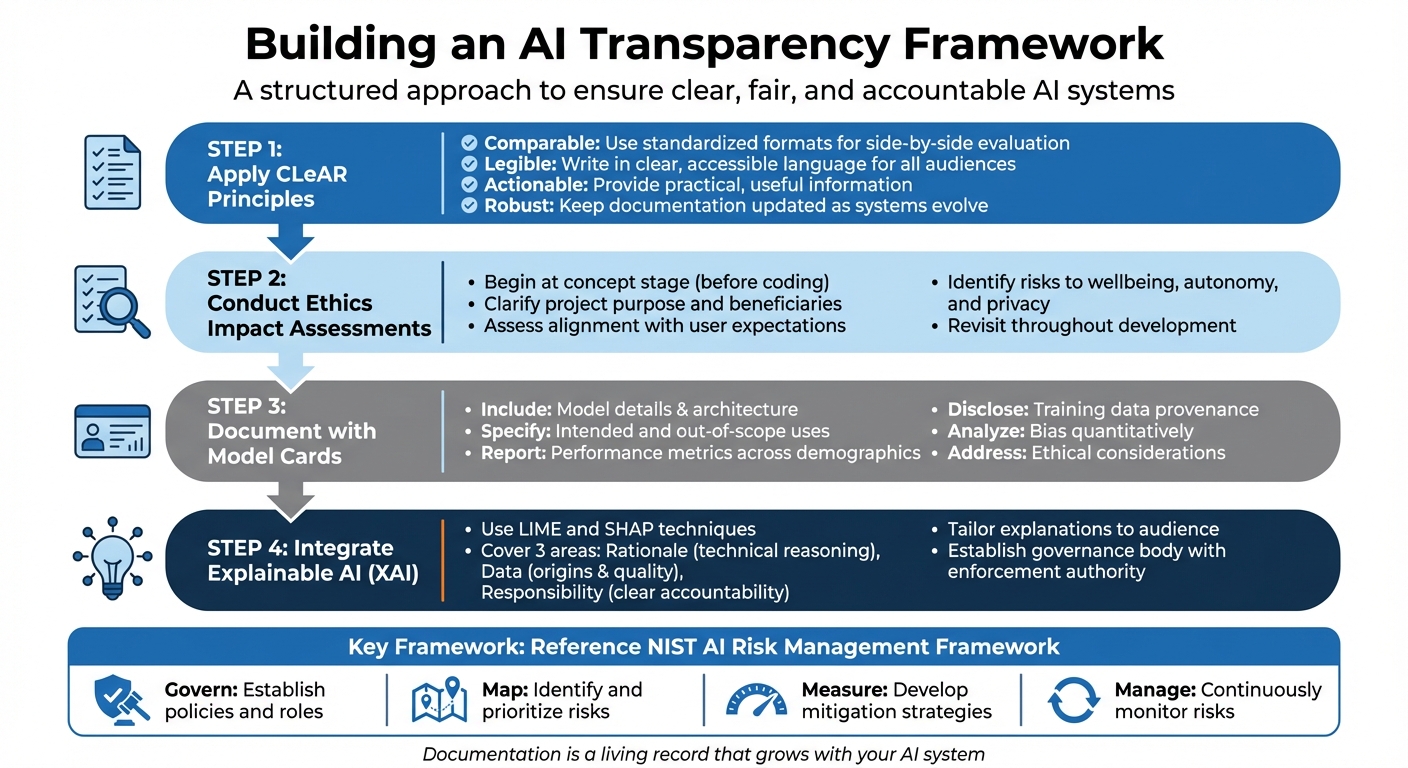
AI Transparency Framework: 4-Step Implementation Guide for Ethical Leadership
To ensure your AI systems are clear, fair, and accountable, it's essential to establish a framework that documents and explains their functionality at every stage. A transparency framework isn’t just about ticking boxes - it’s about creating a structured way to assess and communicate how your AI operates throughout its lifecycle. From the initial concept to ongoing monitoring, transparency should be embedded at every phase. For tech leaders, this approach is a cornerstone for building trust and ensuring accountability.
The CLeAR principles can guide effective documentation. These principles emphasize that documentation should be:
- Comparable: Use standardized formats to allow side-by-side evaluation of different systems.
- Legible: Write in clear, accessible language tailored to your audience - not just technical experts.
- Actionable: Provide information that’s practical and useful, not just theoretical.
- Robust: Keep documentation updated as your system evolves [3].
Think of your documentation as a "living record" that grows and adapts alongside your AI system.
Another valuable resource is the NIST AI Risk Management Framework, which focuses on four key areas: Govern (establishing policies and roles), Map (identifying and prioritizing risks), Measure (developing specific mitigation strategies), and Manage (continuously monitoring risks) [2]. This structured approach is particularly relevant in today’s fast-changing AI landscape. For example, in 2024, 77% of cases reviewed by Microsoft’s Sensitive Uses and Emerging Technologies team involved generative AI, underscoring the need for adaptable frameworks [2].
Your documentation should go beyond technical details to include the "why" behind your decisions. Highlight your initial motivations, explain your data collection choices, and describe the communities you engaged during development [3]. This level of detail lays the groundwork for thorough assessments and ethical accountability.
Conducting Ethics Impact Assessments
Once you’ve documented your AI system, the next step is to evaluate its ethical impacts. Ethics impact assessments are internal evaluations designed to identify potential issues before they become ingrained in your system. Often referred to as Algorithmic Impact Assessments, these reviews should begin at the concept stage, before any code is written [3].
Start by clarifying your project’s purpose: What problem are you addressing, and who stands to benefit? Then, assess whether your AI aligns with users’ expectations and avoids unjustified harm to their wellbeing, autonomy, or privacy [1]. These assessments aren’t one-and-done - they should be revisited throughout development as risks and mitigation strategies evolve.
"The value of reflecting on the impacts of your AI system helps you explain to individuals affected by its decisions that the use of AI will not harm or impair their wellbeing." - Information Commissioner’s Office (ICO) [1]
For instance, in 2024, Microsoft’s product team for Smart Impression - a tool designed to enhance radiologists’ productivity - used the company’s Sensitive Uses review process to conduct an ethics impact assessment. This evaluation helped identify and address risks tied to using AI in healthcare before the tool’s release [2].
It’s also important to determine which types of explanations matter most to your stakeholders. Do they need to understand the technical reasoning behind decisions, the origins of your data, or the safety measures in place? Use these insights to prioritize your documentation efforts [1]. Assign specific individuals to oversee explainability requirements because accountability works best when it’s tied to real names, not just policies [1].
Documenting AI Systems with Model Cards
Model cards are like "nutrition labels" for AI - they provide a clear, concise summary of your system’s capabilities, limitations, and performance. These standardized documents help users make informed decisions by presenting essential details in an accessible format [16].
A well-crafted model card should include:
- Model details: Architecture, version, and related technical specs.
- Intended and out-of-scope uses: Clarify where the model works best - and where it doesn’t.
- Performance metrics: Highlight results across different demographic groups to reveal potential biases.
- Training data provenance: Explain where the data came from and how it was processed.
- Bias analysis: Offer a quantitative review of any identified biases.
- Ethical considerations: Address broader implications of the model’s use [16][17].
| CLeAR Principle | Definition | Practical Application |
|---|---|---|
| Comparable | Standardized across systems | Use consistent templates for sections like "Intended Use" and "License" |
| Legible | Easily understood by the audience | Include plain language and visuals for non-technical readers |
| Actionable | Provides practical insights | Offer recommendations for further testing and monitoring |
| Robust | Regularly updated | Revise as the model is fine-tuned or applied in new contexts |
In summer 2023, Meta and Microsoft published the model card for Llama 2 as part of their research paper appendix. This document stood out by including the model’s carbon footprint alongside standard metrics like training data details and ethical considerations, addressing growing concerns about environmental accountability [16]. Similarly, Google’s Face Detection model card for its Cloud Vision API uses images - such as blurry photos - to illustrate limitations in low-focus settings, making the information accessible to non-technical users [16].
Be explicit about where your model should not be used. This clarity helps prevent misuse and unintended consequences [16]. Share detailed information about your training data’s statistical makeup to help users spot potential biases [16]. Visual aids like diagrams can further enhance comprehension for broader audiences [16].
Documentation isn’t just a formality - it’s a critical investment. Organizations should prioritize this work at the executive level, using insights from ethics impact assessments to keep model cards relevant and effective [7].
Integrating Explainable AI Techniques
Explainable AI (XAI) techniques are essential for understanding how machine learning models make decisions. These methods shed light on which features influence predictions, making your system’s behavior clearer for both developers and users [14]. Two popular techniques are:
- LIME: Creates simplified models to approximate complex behavior for individual predictions.
- SHAP: Uses game theory to assign importance values to each feature, offering a consistent explanation framework.
Your transparency framework should cover three key areas of explanation:
- Rationale: The technical reasoning behind decisions.
- Data: The origins and quality of the data used.
- Responsibility: Clear accountability at every stage [1].
Tailor explanations to your audience. For example, a data scientist might need SHAP values and feature importance scores, while an end-user might prefer a straightforward explanation in plain language. Tools like dashboards, icons, and just-in-time notices can help make explanations accessible [14].
"Transparency is a foundational, extrinsic value - a means for other values to be realized. Applied to AI development, transparency can enhance accountability by making it clear who is responsible for which kinds of system behavior." - Shorenstein Center Report [7]
Establish a governance body - a technical board or council with the authority to enforce ethical guidelines and apply consequences when standards aren’t met [15]. This group should review explainability efforts to ensure they provide real value, empowering stakeholders to understand and challenge decisions rather than just creating the illusion of transparency. The goal is to enable meaningful human oversight and decision-making.
sbb-itb-8feac72
Leadership Strategies for Transparent AI Deployment
Embedding transparency into AI systems starts at the top, with leadership that prioritizes openness as a core value - not just a box to check for compliance. When executives align transparency with organizational goals and incentivize practices like thorough documentation over rushing to market, teams naturally follow suit. This alignment lays the groundwork for stronger governance and accountability structures [3].
A key strategy is implementing governance mechanisms with real authority. Many organizations establish ethics boards or AI councils, but these groups often lack the power to enforce decisions. As Michael Impink, an instructor at Harvard Division of Continuing Education, aptly puts it:
"When something goes wrong, you need a throat to squeeze" [15].
This underscores the need for assigning specific individuals to oversee each component of an AI system. These "champions" must have the authority to pause deployments that fall short of transparency standards and enforce consequences when necessary [15].
In addition to governance, leaders can encourage ethical practices by tying them to measurable incentives. For example, performance reviews can reward teams for identifying biases and producing detailed model documentation, not just hitting business targets. A case in point: In early 2025, Microsoft’s Phi model team adopted a "break-fix" framework, involving experts from the Responsible AI Community to ensure transparency standards were met before public release. By that year, Microsoft had launched 30 responsible AI tools with over 155 features designed to support developers [2].
Leadership should also take a human-centered approach, tailoring transparency efforts to meet the needs of different stakeholders. For instance, technical teams might require detailed metrics like SHAP values, while end-users benefit more from straightforward explanations about how AI impacts their experience. In 2024, LinkedIn, owned by Microsoft, became the first professional networking platform to display C2PA Content Credentials for all AI-generated images and videos on its feed. This feature gave users clear insights into the origins of digital content, setting a new standard for transparency in user-facing applications [2].
Lastly, effective leaders embrace intellectual humility, recognizing that even the most carefully designed systems can fail. Establishing open channels for reporting issues and regularly reviewing AI outcomes with diverse groups can uncover problems that technical teams might miss. When leaders adopt this mindset, transparency becomes a natural part of decision-making rather than an afterthought.
Measuring and Auditing Transparency
Defining KPIs for Transparency
To measure transparency effectively, it's crucial to rely on clear, actionable metrics. Start by assessing how well users understand privacy-related information through tools like surveys and comprehension tests. This ensures that the information provided isn’t just technically available but is genuinely understood by the audience [14]. Additionally, track the creation and use of documentation - such as Transparency Notes and Model Cards - as a way to maintain accountability. For example, Microsoft has published 40 Transparency Notes since 2019 and uses centralized workflow tools to manage pre-deployment reviews across its AI systems [2].
Compliance metrics are another critical area. Consider notification latency, which measures how quickly individuals are informed when AI systems generate new data about them. Under UK GDPR, for instance, this must happen within one month [14]. By identifying specific challenges to transparency through these metrics, organizations can better allocate resources to address gaps.
A useful tool for evaluating documentation quality is the CLeAR framework, which focuses on four key principles:
- Comparable: Use standardized formats for consistency.
- Legible: Ensure clarity for the intended audience.
- Actionable: Provide practical, usable information.
- Robust: Keep documentation regularly updated [7].
By adhering to these principles, transparency moves from being a vague ideal to a set of measurable, actionable goals that teams can systematically pursue.
Auditing and Reporting Processes
Audits play a vital role in confirming whether transparency practices are genuinely in place. Using the metrics outlined earlier, audits evaluate whether transparency efforts effectively inform stakeholders. This involves scrutinizing the technical logic behind model outputs to ensure that input features and correlations hold up to rational and ethical scrutiny [1]. Auditors need to go beyond surface-level checks to understand what drives the predictions and whether these align with ethical standards.
When reporting audit findings, a layered communication approach ensures that information is tailored to the needs of different stakeholders. For example:
- High-level dashboards provide executives and investors with a quick overview.
- Just-in-time notices deliver critical updates to end-users at the moments they need them most.
- Detailed technical documentation supports regulators and compliance teams with in-depth insights [14] [18].
This segmented approach prevents stakeholders from being either overwhelmed with too much detail or left in the dark. By explaining automated decision-making processes - including the logic behind decisions, their impacts, and potential consequences for users - organizations can ensure transparency outcomes are both actionable and understandable [14].
Conclusion
Transparency in AI isn't a one-and-done task - it’s an ongoing commitment that requires proactive leadership and the ability to adapt. As regulations shift and AI technologies evolve in unexpected ways, transparency must remain a dynamic practice. For instance, the UK's Data (Use and Access) Act, set to take effect on June 19, 2025, highlights how quickly governance frameworks can change, urging organizations to revisit and refine their transparency strategies regularly [8][14].
Interestingly, while 79% of executives acknowledge the importance of AI ethics, fewer than 25% actually put those principles into practice [19]. This gap between what organizations say and what they do is both a challenge to overcome and an opportunity to seize. Leaders who address this disconnect - by implementing strong documentation, defining clear accountability, and prioritizing user-focused communication - can build lasting trust with their stakeholders.
One thing is clear: accountability in AI can’t rest on machines. Ethical AI demands human leadership, not automated decision-making [15]. Leaders who balance the technical and human aspects of transparency are better equipped to guide the industry toward responsible and trustworthy innovation. The CLeAR framework - focused on making documentation Comparable, Legible, Actionable, and Robust - offers a practical way to ensure transparency works effectively for all stakeholders [3].
The future of AI calls for a blend of technical skill and ethical leadership. As AI systems grow in complexity and their influence on society deepens, this combination of expertise and responsibility becomes even more critical. Ethical AI isn’t just a technical challenge; it’s a collaborative effort. Organizations, regulators, and researchers must work together to shape global governance that keeps pace with innovation [2][6]. By continuously improving leadership and transparency, we can lay the groundwork for a more responsible and ethical AI landscape.
FAQs
How can leaders maintain transparency in AI systems throughout their lifecycle?
To promote transparency in AI, it's crucial to embed it into every phase of an AI system's lifecycle - starting from data collection and model design, all the way to deployment, monitoring, and eventual decommissioning. This means keeping detailed, evolving documentation that outlines the system's purpose, data sources, design decisions, performance metrics, and potential risks. Such practices not only ensure accountability but also address transparency requirements, like informing users about how their data is used, stored, and shared.
Some practical steps for maintaining operational transparency include:
- Tackling risks like bias or safety concerns early in the process.
- Clearly stating where data comes from and highlighting any limitations in the model.
- Leveraging explainability tools to make decision-making processes easier to understand.
- Conducting independent audits and thorough testing.
- Establishing clear consent and disclosure practices for users.
Ongoing updates and consistent monitoring are also key to keeping AI systems transparent and reliable over time.
Ethical AI leadership goes hand in hand with fostering a sense of accountability. This might involve appointing a transparency officer, incorporating transparency checkpoints into workflows, and training teams to communicate both risks and benefits effectively. Initiatives such as Tech Leaders can help engineering managers develop the leadership and strategic skills necessary to make transparency a strength in the competitive AI landscape.
How do model cards enhance transparency in AI systems?
Model cards are short, structured documents that outline key information about an AI model. They typically include details about the model's training data, evaluation methods, intended uses, and any known limitations. By presenting this information clearly, model cards help developers, users, and policymakers grasp the model's strengths and weaknesses.
These cards are essential for encouraging transparency and accountability in AI. They make it easier to evaluate a model's ethical considerations, potential biases, and whether it's appropriate for specific applications. This approach helps ensure AI systems are used responsibly and earn the trust of stakeholders.
Why is it important to use explainable AI techniques?
Using explainable AI techniques plays a key role in building trust in AI systems by making their decisions more understandable. When users and stakeholders can see how decisions are made, they’re more likely to feel confident in the results. Plus, this clarity ensures accountability, as it’s easier to trace and justify outcomes.
It also makes debugging and troubleshooting much simpler. Teams can pinpoint and resolve issues in AI models more efficiently when they have a clear view of the system’s inner workings.
On top of that, explainable AI promotes ethical decision-making. By shedding light on how conclusions are drawn, it helps address potential biases, meet regulatory requirements, and gives stakeholders the ability to challenge or verify decisions when needed.