

Gamification in Leadership Training: Benefits for Innovation
Gamification is reshaping leadership training by integrating game elements like points, badges, and leaderboards into learning experiences. Unlike traditional methods, which often fail to engage participants or translate into practical skills, gamified training boosts motivation, retention, and application of leadership concepts. For technical leaders, this approach bridges the gap between theoretical knowledge and real-world challenges, fostering better decision-making and collaboration.
Key takeaways:
- Engagement: Gamification increases participation rates significantly, as seen in a study where attendance rose by 276% with a points system.
- Retention: Interactive simulations help learners retain and apply skills more effectively than passive formats like slide decks.
- Collaboration: Team-based challenges and leaderboards promote teamwork and reduce siloed thinking.
- Innovation: Scenario-based simulations provide a safe space for leaders to experiment and refine strategies, essential for navigating fast-paced environments.
Gamification not only strengthens leadership skills but also drives better outcomes in innovation-focused industries, especially in AI-driven workplaces.
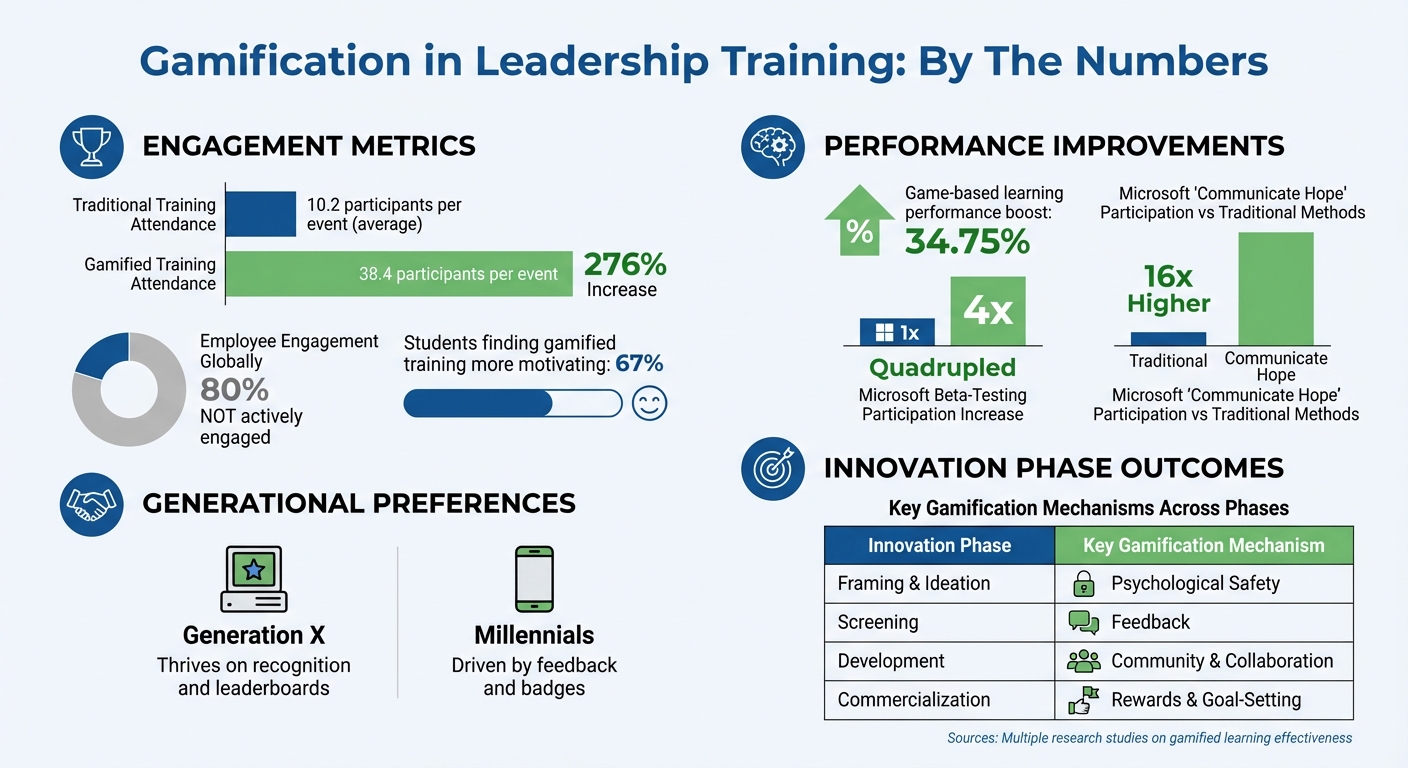
Gamification Impact on Leadership Training: Key Statistics and Benefits
GAMIFICATION IN LEADERSHIP TRAINING #training #leadershipdevelopment #gamification #leadershipskills
Problems with Standard Leadership Training Methods
Traditional leadership training programs struggle with three main issues that limit their effectiveness for technical teams aiming to drive innovation.
Low Engagement and Motivation
Globally, 80% of employees are not actively engaged in their work environments [6]. Leadership training programs fare even worse. For example, a study involving engineering students found that optional leadership workshops attracted an average of just 10.2 participants per event when using traditional formats [2]. For many technical professionals, these programs feel irrelevant to their daily responsibilities.
The lack of engagement goes beyond poor attendance. Passive formats, like endless slide decks, often lead to a dull and uninspiring experience. Jamie Cullen describes the issue perfectly:
We skim through the 50-slide PowerPoint decks hoping to correctly guess enough answers to pass so that we can get back to our 'real work.' Anything we learn may be forgotten by the time we receive our certificate of completion [4].
Despite corporations pouring significant resources into leadership development, the outcomes are often described as largely ineffective [2]. This disengagement also impacts how well participants retain critical leadership concepts.
Poor Knowledge Retention
The passive nature of traditional training methods makes it harder for participants to retain what they learn. Long slide presentations and overly theoretical modules encourage skimming rather than meaningful interaction, with many participants focusing only on passing assessments [2]. Common evaluation methods - such as pre- and post-tests or self-reports - fail to measure long-term growth, leaving organizations with no clear understanding of whether the training has had a lasting impact [2].
Another issue is the lack of personalization. Standard programs often overlook individual differences, such as personality traits, neurodiversity, or the unique challenges of technical disciplines. Instead, they rely on business-centric teaching methods that don’t align with the needs of technical professionals [2]. When participants can't see how the material applies to their specific roles, they’re less likely to retain it. Without this retention, turning theory into actionable leadership skills becomes even more challenging.
Difficulty Applying Concepts in Practice
One of the biggest gaps in traditional training is the disconnect between theoretical learning and real-world application. Technical leaders face complex challenges in their work environments, yet outdated "heroic leadership" models fail to equip them to address issues like cognitive biases, fear of failure, or siloed thinking [2].
These programs often focus on defining "what" leadership is, without addressing "how" to lead effectively in dynamic, technical settings [2]. This shortfall leaves leaders unprepared to handle the psychological and organizational obstacles they encounter daily. Bridging this gap between theory and practice is essential - laying the groundwork for more interactive and practical approaches, such as gamified leadership training.
How Gamification Changes Leadership Training
Gamification brings game-like elements into leadership training to address common issues like low engagement, poor retention, and limited application of skills. Instead of relying on static slides and lectures, gamification creates an interactive environment where participants earn points, collect badges, and compete on leaderboards - all while learning essential leadership skills. Research highlights that 67% of students find gamified training more motivating than traditional methods, and game-based learning can boost performance by 34.75% [7].
This approach taps into psychological triggers to encourage behavior change. For instance, earning rewards triggers dopamine release, while badges stimulate serotonin, creating a sense of achievement [7]. These neurological responses keep learners motivated and engaged, helping to tackle long-standing challenges in leadership training.
A great example comes from Kaunas University of Technology, where a points-based system was introduced for optional leadership workshops aimed at engineering students. The results were striking: attendance jumped from an average of 10.2 to 38.4 students per event, nearly quadrupling participation [2]. Students were drawn in by both the tangible rewards - points that could enhance their grades - and the intrinsic benefits of professional growth.
Game Elements: Points, Badges, and Leaderboards
Points act as immediate feedback, helping participants see their progress in real time. Whether completing a module, solving a challenge, or engaging in discussions, each action earns a score that reflects achievement. This instant validation encourages learners to keep pushing toward their next goal [6].
Badges go beyond generic certificates by marking specific milestones, such as earning titles like "Conflict Resolution Master" or "Strategic Visionary." These digital markers showcase expertise within a group and motivate participants to deepen their skills in targeted areas [6]. Interestingly, different generations respond to these elements in unique ways: Generation X thrives on recognition and leaderboards, while Millennials are more driven by feedback and badges [6].
Leaderboards introduce a competitive edge, allowing participants to compare their performance with peers. This friendly rivalry inspires individuals to work harder and improve their rankings [6]. To enhance collaboration, leaderboards can be paired with team challenges, encouraging collective problem-solving and reducing siloed thinking [3]. Together, these game elements set the stage for deeper, scenario-based simulations that bridge the gap between theory and practice.
Scenario-Based Simulations
Scenario-based simulations immerse leaders in realistic situations, giving them a risk-free space to make decisions and learn from outcomes. While technical leaders face complex challenges daily, traditional training rarely provides opportunities to practice solving these problems. Simulations, on the other hand, let participants experiment without the fear of real-world consequences [3].
These tools also help leaders tackle cognitive biases and adapt to changing environments. By working through increasingly complex scenarios, participants refine their decision-making skills in conditions that mimic real workplace dynamics [2][3]. The storytelling aspect of these simulations fosters empathy, encouraging leaders to think beyond their immediate tasks and consider the broader organizational impact [3].
One standout example is the "EVA Game", developed by Kaunas University of Technology. This gamified board game placed students in the role of project managers, requiring them to make strategic decisions in a hands-on environment. The experience proved far more effective than traditional lectures, equipping participants with the skills needed to handle complex project scenarios in professional settings [2].
Interactive Feedback Mechanisms
Traditional training often delays feedback until the end, but gamified systems flip this model by providing instant performance insights. This real-time feedback helps participants identify their strengths and weaknesses, allowing them to adjust their approach on the spot [4][8]. By addressing what researchers call the "impact barrier" - the gap between learning and applying concepts - gamification ensures more effective skill development [2].
Jamie Cullen from Harvard Business Review captures the essence of this transformation:
Gamified training done right - lessons conducted carefully and over time, incorporating elements such as progression through challenges and levels, instant feedback, points, and competition - can significantly improve employee performance [4].
With immediate validation from points and badges, and continuous feedback to refine skills, participants experience steady progress. Tools like progress bars and achievement markers provide a sense of accomplishment at every step [8]. Combined with immersive narratives, these mechanisms prepare technical professionals to take on leadership roles with confidence and competence [2].
Benefits of Gamification for Innovation in Leadership
Gamification is changing the way leadership training is approached, especially when it comes to fostering innovation within technical teams [3]. By tapping into key psychological drivers like intrinsic motivation, extrinsic rewards, emotional safety, and cognitive goal-setting, gamified training creates an environment where creativity thrives [3]. These mechanisms help reduce the fear of failure, encourage empathy, and inspire participants to experiment more freely. This approach also helps break down the silo mentality that often hinders fresh thinking and collaboration [3]. Let’s dive into how gamification enhances leadership training.
Increasing Engagement and Creativity
Traditional leadership training often struggles to ignite the creative spark necessary for innovation. Gamification, on the other hand, encourages divergent thinking and playful engagement during brainstorming sessions. This not only boosts the volume of ideas but also ensures a broader range of perspectives. By creating a psychologically safe environment, participants feel more comfortable challenging norms and embracing new ideas [3].
A player-focused design taps into the natural human desire for challenge, achievement, and connection [1]. As Celia Hodent, a renowned games UX expert, explains:
Instead of focusing on gamification and badges and rewards and how you can motivate extrinsically users, focus on playful learning. Think about what is going to make it interesting to manipulate the content that you want people to learn about.
This emphasis on playful learning sustains engagement by triggering the brain’s dopamine response, keeping participants motivated and invested over time [1].
Improving Knowledge Retention and Application
Gamified training has a unique way of turning abstract concepts into actionable skills. Features like level progression, immediate feedback, and scenario-based challenges help participants learn by doing rather than just passively consuming information [4]. This hands-on approach is particularly effective for technical leaders, as it allows them to experiment in a risk-free environment while tackling complex ideas in manageable steps [1].
Research supports this method, showing that gamified training significantly outperforms traditional slide-based learning when it comes to real-world application and performance [4].
Encouraging Collaboration in Innovation
Innovation is rarely a solo endeavor. Gamification encourages cross-functional teamwork through social elements like team challenges, networking opportunities, and status-based incentives. These features foster shared problem-solving and build a sense of community [3]. Storytelling within gamified training also plays a critical role, helping leaders see beyond their immediate tasks and understand broader organizational needs.
Interestingly, the impact of gamified training is amplified when senior leaders actively participate and model the desired behaviors [5]. This combination of collaboration and leadership involvement helps unlock greater team creativity and cohesion.
Building Flexible Leadership Through Feedback
One of gamification’s standout features is its ability to provide instant feedback. This real-time input allows leaders to quickly identify their strengths and areas for improvement, making them more agile in adapting to unexpected challenges or high-pressure situations [9]. This continuous feedback loop fosters a mindset of growth and adaptability, which are essential traits for driving innovation [9].
| Innovation Phase | Outcome | Gamification Mechanism |
|---|---|---|
| Framing & Ideation | Creativity & Idea Quantity | Emotional (Psychological Safety) & Cognitive (Divergent Thinking) |
| Screening | Engagement & Alignment | Social (Relatedness) & Instrumental (Feedback) |
| Development | Codesign & Collaboration | Intrinsic (Competence) & Social (Community) |
| Commercialization | Behavioral Change | Extrinsic (Rewards) & Cognitive (Goal-Setting) |
This table highlights how gamification aligns with each phase of the innovation process, linking specific mechanisms to desired outcomes. By enabling leaders to self-assess and understand their performance on a deeper level, gamified training equips them with the tools to adapt and innovate effectively [3][9].
sbb-itb-8feac72
Tech Leaders' Approach to Gamified Leadership Training
Tech Leaders tackles the "leadership gap" by blending gamification with tailored training plans, coaching, and collaborative peer groups [2]. This gap often arises when technical experts are promoted into leadership roles without the necessary preparation, leaving them under-equipped to lead effectively [2]. By integrating gamification into its programs, Tech Leaders transforms these challenges into actionable and engaging learning experiences.
Bridging Technical Expertise and Leadership Growth
Tech Leaders builds on gamification's strengths by using a points-based system to tie technical skills directly to leadership development. For example, seminar attendance saw a noticeable boost when participants could earn points for activities like completing microlearning modules, attending workshops, or achieving personalized milestones [11][12].
Recognition plays a vital role in maintaining motivation. Participants earn visible badges and certifications that signify their journey from "Specialist" to "Master." These achievements not only offer a sense of accomplishment but can also be shared on platforms like LinkedIn to enhance professional credibility [10][11][13]. Additionally, the program fosters "Leader Engagement", where senior leaders actively participate as role models within the gamified platform. This involvement has been shown to improve both performance and participation [14][5].
Tackling Innovation in AI-Driven Workplaces
Tech Leaders also addresses the challenges of innovation, particularly in AI-driven environments. By using interactive simulations, the program helps participants overcome cognitive inertia and siloed thinking, which are common barriers in fast-paced technical fields [3]. These simulations use storytelling and empathy to reduce the fear of failure, creating a safe space for experimentation [3].
The program pays special attention to the "fuzzy front end" of innovation - where new ideas often face skepticism - by encouraging openness to change and countering cognitive biases [3]. Gamified dashboards provide real-time updates on professional growth, showcasing skills acquired, completed training, and readiness for leadership roles through badges and levels [8]. Instant feedback through these dashboards enables participants to track their daily progress and adapt quickly to challenges posed by AI advancements [8][3].
Implementing Gamification in Technical Teams
Starting with Scenario-Based Challenges
A great way to introduce gamification is by using engagement loops: set a clear goal, encourage action, and provide immediate feedback [15]. Microsoft showcased this strategy while encouraging employees to beta-test a new Windows operating system. They created a hangman-style game where testers earned virtual letters to spell "B-E-T-A" after completing tasks. The result? Participation skyrocketed - quadrupling almost immediately [15].
When designing scenarios for technical teams, focus on challenges that reflect real-world innovation problems they encounter. The goal is to create a sense of progression by gradually increasing the complexity of tasks. For example, Microsoft's "Communicate Hope" initiative featured team-based competitions to test disaster relief products. This approach achieved a participation rate 16 times higher than traditional methods [15]. These kinds of dynamic scenarios lay the groundwork for competitive, data-driven improvements in training.
Using Leaderboards and Team Competitions
Adding competitive elements can significantly boost engagement, but it’s important to strike the right balance. Individual leaderboards can motivate employees, but they also risk creating silos. Instead, focus on team-based competitions that encourage collaboration across different functions [3]. Combining individual and team competitions is a smart way to maintain engagement while fostering cooperation. This balance is particularly effective during innovation development, where frequent communication and teamwork are essential for success [3].
Zappos provides an inspiring example with their "Face Game", a tool on their corporate intranet designed to strengthen team cohesion. When employees log in, they see a colleague’s photo and are prompted to identify them. If they don’t recognize the person, they’re encouraged to send an email and make a new connection. This clever twist turned what could have been a simple game into a tool for building collaboration [15].
Using Data Analytics to Improve Training
Gamification works best when paired with data analytics to measure and refine its impact. Tracking key metrics transforms gamification from a fun activity into a powerful training tool. One of the most important metrics to monitor is leader engagement. When managers actively participate in gamified training, their teams show significantly better performance [5]. Researchers Ryan W. Buell, Wei Cai, and Tatiana Sandino highlight this in their findings:
The benefits of gamified training are greater when employees are more engaged - as revealed by their readiness to log onto the gamified training platform - and when more leaders... actively participate [5].
Beyond participation, it’s important to track innovation outcomes at different stages. During ideation, focus on the quantity and originality of ideas. In the screening phase, measure how well participants align and explore diverse perspectives. For the development stage, monitor learning outcomes and the frequency of collaboration. Finally, during commercialization, track metrics like speed to market and customer adoption rates [3]. These insights not only refine gamified training programs but also demonstrate their measurable impact on innovation capabilities.
Conclusion: Gamification as a Driver for Leadership and Innovation
Traditional leadership training often falls short, plagued by passive teaching methods, poor retention, and limited practical application [4]. Gamification flips the script by introducing active engagement, instant feedback, and competitive dynamics that keep technical professionals motivated. Programs like the University of Notre Dame's Jedi-themed training have seen impressive results, including boosted attendance and voluntary participation across departments [2][16].
One of gamification's standout benefits is the creation of a psychologically safe environment where leaders can experiment and innovate without fear of failure [3]. This is especially crucial for leaders managing AI-driven teams, where collaboration across functions and breaking down silos can determine a project's success. The trend is clear: moving away from traditional "heroic" leadership models toward more adaptable, team-oriented approaches aligns perfectly with the demands of modern AI-focused workplaces [2].
The data backs this up - gamification doesn't just engage participants; it delivers results. Active leader involvement has been shown to directly improve team performance [5]. As Jamie Cullen from Harvard Business Review aptly states:
Corporate training isn't all fun and games, but maybe it should be [4].
The secret lies in designing gamified experiences rooted in solid theory, focusing on intrinsic motivators like autonomy and mastery, rather than simply layering on generic game elements [3][16].
With platforms like Tech Leaders, technical professionals can merge their expertise with leadership skills. These programs offer a blend of engineering leadership training and entrepreneurial development, using personalized learning plans, peer masterminds, and private coaching - all tailored for the AI era.
The evidence is clear: gamification addresses the shortcomings of traditional training while fostering innovation. Whether it's enhancing problem-solving skills, improving knowledge retention, or building stronger collaborative teams, gamification is the spark that technical leadership needs to thrive in today's fast-evolving landscape.
FAQs
How does gamification enhance engagement and retention in leadership training?
Gamification breathes life into leadership training by turning learning into an engaging, interactive experience. By incorporating elements like points, badges, leaderboards, and challenges, it encourages participants to embrace leadership behaviors in a way that feels both enjoyable and rewarding. These features tap into basic human drives - achievement, competition, and collaboration - keeping learners actively engaged and driven to succeed.
What makes gamified training especially effective is the safe, game-like environment it creates. Here, participants can test ideas, learn from mistakes, and sharpen their skills without facing real-world consequences. Beyond just being fun, this approach boosts knowledge retention by weaving in competition, teamwork, and recognition, all of which help solidify lessons for the long term. For engineering leaders, gamification not only enlivens training but also nurtures forward-thinking leadership practices that can create lasting value within technical teams.
What are the most effective gamification elements for leadership training?
The most impactful elements of gamification in leadership training create immersive, hands-on learning opportunities. Interactive challenges and simulations give participants the chance to tackle decision-making, problem-solving, and teamwork within scenarios that mirror real-life situations. Competitive features - like points, leaderboards, and timed activities - add a layer of friendly competition, pushing participants to strive for better results. Reward systems, such as digital badges or tangible prizes, offer immediate feedback, fueling motivation and engagement. Meanwhile, collaborative tasks, like team-based missions, strengthen trust, communication, and group synergy among participants.
These strategies not only make the learning process more engaging but also enhance how well participants retain information and apply skills in real-world contexts. By weaving these elements into leadership training, programs can equip technical professionals to lead with greater confidence and adaptability in ever-changing environments.
How does gamification boost innovation in AI-focused leadership training?
Gamification incorporates game-like elements - think points, leaderboards, and challenges - into learning environments to make them more interactive and engaging. It’s not just about fun; it’s about creating a space where leaders can experiment, take risks, and sharpen their decision-making skills in real-time. In AI-driven workplaces, where things evolve at lightning speed, gamified training reflects the complexity of real-world scenarios. This helps leaders adapt faster and retain what they’ve learned more effectively.
By offering instant feedback and rewards, gamification keeps technical professionals energized and focused. It also encourages creativity and teamwork, key ingredients for driving innovation. This method helps leaders confidently navigate challenges, explore AI tools, and fine-tune strategies. For example, at Tech Leaders, gamified modules allow participants to design AI-powered solutions, enhance their leadership abilities, and turn bold ideas into tangible business results.