
Global Networks for Gender Equity Initiatives
Global networks are reshaping efforts to achieve gender equity worldwide. These networks connect leaders, organizations, and communities across borders to address systemic challenges like discriminatory laws, economic barriers, and societal norms. Here’s what you need to know:
- City-Level Networks: CHANGE (City Hub and Network for Gender Equity) unites cities like Los Angeles and London to reform municipal policies, focusing on safety, caregiving support, and gender equity data.
- Grassroots Efforts: Women's Earth Alliance empowers women leaders to tackle gender and climate challenges through local and international collaboration.
- Fellowship Models: Ashoka's Next Now Gender Equity initiative connects 4,000 social entrepreneurs in 90 countries to share solutions on economic empowerment and violence prevention.
- Corporate-Led Programs: The UN Global Compact’s Target Gender Equality program encourages businesses to integrate gender equity into operations, though its impact remains unclear.
- Regional Focus: The African Women Leaders Network trains women leaders to drive progress in leadership, peacebuilding, and economic growth across 30 African countries.
Each network has strengths and limitations. CHANGE leverages city authority, grassroots initiatives build local leadership, and fellowship programs promote global knowledge sharing. However, funding, scalability, and focus areas vary, making a combined approach essential for lasting impact.
How Do Global Networks Support Girls' Education Worldwide? - Gender Equality Network
1. City Hub and Network for Gender Equity (CHANGE)
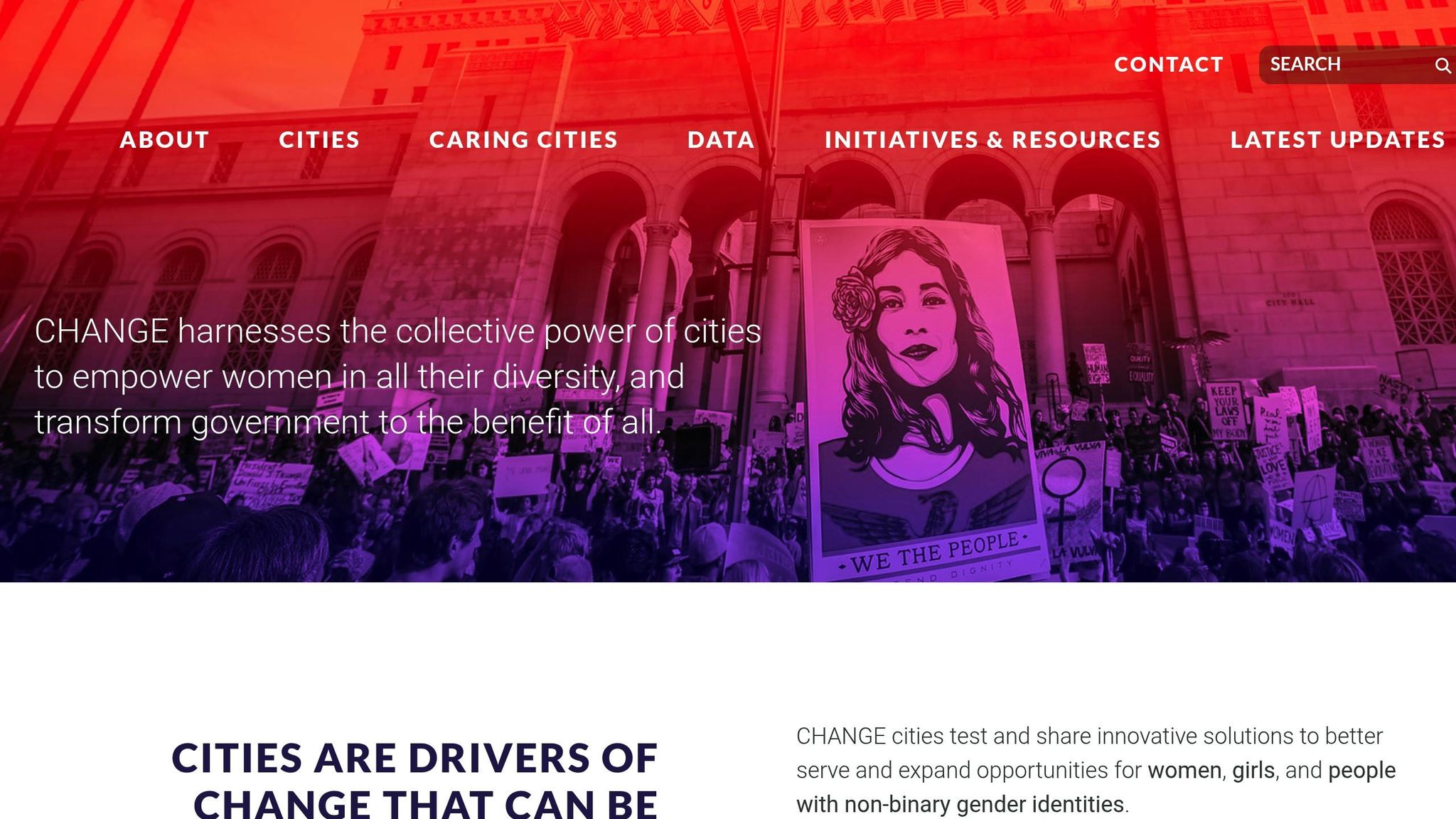
Launched in 2020 by Los Angeles, CHANGE is the first international network led by cities to address gender equity through municipal service reforms. Its approach centers on crafting policies and services that directly improve the daily lives of residents, with a global reach that sets it apart.
Geographic Scope
CHANGE brings together nine cities from across the globe, forming a coalition that spans multiple continents. Los Angeles, as the founding member, is joined by cities like London, Melbourne, and Freetown. This diverse network allows for sharing ideas and adapting solutions to local contexts, showing how city governments can become testing grounds for strategies aimed at advancing gender equity.
Primary Stakeholders
The network’s initiatives are spearheaded by city officials, including deputy mayors and other key leaders. For instance, a deputy mayor from Los Angeles played a central role in launching CHANGE. These leaders work to create programs that benefit women, girls, and gender-diverse individuals.
Core Focus Areas
CHANGE concentrates on four critical areas to drive systemic improvements:
- Gender equity data collection: Gathering data to inform better policymaking.
- Safety policies: Implementing measures to prevent violence and enhance safety.
- Support for caregivers: Developing systems to assist those providing care.
- Reforming municipal services: Overhauling infrastructure, services, and hiring practices to support women, girls, and gender-diverse communities.
Measurable Outcomes
The network’s impact is already visible through tangible results. In London and Melbourne, Night Mayor programs have been introduced to boost safety for women during nighttime hours, with dedicated officials managing policies and safety measures. In Freetown, changes to water access systems have enhanced equity and accessibility for women and marginalized groups. Additionally, CHANGE encourages open discussions among practitioners to fine-tune strategies and share insights [1].
2. Women's Earth Alliance
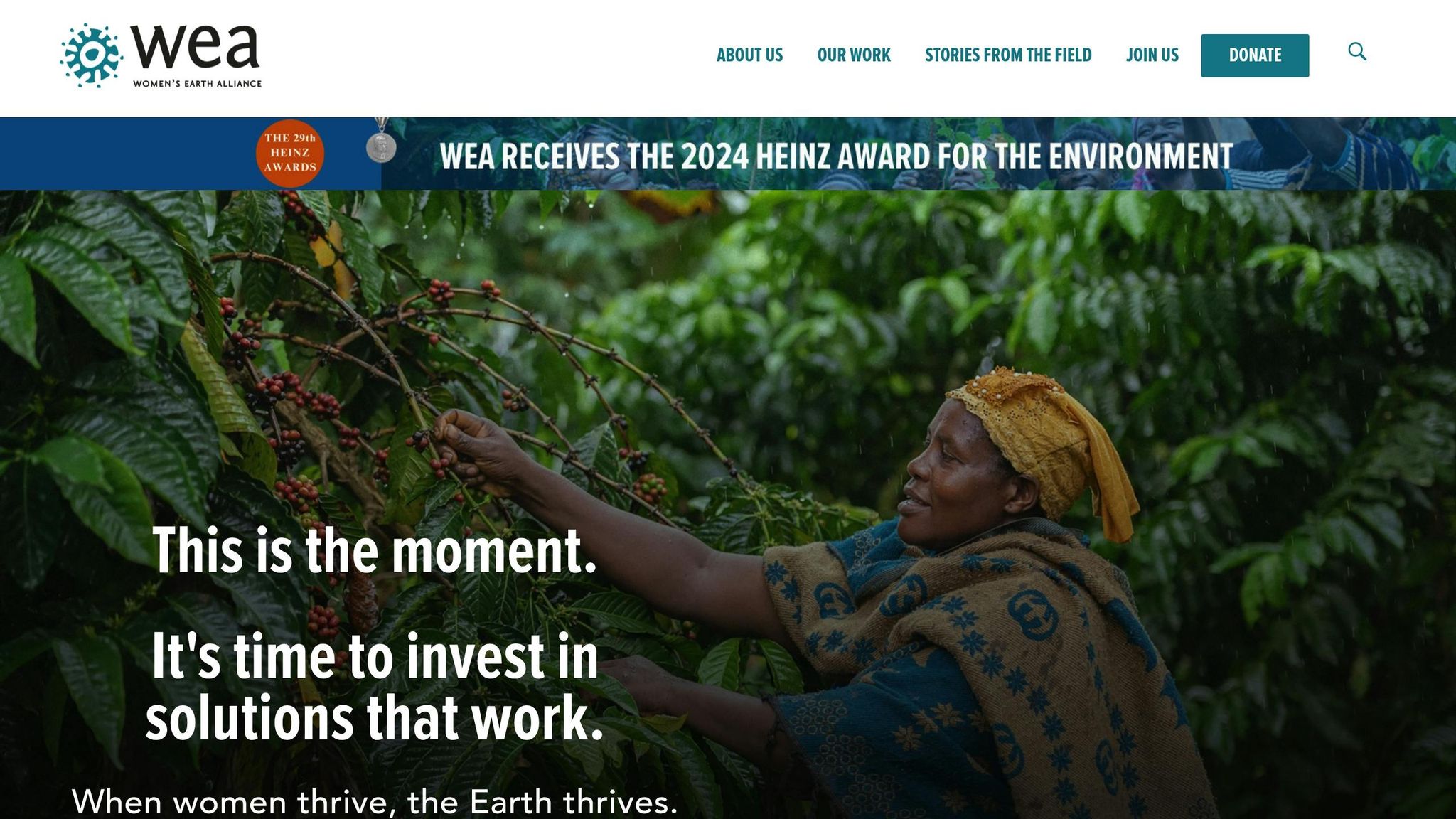
Women's Earth Alliance (WEA) was created with a mission to blend climate action with gender equity, recognizing women as central figures in addressing both challenges. By empowering women leaders, WEA fosters a unique intersection of grassroots climate initiatives and global collaboration.
Geographic Reach
WEA's work spans both the U.S. and international landscapes. Domestically, its U.S. Grassroots Accelerator brings together women leaders, forming a national network focused on climate and gender equity. Globally, the organization connects these leaders with climate advocates around the world, encouraging the exchange of ideas and strategies. This dynamic approach ensures a two-way exchange of knowledge, where U.S. participants learn from global counterparts while sharing their own experiences.
Key Stakeholders
The organization primarily supports U.S.-based women involved in climate advocacy, ranging from local community organizers to leaders of resilience projects. Internationally, WEA taps into a broad network of expertise to enrich its efforts and amplify its impact.
Areas of Focus
WEA concentrates on empowering women through leadership training, supporting women-led initiatives, and building resilient communities that combat environmental harm. Through its Grassroots Accelerator program, it facilitates a platform for collaboration and learning between U.S. and international participants.
Tangible Impact
The results of WEA's efforts are evident in the strengthened abilities of its participants to expand their projects and influence. Women leaders gain critical skills to enhance community resilience and protect the environment. By weaving global perspectives into local strategies, these leaders are driving meaningful, long-lasting change in their communities.
3. Ashoka's Next Now Gender Equity Initiative
Ashoka's Next Now Gender Equity Initiative is a powerful example of how existing networks can amplify efforts toward achieving gender equity. This program connects social entrepreneurs and innovators worldwide who are addressing gender equity challenges. Instead of starting from scratch, the initiative taps into Ashoka's established network of 4,000 Fellows across 90 countries, many of whom are already working on gender-related issues [1].
Geographic Scope
Operating across 90 countries, the initiative bridges the gap between U.S.-based and international social innovators. It creates opportunities for U.S. changemakers to collaborate with peers in regions such as Africa and beyond, enabling a global exchange of ideas and solutions.
Primary Stakeholders
The program focuses on Ashoka Fellows - social entrepreneurs and changemakers dedicated to advancing gender equity. This includes a diverse range of individuals, from U.S.-based practitioners tackling financial independence and domestic violence to Nigerian innovators working to shift societal norms around domestic violence. By bringing together such varied perspectives, the initiative identifies common challenges and fosters collective problem-solving, reinforcing the importance of global collaboration in addressing gender equity.
Core Focus Areas
The initiative zeroes in on three critical areas: economic empowerment, violence prevention, and cultural transformation. For example, U.S. practitioners working on financial freedom for survivors of domestic violence can share strategies with Nigerian changemakers reshaping cultural attitudes toward gender-based violence. These connections encourage the exchange of practical solutions and spark new approaches to shared challenges.
Measurable Outcomes
To ensure meaningful progress, the initiative employs tools like one-on-one connections, learning circles, and live "news hour" conversations. These formats provide platforms for real-time dialogue and knowledge sharing, mirroring earlier successful cross-border exchanges. By breaking down national barriers, the program enables participants to apply insights and lived experiences toward building healthier, more equitable communities. Its success is ultimately measured by the strength of the connections formed and the tangible impact of shared learning and collaboration.
sbb-itb-8feac72
4. UN Global Compact's Target Gender Equality Programme
The UN Global Compact has been a driving force in encouraging businesses to adopt responsible and ethical practices, with gender equity being a key focus. The Target Gender Equality Programme is one of its initiatives aimed at embedding gender equity into the core of corporate operations.
While the program plays a crucial role in advancing the UN's gender equity goals, there’s limited information available about its geographic scope, how it operates, or the tangible results it has achieved so far. It appears to focus on fostering conversations and encouraging companies to reform their policies to address gender disparities. However, the lack of defined participation criteria, measurable goals, and documented outcomes makes it challenging to assess its overall impact. This absence of data stands in contrast to other global initiatives, highlighting the need for further analysis to better understand its contributions to gender equity efforts.
5. African Women Leaders Network (AWLN)

The African Women Leaders Network (AWLN) addresses gender equity issues specific to Africa. Established in 2017 through a partnership between the African Union and the United Nations, with support from Germany [2], AWLN focuses on tackling challenges unique to the African context while fostering connections among women leaders across the continent.
Geographic Scope
As of 2023, AWLN operates in 30 African countries [2], spanning regions such as West, East, and Central Africa. This regional focus enables the network to adapt its strategies to the distinct barriers African women face in leadership, economic growth, and peacebuilding efforts.
Primary Stakeholders
AWLN brings together key institutional partners. The African Union and United Nations are its founding organizations, with Germany offering essential financial and strategic backing [2]. At the heart of the network are African women leaders, who play a pivotal role in driving its initiatives. By combining continental leadership, international resources, and grassroots activism, AWLN bridges the gap between policy advocacy and on-the-ground implementation.
Core Focus Areas
The network prioritizes three key areas: leadership empowerment, peacebuilding, and economic development [2]. These interconnected goals reflect the belief that sustainable gender equity depends on progress across all three fronts. Women need economic independence to make empowered decisions, leadership skills to influence policies, and effective peacebuilding to address challenges in conflict-affected regions. AWLN’s approach aligns with global initiatives while addressing gender equity challenges unique to Africa.
Measurable Outcomes
By 2023, AWLN has trained over 5,000 women leaders [2], showcasing its role in building capacity and advancing gender equity across the continent. This milestone underscores the network's commitment to creating tangible impacts in leadership and development.
Strengths and Weaknesses
Global networks bring both opportunities and obstacles when it comes to advancing gender equity. By examining the different models discussed earlier, we can better understand their strengths and limitations, as well as the variety of strategies needed to address gender equity on a global scale.
City-level networks like CHANGE have the advantage of municipal authority, allowing them to implement reforms directly. For instance, programs like London and Melbourne's "Night Mayors" initiatives are examples of how cities can use their resources to address local issues[1]. However, these networks face challenges, such as the need for government support and their focus on urban areas, which often leaves rural communities underserved.
Grassroots networks such as Women's Earth Alliance shine in fostering local leadership and linking gender equity with environmental action. Through initiatives like the U.S. Grassroots Accelerator, women leaders gain skills and connect with global advocates for climate action[1]. While this approach builds strong community ownership, it tends to be geographically limited and often constrained by resources.
Fellowship networks like Ashoka's Next Now Gender Equity initiative connect nearly 4,000 innovators across 90 countries, promoting cross-border collaboration and knowledge sharing on gender equity[1]. This model supports peer learning and global exchange, but the scale of such efforts demands significant funding and coordination. Additionally, the recruitment process may unintentionally exclude grassroots leaders who lack formal credentials.
Corporate-led partnerships bring financial power and the ability to scale initiatives quickly - resources that nonprofits often lack. For example, in Kenya, Unilever partnered with Mastercard through Jaza Duka to digitize supply chains for small retailers, many of whom are women. This helped them access short-term loans by building financial credentials[4]. While effective, these initiatives often focus on women entrepreneurs who align with business goals, potentially leaving out the most marginalized communities.
International NGO networks like Rise Up have a deep connection to local communities. Rise Up’s network of 500 leaders has directly impacted 7 million girls and helped influence 100 laws and policies across regions such as Africa, Latin America, South Asia, and the U.S.[3]. Similarly, Promundo has reached nearly 10 million individuals, including educators, health workers, and government officials[3]. Despite their reach and cultural understanding, these networks face funding challenges and can only serve a fraction of the global population in need.
Knowledge-sharing networks like CARE's Global Innovation Hub in Atlanta demonstrate how lessons learned internationally can inform domestic efforts. For example, CARE has used insights from its Ecuador offices to create gender-responsive emergency programs for U.S. Gulf Coast communities[1]. This kind of bidirectional exchange strengthens solutions, but adapting strategies across different contexts requires expertise and significant resources.
| Network Type | Strength | Limitation | Scalability | Cultural Adaptability |
|---|---|---|---|---|
| City-Level (CHANGE) | Direct authority for policy changes; access to municipal resources | Urban focus; depends on government support | Moderate, based on political will | High - solutions tailored to cities |
| Grassroots (Women's Earth Alliance) | Builds local ownership; addresses intersecting issues | Geographic and resource limits | Low to moderate - requires intensive support | Very high - grounded in local knowledge |
| Fellowship (Ashoka) | Global reach; connects 4,000 innovators | High coordination costs; potential credential barriers | High - network amplifies impact | High - peer-driven adaptability |
| Corporate Partnerships | Financial resources; rapid scaling | May exclude marginalized groups | Very high - leverages existing infrastructure | Moderate - market priorities can dominate |
| International NGOs | Strong local ties; extensive reach | Funding instability; slower to scale | Moderate - resource-dependent | Very high - long-term local presence |
| Knowledge-Sharing (CARE) | Cross-border learning; strengthens domestic efforts | Complex adaptation; costly implementation | High - lessons spread widely | Moderate - requires multi-context expertise |
The effectiveness of each network depends on the context. City networks thrive where local governments have resources and authority. Corporate partnerships are excellent for financial inclusion but may struggle with addressing issues beyond market priorities. Fellowship networks encourage innovation but require substantial coordination, while international NGOs build trust over time but face resource constraints. No single model can address every aspect of gender equity, making it clear that a combination of approaches is essential.
Measuring impact is another common challenge. Different networks use varying metrics, from tracking policy changes to counting beneficiaries or financial outcomes. Gender equity progress often unfolds over years or decades, making it difficult to directly link outcomes to specific interventions.
Multi-sector collaborations, such as the Unstereotype Alliance - co-founded by Unilever and led by UN Women with partners like Facebook, Google, and Microsoft - show how diverse organizations can work together to tackle gender stereotypes in advertising[4]. However, these alliances can face conflicting priorities, uneven accountability, and the risk of sidelining grassroots perspectives.
Sustainability is a persistent concern. Philanthropy-dependent networks face uncertain futures, and corporate initiatives may lose focus if business interests shift. Government-led efforts often survive political changes only when gender equity becomes an institutional priority rather than relying on individual leaders. The most resilient models diversify funding, build cross-sector partnerships, and create value for a wide range of stakeholders.
Conclusion
Comparing global gender equity networks shows that there’s no one-size-fits-all solution. Success hinges on aligning the network model with specific goals, resources, and local contexts.
City networks, like CHANGE - led by Los Angeles and nine other cities - excel at adapting urban innovations to local needs, such as implementing "Night Mayor" programs[1]. These models work well when municipal leadership can directly influence policy changes.
On the other hand, grassroots networks thrive by empowering local leaders. Take the Women's Earth Alliance's U.S. Grassroots Accelerator, for example. By connecting local leaders annually, this network fosters idea-sharing and blends international perspectives into solutions that strengthen climate resilience and community health[1]. While effective, this approach requires significant investment in support and resources to succeed.
Innovation networks, which focus on global peer exchange, tackle systemic challenges across borders. Ashoka's Next Now Gender Equity initiative is a standout example, linking nearly 4,000 Fellows in 90 countries[1]. This allows practitioners in areas like financial independence and domestic violence in the U.S. to learn from efforts in Nigeria that address similar issues through cultural shifts[1]. However, scaling these networks demands extensive coordination and funding.
Corporate partnerships bring financial backing and the ability to scale quickly, but they often align with market-driven goals, which may not fully address grassroots needs.
Key insights for leaders include evaluating primary objectives. City-level networks are ideal for systemic policy change, grassroots-focused networks excel in local implementation, and fellowship models are best for fostering social innovation. Regional capacity also matters - established infrastructures benefit from global networks, while emerging areas may require foundational support through regional platforms.
Clear metrics tied to a theory of change are critical. Organizations should measure outcomes like policy reforms, funds distributed, or individuals trained. For example, CARE’s Global Innovation Hub in Atlanta draws lessons from its Ecuador offices on gender-responsive emergency programming, applying those insights to U.S. Gulf Coast communities[1]. This two-way knowledge exchange enhances solutions but demands expertise and resources to adapt strategies effectively.
The strongest networks blend various approaches - funding, training, advocacy, and knowledge-sharing - rather than relying on a single method. They diversify funding, build cross-sector partnerships, and deliver value to multiple stakeholders. For instance, Shell’s Executive Committee achieved 44% women representation as of April 1, 2025, aiming for 40% in senior leadership globally by 2030[5]. This demonstrates how corporate commitment can lead to measurable progress.
Leaders should focus on fostering meaningful connections between practitioners tackling similar challenges worldwide. Deputy Mayor Erin Bromaghim highlighted how CHANGE’s platform facilitates candid discussions about successes and failures, enabling cities to adapt innovative ideas to their unique circumstances[1]. These open dialogues accelerate learning and problem-solving.
Ultimately, advancing gender equity requires integrating multiple network models rather than relying on just one. A well-rounded strategy combines city, grassroots, innovation, corporate, and NGO networks to address gender equity comprehensively. Coordinating these diverse approaches ensures that efforts remain centered on the communities that need them most.
FAQs
How do city-level networks like CHANGE tackle the specific challenges of promoting gender equity policies in diverse urban settings?
City-level networks, such as CHANGE, tackle gender equity challenges by customizing their strategies to fit the specific needs of each city. They work closely with local governments, community groups, and businesses to develop policies that align with the area's unique cultural, economic, and social landscape.
These networks rely heavily on data to pinpoint critical issues like wage disparities or unequal access to education. From there, they roll out targeted efforts, such as leadership development programs or workplace policy updates. By encouraging collaboration and exchanging successful approaches among cities, they help advance gender equity in a variety of urban settings.
What challenges do grassroots networks like Women's Earth Alliance face when expanding their gender equity and climate initiatives globally?
Grassroots networks encounter several hurdles when attempting to expand their efforts on a global scale. One of the biggest challenges is limited funding - finding consistent financial support to maintain long-term programs can be a tough task. Without stable resources, scaling initiatives often becomes an uphill battle.
Navigating cultural and political differences is another significant roadblock. Strategies that work in one region might not translate well to another, requiring careful adjustments to ensure inclusivity and effectiveness. This process demands both time and sensitivity to local contexts.
Building local partnerships and trust within diverse communities adds another layer of complexity. Grassroots organizations frequently need to align their overarching global objectives with the distinct needs of local populations. This balancing act can be resource-heavy and requires a thoughtful approach.
Despite these challenges, many grassroots networks continue to achieve meaningful impact. They do so by encouraging collaboration and finding creative ways to address these obstacles head-on.
How do fellowship programs like Ashoka's Next Now Gender Equity Initiative promote collaboration among social entrepreneurs to tackle gender equity challenges in different cultural contexts?
Fellowship programs, such as Ashoka's Next Now Gender Equity Initiative, offer a vital space for social entrepreneurs to come together, share knowledge, and work collectively on tackling gender equity challenges. These initiatives gather individuals with diverse backgrounds and viewpoints, aiming to craft solutions that are mindful of cultural nuances.
By linking changemakers from different parts of the world, these programs promote the exchange of ideas and effective strategies. Participants gain insights that allow them to shape approaches tailored to their local realities. This kind of collaboration plays a key role in advancing meaningful and lasting progress toward gender equity on a global level.