

High-Context vs Low-Context: Global Leadership Skills
Communication styles can make or break global team dynamics. High-context cultures rely on subtle, nonverbal cues and prioritize relationships, while low-context cultures focus on direct, explicit communication and task efficiency. Leaders who understand these differences can reduce misunderstandings, build trust, and improve team outcomes.
Key Points:
- High-Context Cultures: Indirect communication, relationship-focused, nonverbal cues matter (e.g., Japan, Brazil).
- Low-Context Cultures: Direct communication, task-oriented, explicit messages (e.g., U.S., Germany).
- Challenges: Misinterpreting cues like “yes” in high-context settings or blunt feedback in low-context environments.
- Solutions: Blend styles - build relationships while ensuring clarity, use open-ended questions, and tailor feedback delivery.
Quick Tip: Ask, “Am I being understood?” instead of just “Am I being clear?” This shift improves communication across diverse teams.
How High-Context Communication Works
Indirect Communication and Relationship Focus
In high-context communication, much of the meaning is conveyed through shared cultural cues rather than explicit explanations [1]. The essence of the message often lies in what’s left unsaid, requiring leaders to pick up on subtle, unspoken signals.
To lead effectively in such environments, building personal relationships takes precedence over diving straight into tasks [2]. Trust is the cornerstone here - once it’s established, open feedback and genuine collaboration follow naturally [2]. This means taking time for personal interactions, like inquiring about someone’s family, weekend plans, or overall well-being. These seemingly casual conversations set the stage for smoother teamwork and stronger bonds.
Maintaining group harmony is another key aspect. Team members often avoid direct conflict to prevent anyone from "losing face" [2]. This approach extends to both verbal exchanges and nonverbal cues, which play a pivotal role in high-context cultures.
Nonverbal Communication and Context Clues
In high-context settings, nonverbal signals - like tone, facial expressions, gestures, and even moments of silence - carry as much weight as the spoken word [2]. For instance, a slight pause, a furrowed brow, or hesitancy in a response can signal disagreement or concern without a single word being said.
The context of the interaction also matters. A formal group meeting might elicit different nonverbal cues compared to a private one-on-one conversation.
Even in digital communication, high-context cultures rely on subtlety. Emojis and punctuation aren’t just decorative - they’re vital for conveying emotional undertones that text alone might miss [1].
Challenges for Leaders in High-Context Cultures
For leaders, understanding these subtleties is crucial, but it also comes with its own set of challenges.
One common pitfall is the "yes trap." For example, if a leader asks, "Can you finish this by Friday?" and hears a "yes", they might assume it’s a firm commitment. However, in high-context cultures, that "yes" could simply mean "I acknowledge what you’re saying" or a polite way of maintaining harmony, rather than a concrete promise [2].
A 2022 study by Kathrin Burmann and Thorsten Semrau examined 54 banking teams in Germany and Brazil. It revealed that the direct communication style of German teams often caused social rifts that hurt performance. Meanwhile, Brazilian teams, which relied on indirect high-context communication, avoided these issues, even when social divisions existed [1].
Another challenge lies in interpreting silence. Leaders from low-context backgrounds may wrongly perceive silence as agreement or confusion, when in reality, it’s a deliberate strategy to sidestep confrontation [2].
Navigating these challenges equips leaders to better adapt their approach when working with diverse teams.
How Low-Context Communication Works
Emphasis on Clarity and Directness
In low-context communication, the message is fully conveyed through the words themselves - there’s no need to read between the lines. Every detail is expressed explicitly, leaving little room for interpretation.
Leaders in low-context cultures prioritize clear, unambiguous verbal exchanges. Rather than relying on shared experiences or cultural nuances, they clearly articulate expectations, deadlines, and deliverables. Written materials such as detailed contracts, step-by-step guides, and comprehensive handouts play a central role in ensuring clarity.
"In low context culture, communication members' communication must be more explicit. As such, what is said is what is meant, and further analysis of the message is usually unnecessary." - Ramos [1]
A study comparing Sino-American automobile advertising highlights this contrast. American car ads focus on straightforward messaging and explicit product features, while Chinese ads lean into subtlety, using cultural elements like poetry to create a narrative. This difference underscores the direct, no-nonsense approach of low-context communication, which often aligns with individualistic values.
Individualism and Task-Focused Interactions
Low-context cultures place a premium on individual responsibility and clear, task-oriented communication. Conversations are often functional and goal-driven, prioritizing efficiency over building personal connections.
This approach is particularly effective in industries like tech, where rapid progress and precise deliverables are crucial. Time is treated as a linear resource, with schedules and deadlines ensuring productivity. Leaders in these environments encourage team members to make independent decisions and take ownership of their tasks.
However, this individualistic style can create tension in global collaborations. For example, a study involving 447 participants from Kent State University and 225 participants from universities in Mexico City found that U.S. participants used communication for enjoyment more frequently than their Mexican counterparts [1]. This highlights how task-focused communication may overlook relational dynamics that are essential in other cultures.
Challenges for Leaders in Low-Context Cultures
Despite its strengths, the clarity of low-context communication can sometimes lead to challenges, especially in multicultural settings. For leaders working with diverse teams, understanding the nuances of direct communication and its potential pitfalls is critical.
Directness, while efficient, can come across as harsh or overly blunt to individuals from high-context cultures. Feedback that is intended to be constructive may be misinterpreted as a personal criticism. Additionally, low-context communicators often struggle to pick up on subtleties or nonverbal cues. For instance, when a high-context team member says "probably" or "it might be a bit difficult", a low-context leader might not realize this is a polite way of saying "no."
"Western managers who are charged with leading global teams face a trap. Their expertise and training usually have their roots in Western, individualistic contexts, steeping them in ideals such as autonomy, empowerment, egalitarianism, and authenticity." - David Livermore [4]
With around 70% of the global workforce operating in collectivist, hierarchical cultures [4], and immigrants comprising 13.9% of the U.S. population as of 2022 [3], leaders in low-context environments must adapt. Taking the time to engage in what might seem like trivial small talk - discussing family or weekend plans - can be a vital step. These moments build the trust needed to bridge cultural differences and make direct communication more effective.
Low vs. High Context: How to Communicate with People from Different Cultures
sbb-itb-8feac72
Key Differences in Global Leadership Applications
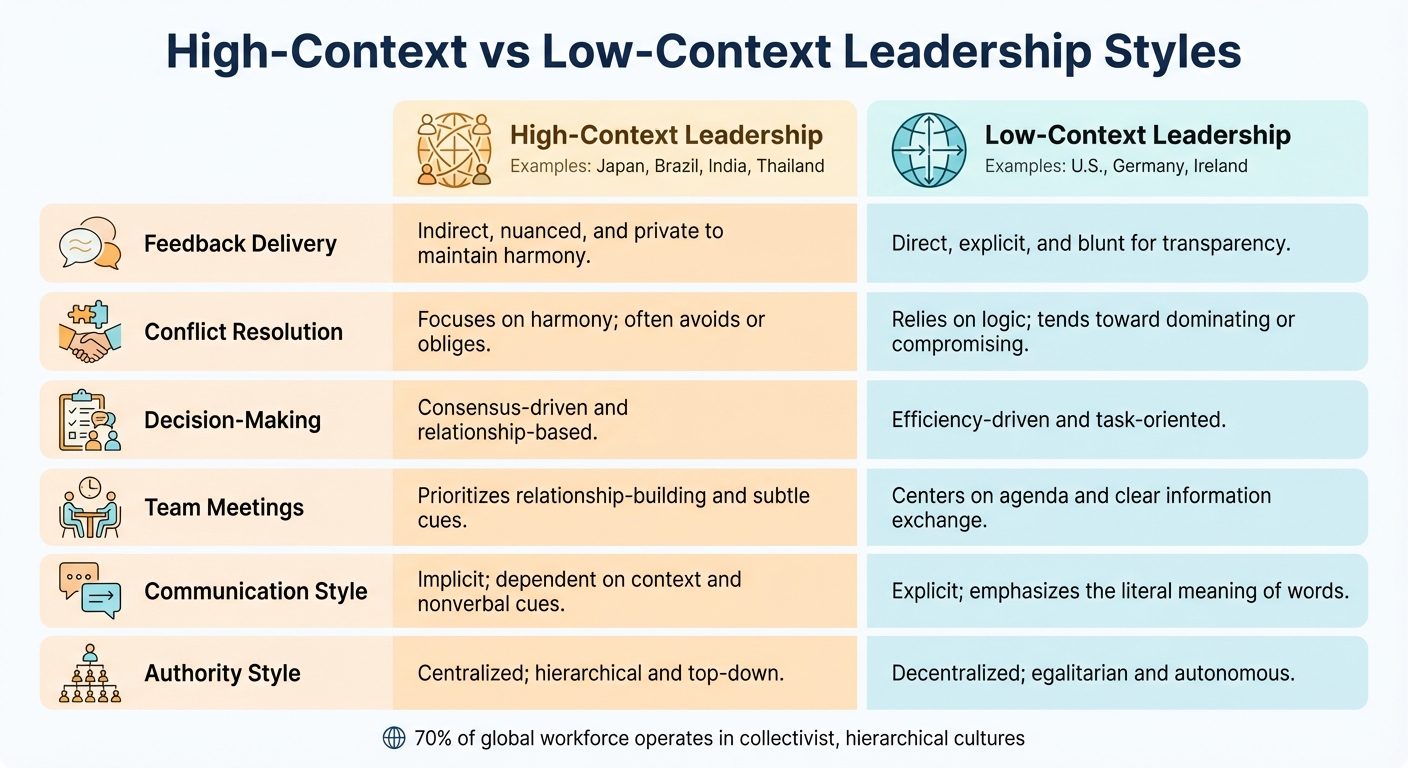
High-Context vs Low-Context Leadership Styles Comparison Chart
High-Context vs Low-Context: Leadership Comparison Table
Leadership styles vary significantly between high-context and low-context cultures, shaping how feedback is given, conflicts are resolved, decisions are made, and authority is exercised. These differences also influence team dynamics, communication, and meeting structures.
| Leadership Trait | High-Context Culture | Low-Context Culture |
|---|---|---|
| Feedback Delivery | Indirect, nuanced, and private to maintain harmony | Direct, explicit, and blunt for transparency |
| Conflict Resolution | Focuses on harmony; often avoids or obliges | Relies on logic; tends toward dominating or compromising |
| Decision-Making | Consensus-driven and relationship-based | Efficiency-driven and task-oriented |
| Team Meetings | Prioritizes relationship-building and subtle cues | Centers on agenda and clear information exchange |
| Communication Style | Implicit; dependent on context and nonverbal cues | Explicit; emphasizes the literal meaning of words |
| Authority Style | Centralized; hierarchical and top-down | Decentralized; egalitarian and autonomous |
For example, leaders in high-context cultures often use subtle hints to address challenges without disrupting harmony. On the other hand, leaders from low-context cultures, like the United States or Ireland, might misinterpret these indirect cues as agreement or lack of concern.
"High-context nations (India and Thailand) prefer the avoiding and obliging conflict styles more than low-context nations (Ireland and the United States), whereas low-context nations prefer the uncompromising and dominating communication style."
– Croucher [1]
This table underscores how these cultural differences influence leadership approaches and team interactions.
Impact on Cross-Cultural Teams
These contrasting leadership traits present unique challenges for cross-cultural teams, requiring leaders to adapt their strategies to bridge communication gaps. Success often hinges on understanding and accommodating these differences.
For instance, a low-context leader might ask a high-context team member, "Can you finish this by Friday?" If the response is "probably", it could mean the deadline is unrealistic rather than a confirmation. Misunderstanding such nuances can lead to unmet expectations.
Similarly, conflict resolution differs greatly. In high-context cultures, challenging an idea might feel like a personal attack, while low-context cultures tend to separate disagreements from personal relationships. Leaders must be mindful of these sensitivities to maintain harmony and productivity.
Adapting leadership styles can make a significant difference. When working with high-context teams, leaders might replace yes/no questions with open-ended ones like, "What challenges do you see in meeting this deadline?" This approach encourages team members to share concerns without fear of confrontation. For mixed teams, taking time to build relationships - through casual conversations about family or weekend plans - can foster trust and collaboration.
Creating a sense of psychological safety is also critical. Delivering feedback in private, informal settings helps high-context team members save face, while recap questions like, "Can you walk me through the new instructions?" ensure clarity without putting anyone on the spot.
Ultimately, effective leadership isn’t about favoring one style over the other. It’s about developing the ability to assess the situation, understand the people involved, and adapt your approach to meet the needs of the team. Flexibility and cultural awareness are key to navigating these complexities.
How Tech Leaders Can Bridge High-Context and Low-Context Styles
To navigate the challenges of global communication, tech leaders need to find ways to integrate high-context and low-context styles, ensuring their teams remain engaged and effective.
Combining Direct and Relational Communication
Blending direct and relational communication can help reduce misunderstandings. For instance, starting meetings with a brief, informal check-in can build trust with team members who lean toward high-context communication. Following this with a structured agenda ensures clarity and efficiency, which appeals to low-context preferences.
One effective method is to structure presentations by starting with clear, concise key points, then opening the floor for discussion to provide additional context. Another helpful practice is creating a team charter during onboarding. This document can outline how feedback is shared, decisions are finalized, and disagreements are resolved, setting clear expectations and minimizing cultural missteps.
Adapting Feedback and Decision-Making Approaches
Feedback delivery is another area that requires careful consideration. For high-context team members, critiques framed as suggestions - like "Have you thought about trying this alternative approach?" - can feel more constructive than direct criticism. On the other hand, low-context communicators often prefer clear, step-by-step instructions without ambiguity.
Recap questions, such as "Can you walk me through your approach to this?" can help uncover potential issues while maintaining a supportive tone. Using dual feedback channels is also effective. Written surveys provide the clarity and documentation appreciated by low-context communicators, while informal one-on-one conversations or focus groups create a comfortable environment for high-context team members to share their thoughts openly.
Using Training Programs for Global Leadership Skills
Once feedback and decision-making approaches are in place, structured training can further enhance cross-cultural communication skills. Programs like Tech Leaders offer training that combines technical expertise with skills like cultural intelligence and adaptive communication - abilities that are becoming increasingly critical in distributed, AI-driven teams.
The rise of asynchronous work highlights the importance of low-context communication. Darren Murph, author of the Remote Work Playbook, emphasizes this point:
"What that means is that you actually communicate with a very high degree of precision and detail. What is the objective of low-context communication? ... If you've communicated in a way that enables someone to 'loop' themselves into a project" [7].
This precision is particularly valuable when drafting AI prompts or documenting technical decisions for teams spread across time zones.
Leadership development programs can also help tech leaders address cultural misalignments early, preventing them from eroding team trust. Whether through coaching, peer masterminds, or organizational training, these programs are a worthwhile investment. Research shows that companies with highly engaged employees see 23% higher profits, while effectively managed diverse teams can outperform peers in profitability by up to 36% [6][5]. By continuously developing leadership skills, tech leaders can navigate the cultural nuances of global teams and drive success.
Conclusion
Grasping the nuances of high-context and low-context communication isn't just a nice-to-have skill - it’s essential. As Dr. Tanya Finnie aptly puts it:
"The ability to flex between different communication styles is what separates good leaders from great ones" [9].
With nearly 70% of the global workforce operating within collectivist and hierarchical systems [4], leaders who can adapt to both communication styles hold a clear edge.
Effective communication requires a shift in mindset - from merely asking, "Am I being clear?" to considering, "Am I being understood?" [9]. This involves knowing when to focus on direct, task-oriented clarity and when to emphasize relationship-building and subtle, context-driven cues. Research involving 1,500 senior executives highlights that global leadership increasingly demands a blend of emotional intelligence and technical expertise [10]. These abilities become even more critical as teams grow more diverse and geographically dispersed.
Miscommunication between these styles can lead to breakdowns in collaboration, stifled creativity, and reduced efficiency [8]. However, when leaders get it right, the rewards are substantial - boosting team cohesion and driving better organizational outcomes.
Leaders who excel at bridging these communication gaps create workplaces where everyone feels understood, no matter their cultural background. They ask thoughtful, open-ended questions, pay attention to subtle language cues like "probably" or "hopefully", and strike a balance between formal documentation and informal conversations. These tools are indispensable for thriving in today’s interconnected world.
Whether you're leading a remote tech team, managing global partnerships, or collaborating across cultures, your ability to navigate between high-context and low-context communication styles will play a defining role in your success as a leader in the years to come.
FAQs
How can leaders effectively navigate high-context and low-context communication styles in global teams?
Leaders managing global teams face the challenge of balancing high-context and low-context communication styles. High-context communication leans on shared understanding, non-verbal cues, and a focus on relationships. On the other hand, low-context communication prioritizes clear, explicit, and detailed messaging.
Here’s how to bridge these differences effectively:
- Start with clarity: Begin with clear goals, timelines, and expectations to address the needs of low-context communicators. Then, layer in broader context and relational aspects to resonate with high-context team members.
- Tune into subtleties: Pay attention to tone, body language, and even hesitation. These cues can reveal unspoken concerns. Asking open-ended questions can help uncover these underlying issues.
- Encourage feedback: Create opportunities for team members to restate their understanding in their own words. This ensures clarity while leaving space for nuanced perspectives.
Building cultural awareness and leveraging collaborative tools that support both detailed documentation and informal communication can make a big difference. For example, programs like those offered by Tech Leaders equip technical professionals with the skills to combine their expertise with culturally sensitive leadership approaches.
How can leaders avoid misunderstandings in high-context cultures?
Avoiding misunderstandings in high-context cultures begins with being mindful of cultural nuances. In these environments, communication often hinges on subtle signals - like tone, body language, and shared understanding - rather than explicit words. Pay close attention to how colleagues convey agreement or hesitation. Using open-ended questions, such as “What are your thoughts on this approach?” can help surface any unstated concerns.
To maintain clarity, establish clear communication practices while honoring the culture’s preference for subtlety. Define specific goals, hold regular check-ins, and foster an environment where team members feel comfortable voicing concerns. Summarizing key points from discussions and seeking confirmation can also help bridge the gap between implied and explicit messages.
Finally, strengthen trust by prioritizing relationship-building activities, like casual conversations or shared meals. These connections not only make it easier to interpret indirect cues but also promote open dialogue, minimizing the chances of miscommunication.
Why is it important for global leaders to understand nonverbal communication?
Understanding nonverbal communication is crucial for global leaders, especially when working within high-context cultures. In these environments, much of the meaning is conveyed through unspoken cues - things like facial expressions, tone of voice, posture, or even moments of silence. Leaders who focus solely on verbal communication risk missing these subtle signals, which can lead to misunderstandings. For instance, a team member’s hesitation or an indirect answer might signal disagreement or a concern, even if it’s not directly stated.
In contrast, low-context cultures place a stronger emphasis on clear and direct verbal communication. The ability to navigate both styles is essential for leaders aiming to build trust, align expectations, and encourage collaboration within diverse teams. Programs like Tech Leaders provide professionals with the tools to interpret and respond to these cultural differences effectively, paving the way for smoother communication and more effective leadership in global environments.