
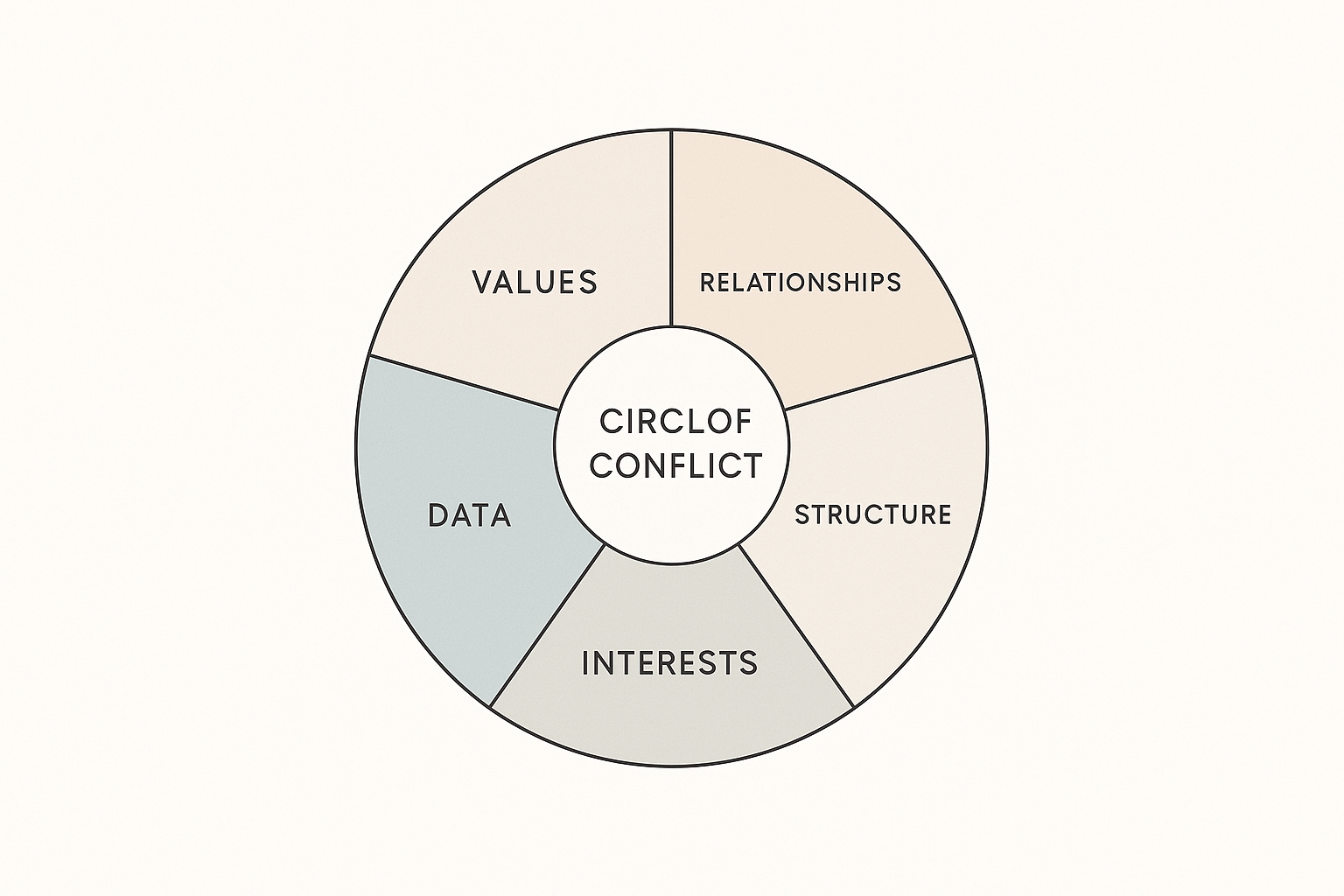
How to Use the Circle of Conflict in Leadership
Conflict resolution is a critical skill for technical leaders. The Circle of Conflict, a framework developed by Christopher Moore, helps leaders identify and address the root causes of disputes. This model categorizes conflicts into five key types: Data, Relationship, Values, Structural, and Interest conflicts. Each type requires a unique approach to resolution, making it a practical tool for navigating workplace challenges.
Key insights from the article:
- Data Conflicts: Stem from inconsistent or misinterpreted information. Solution: Ensure shared, reliable data sources.
- Relationship Conflicts: Arise from personal differences. Solution: Address interpersonal dynamics directly.
- Values Conflicts: Involve differing principles or beliefs. Solution: Seek shared overarching goals.
- Structural Conflicts: Result from unclear roles or power imbalances. Solution: Adjust organizational processes.
- Interest Conflicts: Occur due to competing priorities. Solution: Focus on underlying needs for compromise.
Resolving Differences Using the "Circle of Conflict"
The 5 Sources of Workplace Conflict
The Circle of Conflict model breaks down workplace disputes into five distinct categories, each requiring its own approach. By understanding these categories, leaders can look beyond surface issues and tackle the root causes of team tensions. This framework helps in diagnosing and resolving conflicts effectively.
"The circle, divided into five components, illustrates the potential sources of conflict in negotiations. Understanding the impact of imbalances within the circle forces all parties to first identify and diagnose the source(s) of conflict, and then parley for resolution." [1]
Data Conflicts
Data conflicts arise when team members either lack the necessary information or interpret it differently. In technical settings, these disagreements often revolve around metrics, project specifics, or access to crucial data.
For instance, a development team at a tech company was instructed to "prioritize client satisfaction" but received no clear guidelines on escalation procedures or conflict resolution. This led to mistakes and frustration. Senior management eventually stepped in, clarified the confusion, and created detailed written guidelines to address the issue [4].
Common causes include conflicting performance metrics, vague project requirements, or reliance on inconsistent data sources. For example, if one team uses marketing analytics while another relies on server logs, disputes over user engagement data are almost guaranteed [3].
The key to resolving data conflicts is ensuring all team members have access to the same reliable information and agreeing on a shared data source before making decisions.
Relationship Conflicts
Relationship conflicts are rooted in personal differences and can disrupt team dynamics, even when the work-related issues are minor.
Take Mark and Emily, two marketing specialists with opposing work styles. Mark preferred detailed planning, while Emily thrived on flexibility. Their manager organized a resolution session where they discussed their approaches and found common ground. The result? A hybrid system combining structured timelines with room for creative brainstorming [4].
Red flags include avoiding colleagues, excluding others from discussions, or making personal remarks during meetings. These conflicts tend to escalate quickly, as emotional reactions often overshadow professional judgment.
Unlike data conflicts, resolving relationship issues requires addressing interpersonal dynamics directly, rather than focusing on processes or additional information.
Values Conflicts
Values conflicts occur when team members clash over fundamental principles or beliefs about work. These disputes can be especially tricky because they stem from deeply held convictions.
For example, one employee might prioritize innovation and taking risks, while another values stability and proven methods [3]. In one case, a software developer named Alex felt targeted by a manager's inappropriate age-based comments. This created a values conflict tied to respect and inclusion. The company responded by introducing an anonymous reporting system, conducting an HR investigation, and requiring the manager to complete sensitivity training. They also reinforced a zero-tolerance policy for discriminatory behavior [4].
Resolving values conflicts often involves finding a shared overarching principle that both parties can agree on, as compromise on core values is rarely straightforward.
Structural Conflicts
Structural conflicts arise from organizational issues like unclear roles, uneven workloads, or power imbalances. These challenges can create tension regardless of individual personalities or relationships.
For example, when remote employees at a marketing agency felt excluded from decision-making and undervalued, while in-office staff believed remote workers had it easier, tensions flared. HR stepped in, introducing a hybrid work policy with regular virtual check-ins, balanced workloads, and team-building activities to bridge the gap [5].
Addressing structural conflicts often requires systemic changes, such as redefining roles, reallocating resources, or revising organizational processes, rather than focusing solely on communication.
Interest Conflicts
Interest conflicts happen when team members have competing goals or priorities. Unlike values conflicts, these disputes often involve negotiable positions, making compromise possible.
For instance, two executives clashed over a project's direction due to differing visions. A mediator helped them understand each other's perspectives, leading to a compromise: the project would start with Lisa's data-driven approach and shift to Tom's rapid execution plan if the initial metrics supported it [4].
The secret to resolving interest conflicts lies in identifying the underlying needs behind each person's position. By focusing on why someone wants something, teams can often find win-win solutions.
"If we can understand and locate the sources of conflict, we can create a map to guide us through the conflict process." - Bernard Mayer [2]
How to Apply the Circle of Conflict Model
Now that you're familiar with the five sources of conflict, it's time to put the Circle of Conflict model into action. This approach helps technical leaders move from identifying issues to creating meaningful solutions. By following these steps, you can turn insights into practical strategies.
Step 1: Observe and Listen
Start by paying close attention to team dynamics. Look for both spoken and unspoken cues - things like tone shifts, interruptions, or nonverbal signals (crossed arms, eye-rolling) that might hint at deeper frustrations.
Notice patterns in interactions. Are tensions higher during specific discussions? Do certain team members seem left out? Are people hesitant to speak up or challenge ideas? These observations can reveal the root causes of conflict.
Take time for informal one-on-one conversations. These casual chats often uncover valuable insights that might not surface in formal meetings, where people may feel the need to maintain a professional front.
Step 2: Identify the Conflict Type
Once you've gathered enough observations, the next step is diagnosing the conflict type. This is critical because each type of conflict requires a different approach.
"Using the Circle of Conflict gives you a language for describing what's happening and a way to do something about it." – Jolie Bain Pillsbury [6]
Review the five conflict sources with your team and identify the primary cause. Facilitate open discussions where everyone can share their perspectives on what they believe is driving the tension. Use the circle as a guide to pinpoint one or more sources of conflict [1].
Keep in mind that conflicts often stem from multiple factors. For example, a disagreement over data might also involve personal relationships or clashing priorities. Take the time to fully explore all possible causes.
Step 3: Gather and Clarify Information
For conflicts centered on data, ensure everyone has access to accurate and reliable information. Collaborate to improve data sources if existing ones are insufficient [6].
Clarify any confusing terminology to establish a common understanding, especially in technical environments where the same term might mean different things to different teams.
Document your findings thoroughly. Create shared repositories where everyone can access the same information, and set clear protocols for collecting, validating, and updating data moving forward.
Step 4: Facilitate Open Dialogue
Open and honest communication is key, particularly when dealing with relationship or values-based conflicts. Create a safe environment where people feel comfortable sharing their thoughts. Small-group discussions can be especially effective, and rotating facilitator roles can help ensure everyone feels included.
For sensitive topics, consider breaking larger groups into smaller ones of 6–10 participants. Choose a time and setting that encourages open participation [7].
When addressing values conflicts, focus on understanding rather than judgment. Discuss the experiences that shaped each person's values and work toward finding common ground [6]. Active listening is essential - ask thoughtful questions to ensure all perspectives are heard [7].
Step 5: Address Structural and Interest Issues
Structural and interest conflicts often require more than just improved communication - they may need systemic changes. For structural issues, clarify roles and responsibilities, and acknowledge any limitations to authority. Some issues may even lie beyond your immediate control [6].
Use tools to analyze structural factors contributing to the conflict. This might include examining reporting lines, resource allocation, or decision-making processes [8]. Adjustments in these areas should align with your team’s goals.
When dealing with interest conflicts, focus on the underlying needs of all parties. Brainstorm multiple solutions and shift the conversation from blame to problem-solving [6]. Highlight shared goals to reframe the narrative and foster collaboration.
"There are three ways of dealing with difference: Domination, compromise, and integration. By domination, only one side gets what it wants; by compromise, neither side gets what it wants. And by integration, we find a new way by which both sides get what they wish." – Mary Parker Follett [12]
For complex or high-stakes conflicts, consider bringing in a neutral third-party mediator. Their objectivity can help guide the team toward a resolution [9][11].
Step 6: Follow Up and Adjust
Resolving conflict isn’t a one-time event - it’s an ongoing process. Monitor the outcomes of your solutions and be ready to make adjustments as needed.
Schedule regular check-ins to evaluate whether the agreed-upon changes are effective. Are team members following through? Have new challenges arisen? Are structural changes reducing tension as intended?
Document these outcomes to create a knowledge base for future conflict resolution efforts. Regular follow-ups help ensure that small issues don’t snowball into larger problems.
Keep communication open and transparent. Share your reasoning behind decisions to maintain trust and avoid misunderstandings that could lead to new conflicts [10]. By making conflict resolution an ongoing effort, you can foster a more harmonious and productive team environment.
Common Mistakes to Avoid
Even experienced technical leaders can misstep when using the Circle of Conflict model. These missteps can derail conflict resolution efforts and, in some cases, worsen the situation. The Circle of Conflict model emphasizes pinpointing the actual sources of conflict, so it's crucial to sidestep these common errors that can obscure the real issues.
Over-Focusing on Data
Technical leaders often lean heavily on data and facts. While information is important, treating every conflict as a data problem can lead to frustration. You might spend countless hours compiling metrics, drafting detailed reports, and presenting logical arguments, only to discover that tensions persist and the conflict remains unresolved.
The reality is that many conflicts stem from interpersonal or structural issues that can't be addressed with data alone. For example, if team members feel excluded from decision-making, providing them with performance data won't resolve their underlying concerns about respect and inclusion.
"When people work together, conflict can range from a very simple difference of opinion to a deep-rooted disagreement over what should be done, and when conflicts are left unspoken and unresolved, they become barriers to action and achieving results."
This issue becomes especially challenging when dealing with values or interest conflicts. For instance, two engineers might clash over code review practices - not due to a lack of information but because they hold different priorities, such as valuing quality over speed. No amount of data on bug rates will resolve such a fundamental difference in philosophy.
To avoid this pitfall, use the Circle of Conflict framework to identify the root cause of the disagreement. Ask yourself: Would this conflict disappear if everyone had the same information? If the answer is no, the issue likely stems from relationship, values, structural, or interest-based conflicts, which require a different approach.
Now, let’s look at how overlooking relationship dynamics can further complicate conflict resolution.
Ignoring Relationship Dynamics
Another common mistake is treating conflicts as purely professional issues while neglecting the personal relationships among team members. Technical leaders often assume that focusing on tasks and processes will naturally resolve interpersonal tensions. Unfortunately, this approach often backfires, as unresolved relationship conflicts can continue to fester beneath the surface.
Relationship conflicts can undermine even the most logical discussions. When trust between team members breaks down, they may question each other's motives, dismiss good ideas, or interpret neutral comments as personal attacks. You might notice this dynamic when team members consistently disagree on every topic or avoid collaborating despite having complementary skills.
Relationship conflicts require a different approach than technical disagreements. You can't rebuild trust by reorganizing workflows or updating timelines. Instead, you need to create opportunities for team members to understand each other's perspectives and rebuild professional connections.
You don’t need to force personal friendships, but you should focus on fostering respectful collaboration. This might involve facilitating honest conversations about communication styles, setting clear expectations for professional behavior, or finding ways for team members to work together without stepping on each other’s toes.
Failing to Follow Up
Even if you accurately diagnose the conflict and work toward a resolution, failing to follow up can undo your efforts. Many technical leaders invest significant time resolving conflicts, reach what seems like an agreement, and then move on to other pressing issues. Without proper follow-up, however, these "resolved" conflicts can resurface - often worse than before.
The problem is that initial agreements may not address all underlying issues, or team members may struggle to adopt new behaviors and processes. What seems like a successful resolution in a meeting room can fall apart once people return to their daily routines under pressure.
"Ensuring that a resolution sticks and that all parties move forward in harmony requires thoughtful follow-up strategies. You might have brokered peace, but without effective follow-ups, misunderstandings can resurface, and tensions might reignite."
To ensure lasting resolutions, implement regular check-ins. This doesn’t mean micromanaging, but it does mean staying engaged. Schedule brief follow-up conversations a few days after the resolution, and then again after a week or two.
"Regular dialogue cements resolutions."
During these check-ins, ask specific questions: Are team members following through on commitments? Have any new challenges emerged? Do the solutions need tweaking based on how they’re working in practice? This level of ongoing attention shows your commitment to maintaining a healthy team environment and allows you to address minor issues before they escalate.
Keep in mind that some conflicts, particularly structural ones, may require systemic changes that take time to implement. Be prepared for multiple rounds of adjustments as you fine-tune what works best for your team.
sbb-itb-8feac72
Case Studies from U.S. Tech Teams
The Circle of Conflict model has proven its value in tackling workplace disputes, especially within tech environments. These examples highlight how technical leaders can pinpoint root issues and craft effective solutions.
Case Study: Resolving a Data Conflict in a Development Team
At a fintech startup, tensions flared between the backend and frontend development teams over API performance metrics. The backend team insisted their APIs were meeting expectations, citing server response times averaging 200 ms. Meanwhile, the frontend team reported sluggish load times for vital user actions, attributing the delays to backend inefficiencies.
The technical lead initially sought to mediate by requesting more detailed performance data. However, instead of easing tensions, the additional data fueled the disagreement. Each team focused on their own metrics - backend relying on isolated server logs, while frontend emphasized the broader user experience, including network latency and browser performance.
Using the Circle of Conflict model, the lead identified the core issue: conflicting methods of data collection and interpretation, not a lack of information. To address this, the lead organized structured meetings where both teams could explain their measurement approaches. A shared performance monitoring system was then introduced, combining metrics from both perspectives. Additionally, training sessions were held to enhance data literacy across teams. Within two weeks, the teams reached a mutual understanding of system performance, paving the way for collaboration and a smoother user experience.
Case Study: Addressing Structural Conflicts in a Startup
A startup faced mounting friction among its co-founders, jeopardizing the company’s progress. The conflict revolved around one founder, formerly the chief revenue officer, who began bypassing established protocols. He overruled spending limits, disrupted hiring processes, and made unilateral product decisions. In one instance, he committed to a significant marketing campaign without board consent, prompting the other founders to consider drastic actions, including leadership changes.
An executive coach, applying the Circle of Conflict framework, identified the issue as structural - a clash rooted in unclear roles and authority, rather than personal grievances. The lack of defined responsibilities and decision-making processes had created power struggles.
To resolve the conflict, the founders engaged in facilitated discussions to clarify roles and expectations. Three key issues surfaced: feelings of diminished influence, exclusion from decisions, and vague authority boundaries. The team addressed these by redefining responsibilities, setting clear decision-making protocols, and scheduling regular strategy meetings to ensure alignment. This approach restored balance and trust among the founders, leading to a more cohesive leadership structure.
These examples offer valuable takeaways for technical leaders looking to navigate and resolve team conflicts effectively.
Lessons for Technical Leaders
These case studies highlight essential strategies for handling workplace conflicts. A key takeaway is the importance of addressing the root cause rather than just treating symptoms. In the data conflict, adding more reports didn’t resolve the disagreement because the core issue - differing data collection methods - remained unaddressed. Similarly, drastic leadership changes in the structural conflict would have worsened the situation by ignoring the underlying problem of undefined authority.
The Circle of Conflict model excels at categorizing conflicts, enabling leaders to tailor their solutions. Data conflicts often require transparency and shared metrics to bridge gaps in understanding, while structural conflicts demand clear roles and decision-making frameworks. Proactive measures, like establishing shared criteria or defining authority levels, can prevent many disputes from escalating. Regular follow-ups ensure that resolutions remain effective over time.
Workplace conflict is common - research shows 85% of employees encounter it, with an average of 2.1 hours lost weekly. When used effectively, the Circle of Conflict model transforms these challenges into opportunities for growth and collaboration [13].
How Tech Leaders Training Improves Conflict Resolution Skills

Technical experts are often brilliant at coding but may find themselves less equipped to handle interpersonal disputes. Shifting from being an individual contributor to taking on a leadership role requires a completely different set of abilities - where emotional intelligence, communication, and conflict resolution become just as important as technical know-how.
Specialized training can bridge this gap. Tech Leaders offers leadership programs designed to help technical professionals navigate workplace conflicts effectively. Using practical tools like the Circle of Conflict framework, participants gain the skills needed to tackle challenges and foster collaboration within their teams.
Using Frameworks like the Circle of Conflict
The Circle of Conflict framework is a centerpiece of Tech Leaders' training approach. It provides a structured way to understand and resolve disputes, which is critical for new managers who often feel uneasy about handling conflict [19]. The program incorporates hands-on practice, allowing participants to work through real-world scenarios.
Interactive workshops are a key part of the training. These sessions use role-playing exercises and case study analysis to teach participants how to apply the Circle of Conflict framework in practical situations [14]. The focus is on identifying and addressing underlying interests rather than getting stuck on surface-level positions. This mindset encourages cooperative problem-solving, which is especially useful in technical teams where individuals may become overly attached to their preferred solutions without considering broader business goals or user needs [15].
Participants also build essential communication skills, such as active listening, framing messages thoughtfully, clarifying assumptions, and managing tone and body language [14]. These techniques help leaders create an environment where team members feel safe sharing their concerns and perspectives.
The Role of Peer Masterminds and Coaching
Tech Leaders enhances its training with peer masterminds and personalized coaching, both of which accelerate the development of conflict resolution skills. This collaborative approach allows participants to learn from others who face similar challenges, making the process more relatable and impactful.
Through these peer groups and coaching sessions, leaders work through actual conflicts and receive tailored feedback. This not only normalizes workplace disputes - 85% of employees encounter conflict, with U.S. workers spending about 2.1 hours per week dealing with it [19] - but also equips participants with strategies to handle them more effectively.
"As mediators, we create a safe and supportive environment for clients to do the really hard work of moving away from conflict and hurt, toward resolution and peace." – Hayley MacPhail, Experienced Mediator and Instructor [16]
By combining peer learning with one-on-one coaching, the program provides a robust support system. Leaders gain confidence in their ability to resolve conflicts and learn to model constructive behaviors that encourage open dialogue and shared accountability within their teams [14].
But it’s not just about traditional methods - emerging technologies are also reshaping how conflicts are managed.
Building Leadership Skills for the AI Age
The rise of AI in the workplace adds a new layer of complexity to conflict resolution, especially in digital and remote environments. Tech Leaders addresses this shift by teaching participants how to integrate technology into their approach while maintaining the human touch that’s crucial for effective leadership.
One focus area is the use of AI tools to analyze communication patterns, identify early signs of tension, and streamline resolution processes in remote teams [17]. These tools offer unbiased, data-driven insights into team dynamics, helping leaders spot potential issues before they escalate.
For instance, AI-powered sentiment analysis can detect subtle signs of tension that might be missed in virtual interactions [17]. This is particularly valuable for leaders managing distributed teams, where face-to-face communication is limited.
The training also emphasizes the importance of aligning AI tools with organizational conflict management strategies, policies, and values [18]. Leaders learn to implement systems that support consistent and fair conflict resolution while adapting to the complexities of interpersonal situations.
Simulation-based exercises give participants the chance to practice resolving conflicts in AI-enhanced environments [19]. These scenarios prepare them to step confidently into leadership roles, where they can build stronger, more communicative, and resilient teams.
Key Takeaways
The Circle of Conflict model provides a clear framework for addressing the underlying causes of disputes, especially for technical leaders. By understanding that conflicts arise from five distinct sources, leaders can apply targeted strategies to resolve them effectively. This insight serves as the foundation for the resolution process outlined here.
Leaders dedicate about 24% of their time to resolving conflicts [21], highlighting the importance of a structured approach. The model’s strength lies in its ability to remove personal biases from conflicts, allowing leaders to focus on the actual root causes and solutions [20].
"If we can understand and locate the sources of conflict, we can create a map to guide us through the conflict process." – Bernard Mayer [2]
The six-step process - observe, identify, gather, dialogue, address, and follow up - provides a systematic method for resolving conflicts within teams [3]. By understanding the dynamics of disputes and taking decisive action, leaders can turn challenges into opportunities for growth [3].
Research shows the tangible benefits of effective conflict resolution: 41% of participants reported a better understanding of others, 33% noted improved working relationships, and 29% identified better solutions to problems [21]. For technical leaders transitioning from individual contributor roles to management, mastering this framework is essential for fostering team cohesion and setting a positive tone across the organization.
Combining modern conflict resolution techniques with peer support and coaching equips technical leaders to meet the demands of today’s workplace. Success depends on consistent application, active listening, and fostering safe spaces for open conversations - skills that directly enhance team performance, communication, and problem-solving [22]. By embracing these strategies, technical leaders can drive meaningful and lasting improvements within their teams.
FAQs
How can technical leaders use the Circle of Conflict model to resolve workplace disputes effectively?
The Circle of Conflict model offers technical leaders a practical framework for tackling workplace disputes by pinpointing five primary sources of conflict: values, relationships, data, interests, and structure. The first step in using this model is to dig into these categories to uncover the root cause of the disagreement.
After identifying the source, select a resolution strategy that fits the situation. For example, relationship-based conflicts might benefit from a collaborative approach, while structural issues could call for compromise. Adapt your communication and negotiation style to address the specific type of conflict, aiming to resolve the deeper issue instead of getting stuck on surface-level arguments. This approach encourages open, constructive conversations and paves the way for lasting solutions, ultimately promoting a more cohesive and efficient workplace.
How can leaders identify and resolve structural conflicts within their teams?
To tackle structural conflicts effectively, the first step is identifying the root cause of the problem. This might mean examining how resources are distributed, evaluating team dynamics, or reviewing organizational workflows. Understanding what’s driving the issue helps set the stage for meaningful solutions.
From there, take time to actively listen to each team member’s perspective. This isn’t just about hearing their concerns - it’s about understanding what motivates them and where their frustrations stem from.
Once you have a clear picture of the core challenges, work together as a team to brainstorm realistic solutions. Tools like open group discussions or mediation sessions can help create a space for honest communication and foster mutual trust. By encouraging transparency and collaboration, leaders can resolve conflicts in a way that strengthens relationships and builds a more cohesive team.
How can leaders resolve conflicts in a way that prevents them from recurring?
To keep conflicts from reemerging, it’s crucial to tackle the root causes instead of merely addressing surface-level issues. Encourage open, continuous communication so everyone involved feels genuinely heard and understood. Trust is key - demonstrate fairness and consistency in your actions to build and maintain it.
Take a collaborative approach to problem-solving by involving all stakeholders in crafting solutions. Regular follow-ups are essential to track progress and ensure agreements are upheld. Promoting a workplace culture built on transparency and accountability can go a long way in maintaining long-term harmony.