

ISO/IEC 17024 Explained for Tech Leaders
ISO/IEC 17024 is an international standard for certifying individuals, ensuring that certifications are fair, transparent, and based on verified skills. This standard is particularly relevant for tech leaders who rely on certifications to validate expertise in leadership or technical roles. Unlike many other certifications, ISO/IEC 17024 requires external oversight, impartiality, and rigorous processes, making it a trusted benchmark for global employers and regulators.
Key Takeaways:
- What It Does: Establishes a framework for certifying individuals based on clear, evidence-based competencies.
- Why It Matters: Ensures certifications are unbiased, consistent, and globally recognized, especially in industries like technology and project management.
- How It Works: Certification bodies must meet strict requirements, including job analysis, independent assessments, and recertification processes.
- For Tech Leaders: Helps evaluate credible certifications and align internal leadership programs with global standards.
For U.S.-based professionals, ISO/IEC 17024-aligned certifications are increasingly valued by employers and the federal government, enhancing career opportunities and trust in professional credentials.
ISO/IEC 17024 Training Course
Core Principles and Structure of ISO/IEC 17024
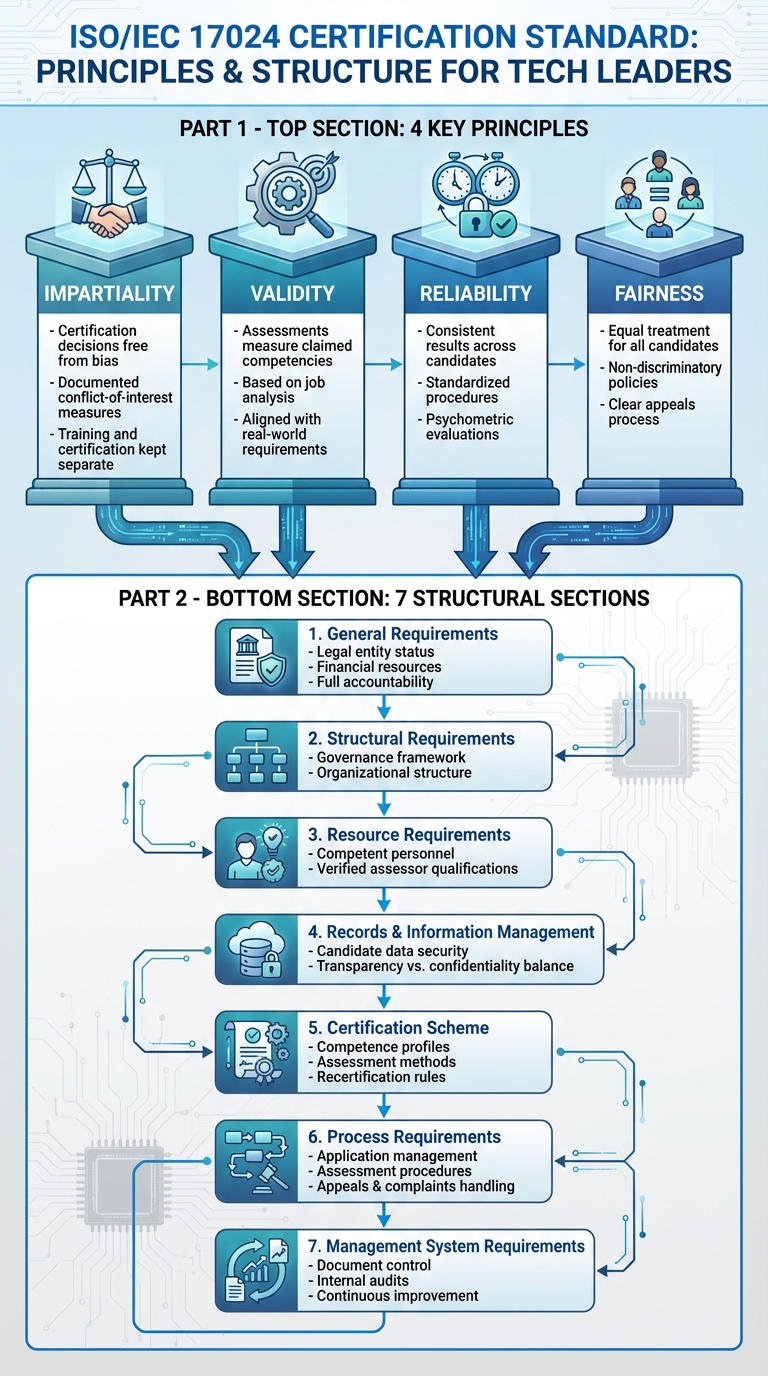
ISO/IEC 17024 Structure: 7 Core Sections and 4 Key Principles
Main Principles of ISO/IEC 17024
ISO/IEC 17024 is built on four key principles that guide the operations of certification bodies: impartiality, validity, reliability, and fairness. Let's break these down:
- Impartiality: Certification decisions must be free from bias. To ensure this, the standard requires documented measures to avoid conflicts of interest.
- Validity: Assessments must genuinely evaluate the competencies they claim to measure. This is achieved through job analysis and alignment with real-world requirements.
- Reliability: Results should be consistent across different candidates, times, and exam versions. This is maintained through standardized procedures and psychometric evaluations.
- Fairness: All candidates must be treated equally. This includes non-discriminatory policies, accommodations for disabilities, and clear processes for appeals.
Certification bodies must establish impartiality committees, require conflict-of-interest declarations, and ensure that training and certification decisions are kept separate. For example, individuals involved in training or exam preparation cannot influence certification decisions for the same candidates. To maintain fairness and accuracy, assessments are regularly analyzed for bias, and every step of the process - application, examination, and recertification - is documented and subject to audit.
The next layer of ISO/IEC 17024 is its detailed structure, which provides the operational framework for these principles.
How the Standard is Organized
ISO/IEC 17024 is structured into seven sections, each addressing a specific area of certification body operations:
- General requirements: Certification bodies must be legal entities with sufficient financial resources and full accountability for certification decisions - this responsibility cannot be outsourced.
- Structural requirements: These cover the governance and organizational framework of the certification body.
- Resource requirements: Personnel involved in certification must demonstrate both competence and impartiality. Assessors need verified qualifications.
- Records and information management: This section ensures candidate data is handled with care. Certification bodies must balance transparency - such as publishing eligibility criteria - with confidentiality, like securing exam materials and personal records.
- Certification scheme: Bodies must define competence profiles based on job analysis, outline assessment methods, and set clear recertification rules.
- Process requirements: This section specifies how applications, assessments, decisions, appeals, and complaints are managed consistently.
- Management system requirements: This includes document control, internal audits, corrective actions, and ongoing improvements.
A critical structural requirement is the separation of training from certification. If a certification body offers both services, it must implement strict controls. These include separate management structures, different personnel for training and certification decisions, and clear policies stating that completing training does not guarantee certification. This ensures certification outcomes remain independent and avoids any perception of "pay-to-pass" practices.
This well-defined structure is backed by rigorous oversight from accreditation bodies.
What Accreditation Bodies Do
Accreditation bodies play a vital role in ensuring certification programs meet the stringent requirements of ISO/IEC 17024. In the United States, organizations like the ANSI National Accreditation Board (ANAB) and the International Accreditation Service (IAS) provide independent verification of compliance. Here's how they do it:
- Document reviews: Accreditors examine the certification body's policies and procedures to ensure they align with the standard.
- Assessments: On-site or virtual evaluations are conducted, during which assessors interview staff and observe operations.
- Gap analysis: Any nonconformities or areas needing improvement are identified and must be addressed.
Accreditation isn't a one-time event. Certification bodies undergo periodic surveillance and full reassessments to ensure they continue to meet the standard. This ongoing oversight adds credibility to ISO/IEC 17024-accredited certifications, making them trusted by employers, regulators, and clients worldwide.
For tech leaders, choosing certifications accredited by organizations like ANAB signals that the credential was earned through a rigorous, transparent process - not simply by completing a training course. This level of scrutiny ensures the certifications carry weight and trust in professional settings.
How ISO/IEC 17024 Certification Works
What Certification Schemes Include
A certification scheme outlines the framework for who can be certified, what they need to demonstrate, and how their competence is evaluated. These schemes are built around seven key elements:
- Scope: Clearly defines the role, industry, and geographic boundaries.
- Job Description: Based on a formal analysis of the role's specific requirements.
- Competence Requirements: Details the knowledge, skills, and abilities needed.
- Prerequisites: Includes criteria like minimum education or years of experience.
- Assessment Methods: Specifies how candidates will be evaluated.
- Code of Conduct: Establishes ethical expectations, when applicable.
- Recertification Criteria: Outlines the timelines and requirements for maintaining certification.
For tech leadership certifications, these schemes are tailored to reflect the responsibilities of real-world leadership roles, such as strategic decision-making and managing stakeholders. For instance, prerequisites might require a bachelor’s degree in a technical field with four years of leadership experience, or a master’s degree with two years of experience. Assessment methods could include written exams on leadership frameworks, hands-on simulations of team management scenarios, and structured interviews to evaluate decision-making abilities. Recertification is typically required every few years, with candidates needing to show continued professional growth through further education, documented leadership activities, or re-examination.
This structured approach ensures the certification process is both fair and transparent.
The Certification Process from Start to Finish
The certification journey begins with candidates reviewing the eligibility criteria, exam format, fees (listed in U.S. dollars), and recertification guidelines. They then submit an application, including identity verification and proof of qualifications. The certification body reviews these submissions, ensuring all prerequisites are met. If anything is missing, the application is returned with clear instructions on what needs to be completed.
Once eligibility is confirmed, candidates are scheduled for assessments conducted under secure and standardized conditions. Exams are scored based on pre-approved criteria, with borderline results undergoing expert review. Importantly, the final certification decision is made by an independent decision-maker who has no involvement in the training or assessment process, as required by ISO/IEC 17024. Successful candidates receive certificates with specified validity periods and are added to a public registry.
To maintain certification, candidates must meet ongoing requirements before their certificate expires. This could involve submitting proof of continuing education, recent relevant work experience, or passing another exam. Certification bodies may also perform surveillance checks to ensure compliance with the code of conduct. Certificates can be suspended or revoked for reasons such as ethical violations, failure to recertify, or falsified information. These actions follow documented procedures, including proper notification and the right to appeal. Appeals and complaints are handled through a defined process with independent review.
A well-structured management system underpins this entire process, ensuring it runs smoothly and adheres to the standard.
Management System Requirements
ISO/IEC 17024 requires certification bodies to maintain a documented management system that oversees processes like document control, internal audits, and continuous improvement. This system ensures that policies and procedures are current, access to candidate and exam records is properly controlled, and periodic audits are conducted to confirm compliance with both ISO/IEC 17024 and internal standards.
The framework allows for the use of ISO 9001-based quality management systems as a foundation, provided they also address the specific requirements of ISO/IEC 17024. Certification bodies can adopt a process-driven approach by clearly defining inputs, outputs, and responsibilities for key functions such as scheme development, assessment delivery, decision-making, and handling complaints. Performance metrics - like exam reliability, appeal rates, and application processing times - help identify areas for improvement. A strong management system not only meets the standard’s requirements but also enhances the credibility needed for tech leaders aiming to take on strategic roles.
sbb-itb-8feac72
How ISO/IEC 17024 Applies to Leadership Certification
Building on the established framework and processes, ISO/IEC 17024 provides a solid foundation for leadership certification.
Why ISO/IEC 17024 is Considered the Top Certification Standard
ISO/IEC 17024 is widely acknowledged as a leading standard for personnel certification because of its rigorous approach to verifying competencies. It requires certification bodies to establish clear, job-related competencies, implement robust assessment methods, ensure impartiality through structured governance, and maintain ongoing improvement via regular audits and reviews.
For leadership certifications, this means focusing on measurable behaviors - like decision-making, stakeholder communication, and risk management - rather than relying on vague personality traits. The assessments are designed with the same level of precision as those used in high-stakes technical certifications.
The growing recognition of ISO/IEC 17024 by the U.S. federal government and major industries reflects its value. ANAB describes it as "a globally accepted benchmark", emphasizing its significance in both regulatory and contractual settings. [3]
Connecting ISO/IEC 17024 to Leadership Skills
ISO/IEC 17024's emphasis on detailed job or practice analysis makes it highly relevant for shaping leadership competency models, particularly for roles such as engineering managers, tech leads, or CTO candidates. This process involves identifying key tasks - like defining technical vision, managing compliance risks, leading incident responses, and coaching engineers - and then mapping the specific competencies needed for each.
For example, these competencies might include systems thinking, effective communication with stakeholders, financial literacy for managing budgets in U.S. dollars, ensuring security and compliance, and integrating AI strategies into product development. By setting measurable benchmarks - such as the ability to "analyze trade-offs in a $1,000,000–$5,000,000 annual budget" or "lead a cross-functional incident review with actionable outcomes" - the standard ensures that assessments are closely aligned with real-world leadership demands. These evaluations often include scenario-based questions, case studies, simulations, and structured interviews, creating a robust framework for trusted certifications.
How Tech Leaders Can Use This Standard

Tech professionals can leverage ISO/IEC 17024 to enhance their leadership credentials and evaluate certification programs effectively.
For U.S.-based tech leaders, this means using the standard as a checklist when assessing external certifications. Start by confirming whether the certification body is accredited or aligned with ISO/IEC 17024 - look for recognition by organizations like ANAB or IAS. Review whether the certification provider offers a transparent competency framework and job/practice analysis that directly links the credential to specific leadership roles in technical fields. Check for clear documentation on eligibility requirements, assessment methods, scoring criteria, and recertification processes. Be cautious of programs that promise guaranteed passes or combine training and certification into a single process, as these may indicate conflicts of interest. Additionally, ensure the program includes mechanisms for appeals and maintains strict confidentiality for candidate data. Programs that rely on evidence-based assessments - such as structured interviews, case simulations, or portfolio reviews - are generally more credible than those relying solely on attendance or basic quizzes.
For tech companies, aligning internal leadership development frameworks with ISO/IEC 17024 principles can strengthen promotion systems. This involves creating a clear competency model based on structured job/practice analysis, establishing transparent promotion criteria with defined behavioral expectations, implementing impartial governance processes (like cross-functional review committees), and designing standardized assessments with feedback mechanisms. These steps can lead to a more consistent and defensible internal promotion process.
Independent consultants and fractional CTOs can also benefit by incorporating the language of ISO/IEC 17024 into their proposals. Highlighting terms like competence, impartial assessment, and recertification signals a commitment to rigorous standards. Programs like Tech Leaders emphasize this approach, bridging the gap between technical expertise and the non-technical skills necessary for a smooth transition into leadership roles.
Conclusion: What Tech Leaders Need to Know
ISO/IEC 17024 stands as the global standard for certifying individuals - not companies or products [1]. For tech leaders in the U.S., this framework helps distinguish certifications that are backed by transparent job analyses and real-world validation from those that lack such depth [1]. When assessing certifications - whether for personal growth, team development, or vendor selection - look for programs that provide documented competency models, independent assessments, clear recertification processes, and accreditation by recognized bodies like ANAB or IAS. This level of rigor ensures that certifications are as dependable and audit-ready as the standards you apply to product quality and security decisions. It not only enhances external credibility but also serves as a foundation for shaping internal leadership strategies.
The standard’s focus on impartiality, validity, and continuous improvement offers a solid blueprint for building more structured internal talent programs. By incorporating ISO/IEC 17024 principles - such as detailed job analyses, structured assessment processes, and the separation of training from evaluation - you can design promotion and leadership development systems that are transparent and aligned with global best practices [1]. For those moving into consulting roles or developing technical expertise into marketable services, aligning offerings with 17024-style competency frameworks signals that your services are measurable and meet international benchmarks.
ISO/IEC 17024 also promotes a mindset of continuous learning, which is critical for staying relevant in the fast-changing technology and AI landscapes [2]. Certifications based on this standard often require recertification every three to five years, ensuring professionals stay updated with evolving practices. This not only reinforces a globally recognized signal of competence but also supports career mobility. For tech leaders transitioning into leadership roles, making hiring decisions, or navigating global opportunities, familiarity with ISO/IEC 17024 enhances credibility with U.S. employers, regulators, and international stakeholders [1].
FAQs
What are the benefits of ISO/IEC 17024 for tech leaders assessing certifications?
ISO/IEC 17024 is a globally respected standard designed to ensure that certifications are built on consistent, high-quality criteria for evaluating professional competence. For those in tech leadership, it offers a dependable way to assess certifications, ensuring they genuinely represent practical expertise and relevant skills.
Certifications aligned with ISO/IEC 17024 give tech leaders the confidence to identify skilled professionals, make smarter hiring choices, and assemble more effective teams. This becomes especially critical when stepping into leadership roles, where evaluating a mix of technical and soft skills is essential.
What is the role of accreditation bodies in the ISO/IEC 17024 certification process?
Accreditation bodies are essential in upholding the trustworthiness and dependability of the ISO/IEC 17024 certification process. Their primary role is to assess and officially validate certification organizations, ensuring these organizations adhere to the stringent international standards outlined by ISO/IEC 17024.
By monitoring and evaluating certification bodies, accreditation bodies help safeguard the consistency, fairness, and quality of certifications. This guarantees that professionals certified through accredited organizations are acknowledged for meeting globally recognized benchmarks of skill and knowledge.
How does ISO/IEC 17024 promote fairness and impartiality in certifications?
ISO/IEC 17024 plays a key role in promoting fairness and impartiality by requiring certification bodies to operate independently and steer clear of any conflicts of interest. It sets out strict guidelines to ensure that decisions are grounded in objective evidence, free from external influences or biases.
The standard also prioritizes transparency in certification processes, demanding regular evaluations to uphold trust and credibility. This approach ensures that every candidate is assessed on equal footing, without regard to their background or connections.