
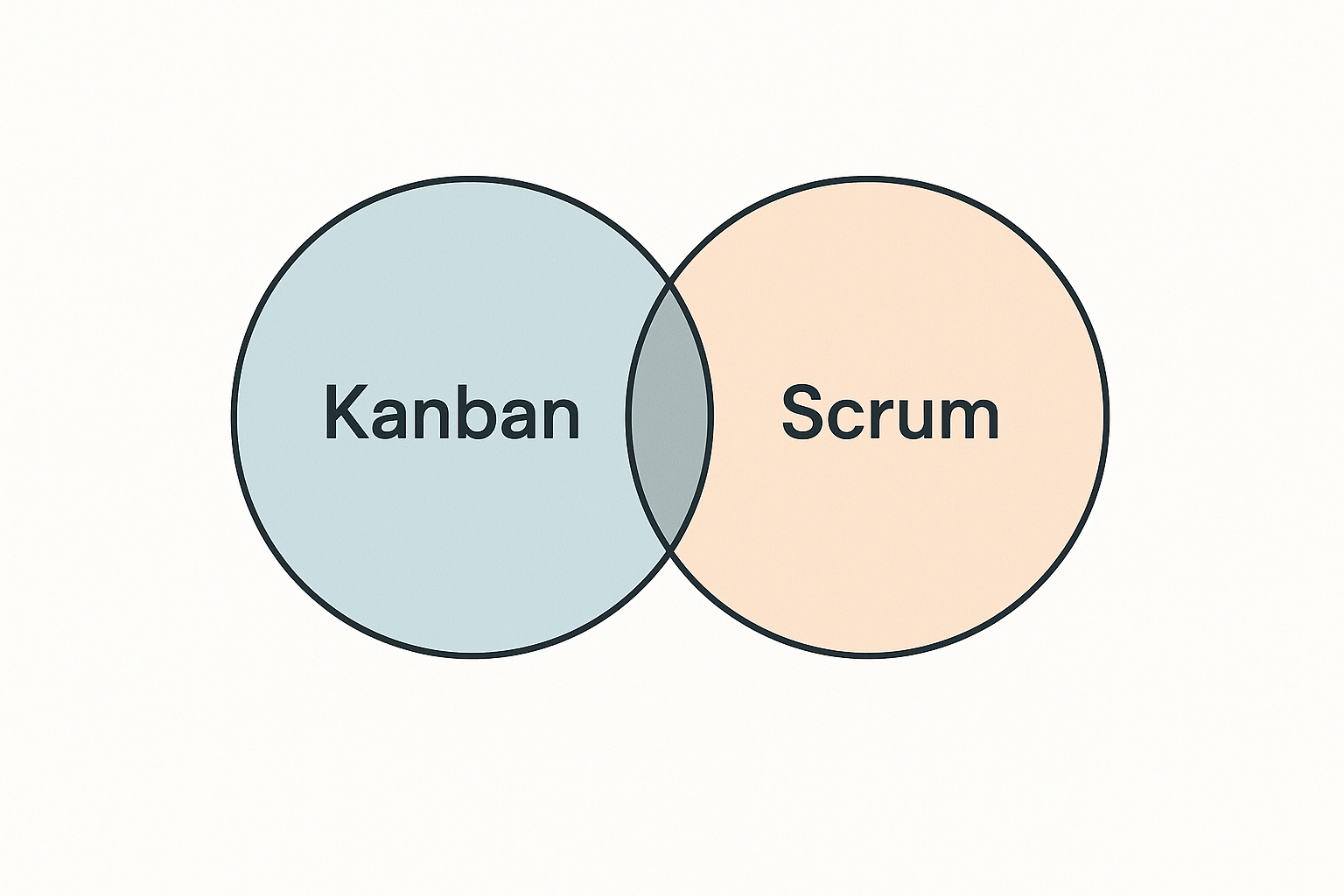
Kanban vs. Scrum: When to Use Each
Kanban and Scrum are two popular Agile frameworks, but they serve different purposes based on team needs, project types, and workflows. Here's what you need to know:
- Kanban: Best for teams with continuous workflows or unpredictable workloads. It uses visual boards and focuses on managing work as it flows, without fixed roles or timeframes.
- Scrum: Ideal for projects with clear deliverables and deadlines. It relies on structured sprints, defined roles, and regular ceremonies to maintain progress and predictability.
Quick Comparison
| Feature | Kanban | Scrum |
|---|---|---|
| Workflow | Continuous flow | Sprint-based iterations |
| Planning | Dynamic, ongoing | Fixed at sprint start |
| Roles | Flexible, no mandates | Defined roles (Product Owner, Scrum Master, Team) |
| Boards | Continuous, never reset | Reset after each sprint |
| Change Management | Frequent adjustments allowed | Limited during sprints |
| Metrics | Lead time, cycle time | Velocity, burndown charts |
Key Takeaways:
- Use Kanban for flexibility and handling ongoing tasks like IT support or marketing campaigns.
- Choose Scrum for structured planning and predictable delivery in product development or time-sensitive projects.
- For mixed needs, consider blending both methods.
The right choice depends on your team’s workflow, goals, and how often priorities shift.
Scrum vs Kanban: Difference Between & When To Use! 🤔
Key Differences Between Kanban and Scrum
Kanban and Scrum approach work management in distinct ways, offering different benefits depending on the needs of a team or project.
Workflow and Role Comparison
The most noticeable difference between Kanban and Scrum lies in how they manage workflow. Kanban follows a continuous flow system, where tasks move through various stages without interruption. Teams pull in new tasks only when they have the capacity to handle them, ensuring steady progress [1].
Scrum, on the other hand, organizes work into sprint-based cycles. These iterations are time-boxed, with teams committing to specific deliverables at the start of each sprint. Each cycle ends with a review, creating natural checkpoints for reflection and planning [1].
The way roles are defined also sets these frameworks apart. Kanban focuses on flexible team roles, allowing members to adjust responsibilities based on the situation and their expertise. In contrast, Scrum defines three specific roles: the Product Owner (who prioritizes and defines the work), the Scrum Master (who ensures the process runs smoothly), and the Development Team (who completes the work).
Even the visualization of work differs. Kanban boards are ongoing and never reset, offering a real-time view of the workflow that evolves over time. Scrum boards, however, are reset at the start of each sprint, reflecting the new set of tasks planned for that cycle [1].
These distinctions in workflow and roles influence how each framework approaches planning and handles changes.
Planning and Change Management
Planning and change management reflect the underlying philosophies of Kanban and Scrum. Kanban employs just-in-time planning, which allows teams to adjust as new information or priorities emerge. This makes Kanban particularly effective in environments where requirements frequently shift or remain undefined [1].
Agile enthusiast Lena Boiser highlights Kanban's approach to change:
"Kanban change management starts with working with what you have instead of quickly introducing a whole new set of rules and processes to your teams." [3]
Scrum, by contrast, relies on structured planning at the beginning of each sprint. Teams commit to specific tasks during sprint planning sessions, creating a predictable work cycle. While Scrum can adapt to changing priorities, it discourages mid-sprint changes to maintain focus [1].
Atlassian explains Scrum’s adaptability as follows:
"Scrum is structured to help teams naturally adapt to changing conditions and user requirements, with re-prioritization built into the process and short release cycles so your team can constantly learn and improve." [2]
In urgent situations, a Product Owner can terminate an ongoing sprint, replan, and start fresh [5]. For less critical adjustments, teams typically allocate 20–30% of their sprint capacity to handle evolving requirements [4].
Metrics and Reporting
The metrics each framework prioritizes reflect their respective goals. Kanban focuses on flow-based metrics, such as lead time (the total time from task initiation to completion) and cycle time (the active working time for a task). These metrics help teams identify bottlenecks and improve efficiency.
Scrum, however, uses iteration-based metrics like velocity (the amount of work completed in a sprint) and burndown charts (graphs showing the remaining work). These tools provide insights into progress and help teams measure their sprint performance.
| Feature | Kanban | Scrum |
|---|---|---|
| Workflow | Continuous flow | Sprint-based iterations |
| Planning | Just-in-time, dynamic | Iterative, at sprint start |
| Change Management | Frequent and flexible | Limited during sprints |
| Work Boards | Continuous, never reset | Reset after each sprint |
These differences influence the day-to-day experience for teams. Kanban offers flexibility but requires discipline to stay on track. Scrum provides structure and predictability but operates within fixed timeframes and commitments.
When to Use Kanban
Kanban shines in environments where flexibility and a continuous flow of work are key. It’s particularly effective when tasks come in unpredictably or when priorities can shift at a moment’s notice.
Projects with Continuous Workflows
Kanban is a natural fit for ongoing workflows where tasks don’t align with fixed sprint cycles. Teams like IT support, maintenance, and operations often deal with unpredictable workloads, making Kanban an excellent choice. For example, IT support teams can handle urgent issues alongside routine tasks without disrupting their overall workflow.
Marketing teams also thrive with Kanban. Campaign requests, content updates, or urgent promotional materials often come unexpectedly. Whether it’s reacting to a competitor’s product launch or managing a PR crisis, Kanban allows teams to dynamically add and prioritize tasks as needed. This adaptability ensures teams stay responsive and minimize delays when priorities shift [8].
The flexibility of Kanban makes it a go-to for teams that need to adjust quickly to changing conditions, especially when their work doesn’t fit neatly into predefined cycles.
Teams Needing Flexibility
Kanban is particularly useful for teams with complex structures or cross-functional roles. Unlike other methodologies, it doesn’t impose rigid roles or mandatory meetings, making it easier to integrate into existing workflows [6].
For teams spread across different time zones, Kanban supports asynchronous collaboration. Bottlenecks are easy to spot on the board, allowing team members to step in and assist without needing scheduled check-ins [7]. This approach fosters a culture of shared responsibility and real-time problem-solving, where team members proactively help each other tackle challenges [7].
Optimizing Throughput Over Deadlines
Kanban is ideal for teams that prioritize workflow efficiency over meeting fixed deadlines. This is especially true for innovation-focused teams, where uncertainty and risk are common [9].
By emphasizing continuous progress, Kanban helps teams maintain momentum even when individual tasks take longer than expected. The visual nature of Kanban boards makes it simple to manage workloads, redistribute tasks, and avoid bottlenecks. This keeps the workflow smooth and resources well-utilized, reducing risks and boosting productivity [9].
For teams that measure success by the value of completed work rather than strict deadlines, Kanban’s continuous flow model is a game changer. It allows for ongoing adjustments to priorities without being confined by rigid sprint boundaries [7]. This adaptability enhances overall efficiency, making Kanban a reliable choice for teams aiming to balance flexibility with productivity.
sbb-itb-8feac72
When to Use Scrum
Scrum shines in situations where structure and predictability are key. Unlike Kanban, which thrives in more fluid settings, Scrum is ideal for projects that require clear deliverables and strict deadlines. Its structured approach benefits projects, teams, and stakeholders with varying needs.
Projects Requiring Structured Planning
Scrum is particularly effective at breaking down complex, fast-moving projects into manageable sprints. These short, focused cycles ensure steady progress while allowing teams to make timely adjustments. This makes it a great fit for projects involving innovation, shifting requirements, or incomplete information [10]. By dividing work into sprints, Scrum allows teams to tackle uncertainty in smaller, more manageable pieces, all while maintaining a steady rhythm.
"In my experience, one of the top benefits of using Scrum is that it forces you to be clear about what you're doing. If you're working on a project, and your goal is to ship a feature or a product, you need to make sure that everyone on your team agrees on what it is you're trying to accomplish." - Gauri Manglik, CEO & co-founder of Instrumentl [11]
Though often associated with software development, Scrum's structured planning cycles can be applied to a variety of fields, such as website redesigns, journalism projects, and UI/UX design [10]. The key is having defined goals and deliverables that benefit from an organized approach.
Smaller, Cross-Functional Teams
Scrum works best with small, cross-functional teams - typically 5 to 9 members - who can work collaboratively to deliver incremental progress on complex projects [13][14]. Unlike larger groups, smaller teams benefit from streamlined communication, reducing the risk of inefficiencies. Scrum emphasizes how team members work together rather than focusing solely on their individual roles [13].
By design, Scrum teams include all the skills needed to deliver value in each sprint [12]. This setup is especially effective for projects that demand close collaboration among team members with diverse expertise [10]. Scrum also fosters a positive team culture by promoting its core values and encouraging personal accountability, which often leads to higher motivation and job satisfaction [15][16].
Focus on Predictability and Progress
One of Scrum's standout features is its ability to provide predictable outcomes. Its fixed-length sprints not only help teams stay on track but also give stakeholders a clear view of progress and opportunities for adjustments. According to reports, Scrum teams experience a 69% boost in collaboration, 54% better alignment with business goals, and a 39% improvement in work environments [11]. These benefits come from Scrum's structured planning and emphasis on regular feedback.
"Using Scrum has helped us be more nimble and adapt to our customers' needs quickly based on their feedback. Incorporating feedback at the end of one sprint and prioritizing new features for the next sprint demonstrates our ability to iterate rapidly." - Sydney Cohen, CTO at Axolo [11]
The impact of Scrum is undeniable. A staggering 87% of Agile teams use it [11], and its implementation has been shown to increase quality by up to 250%, as measured by defect density [11]. For teams focused on hitting deadlines and delivering specific features, Scrum's time-boxed sprints provide the structure and accountability needed to keep momentum throughout the project lifecycle.
Checklist for Choosing Kanban or Scrum
Choosing the right methodology means aligning your team's unique needs with the best framework. Picking the wrong one can lead to frustration, delays, and wasted resources. This checklist builds on earlier discussions about workflows and roles to help guide your decision.
Key Questions to Ask
Discuss these questions with your team. Your answers will help identify whether Kanban or Scrum suits your workflow and goals better.
Is your work continuous or project-based?
For teams managing ongoing tasks like support tickets, maintenance, or operational work that arrives unpredictably, Kanban's continuous flow system is ideal. On the other hand, if your focus is on developing new features, launching products, or completing projects with defined start and end points, Scrum's sprint-based structure is a better fit.
How often do your priorities shift?
If your team faces frequent changes in requirements or evolving business needs, Kanban's flexibility allows for reprioritization without disrupting the workflow. In contrast, Scrum thrives when priorities remain stable during a sprint, as mid-sprint changes require a reset and re-planning.
Do you need defined roles and structured ceremonies?
Some teams perform better with clear accountability and regular meetings. Scrum enforces specific roles - Product Owner, Scrum Master, and Development Team - along with ceremonies like sprint planning and retrospectives. If your team prefers to keep its current structure and make incremental changes, Kanban's flexibility and optional roles may be a better fit.
What’s more important: predictability or adaptability?
If your stakeholders expect regular deliverables or your business operates on strict deadlines, Scrum's time-boxed sprints provide the predictability you need. On the flip side, if your priority is maximizing throughput and adapting quickly to changes, Kanban's flow-based approach is more effective.
How does your team handle change management?
Teams that value continuous improvement and self-organization often find Kanban’s incremental approach less disruptive. In contrast, organizations that prefer clear boundaries and a structured process for managing change may find Scrum’s framework more suitable.
Decision Matrix for Methodology Selection
To evaluate your situation objectively, use the following matrix. Rate each attribute based on your project’s needs, and see which methodology aligns better.
| Project Attribute | Kanban Works Better | Scrum Works Better |
|---|---|---|
| Workflow Type | Continuous, ongoing tasks | Project-based, defined deliverables |
| Priority Changes | Frequent, unpredictable | Stable within set timeframes |
| Team Structure | Existing roles maintained | Benefits from defined roles |
| Planning Style | Ongoing, data-driven | Iterative, sprint-based |
| Deadline Pressure | Focus on throughput | Fixed delivery dates |
| Team Size | Any size works | Small, cross-functional (5–9 people) |
| Change Tolerance | High adaptability needed | Structured change preferred |
| Reporting Needs | Lead time, cycle time metrics | Velocity, burndown tracking |
Count the attributes favoring each methodology to determine the best fit. If the results are close, a hybrid approach might be the way to go.
For instance, a software support team may thrive with Kanban, while a product development team often benefits from Scrum's structured approach. Many teams even blend elements of both - using Kanban boards for ongoing tasks while incorporating Scrum ceremonies for project work. The goal is to adapt these frameworks to your specific needs rather than rigidly following their textbook definitions.
If you're looking to expand your expertise in choosing and implementing these methodologies, expert-led training programs - like those from Tech Leaders - can help bridge the gap between theory and real-world application.
Conclusion: Aligning Methodology with Team and Business Needs
Pick the framework that aligns best with your team's day-to-day reality. Experts point out that Kanban shines in managing workflows, while Scrum is ideal for projects with clearly defined deliverables [17].
The choice often comes down to project type and team dynamics. For teams handling continuous support, maintenance, or operational tasks, Kanban’s ongoing flow can be a natural fit. On the other hand, product development teams working toward specific releases often benefit from Scrum’s structured sprints and well-defined roles.
Experience also plays a role in this decision. Kanban is often seen as a more gradual way to adopt Agile practices, making it easier for teams new to Agile. Scrum, however, requires a higher level of commitment to roles, ceremonies, and structured processes [17]. J. B. Rainsberger offers an insightful perspective:
"I think of Kanban as 'playing the ball where it lies'. It takes a much more gradual, evolutionary approach..." [17]
By contrast, Scrum is more prescriptive, as Rainsberger explains:
"It’s opinionated, so you might prefer it if you have the feeling that you want to throw the organization into some chaos from which they would reorganize themselves." [17]
Leaders play a crucial role in guiding these transformations. Many successful teams adopt a hybrid approach - combining Kanban’s visual workflow tools with Scrum’s structured ceremonies, such as sprint planning. This blend allows leaders to customize processes to fit their teams' unique needs.
The key to success lies in aligning the chosen framework with both team morale and project goals. Leaders must go beyond understanding the mechanics of Kanban or Scrum - they need to develop skills in change management, stakeholder communication, and fostering continuous improvement. These abilities help bridge the gap between technical expertise and effective leadership.
For those navigating these transitions, targeted training can make a real difference. Programs from organizations like Tech Leaders focus on equipping leaders with the strategic thinking and leadership skills needed to implement these methodologies in practical, real-world settings.
FAQs
How can our team choose between Kanban, Scrum, or a mix of both?
To decide between Kanban, Scrum, or a hybrid approach, start by assessing your team's workflow, the nature of your project, and how much structure you prefer.
- Kanban works well for teams that value flexibility and need to focus on continuous delivery. It’s great for visualizing tasks and managing projects without strict deadlines.
- Scrum suits projects with defined timelines and structured sprints. It provides clear roles and a steady rhythm for completing work.
- A hybrid approach is a good fit for teams that require a balance of flexibility and structure, particularly when dealing with evolving or varied project needs.
Take into account your team’s dynamics, the complexity of the project, and any deadlines. Choosing the right framework can improve communication, adaptability, and overall productivity.
What challenges do teams face when switching between Scrum and Kanban?
Switching between Scrum and Kanban brings its own set of challenges, depending on which direction the change is happening.
Moving from Scrum to Kanban can feel like stepping into uncharted waters for teams used to fixed sprints and structured timelines. Without those clear timeframes, planning and tracking progress can become trickier. Teams also need to rethink how they measure success and manage their workflows, as Kanban doesn't rely on the predictable rhythm that Scrum provides.
On the flip side, transitioning from Kanban to Scrum introduces more structure, with defined roles, events, and artifacts. For teams accustomed to the freedom of Kanban, this shift can feel limiting. Adapting to practices like backlog management, work estimation, and aligning team dynamics with the Scrum framework may also pose hurdles.
To make the transition smoother - whether it's to Scrum or Kanban - it's crucial to offer clear guidance, proper training, and ongoing support. Helping the team understand the reasons behind the change and what’s expected can go a long way in easing the adjustment.
How can teams combine Kanban and Scrum to create a custom workflow that fits their project?
Teams can blend Kanban and Scrum by using a hybrid method like Scrumban. This approach combines the structured elements of Scrum, such as sprints and regular planning meetings, with Kanban’s visual task boards and work-in-progress (WIP) limits.
Scrumban gives teams the consistency of Scrum while keeping the flexibility of Kanban, making it easier to adjust to shifting priorities and manage ongoing tasks. It’s especially useful for projects that need both iterative planning and the ability to handle continuous workflows, offering a practical solution for fast-paced, ever-changing team settings.