

Mentorship and Networking: Synergy Explained
Mentorship and networking are the twin engines driving career growth, especially for technical professionals moving into leadership roles. Mentorship provides guidance, skill development, and emotional support, while networking connects you to opportunities and influential people. Together, they create a cycle that accelerates progress.
Key Takeaways:
- Mentorship: Offers career advice, skill-building, and sponsorship for advancement. 76% of professionals see it as critical, yet over half lack a mentor.
- Networking: Builds relationships that lead to opportunities. 85% of jobs are filled through connections, not applications.
- Combined Impact: Mentors leverage their networks to boost your visibility, while networking helps you find mentors with diverse expertise.
Practical Steps:
- Set Goals: Use SMART or GROW models to define clear career objectives.
- Engage Mentors: Start small, seek advice, and offer value in return (e.g., reverse mentoring on emerging tech).
- Expand Networks: Attend events, join communities, and follow up meaningfully.
By intentionally combining these strategies, you can transition from technical roles to leadership, increase visibility, and stay relevant in a rapidly evolving workplace.
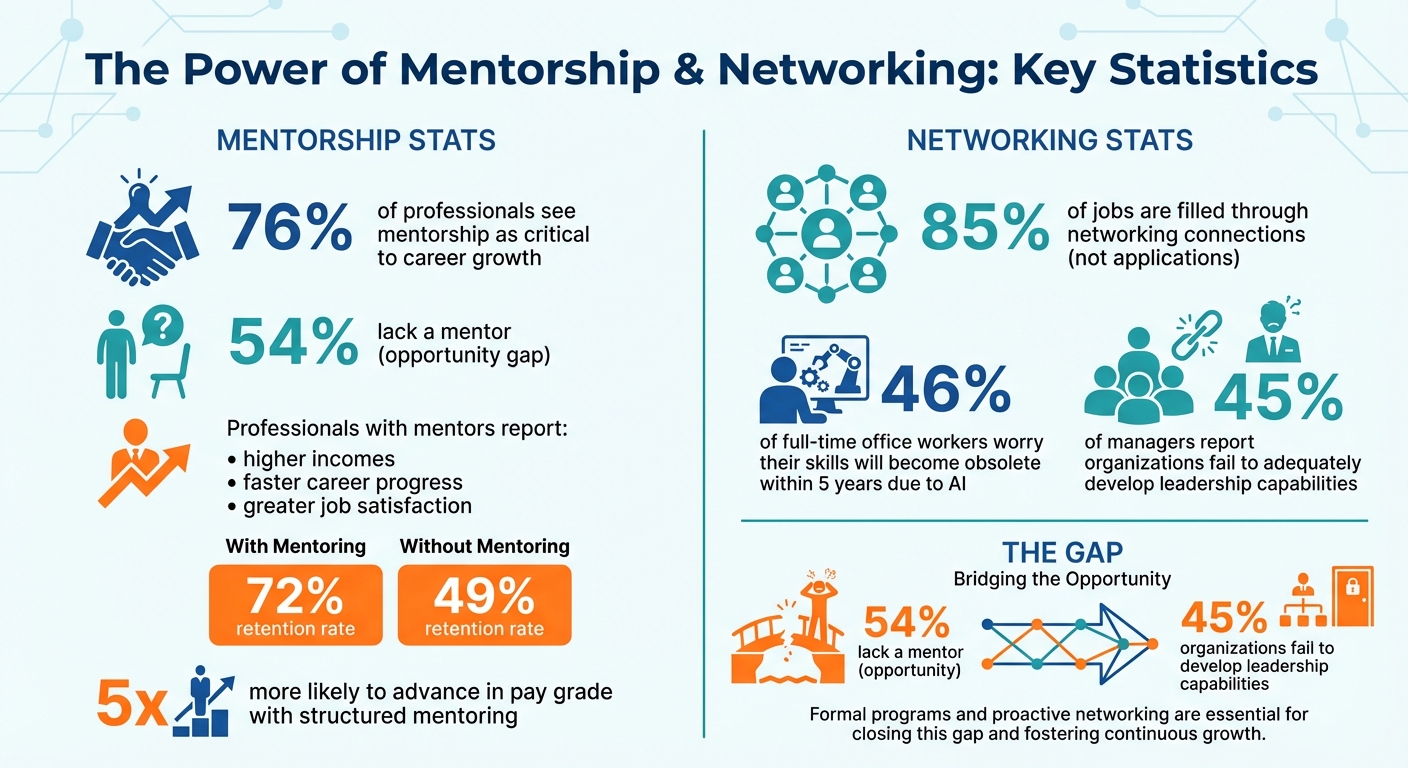
Mentorship and Networking Statistics: Impact on Career Growth
Understanding Mentorship and Networking
What Is Mentorship?
Mentorship is a professional relationship where individuals work together over time to encourage growth and success [7]. It offers two key types of support: career-related guidance - helping with skill development, career planning, and even sponsorship, where a mentor publicly champions your accomplishments - and personal support, such as role modeling and emotional encouragement [7][6].
The impact is clear. In a Harvard Business Review survey of 1,250 top executives, those with mentors reported higher incomes, faster career progress, and greater job satisfaction compared to those without mentors [6]. For technical professionals stepping into leadership roles, mentorship becomes even more important. It helps bridge the gap between technical expertise and the soft skills and strategic thinking often required in leadership - areas not typically covered in engineering programs.
What Is Networking?
Networking is the art of building and maintaining relationships with people who can share opportunities, knowledge, or collaboration [8][9]. It's not just about expanding your contact list; it’s about creating meaningful connections that benefit both your career and personal growth.
"Networking is not just about expanding your contact list - it's about cultivating relationships that offer mutual support and opportunities for collaboration." - Join the Collective [9]
Successful networking hinges on reciprocity - offering help or value to others without expecting immediate returns [9]. It’s about depth, not breadth. Having hundreds of LinkedIn connections means little if those relationships lack authenticity or purpose [8][9].
When done right, networking lays the groundwork for opportunities and collaborations that can propel your career forward.
How They Work Together
Mentorship and networking complement each other perfectly. Mentorship provides human capital - experience, wisdom, and guidance - while networking delivers social capital, such as access to opportunities and introductions to influential people [10]. A mentor can open doors for you by leveraging their network to enhance your visibility and credibility [6]. At the same time, your broader network can help you identify potential mentors who can guide you in specific areas of growth [1][12].
Patrick J. Murphy, Goodrich Chair of the Barefield Entrepreneurship Program at UAB, puts it this way:
"Entrepreneurs benefit from introductions to potential customers, partners, and investors. Seasoned operators with experience and expertise have those connections" [10].
Networking broadens your horizons and introduces new perspectives, while mentorship helps you navigate these connections with confidence and direction. Together, they create a powerful cycle that fuels professional growth in ways neither could achieve alone [1][9].
How Mentorship and Networking Work Together
Building Networks Through Mentors
Mentors do more than just offer advice - they can open doors to opportunities that might otherwise seem out of reach, leveraging their own credibility to help you get noticed [6]. This isn’t just about making introductions; when a mentor vouches for you, they’re putting their professional reputation on the line, which carries far more weight than a cold email or LinkedIn message ever could.
Expanding this concept to a mentoring network - where you have multiple mentors offering guidance in areas like technical skills, career strategy, or work-life balance - can significantly accelerate your growth [1][6]. Your network often helps you find these mentors, while each mentor strengthens a specific aspect of your professional development.
Then there’s reverse mentoring, a concept gaining traction, especially in technical fields. Younger professionals mentor senior leaders on topics like AI, digital tools, or emerging technologies, creating connections that cut across traditional corporate hierarchies [6][14]. This two-way exchange not only enhances learning but also strengthens the networks of both mentors and mentees, creating new opportunities for collaboration and growth.
Ultimately, these relationships do more than expand your network - they elevate your professional standing and visibility.
Gaining Visibility and Credibility
As your network grows, so does your visibility, and that can lead to enhanced credibility. This is where the distinction between mentorship and sponsorship becomes critical. While a mentor offers guidance, a sponsor actively advocates for your advancement, using their influence to help you climb the ladder [13]. Leena Nair, Chief Human Resources Officer at Unilever, highlights the importance of this dynamic:
"Being able to tap into that network of expertise and support is invaluable, particularly in organisational cultures where women might not have the same opportunities as men to expand their networks." [13]
Sponsors don’t just guide you - they champion your achievements, promote your work, and push for your promotion [11][13]. This kind of advocacy usually stems from strong networking relationships, where someone has seen your capabilities firsthand and is willing to stake their reputation on your potential.
The credibility you gain through a mentor’s network can have a snowball effect. When someone respected in your industry introduces you at a conference or highlights your work to others, it instantly boosts your professional reputation.
Creating a Feedback Loop for Growth
Networking exposes you to a variety of perspectives from professionals across industries and career stages [1][6][11]. Mentors, in turn, help you process and refine this information into actionable strategies [4].
A technique often used by mentors is "consolidating" - helping you evaluate and make sense of the skills and knowledge you gain from your network [6]. For example, after attending a professional event, a mentor can help you filter through the insights you’ve gathered and align them with your specific goals.
This process isn’t one-sided. When you bring fresh ideas or insights from your network back to your mentor, you create what experts call a "dynamic learning environment" that benefits both of you [4]. This is especially relevant today, as nearly half (46%) of full-time office workers worry their skills will become outdated within five years due to advancements in AI [14]. Networking keeps you informed about industry changes, while your mentor helps you navigate those changes strategically.
The synergy between mentorship and networking creates a growth cycle that looks something like this:
| Mentoring Function | Network Contribution | Combined Impact |
|---|---|---|
| Career Guidance | Access to job opportunities and industry trends | Strategic career moves based on real-time insights |
| Skill Development | Exposure to diverse technical approaches | A focused learning path validated by experts |
| Emotional Support | Peer connections with shared challenges | Confidence to engage with senior professionals |
| Advocacy | Introductions to decision-makers | Sponsorship opportunities for promotions |
This continuous cycle - where networking provides fresh input and mentorship refines it - creates a momentum that neither can achieve alone. The key is to nurture both intentionally, recognizing that they play distinct but complementary roles in your professional journey.
How to Use Mentorship and Networking Together
Setting Clear Goals
Before diving into mentorship or networking, it’s essential to define specific, measurable goals. Frameworks like SMART (Specific, Measurable, Attainable, Relevant, Time-bound) or the GROW model can help you craft clear objectives. Vague ambitions won’t cut it - be precise about what you want to achieve. For instance, if you’re aiming for a leadership role, use these tools to outline your path [16][17][18].
The GROW model is particularly helpful for professionals transitioning into leadership. Start by identifying your Goal - something like, “Be ready for a Tech Lead position within 12 months.” Next, evaluate your Reality by pinpointing gaps in both technical skills (such as DevOps or architecture) and soft skills (like negotiation or delegation). Then, explore your Options - this might include online courses, volunteering for team projects, or leading meetings. Finally, establish your Way Forward with actionable steps, such as biweekly check-ins or creating a reading list tailored to your goals [18].
Matthew Reeves, CEO of Together, highlights the importance of having a "north star" - a guiding purpose to keep your networking and learning efforts aligned with your career aspirations [16].
Instead of relying on a single mentor, consider building a "mentoring network" - a group of mentors with diverse expertise who can collectively support your development [15]. Research shows that mentees in structured mentoring programs are five times more likely to advance in pay grade, and their retention rates (72%) far exceed those of employees without mentoring (49%) [21].
A helpful strategy for staying on track is using the "Six W's" framework to prepare for mentoring sessions. Reflect on these questions: What have I accomplished? What didn’t I get done? What challenges am I facing? What opportunities lie ahead? How should we use this meeting? What are my next steps? [21] This approach ensures that mentoring sessions remain focused and productive.
By setting clear goals, you’ll lay a solid foundation for meaningful mentorship and networking experiences.
Engaging with Mentors
Once your goals are defined, the next step is to approach mentorship with intention. Be proactive - schedule meetings with clear agendas and follow up with updates on your progress [4][13].
Claudine Adeyemi, Associate at Mishcon de Reya, advises starting small. Instead of immediately asking someone to be your mentor, begin by seeking their advice [13].
Clearly communicate your objectives and look for ways to support your mentor’s goals. This mutual exchange enhances the relationship. For example, technical professionals might offer reverse mentoring on emerging technologies, which not only adds value for senior leaders but also raises your profile within the organization [19][20].
Before your first meeting, come prepared. Have an updated resume, a brief bio, and a concise 60-second pitch ready to share [1]. Establish a meeting schedule, agree on communication methods, and set expectations for confidentiality. It’s also important to understand the distinction between mentorship and sponsorship. While mentors provide guidance, sponsors actively advocate for your career advancement. For instance, at Unilever, women with mentors are more likely to secure senior roles [13]. Over time, some mentors may naturally evolve into sponsors who champion your work to decision-makers.
Expanding Networks Through Events and Communities
With clear goals and proactive mentorship in place, expand your reach by engaging in events and professional communities. Conferences, hackathons, and industry meetups not only provide valuable insights but also help you discover potential mentors and grow your network [1][22].
For those who find traditional networking intimidating, events like hackathons offer a more relaxed environment. The focus on collaborative problem-solving makes it easier to connect with others without the pressure of formal introductions [22].
Before attending any event, prepare a short, polished elevator pitch - under 60 seconds - that highlights your technical expertise and its impact [1]. When following up with someone you meet, reference a specific talk or project they’ve worked on to establish a meaningful connection.
Adam Ipsen, Lead Content Strategist at Pluralsight, sums up the value of networking:
"Mentors are amazing because they've gotten where you want to be and can tell you exactly how to get there. Plus, they can introduce you to their network." [22]
A mentor’s introduction can open doors and lend credibility, saving you years of effort [22][23].
Join communities that align with your field, such as ACM or Women Who Code for developers, OWASP for cybersecurity professionals, or the Cloud Native Computing Foundation (CNCF) for cloud specialists [22]. These groups help you transition from relying on a single mentor to building a diverse network of technical, developmental, and peer mentors. Each type serves a unique purpose: technical mentors help you master tools, developmental mentors guide your career growth, and peer mentors provide relatable advice on everyday challenges.
To identify gaps in your current network, map out your connections. If you’re missing a peer mentor who understands your daily struggles, use community events to find one. Set 1–3 SMART goals for each new mentoring relationship to ensure it remains productive [4]. After meeting someone, follow up promptly - via email or LinkedIn - to maintain the connection [1][22].
It’s worth noting that 46% of full-time office workers in a 2024 survey expressed concern that their skills could become obsolete within five years due to advancements in AI [14]. Staying engaged with mentors and communities that support your learning and upskilling is more important than ever. By combining focused networking with intentional mentorship, you can build a support system that keeps you competitive in an ever-changing technical landscape.
sbb-itb-8feac72
Can a Mentor Help You Grow Your Career Network?
Tech Leaders: Bridging the Gap for Technical Professionals
For many technical professionals, mastering strategies for success is only the first step. The real challenge lies in applying these strategies within the right environment. A common hurdle is the "time trap" - engineers often focus so heavily on production efficiency that they miss out on strategic business discussions and opportunities to build organizational influence [27]. This disconnect makes the leap from technical roles to leadership positions especially tough. That’s where Tech Leaders steps in, offering specialized engineering leadership training and entrepreneurship programs. These programs are designed to merge technical expertise with the leadership skills needed to thrive in mentorship and networking environments. With 45% of managers reporting that their organizations fail to adequately develop leadership capabilities [24], there’s a clear need for structured platforms like Tech Leaders that combine mentorship with hands-on leadership development.
Leadership Training for Engineers
Tech Leaders bridges the gap between technical expertise and leadership skills through structured peer groups and customized learning plans. The platform recognizes that today’s technical professionals benefit most from a "mentoring network" rather than relying on a single mentor. This approach includes:
- Technical mentors to guide on tools and systems.
- Developmental mentors to steer career growth.
- Peer mentors to offer relatable, real-world support [1].
One standout feature is reverse mentoring, where junior professionals share insights on emerging technologies with senior leaders, who, in turn, provide guidance on leadership strategies [19][6]. This two-way exchange is especially valuable in addressing the AI-driven changes reshaping industries and creating new skill gaps [25]. By focusing on these leadership skills, Tech Leaders helps technical professionals prepare for the next step: turning their expertise into marketable services.
Monetizing Expertise in the Age of AI
Tech Leaders goes beyond leadership training by helping professionals transform their technical knowledge into scalable, marketable offerings. Through its entrepreneurship programs, the platform supports the transition from traditional product roles to independent consulting [2]. Participants learn how to package their expertise in ways that attract clients and drive business growth.
Private coaching and career strategy sessions provide tailored guidance for navigating this shift. With 85% of jobs filled through networking rather than traditional applications [3], Tech Leaders emphasizes the importance of building strong professional relationships and increasing visibility to unlock consulting and leadership opportunities.
Building Communities for Networking and Growth
Tech Leaders doesn’t stop at individual training - it fosters growth through community-driven support. The platform organizes peer masterminds that go beyond traditional one-on-one mentoring. These groups offer ongoing encouragement and resources as participants sharpen their leadership skills and broaden their influence. Research shows that employees in formal mentorship programs grow their professional networks and gain workplace credibility more effectively than those without such support [26].
Additionally, Tech Leaders collaborates with development organizations to ensure members stay connected to industry trends and opportunities. This community-driven model aligns with proven networking strategies like attending events, joining professional groups, and cultivating diverse connections. By providing a structured, supportive environment, Tech Leaders empowers technical professionals to confidently step into leadership roles and expand their impact.
Conclusion
Mentorship and networking go hand in hand - they're like two gears that, when aligned, can drive your career forward. Together, they unlock opportunities, speed up professional growth, and establish credibility for leadership roles. The numbers tell the story: 76% of working professionals believe mentors are key to growth, yet over 54% don't have a mentoring relationship [5]. That’s a huge missed opportunity for many technical professionals who could be advancing faster and finding greater work-life balance.
The idea isn’t just about having one mentor anymore. Shifting to a mentoring network - featuring technical, developmental, and peer mentors - provides a variety of perspectives to tackle today’s career challenges [1]. Networking, in turn, is how you find these mentors, whether through industry events, LinkedIn, or informational interviews. These two strategies feed into each other, creating a cycle of growth and opportunity. They can even open doors to investors, collaborators, and senior leaders [10][6].
To make the most of this, start by mapping your network to identify gaps in support. Set SMART goals for each mentoring relationship and have a polished 60-second pitch ready to connect with potential mentors [4][1]. Don’t forget about reverse mentoring - it’s a great way to share your knowledge while gaining valuable insights from others [6].
For those looking for structure, programs like those from Tech Leaders offer a clear framework to put these strategies into action. With 45% of managers saying their organizations aren’t doing enough to develop future leaders [24], it’s up to you to take charge of your growth. Intentional mentorship and networking aren’t optional anymore - they’re essential for staying ahead in the AI-driven workplace.
Success isn’t just about technical skills. It’s about building meaningful relationships, seeking out diverse viewpoints, and expanding your influence through strategic connections. Start growing your mentoring network now, and you’ll set yourself up not just for the next step in your career, but for lasting leadership success. Use this powerful combination to turn your technical expertise into a legacy of leadership.
FAQs
What’s the best way to find and connect with a mentor?
To connect with a mentor, start by tapping into your professional network. This could include colleagues, alumni groups, or online platforms like LinkedIn. Focus on individuals whose career paths or achievements align with your goals and who possess the expertise you’re looking to develop.
When reaching out, craft a short, personalized message. Introduce yourself, mention what you admire about their work, and explain the specific area where you’d value their guidance. Suggest a brief initial meeting, like a 15-minute coffee chat, to make the ask manageable and show respect for their time.
After establishing contact, clarify expectations for the mentorship. Discuss how often you’ll meet and what goals you hope to achieve. Maintain the relationship by keeping them updated on your progress and offering something in return, such as sharing interesting articles or insights they might find useful.
For those in tech, platforms like Tech Leaders can be particularly helpful. They connect professionals with mentors skilled in areas like engineering leadership and AI strategies, making it easier to develop both technical and leadership capabilities.
How can I effectively grow my professional network?
Expanding your professional network requires a mix of clear planning, thoughtful actions, and consistent engagement. Begin by setting specific goals with a mentor. For instance, pinpoint the industries or roles you want to explore and establish measurable targets, like connecting with five professionals in your desired field by a set date.
Leverage your mentor or shared contacts to request introductions, and always have a polished, concise self-introduction ready. After meeting someone, don’t let the connection fade - follow up promptly to keep the relationship alive. Attending industry events or meet-ups is another fantastic way to meet people. Do your homework on attendees beforehand, engage in meaningful conversations during the event, and send personalized follow-ups to leave a lasting impression.
Consider joining focused communities like Tech Leaders. These groups offer structured networking opportunities, connecting you with peers and seasoned professionals who could become mentors or collaborators. By blending these approaches, you’ll steadily cultivate a strong and meaningful professional network.
How do mentorship and networking help technical professionals transition into leadership roles?
Mentorship plays a critical role in helping technical professionals grow beyond their core skills, guiding them toward the strategic mindset needed for leadership. A mentor can bridge the gap between technical expertise and broader leadership qualities such as decision-making, effective communication, and team management. This kind of guidance not only accelerates career progression but also builds the confidence needed to lead cross-functional projects with success.
Networking, on the other hand, serves as a powerful complement to mentorship. By attending industry events, joining professional groups, or even engaging in informal meetups, professionals can connect with senior leaders, potential advocates, and peers. These relationships provide fresh perspectives on leadership challenges and often lead to new opportunities. When combined, mentorship and networking create a dynamic path for technical professionals aiming to move into leadership roles.
Tech Leaders supports this transition by offering programs designed to merge technical skills with leadership development and networking opportunities. These initiatives equip individuals to step confidently into senior positions or pursue independent consulting careers in today's fast-evolving, AI-focused economy.