
Nonverbal Cues in Change Management
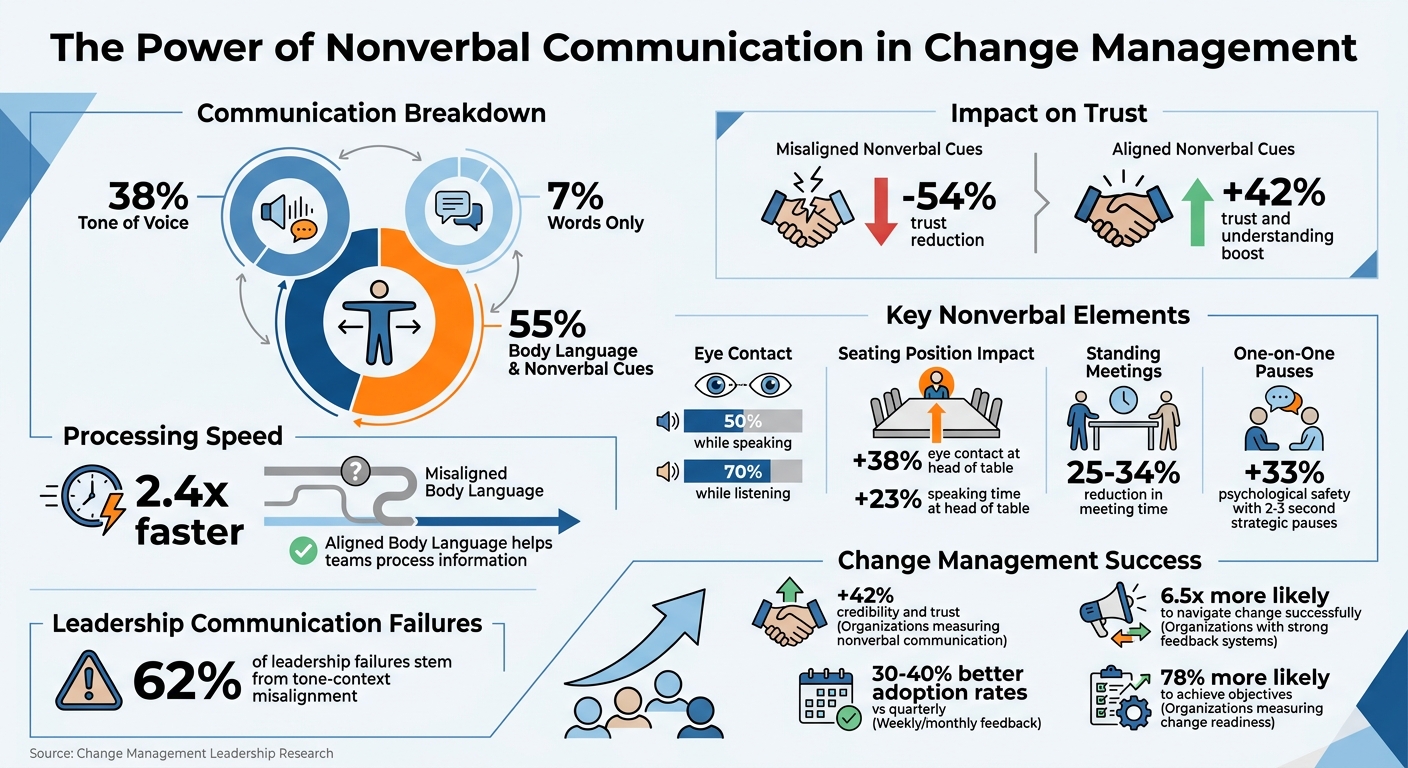
When leading change, your body language matters more than your words. Research shows that 55% of communication is nonverbal, while tone accounts for 38% and words only 7%. Misaligned nonverbal cues can reduce trust by 54%, while aligned cues boost trust and understanding by 42%. Leaders who match their body language with their message help teams process information 2.4 times faster and reduce resistance to change.
Key takeaways:
- Posture: Stand upright, avoid crossed arms, and lean slightly forward to show confidence and engagement.
- Eye Contact: Maintain 50% while speaking and 70% while listening to build trust.
- Gestures: Use open palms for transparency and deliberate movements to reinforce points.
- Tone of Voice: A steady pitch and strategic pauses enhance authority and clarity.
Understanding and interpreting nonverbal cues, especially using the 3 C's Framework (Context, Clusters, Congruence), ensures your message resonates. Even in virtual settings, adjusting camera angles and using gestures can improve communication. These small adjustments can transform how your team perceives and trusts your leadership during change.
Nonverbal Communication Impact on Leadership and Change Management
Leveraging Nonverbal Communication for Leadership with FBI Special Agent Joe Navarro
sbb-itb-8feac72
Key Nonverbal Cues for Change Management
When leading through organizational change, your nonverbal communication can significantly influence how your team perceives your leadership. These signals help build trust and alignment by projecting warmth (to foster trust and safety) and competence (to convey capability and authority).
Here’s a closer look at the nonverbal elements that can strengthen your leadership presence during times of change.
Posture and Body Orientation
Your posture speaks volumes about your confidence and approachability. Standing upright shows authority and composure, while slouching or hunching can suggest stress or disengagement. Avoid crossing your arms or adopting closed-off positions, as these can create a sense of distance when connection is needed most.
During conversations, align your torso, head, and toes toward the person you're speaking with. Leaning slightly forward - about 10 degrees - signals active engagement and care. Standing in an open, expansive posture (keeping your shoulders relaxed and upright) not only makes you appear more confident but can also help you feel more self-assured. Before high-stakes meetings, try holding a power pose for two minutes to boost your confidence.
Seating arrangements also play a role. At rectangular tables, sitting at the head position increases eye contact by 38% and speaking time by 23% [5]. For collaborative discussions, round tables or sitting side-by-side can encourage more balanced participation.
Facial Expressions and Eye Contact
Your face often reveals more than your words. Maintaining 50% eye contact while speaking and 70% while listening strikes the right balance between confidence and approachability. Briefly looking away when gathering your thoughts can make you appear more genuine and less rehearsed.
A great example of this is Oprah Winfrey, who perfected these techniques over 35,000 interviews. Her warm, sustained eye contact, slight physical lean-ins, and comfortable pauses made her subjects feel truly seen and valued, building immediate trust and rapport. A genuine smile - one that reaches your eyes - can further convey empathy and sincerity.
Gestures and Use of Space
Your hands can reinforce your message in meaningful ways. Open-palm gestures signal honesty and transparency, while purposeful movements, like spreading your hands to illustrate growth or scale, make your points more compelling. The "Steeple" gesture (touching your fingertips together) can project confidence and expertise, but use it sparingly to avoid appearing condescending. Smooth, deliberate gestures help convey complex ideas with clarity.
Respecting personal space is equally important. In professional U.S. settings, maintaining a distance of 18 to 48 inches is generally appropriate. Move intentionally - fidgeting, like tapping or bouncing your legs, can undermine your authority. Standing meetings are another effective tool; they can boost engagement and reduce meeting times by 25% to 34% [5], making them ideal for quick updates during times of change.
Vocal Tone and Paralinguistics
Your voice is a powerful tool, accounting for 38% of how people interpret your feelings and attitudes [2]. A mismatch between your tone and the context can lead to communication breakdowns - 62% of leadership failures stem from this misalignment [2].
To sound authoritative, end sentences with a downward inflection rather than an upward one, which can make you seem uncertain. Practice diaphragmatic breathing to keep your pitch steady, especially during stressful situations, so your voice remains strong and composed. Strategic pauses of 2–3 seconds before delivering key points can enhance retention and project confidence. In one-on-one settings, these pauses can also boost psychological safety by 33% [2].
"Former New Zealand Prime Minister Jacinda Ardern utilized intentional vocal restraint and strategic pauses during empathetic communications to reinforce her authoritative presence while maintaining high psychological safety." [2]
Lastly, adjust your volume to fit the situation. Speaking too softly may suggest insecurity, while speaking too loudly can come across as aggressive.
How to Interpret Nonverbal Cues
Understanding how to interpret nonverbal cues is essential for aligning your message with your team's emotional and psychological state, especially during times of organizational change. These cues - like body language - can offer insight into whether someone feels stressed, comfortable, engaged, or ready to make decisions. The trick lies in recognizing that nonverbal signals often reveal emotions that words might conceal [7].
To interpret these signals effectively, you can rely on the 3 C's Framework: Context, Clusters, and Congruence. This structured method helps reduce misinterpretations that could erode trust during crucial transitions. Let’s break it down.
The 3 C's Framework
1. Context
Always consider the broader picture before jumping to conclusions. Start by establishing a baseline for each team member’s usual behavior. Pay attention to factors like cultural norms, power dynamics, and the environment [7][2]. For instance, if someone who typically maintains steady eye contact suddenly avoids it during a change announcement, they might be processing tough news. On the other hand, someone who rarely makes direct eye contact could simply be reflecting their cultural background.
2. Clusters
Look for patterns of behavior rather than focusing on a single gesture. For example, if someone has crossed arms, don’t immediately assume resistance. Check for other cues like a furrowed brow, averted gaze, or shallow breathing - they might just be cold or lost in thought [7]. When gestures, posture, and facial expressions align, you can draw more accurate conclusions. As mentioned earlier, consistent signals make interpretation easier and quicker [2].
3. Congruence
This involves checking whether verbal and nonverbal messages match. If a team member says, “I’m on board,” but their tight jaw, tense shoulders, and leaning posture suggest otherwise, trust the nonverbal cues. Incongruence like this can undermine leadership credibility by as much as 54% [2]. When you notice such mismatches, try asking open-ended questions like, “Would it help if we tackled one issue at a time?” to clarify their true perspective [7].
"The most important thing in communication is hearing what isn't said." - Peter Drucker [6]
Accurately decoding nonverbal cues with this framework not only improves understanding but also strengthens trust and communication within your team.
Nonverbal Communication Across Cultures and Virtual Settings
Cross-Culture Differences in Nonverbal Cues
Nonverbal communication can drastically differ between cultures, and what seems appropriate in one region might be misinterpreted in another. Take eye contact, for instance: in Western cultures, maintaining direct eye contact often signals confidence and honesty. However, in East Asian, Southeast Asian, and Middle Eastern cultures, it can be seen as confrontational or disrespectful, especially toward authority figures [9][10]. This kind of cultural disconnect can create tension in global teams if members rely solely on their own cultural norms.
Personal space is another area where cultural differences stand out. In high-contact cultures like Latin America, the Middle East, and Southern Europe, people typically stand closer - about 1 to 2 feet apart - during conversations. Meanwhile, in low-contact cultures such as Northern Europe, North America, and much of East Asia, a distance of 2.5 to 4 feet is preferred [9][10]. Even gestures can be a minefield: something as simple as a "thumbs-up" or "OK" sign might be offensive in countries like Turkey, Brazil, West Africa, and parts of the Middle East [9][10].
Silence also carries different meanings across cultures. In Finnish and Japanese business contexts, silence often reflects thoughtful consideration or strategic thinking. A well-known example highlights American negotiators who, after encountering a three-minute silence from their Japanese counterparts, mistakenly interpreted it as rejection and lowered their offer [9]. This example underscores the importance of understanding cultural norms around silence, handshakes, and gestures to avoid costly missteps [9].
With virtual communication becoming more prevalent, these nuances are even more important to grasp.
Nonverbal Communication in Virtual Meetings
In virtual settings, the absence of physical presence shifts the focus to facial expressions as a key way to convey engagement. Studies show that 62% of remote employees prefer using video during meetings, and 67% believe it makes communication smoother when they can see others' expressions [12]. To create a sense of connection, position your camera at eye level and look directly into the lens instead of the screen [4][12][14]. This simple adjustment can make a big difference, especially during important discussions or announcements.
Framing and visibility also play a role. Adjust your camera to include your upper body and hands, as gestures can enhance your message and make your delivery more dynamic [12][14]. On video, slightly exaggerating gestures and facial expressions can help ensure your message comes across clearly [14]. To minimize distractions, consider turning off the "self-view" option so you’re not preoccupied with your own image during the meeting [14].
For teams working with cultures that value reflection - such as Finnish or Japanese colleagues - embrace pauses in conversation rather than rushing to fill them. These moments of silence often signal thoughtful consideration rather than disengagement [9][12].
"Nonverbal signals are often interpreted more quickly and can carry more weight than verbal communication." - Carmichael and Mizrahi [11]
How Tech Leaders Can Apply Nonverbal Communication
Nonverbal communication isn't just about gestures - it's a powerful tool for tech leaders to inspire confidence and lead effectively, especially during times of change. When teams face uncertainty, your posture, tone, and even your use of space can either reassure them or amplify their doubts. In fact, organizations that emphasize nonverbal communication skills report a 42% boost in credibility and trust [2]. That’s a game-changer when guiding teams through transitions.
Using Nonverbal Cues in Team Meetings
Your body language can set the tone in team meetings. Standing upright with an open stance and visible palms immediately communicates authority and approachability. For sensitive discussions, sitting down signals attentiveness and a willingness to engage deeply [2][4].
Eye contact is another key element. Aim for 50% eye contact while speaking and 70% while listening. Briefly looking away every 4–5 seconds prevents the interaction from feeling too intense [2][4].
Your voice also plays a crucial role. A lower pitch - around 115Hz - conveys authority, perfect for decisive moments. On the other hand, a slightly higher pitch near 220Hz encourages creativity and collaboration during brainstorming [2].
"A leader's tone of voice functions as the orchestral conductor of nonverbal communication – shaping message reception through subtle pitch variations that amplify or undermine intent." - Robert N. Perry, Lead-America [2]
Strategic pauses can be incredibly effective, giving your team time to process complex ideas. When verbal and nonverbal cues align, teams can process messages 2.4 times faster. However, mismatched signals - like a tense expression while giving positive feedback - can erode credibility by up to 54% [2].
For one-on-one coaching and feedback, these cues need to be adapted to create a more personalized connection.
Nonverbal Communication in Coaching and Feedback Sessions
One-on-one interactions demand a different approach. Sitting down, leaning slightly forward, and keeping your palms open conveys warmth and a willingness to invest time in the conversation [2][4].
Facial expressions are equally important. Relax your facial muscles and avoid pursing your lips, as this can be misinterpreted as disapproval [2][4]. If your natural expression tends to look intense, a quick explanation can help avoid misunderstandings [8]. Before delivering high-pressure feedback, practice diaphragmatic breathing to stabilize your voice and prevent unintended pitch changes [2].
In virtual settings, looking directly at the camera - rather than the screen - creates the impression of eye contact, helping to maintain a sense of connection [4].
Body Language for Presentations and Training
When delivering presentations or training sessions, especially during transitions, your nonverbal communication must balance approachability with competence. A great example is Satya Nadella, who, during a major cultural shift at Microsoft, adopted open-palm gestures, a calm tone, and a steady presence. This deliberate shift helped rebuild trust and foster team cohesion [5].
Use gestures to reinforce your points. For instance, spreading your hands can illustrate scale, while pressing them together suggests alignment. The "steeple" gesture - fingertips touching - signals confidence when addressing complex questions [5]. Avoid distracting behaviors like fidgeting or repetitive movements; instead, use smooth, deliberate gestures to project authority [8][5].
Your vocal delivery should follow a "Vocal Arc": start with a low, steady pitch, build energy in the middle, and return to a resonant low pitch to conclude. Avoid "upspeak", where your voice rises at the end of sentences, as it can make you sound uncertain. Instead, consciously lower your pitch at the end of statements to sound decisive [5]. Microsoft’s leadership training program, which focused on vocal techniques, significantly improved how employees viewed their leaders’ approachability in just six months [2].
Lastly, practice "triple fronting" - align your toes, torso, and head toward your audience to show full engagement [5]. Before stepping up to present, spend 10 seconds relaxing your jaw and shoulders. Why? Because your team will mirror your emotional state. If your body language contradicts your words, your credibility could drop by as much as 54% [5]. Aligning your verbal and nonverbal communication is essential for leading effectively through change.
Measuring Nonverbal Communication Effectiveness
When it comes to nonverbal communication, tracking its impact is just as important as understanding its role. As Peter Drucker wisely put it, "If you can't measure it, you can't improve it" [15]. Nonverbal cues, though subtle, can and should be measured to ensure they align with your intended message. This alignment helps build trust and fosters clarity, especially during change management.
Metrics for Nonverbal Communication
To effectively measure nonverbal communication, use the ABCD Framework: Actor, Behavior, Context, and Desired Impact [3]. This method moves beyond vague goals like "be more approachable" and focuses on specific, trackable actions.
For example, organizations that measure change readiness and adoption rates are 78% more likely to achieve their objectives [15]. Pairing readiness surveys with direct observations boosts accuracy to 92% [15]. You can also monitor engagement by tracking Q&A participation rates, aiming for a target range of 60–80% as a sign of effective communication [17]. Tools like pulse surveys and sentiment analysis can reveal whether your nonverbal cues are reinforcing or undermining your verbal messages [16].
Consistency is key. Companies that gather feedback weekly or monthly see 30–40% better adoption rates compared to those that only measure quarterly [17]. In fact, organizations with strong feedback systems are 6.5 times more likely to navigate change successfully [17]. Start by establishing a baseline before launching a change initiative, and then track your progress over time to see how adjustments to your nonverbal communication are making an impact.
Once metrics are in place, the next step is to pinpoint and address common mistakes in nonverbal communication.
Common Mistakes in Nonverbal Communication
Mismatched signals can undermine credibility in an instant. For instance, if you verbally encourage feedback but your crossed arms and furrowed brow say otherwise, trust can erode quickly. The "Silent but Irritated" look - characterized by eye-rolling, heavy sighs, or a blank expression during team celebrations - can signal disengagement and lower morale [8].
Another pitfall is the "Ever Confused" expression. A puzzled look without follow-up questions can make speakers feel ignored or dismissed [8]. If you naturally have a concentrated or intense "listening face", let your team know so they don’t misinterpret it as disapproval [8]. Virtual settings add another layer of complexity: poor lighting that hides facial expressions, hunching over the screen, or constant face-touching can project insecurity [13].
The "Ignorer" mistake - avoiding eye contact with junior team members - can contribute to feelings of imposter syndrome and reduce psychological safety [8]. Cultural nuances also play a role: in some Asian cultures, unbroken eye contact may feel confrontational, while in parts of the Middle East, a thumbs-up gesture can be offensive [13]. To identify and address these habits, consider recording yourself during meetings to spot unconscious behaviors like fidgeting or closed-off body language [13]. Listening tours can also provide valuable feedback on how your nonverbal cues are perceived [17].
Conclusion
Nonverbal communication plays a key role in fostering trust, credibility, and influence. As Robert N. Perry from Lead America aptly states:
"Mastering nonverbal communication is an ongoing leadership evolution, not a destination - one that defines trust, collaboration, and long-term success" [2].
When your nonverbal signals align with your words, your message becomes clear, and your team is more likely to trust your leadership. On the flip side, any disconnect between the two can quickly erode credibility [2].
Improving your nonverbal communication requires deliberate practice in all kinds of situations. Whether you're leading a meeting in New York, coaching a remote team member in California, or presenting to stakeholders from different cultural backgrounds, your nonverbal cues add weight to your words. Tools like the 3Cs and ABCD models can help ensure your verbal and nonverbal messages are in sync and provide a way to measure their impact [2][3].
Start with manageable changes. For example, record your presentations to spot unconscious habits, aim to maintain eye contact about 50% of the time when speaking and 70% when listening [2], and take a brief emotional pause before important meetings [5]. These small steps can lead to noticeable improvements in how others perceive your credibility.
Keep in mind that nonverbal communication varies across cultures. A gesture that fosters connection in one culture might have the opposite effect in another. Stay observant, seek feedback, and adjust as you learn. Even in virtual interactions, your "digital body language" - like webcam positioning or how quickly you respond to emails - can shape how others view your commitment to effective communication [1].
FAQs
How can I tell if someone’s resistance is real or just their baseline behavior?
To spot genuine resistance, pay close attention to nonverbal cues such as a lack of engagement or hesitation during private conversations. Keep in mind that public agreement might not always reflect someone's true feelings - social pressures or concerns about safety can lead people to hide their real stance. Instead, focus on observing consistent patterns of behavior in more casual or informal settings to get a clearer picture of their perspective.
What should I change in my body language to seem confident without looking intimidating?
To strike the right balance between confidence and approachability, start with open and relaxed body language - steer clear of crossing your arms or appearing closed off. Maintain steady eye contact to show engagement, and pair it with positive facial expressions. A warm smile or a nod can go a long way in reinforcing your confidence while keeping the vibe friendly. Avoid negative cues like frowning, which can send the wrong message. Combining good posture, a calm tone of voice, and inviting gestures helps you exude confidence without coming across as intimidating.
How can I show strong nonverbal cues on video calls with a remote team?
To make a strong impression during video calls, pay attention to your nonverbal communication. Start by maintaining clear and expressive facial cues - smile, nod, and use your eyebrows subtly to convey interest. Look directly into the camera to mimic eye contact, which helps create a sense of connection. Incorporate natural hand gestures to emphasize your points, and sit with an open, upright posture to appear approachable and confident.
Good lighting and a proper camera angle are equally important. Position your camera at eye level and ensure your face is well-lit to make your expressions easy to see. These small adjustments can help you stay visually engaged, making your message more impactful and fostering a stronger bond with your team.