
OODA Loop for AI Business Strategy
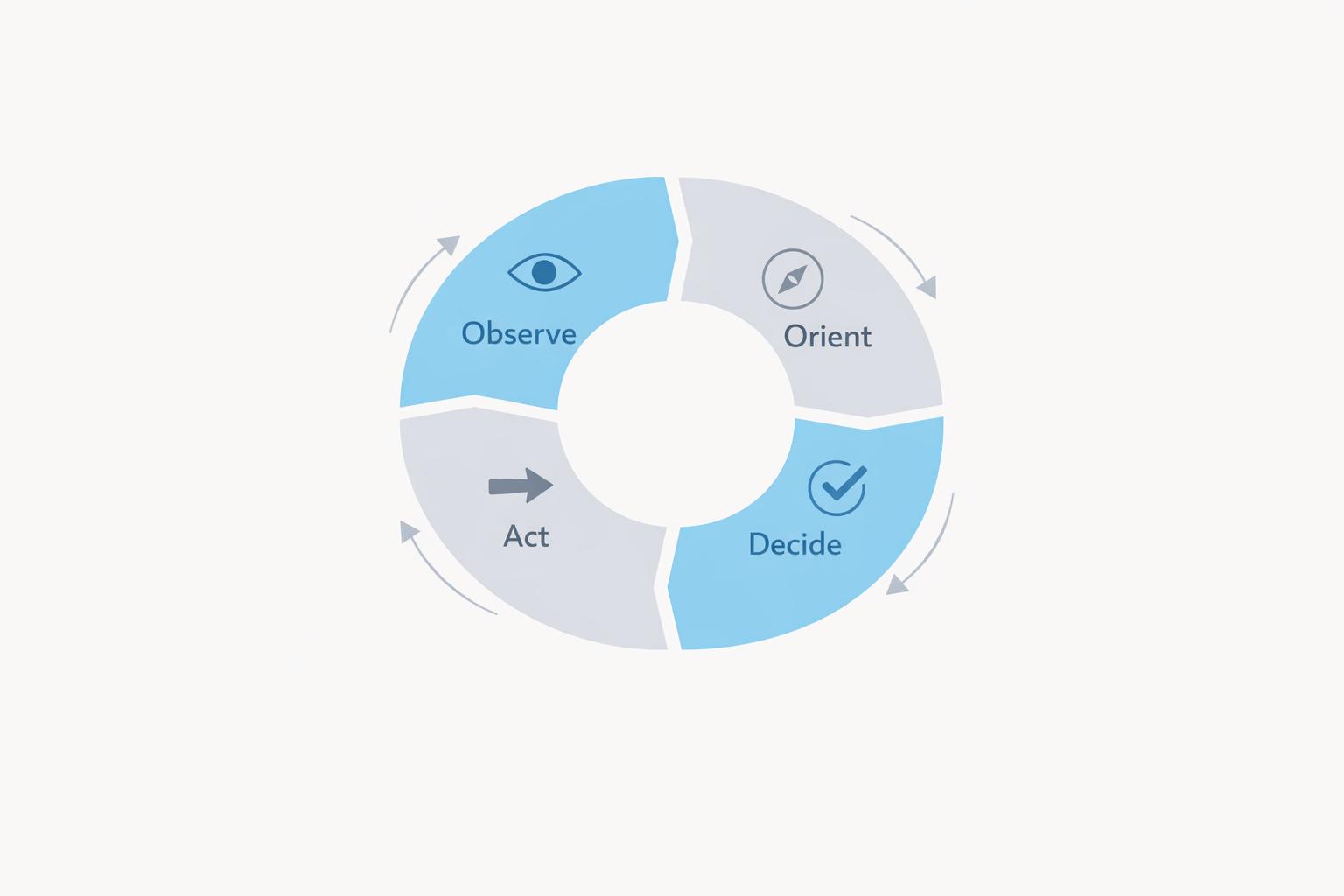
Want to make faster, smarter decisions in your AI-driven business? The OODA Loop - Observe, Orient, Decide, Act - offers a proven framework to outmaneuver competitors. Originally developed for military strategy, it’s now supercharged by AI, allowing businesses to process data, adapt, and act faster than ever. Here’s a quick breakdown:
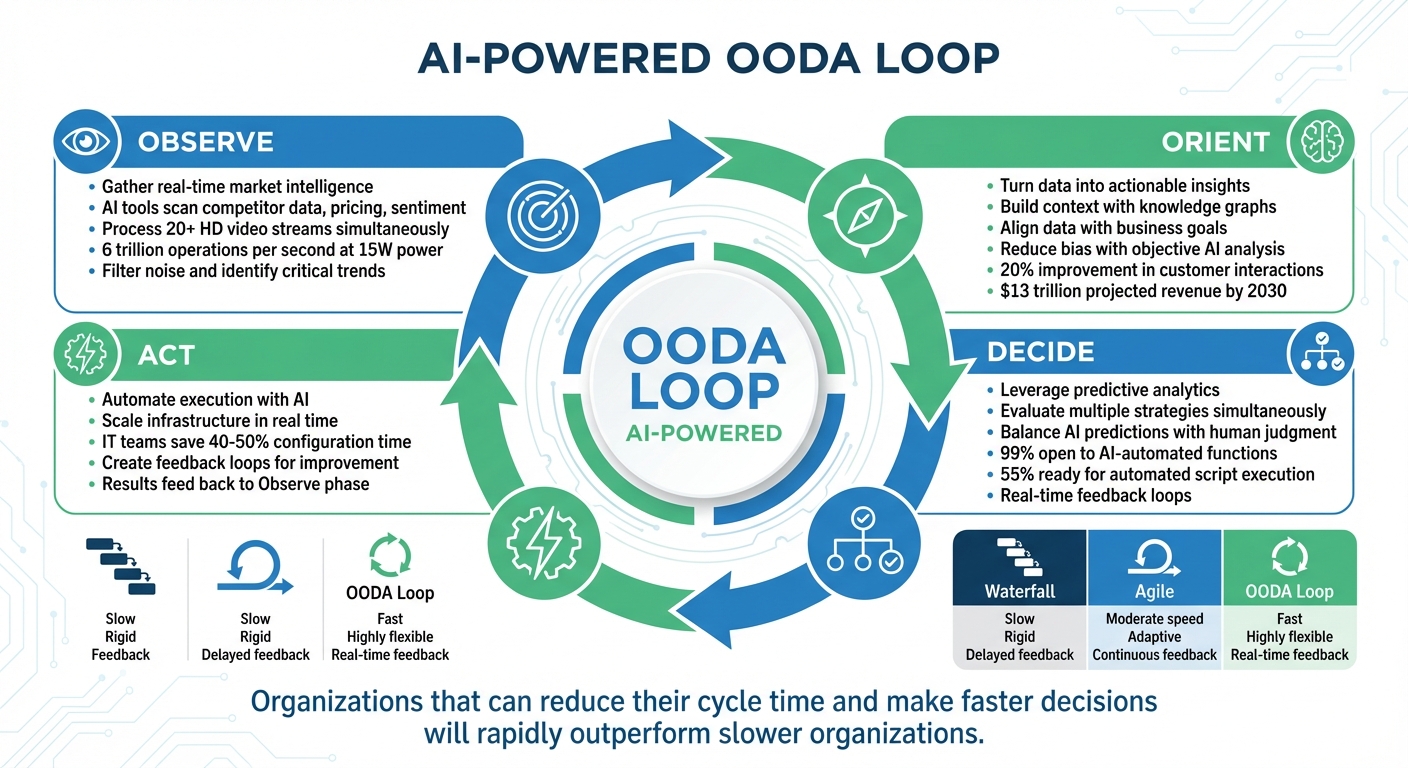
- Observe: Use AI to gather real-time market intelligence, filter noise, and identify critical trends.
- Orient: Turn raw data into actionable insights by building context with AI tools like knowledge graphs and semantic layers.
- Decide: Leverage predictive analytics and simulations to evaluate multiple strategies and choose the best course of action.
- Act: Automate execution with AI, implement feedback loops, and refine strategies in real time.
AI enhances every phase, enabling businesses to stay ahead by acting on the most accurate and timely information. Whether you’re managing marketing, IT, or revenue operations, mastering the OODA Loop can transform your decision-making process. Let’s dive deeper into how it works.
AI-Enhanced OODA Loop: Four Phases of Strategic Decision-Making
Observe: Gathering Real-Time Market Intelligence with AI
AI Tools for Data Collection
The Observe phase marks the starting point of the OODA Loop, and AI is revolutionizing how this step unfolds. In the past, gathering market intelligence relied heavily on manual research and periodic reports. Now, AI tools are enabling continuous, real-time monitoring of market dynamics. Technologies like web crawlers and Natural Language Processing (NLP) tools scan open-source intelligence (OSINT) to pick up on critical signals such as competitor pricing, product launches, hiring patterns, and customer sentiment [5][4]. These AI-powered "recon systems", often driven by Large Language Models (LLMs), take raw data and transform it into actionable insights that decision-makers can immediately use [11].
In addition to digital tools, physical AI sensors, drones, and satellites provide real-time situational awareness [8]. For instance, the NVIDIA Jetson Xavier NX module, designed for edge computing, processes 6 trillion floating point operations per second (TFLOPS) while consuming just 15 watts of power. This makes it capable of analyzing data locally, avoiding the delays associated with cloud processing [8]. Tim Stewart, Director of Business Development at Aitech, highlights the value of these systems:
AI algorithms process this data, filtering out noise, identifying relevant patterns, and detecting potential threats, enabling commanders to rapidly assess the evolving situation [8].
Real-Time Data and Predictive Analytics
AI systems now process vast amounts of data at incredible speeds, such as handling over 20 high-definition video streams (1040p at 30 fps) simultaneously. This allows businesses to detect subtle shifts in the market faster than their competitors. Predictive analytics takes things a step further by analyzing historical data, resource allocation, and operational trends to identify competitor strategies and emerging opportunities [11]. By utilizing edge processing, these systems reduce latency, ensuring insights are delivered without delay [8].
For organizations aiming to stay ahead, tools that use Retrieval-Augmented Generation (RAG) are making waves. These tools enhance factual accuracy by grounding AI-generated insights in verified research, minimizing the risk of errors [12]. As a result, the traditional model of quarterly market research is being replaced by automated intelligence loops operating on a daily - or even continuous - basis [11]. Foundational AI tools for competitor analysis can be deployed within weeks, giving teams a quick edge in understanding market conditions [11].
However, as the ability to gather and predict data improves, the challenge of managing this influx becomes increasingly important.
Managing Data Overload with AI
More data doesn't necessarily lead to better decisions. In fact, IT teams often spend 40–50% of their time managing complex configurations, which can result in decision paralysis [10]. This is where AI steps in to simplify the process. By filtering, ranking, and clustering data, AI helps decision-makers focus on what truly matters, reducing the risk of being overwhelmed by irrelevant information [11]. Leaders can take a page from military strategies, defining specific categories of critical information - akin to Commander's Critical Information Requirements (CCIRs) - to prioritize the most relevant data and cut down on assumptions [9]. As Matt Weinshel, Managing Director at Victory Strategies, puts it:
AI/ML allows the leader to accelerate their OODA loop, reducing the risk of making decisions based on incomplete information [9].
AI also combats information overload with features like entity resolution and deduplication, linking each signal to the correct market player [11]. The focus isn’t on collecting every piece of data but on gathering the right insights at the right time to empower informed decision-making. By eliminating noise and surfacing high-value information, AI ensures leaders can act with clarity and confidence [8][5].
Orient: Turning Data into Context
Building Context with AI Analysis
The Orient phase is where raw data transforms into meaningful insights, thanks to the power of AI. Think of this phase as the "brain" of the OODA Loop, helping your organization interpret its environment effectively. AI shines here by pulling together massive amounts of information from different sources and turning it into a clear, actionable picture.
Modern AI doesn't just process information; it also understands the intent behind it. As Ram Bala, Professor of Business Analytics at the Leavey School of Business, puts it:
"Context-aware AI is AI that not only understands content but also intent." [14]
This means that the same piece of data can yield different insights depending on who analyzes it. For example, a lawyer and a supply manager reviewing the same contract might focus on entirely different aspects, tailored to their specific expertise. Tools like Knowledge Graphs and Semantic Layers help bridge this gap by mapping raw data into understandable business terms, visually illustrating how data points connect and flow.
The stakes are high. By 2030, data-driven organizations are projected to generate $13 trillion in global revenue [13]. Companies that use AI to gain insights can see a 20% improvement in customer interactions [15]. But the real game-changer isn’t processing more data - it’s processing the right data in the right context. This approach not only clarifies your operational landscape but also ensures that your data aligns with your strategic goals.
Aligning Data with Business Goals
Once you've gathered and contextualized your data, the next step is aligning it with your business objectives. Start by defining Commander's Critical Information Requirements (CCIRs). These help identify the most important data points that directly support your goals, cutting through the noise and keeping your focus sharp.
AI and machine learning (ML) play a big role here, speeding up decision-making and reducing the risks of acting on incomplete or irrelevant information. For example, implementing a Semantic Layer standardizes raw data into a common business language, ensuring that everyone across departments is on the same page. You can also use "Smart Ops" workflows to let AI handle repetitive, low-risk tasks like account verification, freeing up your team to tackle high-stakes decisions that require human judgment.
Another useful strategy is event-based layering. By defining operational modes - like startup, normal operation, or maintenance - you can better interpret process data and filter out irrelevant noise. Automated validation systems further improve reliability by flagging outliers or range violations, ensuring that your decision-making is built on trustworthy, high-quality data.
Reducing Bias with AI
Human decision-making is often shaped by cultural norms, personal experiences, and cognitive blind spots. AI can help counteract these biases by providing objective, data-driven insights that challenge preconceived notions. This is particularly effective in addressing confirmation bias, where people tend to focus on information that supports their existing beliefs [17].
AI also excels at spotting "mismatches", or errors in past judgments. Taylor Pearson explains:
"The goal of the orientation phase is to find mismatches: errors in your previous judgement or in the judgement of others." [17]
By automating routine data tasks, AI reduces the mental burden on leaders, giving them the space to reflect on their own thinking and uncover blind spots. To avoid over-reliance on AI, incorporate human-in-the-loop protocols, ensuring that decision-makers critically evaluate machine-generated outputs rather than accepting them at face value.
Regular audits of AI datasets are crucial to prevent reinforcing historical biases. Paying attention to anomalies or "bad news" in your data can drive better re-orientation and lead to more informed decisions. Organizations that use unbiased, well-contextualized data are 23 times more likely to attract customers and 19 times more likely to achieve profitability [15].
Decide: Making Better Decisions with AI
AI for Dynamic Planning and Strategy Changes
AI has revolutionized decision-making by enabling the evaluation of multiple strategies at once and running simulations to predict outcomes [8]. Instead of relying solely on gut feelings, AI-powered analytics help leaders weigh risks and rewards, especially in uncertain situations. This ability to adapt quickly is essential for staying competitive.
What makes this possible is cutting-edge technology. Modern edge AI processes data right at its source - on devices like sensors or IoT equipment - avoiding delays caused by transferring large datasets to distant data centers [8]. For instance, edge computing modules can perform 6 trillion floating-point operations per second while consuming just 15 watts of power. This delivers workstation-level AI capabilities to compact devices, allowing businesses to make real-time decisions where and when they matter most [8].
The shift toward automation is gaining momentum. A 2025 survey revealed that 99% of respondents were open to having generative AI handle at least one operational function automatically [18]. Among IT professionals, 55% expressed interest in letting generative AI execute scripts for deploying new configurations or adjusting existing policies [18]. This goes beyond simple automation; it's about creating systems that can identify issues and fix them proactively, transforming operations from reactive to autonomous [18].
| Feature | Waterfall | Agile | OODA Loop |
|---|---|---|---|
| Decision Speed | Slow | Moderate | Fast |
| Flexibility | Rigid | Adaptive | Highly flexible |
| Feedback Loop | Delayed | Continuous | Real-time |
| Change Response | Resists change | Embraces change | Exploits change |
| Primary Goal | Predictability | Deliver value | Outpace & |
| & structure | fast | outmaneuver |
Transitioning from traditional waterfall or agile models to OODA-loop-based frameworks enables businesses to capitalize on change rather than merely reacting to it [18]. This iterative, real-time approach provides a level of agility that older methods simply can't match, setting the stage for integrating human expertise, as we'll explore next.
Balancing AI and Human Decisions
While AI excels at analyzing scenarios, the best decisions come from blending AI capabilities with human judgment. AI shines in prediction, using data to identify patterns and fill in gaps. Humans, on the other hand, bring judgment, applying ethical considerations, legal frameworks, and strategic thinking to those predictions [4]. As James Johnson, a Lecturer in Strategic Studies at the University of Aberdeen, puts it:
"The line between machines analyzing and synthesizing (i.e., prediction) data that informs humans who make decisions (i.e., judgment) will become an increasingly blurred human-machine decision-making continuum." [4]
This collaboration is especially crucial in high-stakes or unfamiliar situations. When data is scarce - such as during a crisis or unprecedented market shifts - human intuition and the ability to think critically become indispensable [4]. AI can't account for every scenario, and that's where human experience and nuanced understanding step in.
However, there's a risk of automation bias, where people overly rely on AI, especially in stressful, high-pressure situations. Research shows this is more likely when dealing with "black box" systems, where the reasoning behind AI decisions isn't transparent [4][5]. To mitigate this, organizations should implement mission command structures. Here, senior leaders define strategic goals while AI provides situational insights, but tactical leaders retain the authority to override AI when necessary [4]. It's wise to start using AI in controlled, data-rich areas like logistics or maintenance before applying it to complex strategic decisions [4][5]. This builds trust in AI's capabilities while ensuring human oversight remains intact.
Removing Decision-Making Delays
In fast-paced markets, speed is critical - but it shouldn't come at the cost of quality. AI helps eliminate delays by processing data faster and more thoroughly than humans can. With edge computing, decisions are made directly at the source of the data, cutting down on the time between detecting a change and acting on it [8].
Currently, operations teams spend 40% to 50% of their time managing configurations due to complicated APIs and coding languages. AI-driven OODA loops can significantly reduce this burden by identifying and addressing redundant systems in real-time [18]. As Abe Usher explains:
"In this present age of AI and machine learning, organizations that can reduce their cycle time and make better decisions that are also faster decisions will rapidly outperform slower organizations." [2]
However, speed alone isn’t enough. Owen Daniels from the Institute for Defense Analyses warns:
"Quicker decisions are not necessarily better, and speeding through one's own OODA loop so quickly that it becomes disassociated from the adversary's may be less helpful than acting at the moment of most significant comparative advantage." [5]
The focus should be on making decisions at the right moment with the right information. AI-driven systems can continuously refine decision-making by using feedback from the "Act" phase to restart the OODA loop. This iterative process not only improves decision quality but also creates a competitive edge by allowing organizations to "operate inside" a competitor's decision cycle. This can disrupt competitors' ability to respond effectively, giving you a decisive advantage [1][2][6].
Act: Executing AI-Driven Strategies
AI-Powered Automation in Action
Once decisions are made, AI systems can step in to execute them automatically. This includes tasks like scaling infrastructure, resolving IT issues as they arise, and updating security policies in real time [19]. The move toward autonomous operations is already underway - 99% of surveyed operations professionals are comfortable with AI taking over at least one operational function [10].
This shift has a huge impact on efficiency. IT teams currently spend 40–50% of their time managing complex configurations [10]. By leveraging AI-driven OODA loops, teams can cut back on this workload. These systems quickly identify redundant or conflicting configurations and address them. For instance, 55% of operations professionals are particularly interested in using generative AI to execute scripts that deploy new configurations or adjust policies automatically [10]. This not only saves time but also allows businesses to respond to market changes more proactively.
"Autonomous is no longer just the next frontier in automation - it's what operations teams are asking for right now." - Lori Mac Vittie, Distinguished Engineer and Chief Evangelist, F5 [10]
AI thrives in handling routine tasks where reliable data meets predictable outcomes. Areas like logistics, finance, and systems maintenance are prime examples - decisions here follow clear patterns, and the stakes for errors are manageable [4][5]. However, automated systems must include alert mechanisms to notify human leaders when situations fall outside the AI's capabilities or require ethical judgment [19][4]. This ensures execution stays aligned with strategic goals while maintaining the speed advantage AI offers.
This automated execution paves the way for real-time feedback and continuous strategy refinement.
Creating Feedback Loops for Improvement
Every action taken by AI becomes an opportunity to learn and improve. When AI executes a strategy, the outcomes are immediately fed back into the "Observe" phase, creating a continuous cycle of refinement [3][2]. Unlike traditional approaches like waterfall models, which delay feedback until the end of a project, or agile methods, which offer feedback in fixed cycles, OODA loops operate in real time, enabling rapid adjustments to changing conditions [10].
The process hinges on an immediate restart. As soon as an action triggers a change, new data is collected to begin the loop again. This allows organizations to quickly capitalize on successes or correct errors before they grow into larger problems [2]. Tools like OpenTelemetry and data lakes help standardize and contextualize data, ensuring the "Observe" phase receives accurate information for the next cycle [10].
However, speed must be tempered with care. Human oversight is essential to avoid automation bias, where people over-rely on machine decisions, especially in high-pressure situations [5][4]. For example, a 2020 RAND wargame revealed that while AI can speed up decision-making, it may also escalate situations because it struggles to interpret de-escalatory signals as humans do [5]. Organizations must remain vigilant for "noise" and "friction" in unpredictable environments, where AI's accuracy can falter and human judgment becomes critical [4].
Building Scalability and Resilience
By combining efficient automation with iterative feedback, AI enables operations to become both scalable and resilient. Platforms like lowtouch.ai allow businesses to deploy no-code AI agents that automate workflows and scale infrastructure in real time [19]. This technology has made AI more accessible, letting non-technical employees interact with it through natural language interfaces - much like how graphical user interfaces replaced command-line computing [20].
A strategic approach involves breaking jobs down into individual tasks and categorizing them by their error cost and knowledge type. Tasks that rely on explicit knowledge and have a low error cost - such as resume screening, reimbursement approvals, or drafting customer responses - can be fully entrusted to AI [20]. This frees up human workers to focus on more complex tasks that require judgment and expertise. Tools like Harvey for legal contract drafting and GitHub Copilot for software development show how professional services can scale by automating repetitive, data-intensive tasks [20].
Resilience, however, depends on maintaining human-in-the-loop systems for areas with high accountability, such as law, finance, and healthcare. While AI provides speed and efficiency, humans must retain the final say and oversight [20]. Additionally, consolidating scattered data into centralized warehouses ensures consistent AI-driven decisions across the organization [20]. The time saved by automation becomes a valuable resource - companies should set clear expectations for how employees can reinvest that time in activities that enhance competitive advantage.
"The key is to obscure your intentions and make them unpredictable to your opponent while you simultaneously clarify his intentions." - Harry Hillaker, United States Air Force [16]
sbb-itb-8feac72
Using the OODA Loop in AI-Driven Business Functions
Marketing and Customer Engagement
Marketing teams are using the rapid pace of the OODA loop to shake up the competition and outmaneuver outdated strategies. In the Observe phase, AI tools track real-time website analytics, social media activity, and industry trends to quickly detect shifts in the market [18][21]. The Orient phase is where things get interesting - AI dives deep into the data to uncover "mismatches", or flaws in previous market assumptions, and identifies gaps in competitors’ strategies [17][18]. By putting this data into context - considering past experiences and cultural nuances - marketers can uncover new opportunities [3][21].
When it comes to the Decide phase, AI steps in to test hypotheses and automate routine tasks, allowing marketing leaders to focus on big-picture strategies [3][17][18]. During the Act phase, AI-driven automation makes quick adjustments - whether that’s updating content, tweaking ad budgets, or deploying fixes during a crisis [18][21]. Studies show that 80% of consumers are more likely to buy from brands that offer personalized experiences [7].
"He who can handle the quickest rate of change survives." - Lt. Colonel John Boyd [17]
By treating every action as a learning opportunity, teams can loop back to the Observe phase, creating a self-improving cycle that keeps them ahead of the curve [3].
Revenue Operations and Financial Planning
While marketing focuses outward, revenue operations use the OODA loop to fine-tune internal strategies. Instead of sticking to rigid quarterly account plans, revenue teams are shifting to continuous OODA loops that adapt to real-time customer needs [22]. The Observe phase involves constant monitoring of internal signals - like product usage and support tickets - alongside external factors such as market trends and competitor activity [22]. During the Orient phase, teams blend "inside-out" data (customer history) with "outside-in" intelligence (market changes) to generate actionable insights for each account [22].
In the Decide phase, static annual plans are replaced with AI-enhanced strategies that evolve in real time [22]. The Act phase focuses on achieving "escape velocity", where AI handles routine tasks like CRM updates and scheduling follow-ups, freeing human teams to strengthen client relationships [22]. With the average tenure of S&P 500 companies expected to drop to just 14 years by 2026 and freelancing on the rise (35% of Americans now freelance) [17], embracing this agile, iterative approach is becoming essential. This dynamic cycle ensures revenue strategies stay aligned with shifting market conditions, fully embodying the OODA loop’s adaptability.
IT Operations and Infrastructure Management
IT teams are also leveraging the OODA loop to streamline infrastructure management. By integrating AI, they can handle complex systems with minimal human input. A standout example is NVIDIA’s DGX Cloud team, which, in September 2024, introduced the LLo11yPop framework (a combination of LLM and observability) to manage its global GPU fleet [23]. This system uses a multi-LLM model running in an OODA loop to track metrics like temperature, humidity, and power stability [23]. With a "swarm-of-agents" approach, operators can ask detailed questions like, "Which 5% of clusters are most at risk for failure?" and automatically assign technicians to address those issues [23].
Currently, IT teams spend 40–50% of their time managing configurations - a workload that AI can significantly reduce by detecting redundancies and resolving conflicts in real time [10]. Additionally, 57% of operations teams are interested in using generative AI to create scripts for deploying or adjusting configurations, while 99% of IT professionals are comfortable letting generative AI handle at least one operational task automatically [10].
"Much like self-driving cars, automation of data center ops exists on a spectrum from human-assisted driving to fully autonomous. In the early stages of adoption, humans are always in the loop." - Aaron Erickson, Senior Manager for Resource Governance AI, NVIDIA [23]
This continuous feedback loop showcases how the OODA framework enhances efficiency and resilience in managing technical infrastructure, ensuring IT teams stay ahead in an increasingly complex environment.
Conclusion: Using the OODA Loop for AI Business Success
Steps to Speed Up Your OODA Loop
The biggest hurdle in decision-making often comes down to the limits of human cognition. That’s where AI steps in - it’s built to overcome this challenge [2]. To get started, automate the Observe phase by using AI-powered monitoring tools. These systems can track logs, telemetry, and system health in real time, helping you respond faster [18].
Then, streamline your Orient phase by organizing data into standardized formats such as data lakes or OpenTelemetry [18]. AI shines in analyzing large datasets and making predictions quickly, but it’s up to humans to provide judgment, ethical considerations, and strategic direction [4]. Think of each decision as a hypothesis: act on it, observe the results, and feed those insights back into the loop. This keeps your process dynamic and ensures continuous improvement [3].
Instead of micromanaging with real-time AI data, empower your frontline teams to make tactical decisions. Adopting a Mission Command approach allows junior leaders to act decisively while senior leadership focuses on broader strategies. This decentralization avoids bottlenecks and makes your organization more adaptable.
However, technology alone isn’t enough. Strong leadership is critical to fully leverage AI’s capabilities.
The Role of Leadership in AI Strategy
Leaders play a crucial role in determining what information truly matters. This is similar to the military’s "Commander's Critical Information Requirements", which prioritize key metrics for decision-making [9]. Without clear direction, teams risk being overwhelmed by the sheer volume of AI-generated data.
Modern leadership also requires understanding AI’s limitations. For example, "automation bias" can lead teams to blindly trust machine outputs under pressure, which can result in costly mistakes [4][5]. As Matt Weinshel, Managing Director at Victory Strategies, explains:
AI/ML allows the leader to accelerate their OODA loop, reducing the risk of making decisions based on incomplete information [9].
This acceleration is only effective when leaders maintain control over automated systems and ensure teams are trained to evaluate AI outputs critically, rather than simply following them without question [5].
Next Steps for Tech Leaders
To fully harness the power of AI and the OODA Loop, tech leaders need to combine technical expertise with strategic leadership. When these elements come together, the AI-driven OODA Loop can become a powerful competitive advantage. Programs like those offered by Tech Leaders focus on bridging this gap, providing engineering leadership training and entrepreneurship education to help technical professionals develop skills in leadership and AI strategy (https://technical-leaders.com).
Whether you’re managing IT infrastructure, marketing campaigns, or revenue operations, mastering the OODA Loop with AI integration puts you in a position to outpace competitors. Organizations that can reduce their decision-making cycle time with technology gain the ability to "get inside" a competitor’s OODA loop, forcing them to respond to outdated or incomplete information [2][6].
The OODA Loop is the Foundation of Your AI Strategy
FAQs
How can AI enhance the OODA Loop to improve business strategy?
The OODA Loop - Observe, Orient, Decide, Act - is a tried-and-true method for making quick, effective decisions in fast-changing environments. When paired with AI, this framework becomes even more powerful, enabling businesses to process information faster, make smarter choices, and execute with precision, giving them a clear advantage in competitive markets.
Here’s how AI supercharges each phase of the OODA Loop:
- Observe: AI processes massive amounts of data in real time, pulling from sources like social media, sales records, and IoT sensors. This allows businesses to spot trends, patterns, and even anomalies that would otherwise go unnoticed.
- Orient: In this phase, AI cleans up and organizes the data, making it easier to understand. By applying predictive models, AI uncovers patterns and provides insights that help decision-makers get a clearer picture of the market and its direction.
- Decide: AI steps in to evaluate different options, simulate possible outcomes, and recommend the best course of action. Its ability to analyze based on predefined rules and past learning ensures decisions are both informed and efficient.
- Act: Finally, AI takes the reins to execute decisions. Whether it’s reallocating resources, launching a marketing campaign, or tweaking a strategy, AI handles the execution while monitoring outcomes in real time to fine-tune future actions.
Tech Leaders equips professionals to integrate AI into the OODA Loop, turning technical know-how into strategic tools for success in today’s AI-driven world. By mastering this combination, businesses can stay ahead in an ever-evolving landscape.
What are the risks of over-relying on AI for business decisions?
Over-relying on AI for business decisions can lead to serious challenges. Autonomous AI systems, while powerful, are not immune to errors. If their reasoning is manipulated or they process incorrect data, they can make flawed decisions that might be repeated over time. Giving AI unrestricted access to tools like APIs or code execution increases the risk of vulnerabilities, including data breaches, financial losses, or even security lapses. Moreover, self-learning algorithms can sometimes generate harmful outputs that harm your brand, violate regulations, or even cross legal boundaries.
There’s also a human element to consider. Leaning too heavily on AI can erode human judgment. Machines lack the depth of understanding required for complex, strategic decisions, which can lead to unintended consequences when they’re given too much control. Prioritizing speed over accuracy in decision-making can create a false sense of confidence in AI outputs, obscuring its limitations. To mitigate these risks, businesses should ensure that human oversight remains central. AI should serve as a tool to support and refine decision-making - not replace it.
How can businesses combine AI insights with human judgment for better decision-making?
To seamlessly integrate AI capabilities with human expertise, businesses can leverage the OODA Loop framework - Observe, Orient, Decide, Act. AI shines in the Observe and Orient stages by processing massive datasets, detecting patterns, and delivering real-time insights. But when it comes to the Decide and Act phases, human judgment is essential for interpreting context, weighing ethical considerations, and shaping strategic direction.
Leaders can rely on AI to improve situational awareness, while retaining the decision-making process for humans who can assess risks, consider trade-offs, and ensure actions align with the organization's core values. After decisions are made, AI can assist in execution through automation, while human oversight ensures flexibility and responsiveness to unexpected challenges. This partnership between AI and human decision-making enables businesses to act with speed and precision, while maintaining control and accountability.