
5 Tips for Open Dialogue in Diverse Teams
Open dialogue is critical for effective teamwork, especially in diverse groups. Research shows that teams with varied perspectives are 87% more likely to make better decisions, but only when communication is clear and inclusive. Without it, teams risk falling into silos, miscommunication, and missed opportunities. Here’s a quick breakdown of the five key strategies to improve communication and collaboration:
- Build trust with activities like "My User Manual" and collaborative "Rules of Engagement."
- Practice active listening by paraphrasing and using clear, jargon-free language.
- Set up regular feedback sessions to create a consistent space for input and improvement.
- Talk about differences openly through storytelling and reflective exercises like the "Iceberg Activity."
- Create safe spaces by leading with empathy and addressing conflicts with transparency.
These steps help teams feel heard, valued, and aligned, driving better results and stronger connections.
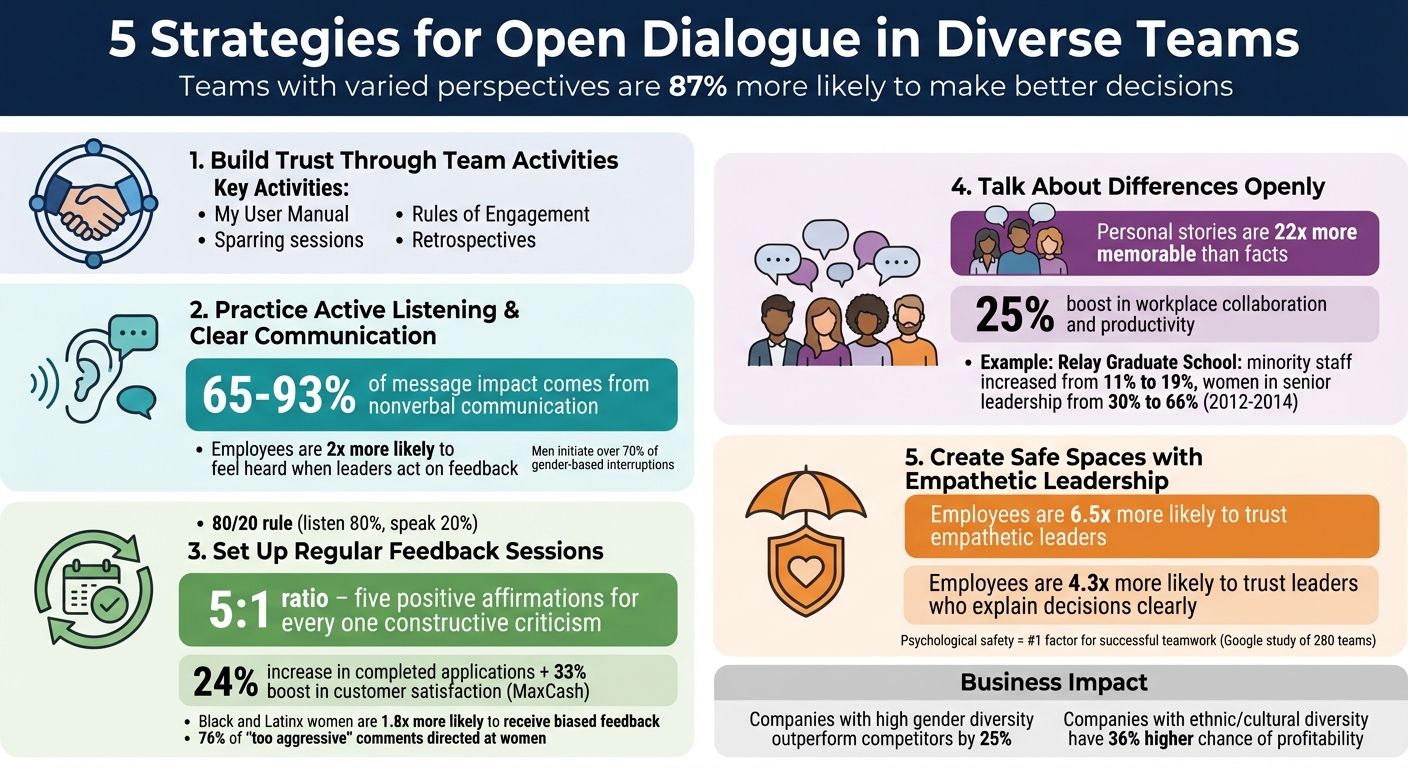
5 Strategies for Open Dialogue in Diverse Teams: Key Statistics and Benefits
Communication in Multicultural Teams: 6 Steps to Make it Work | Be an Effective Communicator
1. Build Trust Through Team Activities
Trust is the backbone of any successful team, especially in diverse and dynamic settings. Instead of relying on outdated trust-building exercises, consider integrating activities that not only strengthen relationships but also contribute to real project progress. Here are some practical ways to build trust while keeping the work moving forward.
Start with a "My User Manual" exercise. Each team member answers questions about their work preferences, communication style, and what they wish their colleagues understood about them. This simple activity promotes understanding and empathy by shedding light on individual work habits. It’s a great way to open up dialogue and encourage transparency.
Next, create "Rules of Engagement" through a collaborative workshop. Together, the team defines unwritten norms and clarifies expectations. For example, what does "urgent" mean? How quickly should messages be answered? When is it appropriate to challenge ideas during a meeting? By addressing these questions, the team builds a shared understanding that respects everyone’s perspectives and reduces potential misunderstandings.
Introduce "Sparring" sessions where team members review work-in-progress and offer constructive feedback. These sessions create a safe space for intellectual debates, focusing on refining ideas rather than protecting egos. It’s a powerful way to normalize healthy conflict and ensure everyone’s input is valued equally.
Finally, schedule regular Retrospectives to reflect on what’s working, what’s not, and how to improve. These meetings provide an opportunity to celebrate achievements, address frustrations, and brainstorm solutions. Retrospectives show that every voice matters and reinforce the team’s commitment to growing together, embracing differences, and improving as a unit.
2. Practice Active Listening and Clear Communication
Active listening is about fully focusing on the speaker to truly understand their message. In diverse teams, communication styles can vary greatly due to differences in cultural backgrounds, language skills, and personal approaches. This makes it crucial to adopt practical methods that enhance communication.
One effective technique is paraphrasing. After someone shares an idea or concern, repeat back what you understood in your own words. For example: "So, what you're saying is…" or "If I understand correctly…". This not only confirms that you're aligned but also demonstrates that you value their input. Between 2012 and 2014, the Relay Graduate School of Education saw impressive results from implementing cultural competence training with open discussion groups. During this period, the percentage of full-time minority staff increased from 11% to 19%, and women in senior leadership roles rose from 30% to 66% [5]. Pairing this approach with clear language and nonverbal cues can further ensure everyone is on the same page.
Speaking of clarity, avoid using jargon or acronyms that might confuse team members from different backgrounds. If you need to use technical terms, define them the first time they come up. Keep in mind that nonverbal communication carries significant weight - studies show it can account for 65% to 93% of the impact of a message [6]. Simple gestures like nodding, maintaining an open posture, or making culturally appropriate eye contact signal engagement and attentiveness.
Another strategy is following the 80/20 rule: listen 80% of the time and speak 20%. Open-ended questions like "Can you tell me more about…" encourage deeper conversations. Research shows that employees are twice as likely to feel heard when leaders take action based on their feedback [3]. Additionally, gender dynamics play a role in conversations - studies reveal that men initiate over 70% of gender-based interruptions in professional settings [4]. Making a conscious effort to allow everyone to finish their thoughts can create a more inclusive environment.
"A speaker who feels she isn't being heard, or suspects she won't be, will often withhold her views."
- Judith Humphrey, Founder, The Humphrey Group [4]
3. Set Up Regular Feedback Sessions
Regular feedback sessions are a cornerstone of effective communication and team cohesion. By scheduling consistent check-ins - whether through weekly one-on-ones, quarterly reviews, or monthly pulse surveys - you create a reliable space where everyone knows their input is valued. This consistency not only fosters trust but also encourages actionable improvements.
The type of feedback you provide is just as important as the frequency. Feedback generally falls into three categories: appreciation, which acknowledges contributions (e.g., "I really liked the effort you put into that project"); coaching, which focuses on growth (e.g., "Let’s review the kickoff meeting to identify ways to improve"); and evaluation, which clarifies performance relative to expectations. Clearly identifying the type of feedback helps reduce defensiveness - an emotional response that can cause heart rates to spike by up to 50% during feedback conversations [9].
For some teams, anonymous feedback tools can help overcome power dynamics or cultural barriers. For example, in August 2024, MaxCash Founder Fred Winchar introduced monthly anonymous employee surveys via SurveyMonkey. One survey revealed a need to simplify the loan application process, leading to a 24% increase in completed applications and a 33% boost in customer satisfaction [7]. Similarly, Stacie Baird, Chief People Officer at Community Medical Service, implemented an open-question portal for town halls. Employees could submit and upvote questions anonymously, which led to strategic goal adjustments and policy changes based on frontline feedback [7].
Striking the right balance in feedback delivery is crucial. Studies suggest an optimal ratio of five positive affirmations for every one piece of constructive criticism [9]. This balance is especially important in diverse teams, where bias can influence feedback. For instance, Black and Latinx women are 1.8 times more likely to receive biased feedback compared to Asian men [8], and 76% of "too aggressive" comments in performance reviews are directed at women [9]. To address these disparities, consider segmenting survey data by gender, ethnicity, and generation to uncover and close inclusion gaps.
"Feedback is a gift when given with the right intention and based on facts, not feelings."
- Tanya Turner, HR Director, SALTO Systems, Inc. [7]
sbb-itb-8feac72
4. Talk About Differences Openly
Pretending differences don’t exist doesn’t make them disappear - it just creates a shallow version of tolerance. Omer Ongun, Senior Consultant at Korn Ferry, puts it this way:
"Tolerance happens when we ignore differences because we just want to get into action" [2].
Instead of skimming past what makes each team member unique, fostering open conversations about differences can strengthen both team cohesion and decision-making. One way to do this is through storytelling, which helps highlight and celebrate individual perspectives.
Creating spaces for storytelling and personal sharing is key. Take Relay Graduate School of Education as an example: they formed a Diversity Steering Committee that launched discussion groups on identity and cultural awareness. These efforts led to measurable growth in diversity and leadership representation [5].
Storytelling sessions are especially impactful because personal stories are up to 22 times more memorable than just sharing facts [11]. Consider starting with low-stakes activities like "The Name Story", where team members explain the origins or meanings behind their names. This simple activity can open up deeper conversations about heritage and identity [28, 31, 32]. Another option is "Story Circles", where participants take 3–5 minutes to share stories around specific themes, such as a time they felt included or excluded [28, 31].
To dig even deeper, try the "Iceberg Activity." This exercise helps teams explore both visible cultural traits - like language and clothing - and the less obvious ones, such as values, communication styles, and beliefs [12]. These kinds of activities don’t just build understanding - they can boost workplace collaboration and productivity by nearly 25% [10].
When conflicts arise, take a moment to pause and address triggers and vulnerabilities. This approach can turn challenges into opportunities to build trust [2]. Subha Barry, President of Seramount, captures this idea perfectly:
"Inclusion stories hold immense power. They sensitize, but do not condemn. People can't rewrite history, but they can evolve" [13].
5. Create Safe Spaces with Empathetic Leadership
Empathetic leadership takes trust and clear communication to the next level, creating environments where open dialogue thrives. It's not just a feel-good concept - it directly impacts performance. A study involving 6,731 mid- to upper-level managers across 38 countries revealed that empathetic leadership correlates with better job performance [14]. By 2025, half of employers identified empathy and active listening as essential workplace skills [15].
When leaders genuinely care about their employees' challenges, trust grows. In fact, employees are 6.5 times more likely to trust leaders who show authentic concern [16]. This trust is the bedrock of psychological safety - the belief that team members can voice ideas, ask questions, or admit mistakes without fear of embarrassment or punishment [17]. Google's two-year study of 280 teams found that psychological safety is the most critical factor for successful teamwork and innovation [18].
Leaders who embrace vulnerability - admitting mistakes and sharing lessons - strengthen their teams. These moments of honesty can turn conflicts into opportunities to build trust. Omer Ongun, Senior Consultant at Korn Ferry, emphasizes this point:
"If you can manage to be vulnerable with your colleagues in [a] moment of conflict, you can seize the opportunity to establish trust among team members" [2].
When conflicts arise, taking a moment to reflect on your own reactions and openly sharing your feelings can defuse tension and foster connection [2]. Transparency is also key. Addressing conflicts with clear explanations for decisions helps maintain trust. Ned Feuer, Senior Director at Gartner HR Practice, explains:
"A lack of trust most often stems from senior leaders withholding information, scapegoating or retracting decisions" [16].
Employees are 4.3 times more likely to trust leaders who clearly explain their reasoning, especially during uncertain times [16]. Paying attention to nonverbal cues can also help leaders understand the deeper emotions behind words [14]. This approach naturally leads to practical outcomes, as empathetic leadership often sparks innovation.
Take IDEO’s February 2025 airport project, for example. By creating a safe space where frontline employees felt comfortable sharing ideas, the team improved baggage handling processes. Leadership used games and small rewards like pins to encourage judgment-free discussions, which led to creative solutions [18]. Alan Ratliff, Senior Experience Lead at IDEO, summed it up perfectly:
"Gain trust by being real. Speak like a human" [18].
Conclusion
Open communication is the backbone of effective collaboration and a powerful antidote to workplace silos [1]. The strategies we’ve explored - trust-building through team activities, practicing active listening, holding regular feedback sessions, addressing conflicts openly, and fostering safe spaces with empathetic leadership - can reshape how diverse teams function.
Consider this: teams that embrace diversity and inclusion are 87% more likely to make better decisions than those that don’t [2]. Companies with high gender diversity outperform competitors by 25%, and those with strong ethnic and cultural diversity have a 36% higher chance of profitability [19]. But as theEmployeeApp aptly notes, "Diversity alone isn't enough. Without strong communication practices, even the most diverse teams can struggle" [19]. The key difference between merely tolerating differences and truly appreciating them lies in deliberate, consistent effort [2].
These practices don’t just improve communication - they transform team dynamics. Regular feedback and open dialogue create a culture where updates are shared freely, and differing opinions are welcomed [1]. When leaders model humility and curiosity, they encourage others to share their unique viewpoints, turning diversity into a driver of innovation and problem-solving [2].
That said, achieving these outcomes requires ongoing effort. Communication skills, especially in technical environments, can be learned and refined through structured practice. By weaving trust-building activities, active listening, and open discussions into your team’s routine, you lay the groundwork for an inclusive culture built on authentic communication.
For tech leaders aiming to bridge the gap between technical expertise and leadership skills, Tech Leaders offers tailored programs focused on engineering leadership and entrepreneurship. Their offerings include peer masterminds, personalized learning plans, and private coaching - all designed to help leaders master critical skills like communication and team management in technology-driven settings.
The tools are out there. Invest in leadership training and take the first step toward unlocking your team’s full potential.
FAQs
What is 'My User Manual,' and how can it enhance trust and communication in teams?
A 'My User Manual' is essentially a personal guide that someone creates to outline their work preferences, communication style, and values. By sharing these insights, team members gain a clearer understanding of how to collaborate effectively with one another. This practice promotes transparency, helps build trust, and reduces the chances of misunderstandings, leading to smoother and more effective team communication.
Encouraging everyone on the team to craft and share their own manuals can be a simple yet powerful way to strengthen relationships and create a more connected and harmonious team dynamic.
How can I effectively practice active listening in diverse teams?
Active listening means fully engaging with the speaker - focusing on their words, understanding their message, and responding in a way that makes them feel truly heard. This skill becomes even more crucial in diverse teams, where communication styles and norms can differ widely. When you prioritize understanding and respect, you create a space where everyone feels appreciated and included.
Here are some practical ways to strengthen your active listening skills:
- Give undivided attention: Put away distractions, maintain eye contact, and use open body language to show you're present.
- Paraphrase and clarify: Restate the speaker's message in your own words to ensure you're on the same page.
- Ask open-ended questions: Invite deeper dialogue with prompts like, "Could you explain that further?"
- Notice non-verbal signals: Pay attention to tone, facial expressions, and gestures, and respond thoughtfully.
- Pause before responding: Allow a moment of silence to let the speaker fully express themselves and to process what you've heard.
Incorporating these habits into daily interactions - whether in one-on-one conversations or group settings - can make a big difference. It ensures that every voice feels heard and valued, paving the way for stronger collaboration and fresh ideas.
Why is it important for teams to openly discuss differences?
Openly discussing differences plays a key role in building trust and creating a collaborative team atmosphere. When team members feel comfortable sharing their unique perspectives, it minimizes misunderstandings, brings hidden tensions to light, and sparks new ideas by blending diverse viewpoints. This kind of open dialogue also helps set clear expectations, enhances problem-solving, and fosters a work culture where mistakes are treated as opportunities to learn and grow, rather than as failures.
Teams that prioritize open communication and inclusivity are better positioned to make smarter decisions and maintain higher levels of engagement. When employees feel heard and respected, it not only lifts morale but also improves retention. For tech leaders, cultivating this kind of environment is essential to managing the challenges of modern, AI-driven teams while enabling smoother, more effective collaboration.