

How to Price AI Services with Recurring Revenue
AI services are expensive to scale, and traditional pricing models don’t work. Why? Unlike typical software, AI incurs ongoing costs - like GPU compute, API calls, and database queries - that grow with usage. Without a proper pricing strategy, these costs can crush your margins.
Here’s the solution: Recurring revenue models. These include subscriptions, usage-based fees, or hybrid options that balance predictable income with scalable costs. For example, 56% of AI companies now combine a base subscription fee with usage overages, ensuring steady cash flow while covering infrastructure expenses.
Quick takeaways:
- AI services require pricing that accounts for variable costs (e.g., compute and tokens).
- Hybrid models (subscription + usage fees) are the most effective for balancing income and costs.
- Align pricing with customer value - charge for outcomes like resolved tickets or processed documents.
- Use tools like soft caps and alerts to prevent "bill shock" for customers.
The key? Build a flexible pricing system that grows with your business while protecting your margins.
How to Package, Sell, and Scale AI Systems Into Real Recurring Revenue | Michael Reimer
Matching AI Services to Recurring Revenue Models
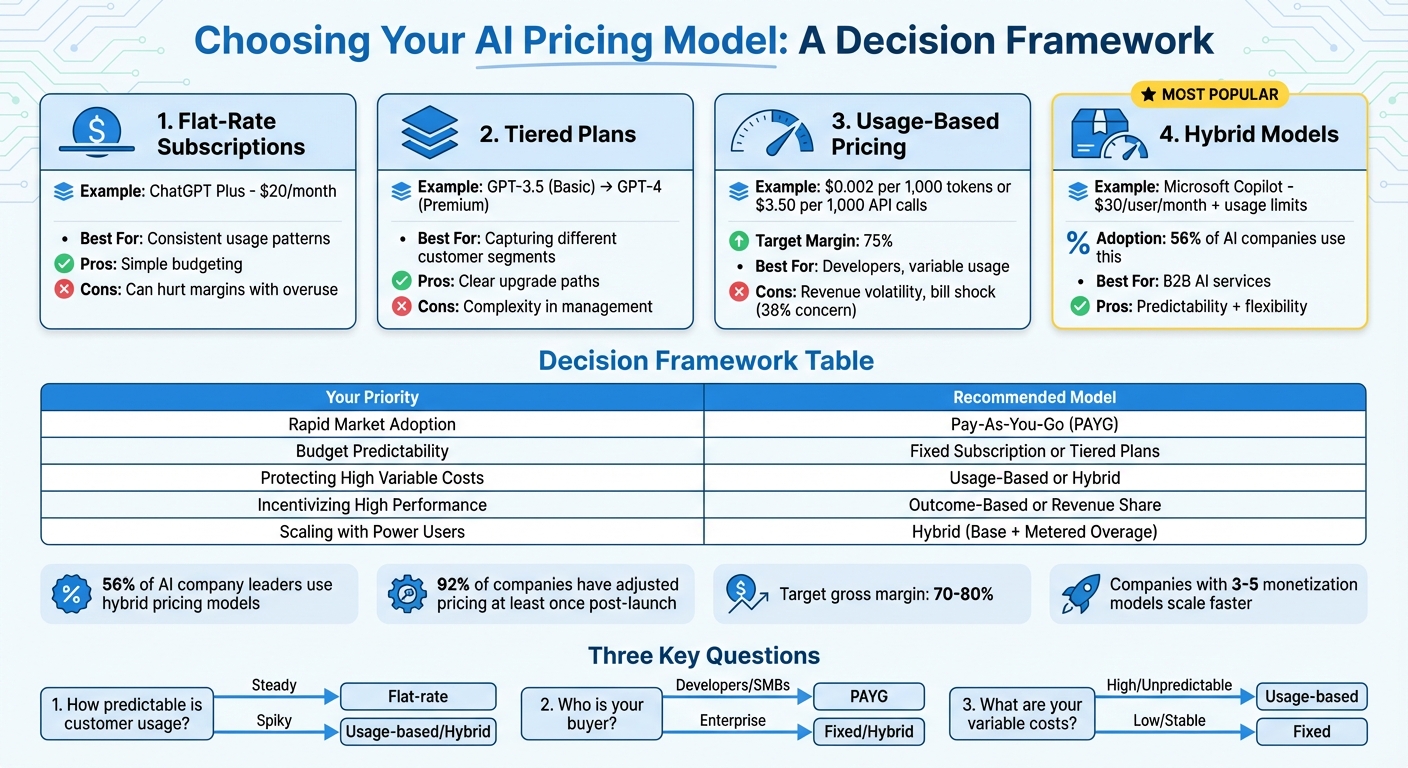
AI Service Pricing Models Comparison: Choosing the Right Revenue Strategy
Tying AI services to the right revenue model is a critical step in navigating the challenges of pricing. The trick lies in aligning your service type with a model that matches both your cost structure and how customers use your product. 56% of AI company leaders now rely on hybrid pricing models, blending subscription fees with usage-based charges to achieve a balance between predictable income and variable infrastructure expenses [4].
When deciding how to package your AI services, consider three key factors: predictability of customer usage, the level of integration into workflows, and whether your target audience is technical or business-focused. For example, a standalone API for developers will require a different pricing approach than an AI feature embedded in a SaaS platform. Research shows that companies using multiple monetization models - typically 3 to 5 - scale faster than those sticking to just one [2]. Flexibility, clearly, is a game-changer.
Packaging AI Services for Subscriptions
AI services generally fall into three packaging structures:
- Bundled tiers: Here, AI features are included within existing subscription plans. Think of it like adding AI capabilities to a "Pro" plan. This approach works best when variable costs are predictable and adoption is straightforward.
- Paid add-ons: AI is offered as a premium feature, such as GitHub's "AI Copilot", which costs between $10 and $39 per user per month [1].
- Standalone services: These are independent AI tools with their own pricing, ideal for highly specialized solutions.
The way you charge customers shapes how they perceive value. For technical buyers, consumption-based metrics like API calls or tokens often make sense. For operations teams, workflow-based metrics like completed tasks or documents processed are a better fit. Meanwhile, executives often prefer outcome-based metrics tied to measurable ROI, such as resolved tickets or qualified leads. For instance, Intercom's Fin AI Agent charges based on successfully resolved support tickets rather than interactions [4].
For enterprise clients, credit-based systems provide a middle ground. Customers prepay for a set number of credits, which can then be used flexibly within defined limits. This approach offers budget predictability while accommodating fluctuating usage patterns [5].
Selecting the Right Pricing Model
AI service pricing typically revolves around four main models, each with its own strengths and challenges:
- Flat-rate subscriptions: This model simplifies budgeting. For example, OpenAI's ChatGPT Plus charges $20 per month for "unlimited" usage within reasonable limits [5]. It’s great for consistent usage but can hurt margins if some customers overuse the service.
- Tiered plans: These segment customers by features or usage caps. A common example is offering GPT-3.5 access in a basic tier and GPT-4 in a premium tier. This approach helps capture different customer segments while providing clear upgrade paths [1].
- Usage-based pricing: Pay-as-you-go models tie revenue directly to consumption. Rates like $0.002 per 1,000 tokens or $3.50 per 1,000 API calls are common, with companies targeting a 75% margin [3][6]. While appealing to developers, this model can result in revenue volatility and "bill shock", a concern for 38% of AI companies using it [4].
- Hybrid models: These combine a base subscription fee with metered overages, offering predictability alongside flexibility. Microsoft Copilot, for example, charges $30 per user monthly for enterprise customers, with usage limits to safeguard margins [1]. This model is becoming the go-to choice for B2B AI services, as it balances fixed costs like governance and security with variable costs tied to usage.
Decision Framework for Pricing Models
To choose the best pricing model, start by asking a few key questions:
- How predictable is customer usage? Flat-rate subscriptions work well for steady, predictable usage, while spiky or unpredictable patterns might call for usage-based or hybrid models [6][8].
- Who is your buyer? Developers and small businesses often prefer low-friction, pay-as-you-go models. In contrast, enterprise clients value budget certainty and lean toward fixed subscriptions or hybrid structures [6][8]. While technical buyers are comfortable with metrics like tokens or API calls, business buyers typically prefer metrics like "completed tasks" or "documents processed" [3][6].
- What are your variable costs? If your inference costs are high or unpredictable - such as with large models or complex orchestration - you’ll need usage-based components to protect your margins. Aim for a 70–80% gross margin by factoring in all costs, including LLM tokens, infrastructure, and orchestration [3]. For low, stable costs, fixed pricing simplifies operations.
| Your Priority | Recommended Model |
|---|---|
| Rapid Market Adoption | Pay-As-You-Go (PAYG) |
| Budget Predictability | Fixed Subscription or Tiered Plans |
| Protecting High Variable Costs | Usage-Based or Hybrid |
| Incentivizing High Performance | Outcome-Based or Revenue Share |
| Scaling with Power Users | Hybrid (Base + Metered Overage) |
Finally, safeguard your pricing with guardrails. Soft caps, usage alerts at 50%, 80%, and 100% of limits, and hard caps can prevent runaway costs, especially from autonomous agent loops [3][6]. Keep in mind, 92% of companies charging for AI usage have adjusted their pricing at least once as market demands evolve [4]. Building flexible billing infrastructure is essential for long-term success.
Calculating Costs and Setting Value-Based Pricing
Let’s dive deeper into how to calculate costs and transition to value-based pricing for AI services. Getting your costs right is the foundation for sustainable pricing. AI services typically have two cost profiles: training, which is a one-time capital expense, and inference, an ongoing operational cost that grows with customer usage [10]. Your total cost stack includes components like LLM tokens, embeddings, vector database queries, orchestration layers, observability tools, and safety mechanisms. Among these, data-related tasks - such as curation, labeling, and filtering - often represent the largest non-compute expense [3][10]. Once you’ve defined these cost structures, the next step is understanding unit economics to guide customer-focused pricing.
Understanding Unit Economics for AI
Every variable cost should be tied to a customer-relevant unit. Instead of thinking in abstract terms like "tokens per request", focus on tangible metrics such as cost per email draft, cost per resolved support ticket, or cost per document processed [3]. For example, if your raw cost is $0.80 per 1,000 API calls and you aim for a 75% gross margin, you’d price those calls at about $3.20 per 1,000 [3]. However, keep in mind that factors like long prompts, retrieval bundles, and larger KV cache footprints can drive up costs and reduce batch efficiency [10].
"Training is episodic, bursty, and risky... Inference is ongoing, demand-driven, and tightly coupled to latency and reliability." - Umbrex [10]
Estimating Per-Customer Costs and Margins
AI SaaS companies often aim for gross margins in the range of 70–80% [3]. To reach these targets, start by estimating average customer usage, multiply that by your cost per unit, and add a 20–30% buffer for retries and failures [10]. To optimize costs, use portfolio routing: send simpler requests to cost-efficient models and reserve more expensive models for complex tasks [10]. Implement soft caps and automated alerts at 50%, 80%, and 100% of usage limits to avoid unexpected costs and protect your margins [3][4].
Once you’ve nailed down per-customer cost estimates, the focus shifts to aligning your pricing with the value you deliver.
Applying Value-Based Pricing
Value-based pricing ties what you charge to measurable outcomes for your customers. For instance, if a manual process costs a client $96,000 annually in staff time, offering a one-time build fee of $15,000 (roughly 15% of their first-year savings) makes for a compelling ROI argument [11]. A common benchmark is charging 10–20% of the first year’s value created, whether that’s through time saved, reduced errors, or increased revenue [11]. For ongoing services, you can use outcome-based metrics like charging $1.50 per resolved ticket when your cost is around $0.40, or setting a minimum monthly fee of $1,000 for up to 50,000 pages of document processing [3]. This approach shifts the conversation from costs to the value you’re delivering.
sbb-itb-8feac72
Designing Subscription and Hybrid Pricing Structures
Once you've established your costs and the value of your offering, the next step is creating clear and effective pricing structures. By leveraging unit economics and value-based pricing, you can craft models that are easy for customers to understand while ensuring your margins remain secure. Many leaders in the AI industry lean toward hybrid models, which combine subscription fees with usage-based charges. This approach balances predictable revenue streams with fair cost-sharing, opening the door for tiered, hybrid, and specialized pricing options that cater to both fixed costs and scalable usage.
Creating Subscription Tiers
A well-thought-out subscription tier system often includes basic, enhanced, and premium levels, each offering more value than just increased usage limits. For instance:
- A Starter plan could include assistive AI tools like summaries and recommendations.
- A Pro tier might add semi-autonomous workflows that handle tasks for users.
- An Enterprise plan could provide fully autonomous agents equipped with advanced governance and compliance features [7].
This tiered structure allows customers to choose the level of AI integration that best suits their needs.
When setting prices, focus on the business outcomes your product delivers. Instead of charging based on technical metrics like tokens or API calls, translate those into tangible results. For example, market your service as "1,000 AI-generated reports" rather than "2 million tokens" [12]. To avoid surprising customers with unexpected costs, set usage limits and provide alerts at 50%, 80%, and 100% thresholds. This transparency helps customers manage their spending effectively [3][6].
The next step is to explore how metered usage can complement subscription tiers through hybrid pricing models.
Implementing Hybrid Pricing Models
Hybrid pricing combines a fixed platform fee with charges for metered usage, making it ideal for handling high-cost workloads. For example:
- A $1,000 monthly platform fee could include 1 million tokens, with an additional $2 charged for every 100,000 tokens beyond that [3].
- Alternatively, a $750 monthly fee might include basic usage, with $1.50 charged per AI-resolved support ticket. Volume discounts could lower this rate to $0.90 for customers with high usage [3].
This approach offers customers predictable budgeting while protecting your margins during periods of heavy use. The fixed fee should cover "minimum meaningful usage", ensuring customers see a clear return on investment without immediately facing overage charges [9]. During the early adoption phase, consider using soft caps to monitor customer behavior before introducing hard limits, which could discourage experimentation [6][12].
Specialized Pricing for AI Features
For advanced AI capabilities, consider offering specialized features as add-ons. For example, AI copilots often command an additional $30 to $49 per user per month on top of standard SaaS fees [3][7]. For autonomous agents - essentially virtual team members - per-agent billing works well, mirroring the cost structure of hiring an employee [7][9]. Similarly, per-action pricing can suit automation tasks, such as charging $0.05 per generated image or $1.50 for an AI-resolved support ticket, especially when the internal cost is about $0.40 [6][7].
High-value enterprise features, like compliance bundles (e.g., HIPAA or private VPC) or specialized API integrations with ERP systems, can be offered as separate add-on packages. This strategy lets you capture additional revenue from customers willing to pay more for these advanced capabilities without complicating your core pricing tiers.
Refining Pricing Using Financial Metrics
Pricing isn’t a one-and-done task - it’s an ongoing process that demands regular monitoring and tweaks. With costs and usage patterns constantly shifting, staying on top of the right metrics, keeping an eye on your margins, and testing changes methodically are key. Let’s break down how to fine-tune your pricing strategy using specific financial metrics, building on the cost calculations we’ve already covered.
Tracking Key Metrics
Start with the basics: Monthly Recurring Revenue (MRR), Annual Recurring Revenue (ARR), and churn rate. These metrics provide a snapshot of your business’s health. But for AI services, you need to dig deeper. Net Dollar Retention (NRR) is especially important because it reflects both customer retention and expansion - showing whether users are increasing their AI usage over time [14]. Another critical metric is the AI Attach Rate, which measures the percentage of customers purchasing AI add-ons, giving you insight into demand for specific features [3].
On the cost side, track AI COGS (Cost of Goods Sold), which includes expenses like tokens, embeddings, vector search, and orchestration. Then calculate your AI Gross Margin by subtracting AI COGS from AI revenue and dividing by AI revenue. Aim for margins between 70% and 85% to ensure your AI features drive profitability rather than drain resources [3][7]. Also, pay attention to ARPU Uplift (Average Revenue Per User increase), which quantifies the additional revenue AI features bring to your service [3].
Monitoring Usage and Margins
Beyond tracking metrics, you need to monitor usage patterns and how they impact margins. Look at Usage Concentration - the proportion of total usage driven by your top customers. These "power users" can strain profitability under flat-fee pricing if their consumption far outweighs their revenue contribution [3][6]. Group customers into low, medium, and high-usage categories to pinpoint who’s impacting your margins most [3].
Run internal profit-and-loss simulations to evaluate your blended gross margins across different adoption scenarios before implementing pricing changes [3]. If certain customers consistently exceed profitable usage levels, consider adjusting their tier thresholds or introducing metered overage charges [6][9]. You can also optimize costs by routing usage to more affordable or efficient models internally while maintaining the same service-level agreements (SLAs) for customers. This approach helps protect margins even as model costs fluctuate [3][6].
It’s worth noting that 92% of AI companies charging for usage have adjusted their pricing post-launch [4]. This isn’t a failure - it’s a sign that successful businesses treat pricing as a dynamic system shaped by real-world data.
Testing Pricing Adjustments
When experimenting with new pricing models, start small. Test changes with a subset of new customers while keeping existing customers on their current plans through grandfathering. This approach maintains trust during the transition and provides clean data on how the new structure performs [3][13].
Once you’re ready to implement changes, roll them out to new customers first. Allow existing customers to remain on their legacy pricing for a set period - typically 6 to 12 months - to preserve relationships while validating the new model’s effectiveness [3][13]. You can also use limited-time offers, like a "Founders' AI Pack", to test pricing without making long-term commitments [3].
Review your pricing structure annually and key metrics quarterly [13]. Don’t overlook feedback from your sales team - they’re on the front lines and can provide valuable insights into deals that fall through due to pricing misalignment [15]. As model costs decline and competition heats up, you’ll face decisions about whether to improve margins or pass savings on to customers to remain competitive [3].
Conclusion
Pricing AI services with a recurring revenue model isn't just about setting rates - it’s about creating a system that grows and adapts alongside your business. Interestingly, 56% of AI company leaders rely on hybrid pricing models, combining predictable subscriptions with usage-based fees to refine their strategies over time [4].
Your technical expertise plays a crucial role here. Understanding the costs of tokens, embeddings, and compute resources is essential for balancing profitability. For instance, you can route simpler tasks to cost-effective models while reserving premium compute power for more complex jobs. This approach not only safeguards your margins but also ensures your customers get value without overspending.
Strategic pricing decisions today lay the groundwork for scalability and reinvestment tomorrow. As highlighted by BCG, a weak pricing strategy can limit the potential of AI solutions, often discouraging customers from experimenting with your services [1]. To counter that, tie your pricing to outcomes - whether it’s charging per resolved ticket, per qualified lead, or per processed document. This ensures your revenue grows as your customers benefit more from your services.
To build trust and encourage upgrades, consider implementing soft usage limits at 50%, 80%, and 100% of allowances [3][4]. Test pricing changes with new customer groups first, while grandfathering existing clients to maintain strong relationships. Regularly review your metrics - quarterly is a good cadence - to stay ahead of cost changes and competitive pressures.
Ultimately, aligning your pricing strategy with shifting market dynamics positions your business for both growth and profitability. Companies offering 3 to 5 monetization models tend to scale faster than those sticking to just one [2]. By combining your technical expertise with a forward-thinking business approach, you can craft flexible pricing systems that adapt as model costs decrease and market conditions evolve. In the ever-changing world of AI services, staying agile is key.
FAQs
What are the advantages of using a hybrid pricing model for AI services?
A hybrid pricing model blends a fixed subscription fee with a usage-based component, creating a balanced approach for AI services. This setup ensures consistent revenue through a predictable base fee while accounting for fluctuating costs like compute or GPU usage. It’s a smart way to safeguard profit margins during periods of increased demand and maintain a reliable cash flow.
For customers, this model offers flexibility and fairness by letting them pay only for what they use. It minimizes financial risks, fosters trust, and appeals to a broad range of clients - from small-scale projects to large enterprises. Plus, aligning costs with actual outcomes makes it easier to showcase ROI and adapt pricing for high-volume users.
By adopting this approach, tech leaders can build scalable, subscription-based businesses that prioritize both customer satisfaction and financial stability.
How can companies avoid unexpected costs with usage-based pricing?
To avoid unexpected expenses, businesses can take several proactive steps. Start by setting usage caps to limit overages, and offer real-time alerts so customers can track their consumption as it happens. Using clear, customer-focused metrics ensures pricing aligns with what users value most. Transparent pricing structures and consistent communication about usage are also key to building trust and minimizing surprises. On top of that, analyzing customer usage patterns regularly can help fine-tune pricing models, making them more predictable and equitable over time.
What should I consider when pricing AI services to match customer value?
To price AI services effectively, it's all about connecting the cost to the value your customers see. Start by assessing the business outcomes your service delivers - things like boosting revenue, cutting costs, or speeding up time-to-market. A value-based pricing approach works well here, as it ties pricing directly to measurable results, making it clear to clients how their investment translates into benefits.
Next, consider the cost structure of your AI solution. Running AI services often involves expenses like compute power, data storage, and infrastructure. A good strategy is to use a hybrid pricing model that combines a base subscription fee with usage-based charges. This setup helps cover fixed costs while staying fair to customers. Don’t forget to factor in the complexity of your solution, such as the sophistication of the AI model or the effort required for integration, as these elements should influence your pricing.
Lastly, adjust pricing based on customer-specific factors like how much they use the service, their risk tolerance, and the level of support they need. By balancing these elements thoughtfully, you can build a recurring revenue model that works for your business while remaining transparent and fair for your clients.