
How to Prioritize Sprint Backlog Items
Prioritizing sprint backlog items is all about choosing tasks that deliver the most impact within a sprint. A sprint backlog includes the Sprint Goal, selected Product Backlog Items (PBIs), and a delivery plan. Here's how teams can effectively prioritize:
- Focus on Value: Prioritize tasks that meet customer needs, boost user satisfaction, or align with business objectives. Use frameworks like the Kano Model to classify features into must-haves, performance enhancers, and delighters.
- Estimate Effort: Assess the complexity of tasks using story points or T-shirt sizing. Limit overly large tasks by breaking them down into smaller, manageable pieces.
- Address Dependencies Early: Identify and resolve dependencies or risks during backlog refinement to prevent delays.
- Use Prioritization Techniques: Methods like the MoSCoW framework, Value vs Effort Matrix, or stack ranking help teams focus on the most impactful work.
- Collaborate with the Team: Involve developers, designers, and stakeholders in discussions to ensure priorities are clear and feasible.
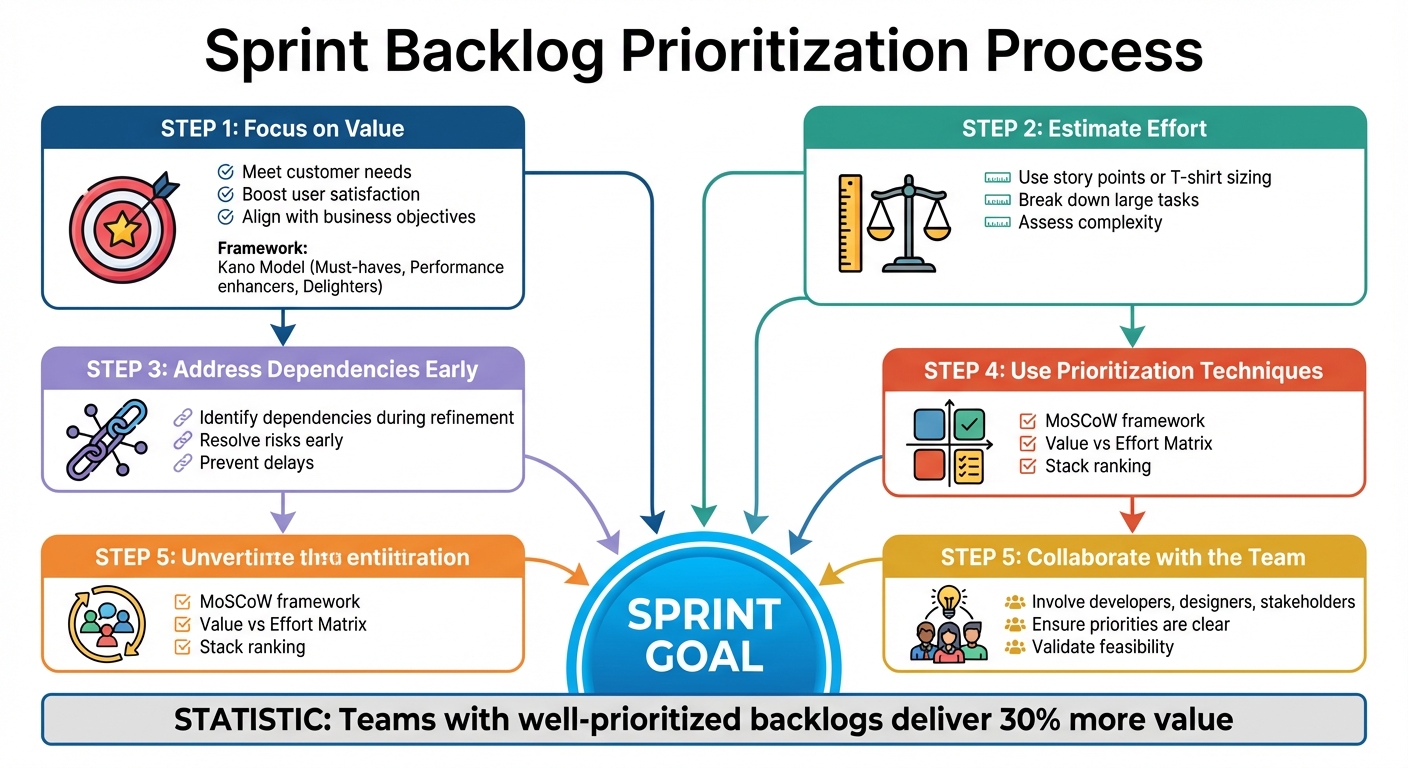
5-Step Sprint Backlog Prioritization Framework
5 Key Factors for Effective Product Backlog Prioritization
sbb-itb-8feac72
Key Factors to Consider When Prioritizing
Prioritization is all about focusing on what truly matters. The aim isn't just to check tasks off a list - it's to achieve outcomes that make a real difference for your business and your customers. To do this effectively, you need to weigh three key factors: the value a task delivers, the effort it demands, and any dependencies or risks that might slow things down.
Business and Customer Value
Value reflects how much impact or benefit something brings to a specific group - whether that’s your users, stakeholders, or even your internal teams [5]. But here’s the catch: value can fade over time. In industries like fantasy sports, for instance, features must be ready by Draft Day. Miss that deadline, and the value of those features plummets because users have already moved on to competitors [5].
The shift here is crucial: stop focusing on outputs (like the number of features delivered). Instead, look at outcomes - the measurable benefits that improve the customer experience. For example, it’s more meaningful to celebrate users completing tasks 20% faster than to boast about shipping ten new features.
Value is a measure of the usefulness or impact on a particular audience.
Revenue alone doesn’t paint the full picture. It’s a lagging indicator and doesn’t always reflect what customers care about most [6]. That’s why it’s important to define clear criteria for value upfront. Is success about boosting revenue, improving user retention, increasing Net Promoter Scores (NPS), or aligning with long-term goals? Frameworks like the Kano Model can help you categorize features into Basic Needs (must-haves that frustrate users if missing), Performance Needs (features that enhance satisfaction as they improve), and Delighters (unexpected features that create loyalty). And don’t forget the 80/20 rule: around 80% of a product’s impact often comes from just 20% of its features [2][7]. Your challenge is to find and focus on that critical 20%.
Effort and Complexity
Value alone isn’t enough - you also need to consider how much effort a task will take. Effort estimation isn’t about exact hours but about understanding the relative complexity of the work.
Story points should represent complexity, not time. Why? Because time estimates can vary significantly between engineers.
Use methods like relative estimation (e.g., story points or T-shirt sizing) to compare tasks. For example, a 1-point story might involve a quick copy update, while an 8-point story could mean building a complex feature in an unfamiliar codebase [8].
Set limits to keep tasks manageable. If a story exceeds 8 points, break it into smaller subtasks that can ideally be completed in a day [8][1]. Also, factor in your team’s actual capacity - account for things like vacations, holidays, and meetings. A common practice is to dedicate 80% of your team’s velocity to new work, leaving 20% for unexpected bugs or incidents [1]. Tools like Planning Poker during refinement sessions can help your team reach consensus on estimates while avoiding anchoring bias [8][10]. And don’t forget to track progress with burndown charts to spot estimation issues early and make adjustments mid-sprint [3].
Once you’ve nailed down effort estimates, it’s time to focus on dependencies and risks.
Dependencies and Risks
Dependencies can quietly derail your timeline if not addressed early. For instance, a feature that relies on third-party API access might get delayed because no one submitted the necessary firewall requests in time.
Prioritizing dependencies in the right order will optimize development time.
During backlog refinement, identify dependencies by involving key stakeholders and subject matter experts (SMEs).
SMEs can help uncover hidden dependencies and risks tied to the product domain or industry.
Breaking down complex user stories early can reveal technical, functional, or logical constraints you might not have noticed otherwise [11][1][7].
Tackle high-risk items early in the sprint by prioritizing spikes - investigative tasks that resolve technical uncertainties before full development begins [1][4]. Document these risks directly in your sprint backlog and create actionable mitigation steps [3]. Some organizations use the Weighted Shortest Job First (WSJF) approach, which includes risk reduction in its formula. This method has been shown to cut cycle times by 30% [12]. The WSJF formula - (Business Value + Time Criticality + Risk Reduction) / Job Size [9][13] - helps ensure you’re addressing the most impactful tasks, not just the easiest ones.
Common Prioritization Techniques
When it comes to turning insights into actionable priorities, the right approach can save time, cut down on debates, and keep everyone focused on what truly matters. Below are three effective methods for organizing sprint backlogs that help teams prioritize with clarity and purpose.
Using the MoSCoW Method
The MoSCoW method organizes backlog items into four categories: Must have, Should have, Could have, and Won't have [14][15]. Pairing this method with timeboxing - a fixed sprint deadline - can help teams focus on what’s essential [14][19].
-
Must Haves: These are critical for delivering the Minimum Viable Product (MVP). Missing even one means the sprint fails [14][18]. As Adam Sandman, CEO of Inflectra, explains:
Must Haves are User Stories that must be included to create the MVP. Must Haves form the core of the scope of work that will need to be delivered.
- Should Haves: Important but not immediately necessary [15][19].
- Could Haves: Nice-to-haves that can be dropped if time runs short [15][17].
- Won't Haves: Items explicitly excluded from the sprint but may be considered later [16][17].
One common pitfall is overloading the "Must Have" category, which can undermine prioritization. Product Owners and Scrum Masters should ensure only genuinely critical tasks are labeled as such. Tools like Jira or Trello can help by visually organizing "Won't Have" items into folders like "On Hold", making it clear what’s deferred [16][17].
What sets MoSCoW apart from simple numeric ranking is its clarity. Numeric scales often result in most items being labeled "High" or "Medium", leading to indecision. MoSCoW’s descriptive categories force teams to make hard choices [15].
Applying the Value vs Effort Matrix
The Value vs Effort Matrix is a simple 2x2 grid that evaluates backlog items based on their business value and the effort required to implement them [20][23]. It’s a visual tool that divides tasks into four groups:
- Quick Wins: High value, low effort - these are top priorities because they deliver fast results and build momentum [23].
- Major Projects: High value, high effort - strategic initiatives that need to be broken into smaller tasks [22][23].
- Fill-ins: Low value, low effort - tasks to tackle only when there’s extra capacity [21][22].
- Time Sinks: Low value, high effort - items to avoid or remove from the backlog [20][23].
Teams using this method report improved alignment with stakeholders (50%) and better prioritization accuracy (40%) [23]. It also optimizes resource allocation by 60% [23].
To make the matrix work, involve the whole team. Product Owners assess value, while developers estimate effort to account for technical complexity [21][23]. Use relative estimation techniques like Fibonacci numbers (1, 2, 3, 5, 8) or T-shirt sizing (S, M, L, XL) instead of exact hours [22][24]. For high-value, high-effort items, consider breaking them into smaller, more manageable "Quick Wins" [22].
As Alexandra Chen Rodriguez from onepm highlights:
The Value/Effort matrix is one of the most powerful tools in a product manager's arsenal.
Stack Ranking for Clear Prioritization
Stack ranking creates a straightforward, sequential list of tasks, ordered from most important to least important [24][25]. Unlike systems like "High/Medium/Low", where multiple tasks can share the same priority, stack ranking ensures each item has a unique position [24].
This method often uses pairwise comparisons to determine the order. As Alex Zhezherau, Product Director at Wrike, puts it:
The task with the most critical functionalities is set at the highest rank, followed by the next set of important tasks.
Stack ranking is especially useful for small backlogs. If a team member finishes a task, they can immediately start the next one without needing further direction [24]. However, for larger backlogs, it can become time-consuming - for 100 items, over 4,900 comparisons are needed [24].
While more subjective than formula-based methods like RICE or WSJF, stack ranking provides transparency. It helps Product Owners explain to stakeholders why certain features haven’t been prioritized yet. When new tasks are added, they’re compared against the existing list to find their place [25].
Team-Based Approaches to Prioritization
Getting the whole team involved in prioritization isn't just a nice-to-have - it’s essential for avoiding bias and tapping into a range of expertise. When developers, designers, and the Product Owner work together, the process benefits from diverse perspectives. This teamwork complements the earlier quantitative methods by adding real-world, qualitative insights. Structured techniques also ensure that everyone, even quieter or less experienced team members, has a voice.
Wideband Delphi for Team Consensus
Wideband Delphi is a structured method where team members anonymously provide estimates over several rounds [26]. Anonymity plays a key role here - it keeps dominant personalities from influencing others before they’ve had a chance to form their own opinions. After each round, the team discusses any major differences, focusing on the assumptions and uncertainties behind them. This back-and-forth helps the group gradually reach a consensus [26].
For the best results, aim for a group size of 3 to 7 members. This keeps discussions detailed but manageable [26]. As PM Repo explains:
Wideband Delphi... leverages collective intelligence to mitigate biases and enhance planning precision, vital for product success.
Another popular method is Priority Poker, which adds a touch of gamification. Team members reveal their priority votes simultaneously, preventing anchoring bias [28][29]. When votes differ, the ensuing discussions often reveal hidden challenges or misunderstandings. These techniques not only foster collaboration but also create a strong foundation for involving broader stakeholders.
Engaging Stakeholders in Prioritization
While internal team alignment is critical, involving external stakeholders ensures that priorities align with both technical feasibility and market needs. The Product Owner often acts as the bridge between customer goals and technical execution [30]. However, feedback from engineers, designers, sales, and support teams can add even more depth to the prioritization process [10][31][29].
Interestingly, while 73% of product managers take part in user research, only 45% of designers and 23% of tech leads do. This highlights a gap where broader involvement could lead to better alignment [10].
To keep discussions objective, establish shared evaluation criteria before each session. For example, you might weigh priorities as 40% business value, 30% urgency, and 10% risk [10][31]. This approach helps keep the loudest voices from dominating and ensures decisions are grounded in strategy rather than opinion.
Timebox refinement sessions to 90 minutes or less to avoid "backlog fatigue" and maintain focus [30]. Allocating up to 10% of the team’s capacity for regular refinement ensures that backlog items are "Ready" for sprint planning, cutting down on last-minute debates [27].
Best Practices for Effective Prioritization
Effective prioritization isn't just about choosing what to work on - it's about creating a process that aligns with your business goals and your team's capacity. Avi Siegel, Co-Founder of Momentum, explains it perfectly:
The real magic isn't in finding the one true prioritization technique; it's in transforming prioritization from a dark art into a transparent, repeatable science. [32]
To make this happen, frameworks like MoSCoW or the Value vs. Effort Matrix can help you identify and rank high-value tasks. Think of these as tools, not strict rules, to guide your decision-making [32].
Another critical piece of the puzzle is capacity planning. For sustainable delivery, aim to reserve 80% of your team's velocity for new development work and 20% for bugs and incidents [1]. Additionally, consider dedicating 10% to 20% of each sprint to addressing technical debt - this acts as an investment in your team's long-term efficiency [13][29].
Prioritization isn’t a one-and-done task. Make it a habit to review your top 10 items every week and conduct a full backlog review monthly. This ensures your priorities stay aligned with evolving business needs [13]. Start each sprint with "quick wins" to build momentum, and tackle dependencies early to avoid blockers that could slow the team down [1].
By blending objective scoring methods with team input, you can create a prioritization process that truly drives success.
Key Takeaways for Sprint Planning Success
These insights build on our earlier prioritization strategies, helping you bridge the gap between planning and execution.
Effective prioritization combines data-driven scoring with team collaboration. Use structured methods like RICE or WSJF, paired with clear evaluation criteria, to make strategic decisions. To ensure these scores reflect reality, validate them through team discussions using techniques like Wideband Delphi, which incorporates real-world technical considerations [32][13].
Here’s the payoff: teams with well-prioritized backlogs deliver 30% more value than those without [13]. The key is maintaining a single, fully ordered backlog - avoid vague categories like "high/medium/low." Instead, use stack ranking to make tough decisions about what matters most. Remember, if everything is labeled a priority, nothing truly is. Be explicit about your top priority and work your way down from there [10].
FAQs
Who decides sprint backlog priorities?
The Product Owner plays a key role in deciding which tasks in the sprint backlog should take priority, focusing on those that offer the most value. While sprint planning involves collaboration across the entire Scrum team to refine and choose items, it's usually the Product Owner who kicks off and leads the prioritization effort. This ensures that work aligns with stakeholder expectations and delivers results efficiently.
How do we prioritize when everything feels urgent?
When everything seems urgent, it’s time to take a step back and let your product vision steer your decisions. Using frameworks like MoSCoW (Must have, Should have, Could have, Won’t have) can help you prioritize tasks based on their value and impact. Make sure to involve your team and stakeholders in the process to align everyone on what matters most. This way, you can avoid making reactive decisions and stay focused on the work that genuinely drives your goals forward.
When should we use WSJF vs MoSCoW?
WSJF is a prioritization method that helps rank backlog items by considering economic value, risk reduction, and effort. It’s particularly effective in Lean or SAFe environments where tasks have measurable costs of delay and vary in size. By calculating WSJF, teams can focus on delivering the highest value work first, ensuring resources are used efficiently and strategically.
MoSCoW
MoSCoW is a prioritization framework focused on scope and deadlines. It divides tasks into four categories:
- Must: Critical features that must be delivered.
- Should: Important tasks that add value but aren't mandatory.
- Could: Nice-to-have features that can be included if time permits.
- Won’t: Items that won't be addressed in the current scope.
This method ensures essential features are completed first, helping align priorities across stakeholders and meeting project goals effectively.