
Psychological Safety vs. Cultural Barriers
Psychological safety and cultural barriers are two forces that can make or break team success, especially in globally distributed workplaces. Psychological safety ensures team members feel comfortable speaking up without fear of judgment. On the other hand, cultural differences - like communication styles and views on hierarchy - can block collaboration and trust.
Key takeaways:
- Psychological safety boosts team performance, helping diverse teams share ideas and solve problems.
- Cultural barriers create challenges, such as miscommunication and reduced trust.
- Without psychological safety, diverse teams struggle to reach their potential.
The solution? Leaders must create environments that encourage open dialogue, address cultural differences, and view mistakes as learning opportunities. This balance helps teams work effectively, turning diversity into an advantage.
Psychological Safety in Diverse Teams: Building Trust Across Differences
Defining Psychological Safety and Cultural Barriers
Psychological safety is the belief that team members can share concerns, ask questions, or admit mistakes without fear of judgment or backlash. Amy Edmondson from Harvard Business School describes it as "the perception that candor is welcome", adding that it’s the belief one can take interpersonal risks by speaking up with questions, concerns, mistakes, or dissenting views [12].
Google’s Project Aristotle highlighted psychological safety as the most crucial factor for team success [9]. Research involving 28,000 employees across 16 countries revealed that retention risk dropped significantly - from 12% in low-safety environments to just 3% in high-safety environments. The impact was particularly striking for underrepresented groups: retention increased over four times for BIPOC employees, five times for employees with disabilities, and six times for LGBTQ+ employees when psychological safety was high [10].
Cultural barriers, on the other hand, can obstruct collaboration by introducing challenges like differing communication styles, hierarchical norms, and cultural expectations [3]. In high power distance cultures, for example, subordinates are often expected to remain silent and wait for directives from authority figures. As Edmondson explains, "In other cultures, there is a value on 'Oh, you're not supposed to speak up, you're supposed to wait for the boss.' So it's harder, no question about it, but it's no less necessary and it can be done" [12].
Other factors, such as norms emphasizing politeness, language barriers, and impression management - where individuals avoid speaking up to prevent appearing incompetent - can also limit open communication. These dynamics make it clear why psychological safety is so important in overcoming these challenges.
When psychological safety is present, it can help bridge the gaps created by cultural differences. It fosters an environment where diverse teams can communicate openly and feel just as satisfied in their roles as their more privileged peers [10]. By addressing these barriers, teams can unlock their full potential and work more effectively together.
1. Psychological Safety
Team Dynamics
Psychological safety plays a crucial role in how multicultural teams collaborate. It acts as the bridge that helps overcome cross-cultural communication challenges [8]. Without it, even the most skilled teams can struggle to function effectively [3][8].
Research on globally dispersed teams highlights this point. Ella Glikson, an expert in collective intelligence, discovered that only teams with high psychological safety can convert their collective intelligence into improved task performance [2]. For diverse teams, creating a safe space to share ideas is essential.
Psychological safety in team settings is built on four main pillars: willingness to help, inclusion and diversity, attitude toward risk and failure, and open conversation [11]. These elements help eliminate the fear of being judged or appearing incompetent, which often causes people to hold back their ideas - especially in multicultural environments [11]. When this hesitation is removed, teams can engage more openly and tackle challenges together.
This trust forms the foundation for teams to address problems effectively, paving the way for better risk management.
Risk Management
Teams that foster psychological safety approach mistakes and challenges differently. Members feel at ease admitting errors and discussing problems without fear of criticism [9][7]. This openness ensures that small issues are addressed early, preventing them from escalating into bigger failures [9].
Leaders must prioritize a culture of learning and innovation for team members to be comfortable speaking up, taking risks, and sharing information. This does not happen by default. It emerges with effort and curiosity and care. - Amy Edmondson, PhD, Professor, Harvard Business School [9]
While staying silent might feel safe for individuals, it can harm overall organizational performance. Leaders need to reframe projects as opportunities to learn rather than just tasks to execute. This shift encourages team members to admit mistakes and ask questions, creating a culture where everyone feels safe contributing [8][11].
Conflict Resolution
Psychological safety also transforms how teams handle disagreements. Research involving nearly 300 leaders over 2.5 years revealed that teams with high psychological safety experienced better performance and fewer interpersonal conflicts [4]. This doesn’t mean everyone agrees all the time - it means members feel free to express differing opinions constructively.
In these safe environments, teams welcome healthy debates. Members engage in honest conversations, challenging ideas respectfully and testing proposals without making personal attacks [4]. Teams typically progress through four stages - inclusion, learner, contributor, and challenger safety - to enable meaningful, outcome-focused discussions [4].
Performance Impact
The benefits of psychological safety are particularly evident in diverse teams. While diversity introduces a range of perspectives that can spark innovation, research shows that diversity alone isn’t enough. Psychological safety is essential to unlock those ideas [1][8]. Lori Nishiura Mackenzie, Lead Strategist for DEI at Stanford Graduate School of Business, puts it succinctly:
Inclusion is something we all want, but it can be difficult to put into practice. Psychological safety is an important concept with practical strategies to enact culture where people are invited in and valued. [8]
However, only 43% of respondents report a positive team climate, highlighting a major gap and an opportunity for leadership development [13]. Organizations that heavily invest in leadership development are 64% more likely to have senior leaders rated as inclusive [13]. For multicultural teams, where cultural differences can often hinder innovation, prioritizing psychological safety allows teams to turn their collective intelligence into tangible performance improvements.
sbb-itb-8feac72
2. Cultural Barriers
Team Dynamics
Cultural differences often create divisions within teams, forming groups along lines like age, gender, or ethnicity [7]. These divisions can weaken team cohesion and erode trust.
The effects are far-reaching. A review of over 1,100 studies spanning 24 years revealed that 95% of the research focused on the negative consequences of team member differences [14]. When team members come from diverse cultural backgrounds, they often find it less enjoyable to collaborate, trust each other less, and make unfavorable assumptions about one another's intentions [14]. These tensions often operate beneath the surface, leading teams to misinterpret cultural friction as personality conflicts rather than recognizing the broader issue [15].
When team members come from different cultures... they tend to find it less enjoyable to spend time together, trust each other less, make less favorable attributions about each other's motives, and generally communicate less.
- Vasyl Taras, Dan Baack, Dan Caprar, Alfredo Jiménez, and Fabian Froese [14]
Such divisions not only hinder collaboration but also complicate critical areas like risk management and conflict resolution, creating further challenges for teams.
Risk Management
Cultural barriers often lead to information silos, which can obscure critical risks [7]. In teams with strong demographic divisions, members tend to share information more readily within their subgroup rather than with the entire team. This lack of cross-group communication prevents teams from gaining a complete understanding of potential problems [7]. As deadlines approach, this tendency can worsen, making it even harder to report risks effectively [7].
The impact of these silos goes beyond missed deadlines. A study of over 1,000 teams and 7,000 employees at Novartis/Sandoz showed that low psychological safety in diverse teams often prevents individuals from voicing ethical concerns or reporting misconduct [16]. Alarmingly, only 3 in 10 employees strongly agree that their opinions are valued at work, highlighting a widespread reluctance to address risks openly [4].
Conflict Resolution
The same barriers that hinder risk reporting can also escalate conflicts within teams [6]. While cultural diversity can drive innovation, it also increases the likelihood of misunderstandings and tensions, especially when differences in language, values, or communication styles come into play [14][15]. These misunderstandings can harm the team environment and make conflict resolution more challenging.
Cultural approaches to conflict vary significantly. In some cultures, openly addressing setbacks or delays is uncommon, which can lead to avoidable personal tensions [6]. Research involving nearly 300 leaders found that teams with low psychological safety experience higher levels of interpersonal conflict [4]. Without proper management, productive disagreements about tasks can quickly devolve into personal friction [15][6]. When leaders step in too often to mediate cross-cultural disputes, teams may become overly reliant on them, preventing the development of effective communication practices [6].
Performance Impact
Cultural diversity doesn't directly determine team success or failure. Instead, its influence on performance is mediated by factors like creativity, cohesion, and conflict [15]. This means that while cultural barriers pose challenges, they can be managed to unlock potential benefits.
Cultural diversity does not have a direct impact on team performance but rather that the effect is indirect, mediated by process variables such as creativity, cohesion, and conflict.
- Günter K Stahl and Martha L Maznevski [15]
The type of diversity matters. Contextual diversity - differences in economic or political systems - tends to enhance creativity and task performance. On the other hand, personal diversity - differences in culture, age, or gender - often challenges team dynamics and climate [14]. With 89% of white-collar workers in 90 countries reporting that they work on global virtual teams, overcoming these barriers is essential for modern organizations [14].
Advantages and Disadvantages
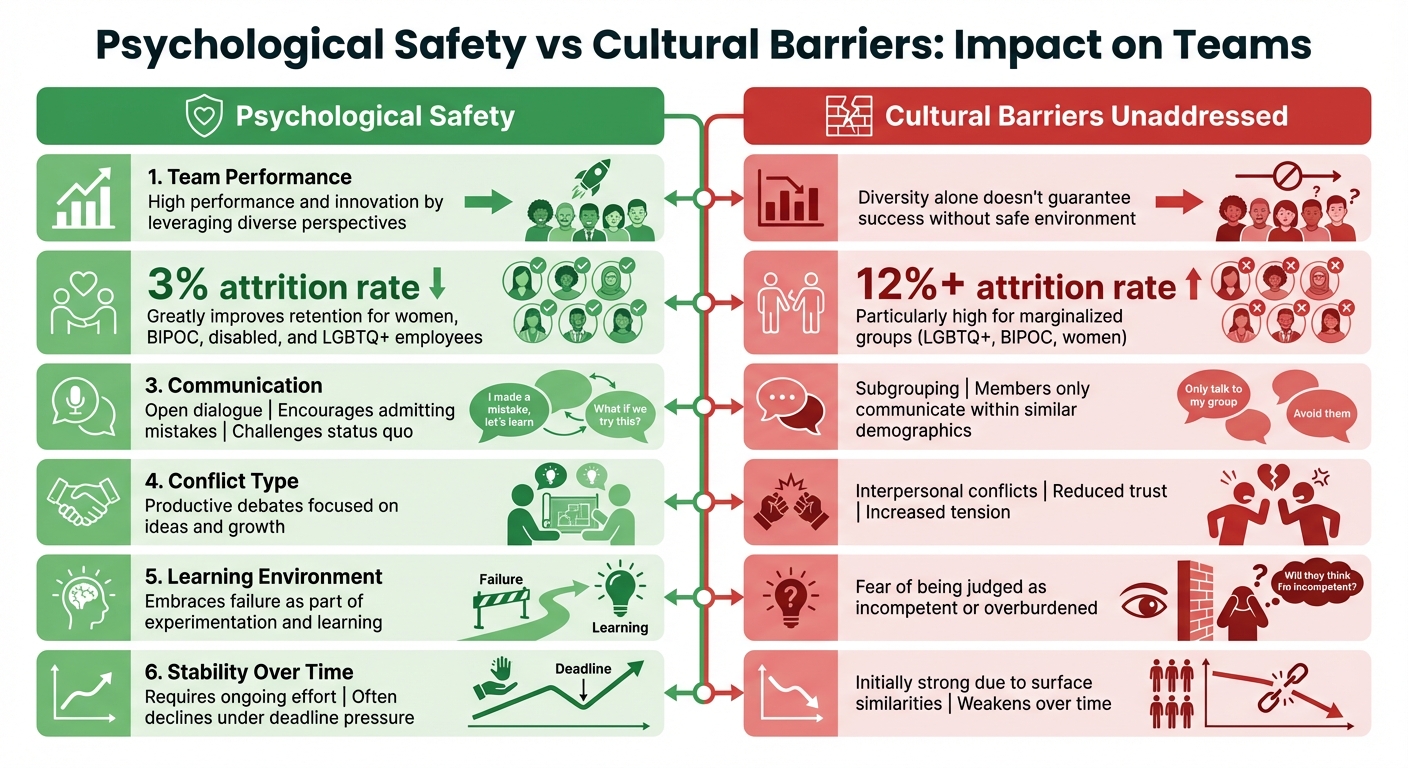
Psychological Safety vs Cultural Barriers: Impact on Team Performance and Retention
This section dives into the pros and cons of prioritizing psychological safety versus leaving cultural barriers unaddressed. By comparing these two approaches, it becomes clear why fostering psychological safety consistently benefits diverse teams.
| Aspect | Psychological Safety | Cultural Barriers (Unaddressed) |
|---|---|---|
| Team Performance | Sparks high performance and innovation by leveraging diverse perspectives [1][8]. | Diversity alone doesn’t guarantee success without a safe environment [1]. |
| Employee Retention | Cuts attrition to 3% and greatly improves retention for women, BIPOC, disabled, and LGBTQ+ employees [10]. | Leads to higher attrition (12%+), particularly for marginalized groups like LGBTQ+, BIPOC, and women [10]. |
| Communication | Promotes open dialogue, encourages admitting mistakes, and challenges the status quo [10]. | Results in subgrouping, where members only communicate within similar demographics [7]. |
| Conflict Type | Encourages productive debates focused on ideas and growth [10]. | Triggers interpersonal conflicts, reduced trust, and increased tension [7]. |
| Learning Environment | Embraces failure as part of experimentation and learning [10][7]. | Creates fear of being judged as incompetent or overburdened [7]. |
| Stability Over Time | Requires ongoing effort to sustain and often declines under deadline pressure [7]. | Initially strong due to surface-level similarities like age or ethnicity, but weakens over time [7]. |
The data paints a clear picture: psychological safety acts as a leveling force, allowing underrepresented groups to experience the same workplace satisfaction as their peers [10]. This dynamic not only boosts performance but also minimizes the harm caused by cultural barriers.
However, maintaining psychological safety isn’t without its hurdles. Research on 61 self-managed teams over five months revealed that psychological safety tends to decline as projects progress [7]. A single unsupportive team member can derail the environment, making it fragile and requiring consistent attention from leaders [7]. This is especially critical at a project’s midpoint, when teams often shift from a "learning" mindset to a "performance" mindset [7].
On the other hand, cultural barriers create immediate challenges. Teams with pronounced demographic divides report lower initial levels of psychological safety [7]. Without deliberate action, these divides persist, fostering silos that stifle collaboration and innovation.
Conclusion
Diversity alone doesn't guarantee success - it requires psychological safety to thrive. Without an environment where individuals feel comfortable voicing their thoughts, diverse teams may struggle to perform as well as more uniform ones [5][1]. Psychological safety acts as the bridge, transforming cultural differences from potential conflict into sources of creativity and innovation.
This highlights the critical role of leadership in fostering inclusivity. Leaders need to implement practices that value individuality, encourage open dialogue, and view mistakes as opportunities for growth [16][8]. As Amy C. Edmondson explains:
Diverse teams need the lubricant of psychological safety to ensure that their members ask questions and share ideas. Leaders... play a crucial role in nurturing psychological safety through framing, inquiry skills, and a capacity to step in to bridge different perspectives.
- Amy C. Edmondson [8]
Practical steps for leaders include scheduling meetings with cultural holidays in mind, creating judgment-free zones for language differences, and establishing norms that encourage learning from mistakes [5][17]. Regular one-on-one conversations that explore what matters most to each team member can also enhance psychological safety and promote open communication. The impact of such efforts was evident in a 2021 Sandoz study of over 7,000 employees, which showed improved speaking-up behaviors when these practices were implemented [16].
Programs like Tech Leaders demonstrate how combining technical expertise with leadership development can create environments where diversity thrives. Organizations that prioritize leadership training report significant benefits: employees are 64% more likely to view senior leaders as inclusive [13][18]. These programs emphasize skills like humility, sponsorship, and consultative leadership - areas that many organizations still overlook, with only 36% and 26% addressing these competencies, respectively [13].
Investing in leadership development isn't just a nice-to-have - it's a strategic move that drives retention, innovation, and team performance. For organizations navigating today's diverse workplace, creating a culture of psychological safety is essential to overcoming cultural barriers and unlocking the full potential of their teams. This approach ties together the importance of inclusivity and safety in every interaction.
FAQs
How can leaders create psychological safety while respecting cultural differences in diverse teams?
Leaders can help create psychological safety in diverse teams by focusing on trust, open communication, and respect for differences. It starts with fostering an environment where every team member feels comfortable sharing ideas without fear of judgment or exclusion.
To make this happen, leaders should actively seek input from everyone, recognize and respect cultural differences, and lead by example - whether that’s owning up to mistakes or asking for feedback. Setting clear expectations that diverse viewpoints are not just accepted but essential can also encourage collaboration and fresh thinking.
When leaders prioritize mutual respect and ensure all voices are included, they can navigate the complexities of cultural diversity while building stronger, more cohesive teams that perform better together.
How can organizations create a workplace that fosters psychological safety?
Creating a workplace where employees feel safe to express themselves without fear of judgment or repercussions is key to building psychological safety. Leaders are at the heart of this effort - they set the tone by promoting open communication, genuinely listening to concerns, and appreciating different perspectives. When leaders show empathy, provide feedback that’s constructive, and aren’t afraid to admit their own mistakes, they create a foundation of trust that strengthens team dynamics.
Some practical ways to nurture this environment include offering structured opportunities for employees to share their ideas, acknowledging individual contributions, and treating mistakes as chances to learn rather than failures. By fostering trust and ensuring everyone’s voice is heard, organizations can help employees feel respected and valued, paving the way for teams to thrive and fully leverage their diverse talents.
How do cultural differences affect team dynamics, and how can leaders address them?
Cultural differences influence how team members interact, work together, and view one another. These differences can sometimes lead to misunderstandings, miscommunications, or even feelings of being left out. When such issues go unaddressed, they can erode trust, stifle creativity, and hurt overall team performance.
One way to tackle these challenges is by focusing on psychological safety - creating an environment where everyone feels safe to share their ideas, ask questions, and challenge the status quo without fear of being judged. Leaders can promote this by encouraging open discussions, setting an example with inclusive behavior, and actively seeking input from a variety of perspectives. Leadership training that emphasizes cultural awareness and emotional intelligence can also help leaders bridge divides and build stronger connections within diverse teams.
When psychological safety and cultural understanding take center stage, teams can harness the strengths of their diversity, driving better collaboration, fresh ideas, and stronger outcomes.