

Q&A: Adapting Leadership for AI-Driven Change
AI is transforming leadership by reshaping industries, workflows, and decision-making. Leaders must now navigate a fast-paced, AI-driven environment while addressing human concerns and ethical challenges. Here's what you need to know:
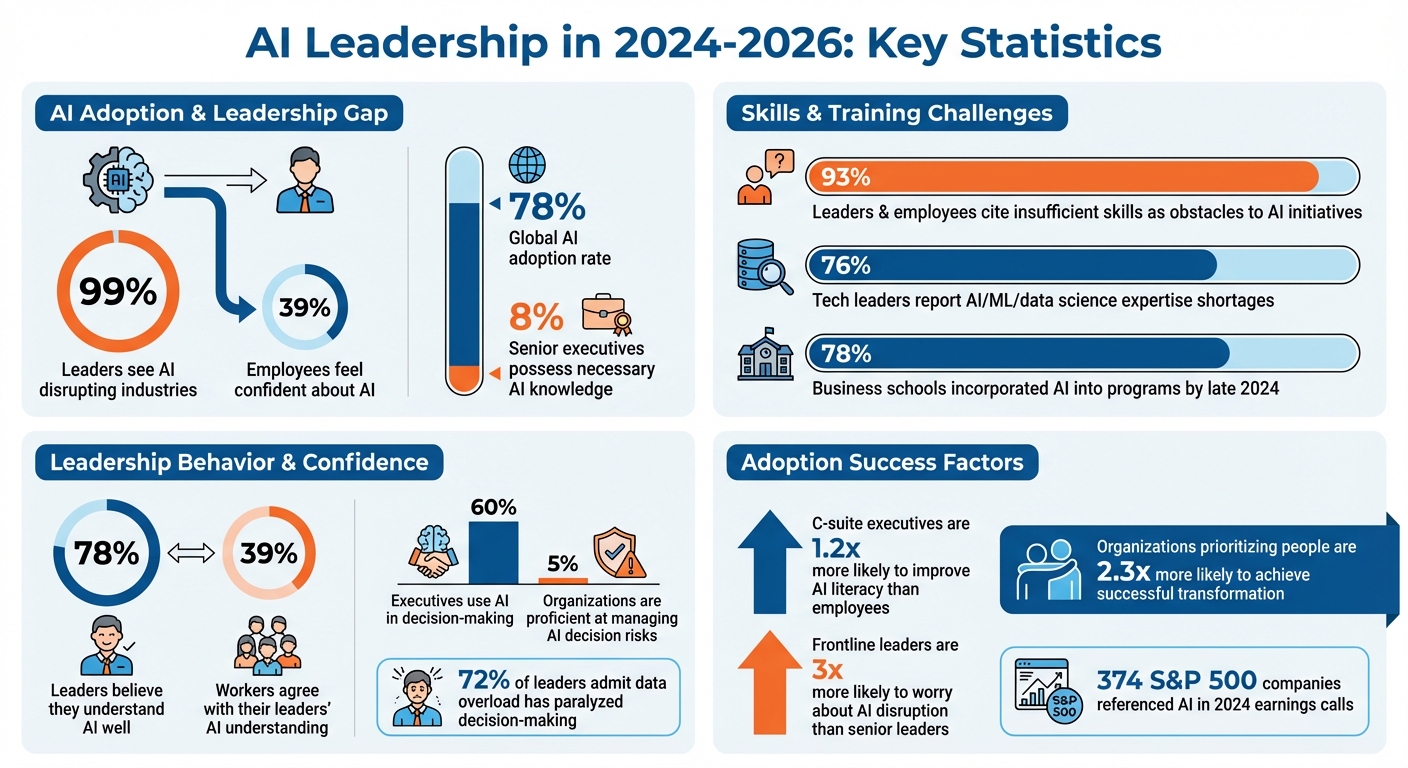
- AI Impact on Leadership: 99% of leaders see AI disrupting industries, but only 39% of employees feel confident about it. This disconnect creates pressure to align teams.
- Core Leadership Skills: Leaders need AI literacy, ethical decision-making, and the ability to manage continuous change effectively.
- AI-Ready Teams: Upskilling, integrating AI into workflows, and fostering experimentation are key to successful adoption.
- Human Judgment vs. AI: Leaders must balance AI insights with intuition, especially for high-stakes or ethical decisions.
The future of leadership requires blending technical knowledge with empathy and adaptability to guide organizations through constant change.
AI Leadership Statistics: The Gap Between Leaders and Employees
Core Skills for Leaders in the AI Age
AI Literacy and Technical Knowledge
Leaders today need a solid grasp of AI's capabilities, risks, and how it interacts with data. Yet, the numbers reveal a stark reality: only 8% of senior executives possess the necessary AI knowledge, even as global AI adoption has hit 78% [4][5].
Understanding the differences between AI types is key. For instance, generative AI can assist with tasks like drafting emails, while agentic AI handles more complex workflows, such as creating contracts or updating systems [5][6]. Leaders should also familiarize themselves with technical metrics like precision, recall, and model drift. This knowledge empowers them to critically evaluate AI systems and question claims from vendors.
"When you hear someone say, 'Our system is 90 percent accurate,' don't stop there. Ask, 'Accurate in what way? What about the other 10 percent - what kinds of mistakes does the system make?'" - Karim Lakhani, Professor, Harvard Business School [4]
Interestingly, C-suite executives are 1.2 times more likely than their employees to actively work on improving their AI literacy [6]. Supporting this trend, 78% of business schools had incorporated AI into their programs by late 2024 [5]. This technical foundation not only improves decision-making but also lays the groundwork for addressing ethical challenges in AI usage.
Ethical Decision-Making in AI Use
The focus has shifted from asking "Can we use AI for this?" to "Should we?" Leaders are now responsible for ensuring AI systems promote fairness, privacy, and transparency [8].
"AI reflects the data you feed it, the incentives you design, and the questions you ask." - TimesPro [8]
To uphold these values, leaders should implement regular bias audits and embed ethical reviews throughout the AI project lifecycle [8]. Another crucial step is fostering an environment where employees feel safe questioning AI outputs or raising concerns about compliance and reputational risks [6]. This isn't just about creating a positive work culture - it’s a practical necessity to prevent small errors from escalating into large-scale issues. As ethical oversight becomes a core part of operations, leaders must rethink their management strategies to fit this AI-driven landscape.
Change Management and Flexible Leadership
AI isn’t a one-time shift - it’s a continuous process of adaptation. Leaders must embrace what experts call "rapid recalibration", meaning they adjust decisions quickly while maintaining transparency and trust [3]. This approach moves away from rigid strategies, focusing instead on shared principles and clear intent.
"Leaders need to slow down their judgment precisely when everything around them is speeding up." - Michael G. Jacobides, Professor of Strategy, London Business School [3]
As AI speeds up execution, leaders need to pause and question assumptions, considering the broader impact of their decisions [3]. Take GE Healthcare’s example from 2025: they scaled AI learning to about 50,000 employees using microlearning "sprints" - six-week programs with daily prompts. This method proved far more effective than traditional one-off training sessions [6][7]. Integrating these short, focused learning opportunities into daily workflows helps reinforce both technical skills and ethical awareness.
Leaders should also pay close attention to "small data" signals, such as team hesitation or disengagement, which can indicate misalignment with AI before the problem shows up in metrics [3]. Frontline leaders, who are 3 times more likely than senior leaders to worry about AI disruption, are often the first to spot these issues [7]. Addressing these concerns early can help ease transitions and keep teams aligned.
sbb-itb-8feac72
Building AI-Ready Teams
Promoting Continuous Learning and Upskilling
The skills gap in AI-related fields is a growing challenge. A striking 76% of technology leaders report facing shortages in AI, machine learning, and data science expertise within their teams [10]. Even more concerning, 93% of leaders and employees cite insufficient skills and training as major obstacles to advancing AI initiatives [11].
To address this, leaders must invest in ongoing training programs that focus on building "AI fluency." This includes foundational skills like problem decomposition - breaking down complex tasks into manageable steps for AI - and quality evaluation, which involves assessing AI output against established standards [13][16].
Cross-functional learning programs can be particularly effective, especially when they allow teams to experiment in low-stakes environments before scaling up [2]. One idea is to implement "AI Open Hours", where team members can share their experiences, including successes, mistakes, and lessons learned. This collaborative approach not only reduces the isolation that often accompanies learning new technologies but also accelerates confidence-building. With these skills in place, teams are better equipped to improve existing processes and deploy AI more effectively.
Adding AI to Existing Workflows
Once teams develop a baseline understanding of AI, the next step is integrating these skills into everyday work. Start by identifying the most inefficient or repetitive tasks - like data entry, scheduling, or report formatting. Automating these tasks can deliver quick wins and build momentum for broader AI adoption [16].
Workflow mapping is a useful tool here. By visually mapping out team processes, leaders can pinpoint bottlenecks and identify tasks that are repetitive, time-consuming, or add limited value [13]. From there, run 30-day pilot programs with clear goals and built-in "kill switches" to manage risks without stalling progress [14]. This approach shifts the focus from job titles to specific tasks, helping teams see AI as a tool that complements their work rather than replacing it [15].
It's also important to manage expectations after AI is introduced. Avoid overburdening employees with additional responsibilities. Instead, adjust performance metrics to reward outcomes rather than effort [12]. When employees view AI as a way to enhance their work rather than as a means to extract more productivity, adoption tends to happen more naturally. By refining workflows and encouraging an experimental mindset, teams can fully embrace AI's potential.
Creating a Culture of Experimentation
Training and workflow adjustments are essential, but fostering a culture of experimentation is what truly prepares teams for AI. There's often a disconnect between leadership and employees: while 78% of leaders believe they have a solid grasp of AI, only 39% of workers agree [2]. This gap becomes even more problematic when leaders fail to visibly adopt and experiment with AI themselves.
"AI integration is a leadership challenge. Not a technology challenge."
- CEO & Founder, Business Builders [16]
Leaders must set the tone by using AI in their own work and openly discussing both its advantages and limitations. This creates "social proof" and encourages teams to follow suit [1]. Leadership roles need to evolve from being purely decisive to being more exploratory - embracing curiosity, collaboration, and adaptability over rigid top-down management [17].
Addressing employee fears is also crucial. If team members see AI as a threat to their jobs, resistance is inevitable [16]. Leaders can ease these concerns by framing AI as a "thinking partner" during meetings, using it to generate ideas, evaluate risks, or draft plans [15]. When failure is viewed as a chance to learn rather than a career setback, teams feel safer experimenting and innovating [12]. Finally, focus on teaching transferable skills that apply across different AI platforms. While tools may evolve, the ability to recognize where AI can add value will remain a vital asset [13].
The Real Challenge of AI: Leadership, Adaptability, and the Human Factor | AI Business Symposium
Combining AI Insights with Human Judgment
As organizations embrace AI, blending its analytical capabilities with thoughtful human judgment becomes a critical strategy for navigating change effectively.
When to Choose Human Judgment Over AI
AI excels at identifying historical patterns but struggles with weak signals or entirely new scenarios. This is where leaders must step in - especially when facing high-stakes decisions that are unprecedented or carry significant risks [20]. These moments call for human intuition, the ability to imagine alternatives, and the willingness to make bold decisions that AI cannot foresee.
The nature of the decision itself also dictates the need for human involvement. Take irreversible "one-way door" decisions, for instance - choices that are difficult or impossible to undo. These require careful human evaluation rather than relying on automated speed [19]. Similarly, moral and ethical dilemmas demand empathy and a nuanced understanding of social context, areas where data-driven algorithms fall short [18][19].
A helpful framework for decision-making involves categorizing decisions into three types:
- Tier A: Routine, predictable decisions suitable for automation.
- Tier B: Uncertain or evolving decisions that benefit from human-AI collaboration.
- Tier C: High-stakes, novel decisions where human judgment takes the lead, with AI offering support.
Interestingly, while 60% of executives use AI in their decision-making processes, only 5% of organizations consider themselves proficient at managing the risks associated with AI-driven decisions [19]. Striking the right balance between AI insights and human intuition depends on clear accountability structures.
Maintaining Accountability in AI-Driven Decisions
While AI can provide speed and efficiency, accountability remains a human responsibility. In high-stakes situations, leaders must own the outcomes of AI-driven processes. One way to ensure this is by requiring a one-page written rationale whenever a leader overrides an AI recommendation. This document should outline the hypothesis, evidence, constraints, and learning plan [20]. Such practices promote transparency and create a record for refining future decisions.
"The moment AI enters the workflow, the real question isn't 'What does the model say?' It's 'Who gets to disagree with it, and how fast?'"
- Leader at Liberty Mutual Insurance [19]
Another strategy is to allocate "gamble budgets", setting aside 5–10% of resources for human-led experiments that don’t rely on traditional ROI metrics [20]. This allows leaders to explore unconventional ideas that AI might dismiss due to a lack of historical data. Additionally, keeping a log of human-AI disagreements can help identify patterns where human oversight adds the most value [19][20].
With 72% of leaders admitting that data overload has sometimes paralyzed their decision-making [19], establishing clear accountability systems is more important than ever. These measures ensure that AI remains a tool to enhance decision-making, not a replacement for human responsibility.
How Tech Leaders Supports AI Leadership Development
Navigating AI-driven transformation is a shared effort, and Tech Leaders provides the tools to make that journey smoother. Through its leadership training and entrepreneurship programs, the platform helps bridge the gap between technical expertise and the leadership skills needed in the AI era. With a community of over 6,500 tech leaders from startups, SMBs, and non-profits, Tech Leaders connects individuals who are tackling similar challenges [21].
The focus here isn’t just on technical execution - it’s about fostering a deep understanding of AI’s strategic potential, risks, and business outcomes [4]. Leaders are encouraged to become “orchestrators,” skillfully dividing tasks between human talent and AI agents [22]. This approach ties directly into the leadership skills necessary for successfully integrating AI into business operations.
To help leaders balance technical know-how with management skills, Tech Leaders offers tailored programs designed to strengthen leadership in an AI-driven environment.
Engineering Leadership Training for the AI Era
Tech Leaders redefines leadership for the AI age by focusing on "Integrated Skills." These skills combine technical knowledge with human capabilities like domain expertise, systems architecture, creative problem-solving, and mentorship [22]. Instead of being the person who builds everything, leaders are trained to act as strategic captains, effectively managing both human and AI resources [22].
A great starting point is the AI Readiness Assessment - a quick, free diagnostic tool that evaluates your AI Maturity Level (from L1 to L5) and provides a tailored roadmap for adoption and ROI [21]. This tool delivers instant insights, showing where you stand and what steps to take next. From there, you can dive into training modules and use strategic planning tools available on the platform. For a more structured approach, the AI Skills Operating System™ Guide offers a detailed framework to help you systematically develop your AI-related skills [21].
Entrepreneurship and AI Business Strategy Programs
These programs address the gap between technical expertise and strategic leadership, equipping leaders to turn their knowledge into actionable business strategies. Weekly workshops, such as "Go Beyond ChatGPT with AI Workflows", teach participants how to create MVPs in a matter of days instead of months [21]. These live sessions feature practical demos and Q&A opportunities, ensuring you leave with actionable insights.
Additionally, the programs guide you in identifying the top three workflows to prioritize, helping you focus on areas that deliver immediate and measurable results [21].
Peer Masterminds and Personalized Coaching
Tech Leaders goes beyond traditional learning by offering Strategic Leadership Sessions, which provide one-on-one coaching to enhance your leadership skills and improve team communication during AI transitions [23]. As Brad Schwartz, a Tech Leaders Coach, explains:
"You don't have to navigate this journey alone - let's collaborate to unlock your leadership potential and enhance open communication within your team." [23]
The platform also fosters a sense of community through its network of over 6,500 members. This peer group offers a space for collaborative learning, where you can exchange ideas and insights with others facing similar challenges. By combining expert coaching with real-world perspectives from peers, Tech Leaders creates a supportive environment for leaders adapting to AI-driven changes.
Conclusion
Final Thoughts on Leadership Evolution
The rise of AI is reshaping what it means to lead, setting a new bar for excellence. As Jazz Croft and colleagues from Harvard Business Review observed: "AI does not diminish the role of leadership, it raises the standard for it" [25]. It’s not about leaders moving faster but about staying grounded and focused as the pace of change accelerates [3].
To succeed in this environment, leaders will need three key abilities: the capacity to recalibrate quickly, the wisdom to exercise reflective judgment, and the empathy to lead with a human touch [3]. These aren’t just desirable traits - they’re essential for navigating an era of constant disruption, where change is the norm rather than the exception [25].
Statistics back this up. While 374 S&P 500 companies referenced AI in their 2024 earnings calls [9], a 2026 survey revealed that 93% of AI and data leaders saw human factors - not technology - as the main obstacle to adoption [25]. Organizations that prioritize people are 2.3 times more likely to achieve successful transformation [24]. This underscores the importance of redesigning workflows, fostering psychological safety, and cultivating curiosity. In the end, the ability to connect with people often outweighs the sophistication of the tools at hand.
Michael, an Executive Coach, summed it up perfectly:
"The test is not how fast a leader acts, but whether they can explain their actions, adjust without losing credibility, and maintain humanity amid acceleration." [3]
Leaders who carve out time for reflection, use AI transparently to encourage shared learning, and remain attuned to the human elements that algorithms miss will stand out. The strongest leaders don’t just adapt - they embrace uncertainty, stay present, and guide their teams with a mix of technical expertise and emotional intelligence.
FAQs
How can I quickly raise my AI literacy as a leader?
To get up to speed with AI, start by learning how it’s used strategically, what it does well, and where its limits lie - no need to dive into coding. You can build your knowledge by engaging with professionals from various sectors, including industry leaders, startups, and regulatory experts. Stay informed about AI advancements and be ready to adjust to the changes it brings. These skills will empower you to make smarter decisions in today’s rapidly evolving business environment.
What’s a simple way to start using AI in my team’s workflows?
Start by weaving AI tools into your current workflows instead of trying to reinvent the wheel all at once. Begin with small pilot projects to test concepts, and concentrate on achieving measurable results that benefit both your business and your customers. Leaders don't need to be tech experts to make this work. Instead, focus on strong business insight, effective collaboration across teams, and managing change to ensure AI tools seamlessly integrate into everyday operations.
When should leaders override AI recommendations?
Leaders must step in and override AI recommendations when trust in the output is uncertain, even if the results seem technically correct. Rely on your judgment and weigh critical factors such as the broader context, ethical considerations, and potential risks before fully depending on AI-generated insights.