
Regional AI Fairness Laws: Key Differences
Artificial intelligence regulations are evolving rapidly, with major regions taking distinct approaches to address bias, transparency, and accountability. Here's a quick breakdown:
- European Union (EU): The EU AI Act is a risk-based framework with strict requirements for high-risk AI systems. Penalties can reach up to €35 million (around $38 million) or 7% of global annual turnover. Enforcement begins in 2026.
- United States (US): The US lacks a unified federal law, relying on state-specific rules and federal agency oversight. Penalties vary widely, with Colorado imposing fines of up to $20,000 per violation.
- China: A centralized model enforces strict controls, requiring AI systems to be registered and compliant with content regulations. Fines can reach 5% of annual revenue or higher.
Multinational companies face challenges navigating these diverse frameworks. Many adopt the "Brussels Effect" strategy, aligning with the EU's stringent standards as a baseline while addressing local requirements in the US, China, and other regions. This approach simplifies compliance across jurisdictions but demands robust documentation and oversight to avoid penalties.
AI Fairness Laws Comparison: EU vs US vs Asia Regulations 2026
Understanding AI Regulations Across the World | Experts Share All
sbb-itb-8feac72
1. EU AI Act
The EU AI Act establishes a robust framework aimed at creating a fair and transparent AI ecosystem. It operates through a three-tier oversight system: the EU AI Office at the Commission level, National Competent Authorities in each Member State, and Notified Bodies that independently audit high-risk AI systems [5]. This setup gives national authorities the power to access source code, carry out surprise on-site inspections, and even demand the removal of non-compliant AI systems from the market.
Scope of High-Risk AI Definitions
The Act defines high-risk AI systems across eight key categories: biometrics, critical infrastructure, education, employment (hiring and promotion), essential services like credit scoring and insurance, law enforcement, migration, and the administration of justice [5]. Additionally, any AI system that conducts profiling of individuals is automatically classified as high-risk. Safety components in products such as medical devices or aviation systems, which require third-party conformity assessments, also fall under this category [8].
Bias Testing Requirements
According to Article 10, providers must ensure that their training, validation, and testing datasets are "relevant, representative, error-free, and up to date" [5]. This includes documenting bias testing and mitigation measures before deployment. Tools like Chi-squared (χ²) and Kolmogorov–Smirnov (KS) tests are examples of methods used to identify algorithmic bias. The Act also requires providers to maintain a 10-year audit trail that includes technical documentation, training data lineage, and records of bias mitigation efforts [5]. A Global AI Governance Practice Lead at Pertama Partners noted:
"Documentation is the universal currency of AI compliance: without clear records of design, testing, and oversight, regulators will assume you did nothing" [5].
These stringent requirements set the stage for rigorous enforcement.
Enforcement Mechanisms
The Act outlines several ways to enforce compliance. Actions can be initiated through individual complaints, "serious incident" reports (which must be filed within 15 days), proactive market audits, and whistleblower reports protected under Article 87. Prohibited AI practices, such as social scoring, will be enforceable starting February 2, 2025, while obligations for high-risk AI systems come into effect on August 2, 2026 [7].
Penalties
The Act imposes heavy financial penalties for violations. Fines can reach up to €35 million (approximately $38 million) or 7% of global annual turnover for prohibited practices. High-risk violations carry penalties of €15 million or 3% of turnover, while providing misleading information to authorities can result in fines of €7.5 million or 1.5% of turnover. For smaller businesses and startups, penalties are calculated as the lower of the fixed euro amount or the corresponding turnover percentage [7]. Legalithm has pointed out that these penalties surpass even those under the GDPR, making them some of the most severe regulatory fines to date [7].
2. US AI Regulations
In contrast to the European Union's cohesive approach, the U.S. relies on a mix of state laws, federal guidelines, and civil rights statutes to regulate AI. There’s no overarching federal law governing AI, leaving enforcement to agencies like the FTC and EEOC. The FTC uses Section 5 of the FTC Act to address "unfair or deceptive" AI practices, while the EEOC enforces Title VII and the ADA in cases of AI-driven employment discrimination [9][10]. This patchwork system results in varying definitions and rules across different states.
Scope of High-Risk AI Definitions
States vary widely in how they define and regulate high-risk AI. For example, Colorado’s AI Act targets systems that significantly influence areas like education and healthcare. Meanwhile, California’s SB 53 focuses on advanced AI models, such as those trained with over 10^26 FLOPs. It mandates quarterly catastrophic risk assessments and requires incidents to be reported within 15 days [2][10][11][12]. These differing state-level standards force companies operating across multiple jurisdictions to manage complex compliance requirements.
Bias Testing Requirements
Bias testing rules also differ from state to state. In New York City, Local Law 144 mandates annual independent bias audits for automated employment decision tools. These audits must include calculations of selection rates and impact ratios for different demographic groups [13][14]. The EEOC applies the "four-fifths rule", which flags potential discrimination if a protected group’s selection rate is less than 80% of the highest-performing group [14]. A notable case occurred in August 2023, when iTutorGroup, Inc. settled for $365,000 after its hiring software automatically rejected female applicants over 55 and male applicants over 60, impacting more than 200 individuals [14].
Enforcement Mechanisms
Enforcement of state AI laws typically falls under the authority of State Attorneys General, with violations often treated as deceptive trade practices [2][10]. However, some laws, like Illinois’ HB 3773 and New York City’s Local Law 144, allow private individuals to sue for AI-related harms [10][12]. Adding to this landscape, a December 2025 Executive Order (EO 14365) created a DOJ AI Litigation Task Force to challenge state laws deemed overly restrictive or conflicting with federal policies [10][11]. Recent audits have also led to a more proactive approach to investigations [12].
Penalties
Penalties for AI violations in the U.S. vary significantly by state and are generally less severe than those in the EU. For instance, New York City’s Local Law 144 imposes fines of $500 for a first violation and $500–$1,500 for subsequent daily violations [11][12]. Colorado’s AI Act allows penalties of up to $20,000 per violation, while Texas’ TRAIGA fines range from $10,000 to $200,000 per violation. California’s SB 53 has the highest penalties, with fines reaching up to $1 million per violation for developers of advanced AI systems [11][12]. These diverse penalties underscore the challenges companies face in navigating compliance across multiple states.
3. Asia's AI Frameworks
Asian nations have traditionally leaned on voluntary guidelines and soft law to manage AI, contrasting sharply with the EU's centralized model and the fragmented, state-level approach seen in the U.S. But things began to shift in 2026. South Korea introduced its AI Framework Act in January, while Vietnam enacted Law No. 134/2025 in March, becoming the first Southeast Asian country with binding AI legislation [15]. Japan and Singapore, while still favoring flexible, innovation-friendly approaches, are beginning to adopt mandatory rules for high-risk AI applications [15]. Like the EU and the U.S., Asia shares concerns about algorithmic bias but tailors its frameworks to fit local industries and cultural dynamics. For multinational companies, these varied frameworks create a complex landscape requiring careful adaptation to meet different regulatory demands.
Scope of High-Risk AI Definitions
South Korea defines "high-impact AI" by evaluating its effects on life, safety, and fundamental rights across 11 key areas, including healthcare, education, financial services, and public administration [15]. Vietnam, on the other hand, uses a three-tier risk classification - high, medium, and low - and mandates conformity assessments for high-risk systems [17]. China takes a different route by categorizing AI based on technology type, with a particular focus on algorithms and deep synthesis technologies [1]. These varied definitions directly shape how enforcement is carried out across the region.
Enforcement Mechanisms
Enforcement mechanisms vary widely across Asia. In South Korea, the National AI Committee, which reports directly to the President, and the Ministry of Science and ICT oversee compliance through investigations and corrective actions [15]. Japan's AI Strategy Headquarters, chaired by the Prime Minister, coordinates AI policy across ministries but relies on existing laws like the Act on the Protection of Personal Information (APPI) for enforcement. Violations under the APPI can incur penalties of up to ¥100 million [15]. Singapore takes a softer approach with voluntary frameworks supported by the AI Verify Foundation's open-source tools, which aim to encourage fairness and transparency [15]. For global businesses, these differences mean developing country-specific compliance strategies is essential.
Bias Testing Requirements
Bias testing is a key component of these frameworks, with each country taking its own approach. Singapore's AI Verify toolkit assesses bias using metrics like demographic parity and equalized odds [15]. South Korea mandates impact assessments for high-impact AI to minimize bias and ensure human oversight [15]. In China, algorithm regulations require providers to demonstrate fairness and non-discrimination in their recommendation logic, though enforcement is more focused on content control [1]. These varying requirements compel multinational companies to adopt localized validation processes to meet each country's standards.
Penalties
Penalties for non-compliance in Asia are generally less severe than those in the EU but still vary significantly by country. In South Korea, fines can reach up to 3% of relevant revenue, with administrative penalties for transparency failures capped at 30 million Korean won (around $20,300) [17]. China imposes stricter penalties, including fines of up to 10% of revenue or 50 million RMB, and severe violations can result in imprisonment for up to seven years [18]. Singapore's voluntary framework is supported by the Personal Data Protection Act (PDPA), which can levy fines of up to SGD 1 million or 10% of annual turnover for personal data breaches [16]. Japan's APPI allows for penalties as high as ¥100 million for violations involving AI data processing [15]. Overall, while Asian penalties are less harsh than those in the EU, they still present significant risks for non-compliance.
Pros and Cons
This section dives into the strengths and challenges of different regional approaches to AI regulation, building on the regulatory details discussed earlier.
Each region has its own take on AI fairness, offering distinct benefits and hurdles. The EU's framework provides a clear, unified set of rules across its member states, simplifying compliance for companies operating within the bloc. However, its strict regulations - such as penalties that can reach up to €35 million or 7% of global turnover - can be daunting for smaller businesses [1]. The EU's centralized-decentralized model, where the European AI Office oversees general-purpose AI and national authorities handle other systems, ensures consistency but also creates a multi-layered enforcement structure [1].
The US, on the other hand, adopts a fragmented, sector-specific approach. This allows for flexibility and fosters innovation, avoiding rigid, one-size-fits-all regulations. But with all 50 states introducing AI laws by 2025, businesses face a patchwork of compliance requirements. Federal agencies like the FTC and EEOC enforce rules through existing consumer protection laws, while state attorneys general impose varying penalties [1]. FTC Chair Lina Khan highlighted this balance:
"America's approach is about enabling innovation while addressing real risks - without stifling the entrepreneurial ecosystem" [3].
Asia presents a mixed picture, with significant variations between countries. In China, the Cyberspace Administration of China (CAC) enforces a centralized registration model, ensuring clear oversight. However, its focus leans heavily on controlling content and promoting core socialist values, diverging from Western priorities like bias testing. Meanwhile, Japan and Singapore rely more on voluntary measures and reputational incentives. Japan employs a "naming and shaming" strategy instead of fines [4], while Singapore uses voluntary frameworks supported by open-source tools to encourage innovation, though enforcement is less rigorous [15].
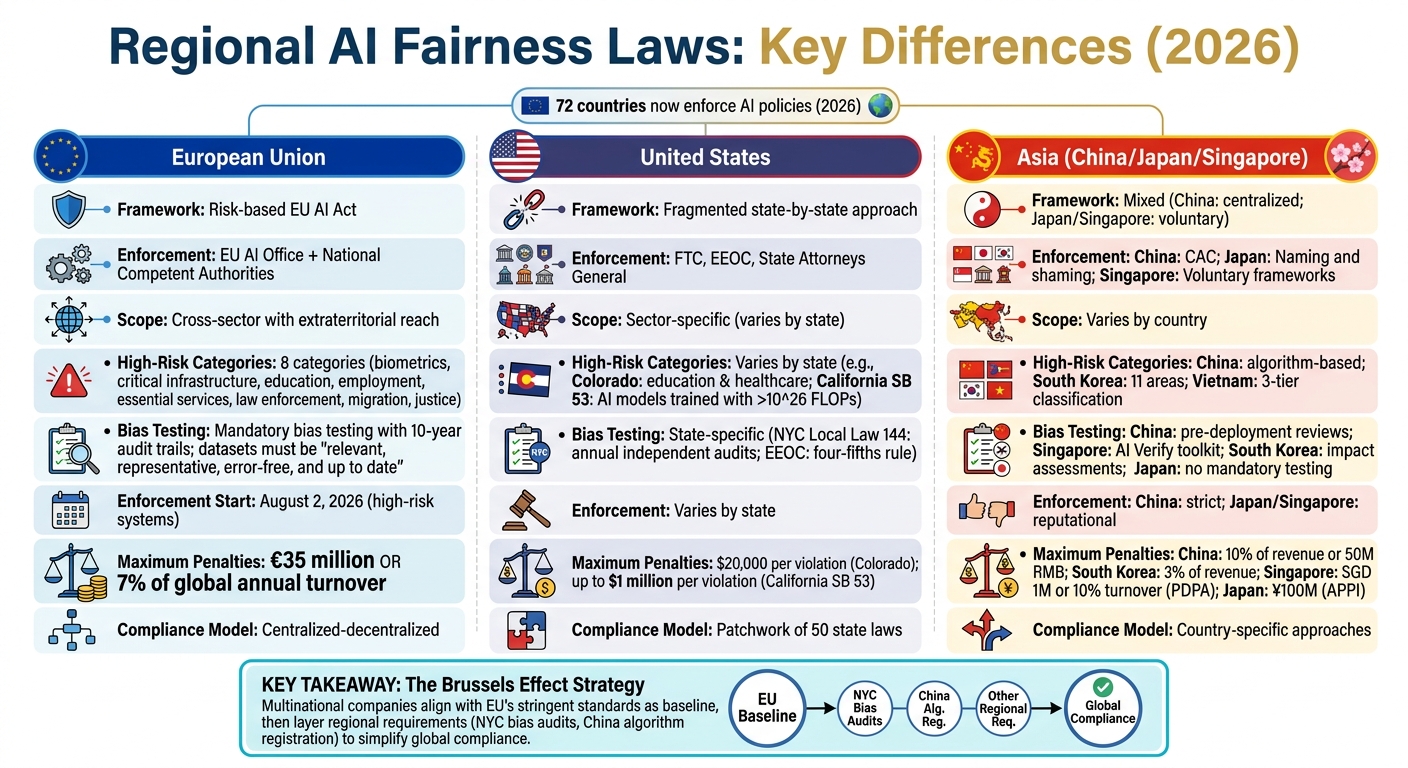
| Feature | European Union | United States | Asia (China/Japan/Singapore) |
|---|---|---|---|
| Enforcement Mechanism | EU AI Office and National Authorities | FTC, EEOC, and State Attorneys General | China: CAC; Japan: Naming and shaming; Singapore: Voluntary frameworks |
| Scope | Cross-sector with extraterritorial reach | Sector-specific (e.g., Finance, Health) | Varies by country (China: prescriptive; Japan/Singapore: voluntary) |
| Bias Testing | Rigorous bias testing for high-risk systems | State-specific measures (e.g., NYC bias audits) | China: Pre-deployment reviews; Japan/Singapore: No mandatory bias testing |
| Maximum Penalties | Up to €35M or 7% of global turnover | For example, $20,000 per violation in Colorado | China: 5% of revenue plus license revocation; Japan/Singapore: Primarily reputational sanctions |
Given these regional differences, multinational companies face a challenging compliance landscape. To address this, many adopt the "Brussels Effect" as a practical strategy: they align with the EU AI Act's standards as a global baseline, then layer on regional requirements like NYC's bias audits or China's algorithm registration. This approach simplifies compliance while ensuring access to diverse markets [3].
Compliance for Multinational Organizations
Operating across multiple jurisdictions presents what experts call the "Regulatory Trilemma" - juggling the EU's risk-based framework, the US's fragmented state-by-state approach, and China's centralized registration model [5]. Global companies face the challenge of adhering to all these frameworks simultaneously. As Abhishek G Sharma, CEO of Move78 International, explains:
"If you serve both EU and US markets, you don't choose one regime. You comply with both." [2]
This extraterritorial reach means companies must align their AI systems globally, regardless of where their servers are located. For example, the EU AI Act applies to any company with AI systems used or marketed in the EU, while China's regulations follow a similar extraterritorial logic. A U.S. company serving European customers must meet EU standards, no matter where its servers reside [2][19][21]. This global reality is pushing businesses toward adopting uniform compliance measures, often through the "Brussels Effect" strategy.
The "Brussels Effect" strategy involves building a universal governance program based on the EU AI Act's stricter standards and then layering on specific jurisdictional requirements. These might include NYC's bias audit requirements or China's mandatory algorithm registration [2][5].
To make this strategy work, companies are implementing robust documentation and assessment processes. Key practices include maintaining Model Cards (which outline an AI system's purpose and limitations), conducting Fundamental Rights Impact Assessments (FRIA) for high-risk systems, and keeping detailed audit trails [5][20]. Many organizations are also establishing cross-functional AI governance committees. These committees bring together legal, risk, data science, and business representatives to ensure accountability, with clear system owners assigned for each significant AI system.
Leadership training is another critical component in managing this complex compliance landscape. Programs like Tech Leaders' AI business strategy training help executives understand the fiduciary responsibilities and strategic risks of deploying AI across multiple jurisdictions [20]. With over 50 jurisdictions now enforcing AI regulations - covering 70% of global GDP [6] - the period between 2026 and 2027 is expected to be pivotal as major laws take full effect [5][4]. Companies that fail to prepare risk steep penalties, ranging from $20,000 per violation in Colorado [2] to as much as 7% of global turnover under EU rules [5].
Conclusion
By 2026, the world of AI regulation is defined by three main approaches: the EU's risk-based and detailed framework, the US's varied state-level rules, and China's centralized registration system [5]. With 72 countries now enforcing some form of AI policy [4], it's clear that the era of optional ethical guidelines is behind us. For international organizations, this means navigating a web of overlapping rules and standards across different jurisdictions.
For businesses operating globally, using the EU AI Act's rigorous standards as a foundation and layering on specific local requirements can streamline compliance efforts. This approach reduces the complexity and cost of managing multiple regulatory systems. However, success hinges on maintaining clear documentation. As one expert in global AI governance noted, “Without clear records of design, testing, and oversight, regulators will assume you did nothing” [5]. To meet these expectations, organizations should establish concise audit trails and assign clear accountability for every major AI implementation.
The period leading up to August 2, 2026 - when the EU AI Act's high-risk provisions become enforceable [4] - is a crucial window for preparation. As regulatory demands grow, leadership training becomes indispensable. Programs like Tech Leaders' AI business strategy training equip executives with the knowledge to bridge the gap between technical execution and regulatory requirements. This ensures they understand both the strategic risks and fiduciary responsibilities tied to deploying AI across borders.
The regulatory environment will keep shifting, especially with the rise of autonomous, agent-driven AI systems [4]. These regional variations highlight the importance of treating compliance as an ongoing, strategic effort rather than a one-time task. Organizations that prioritize this approach can navigate the complexities effectively while earning the trust of users, regulators, and stakeholders in every market they serve.
FAQs
Does the EU AI Act apply to my company if we’re based outside Europe?
Yes, the EU AI Act applies to your company if your AI system is either:
- Placed on the EU market
- Put into service within the EU
- Or if its output is used in the EU
This holds true no matter where your company is based or incorporated.
What’s the fastest way to comply across the EU, US states, and China at once?
To efficiently navigate compliance across the EU, various US states, and China, consider a layered strategy. Start with the EU AI Act, which serves as a strong foundation due to its global influence and risk-based framework. From there, tailor your approach to meet state-specific regulations in the US and China’s unique requirements, such as data localization and adherence to ethical standards. This method helps ensure alignment with diverse legal frameworks while reducing potential compliance gaps.
What documentation do regulators expect to prove AI fairness and bias testing?
Regulators often demand specific documentation to verify efforts in addressing AI fairness and bias testing. This typically includes compliance reports, risk assessments, bias testing results, and transparency disclosures. These documents are critical for showcasing accountability and ensuring that organizations meet regional regulatory standards.