

How Regulatory Compliance Impacts Leadership
Regulatory compliance is no longer optional - it’s a leadership priority. Failing to meet regulations can lead to massive fines, failed deals, and reputational harm. Leaders must now integrate compliance into decision-making, balancing innovation with legal obligations.
Key insights:
- Non-compliance costs are skyrocketing: Fines reached $19 billion in 2024, and GDPR penalties alone surpassed $4.75 billion.
- Leadership accountability is growing: Laws like the EU Digital Markets Act require compliance officers at the board level.
- Compliance affects business strategy: Recent cases like Adobe’s failed Figma acquisition and Microsoft’s restructured Activision Blizzard deal show the direct impact of regulations on major decisions.
- Proactive compliance saves money: Retrofitting compliance costs $56,000+ per AI model annually, while upfront governance reduces violations and operational risks.
To succeed, leaders must treat compliance as a strategic tool, embedding it into daily operations, training, and innovation processes. This shift not only mitigates risks but also builds trust and supports long-term growth.
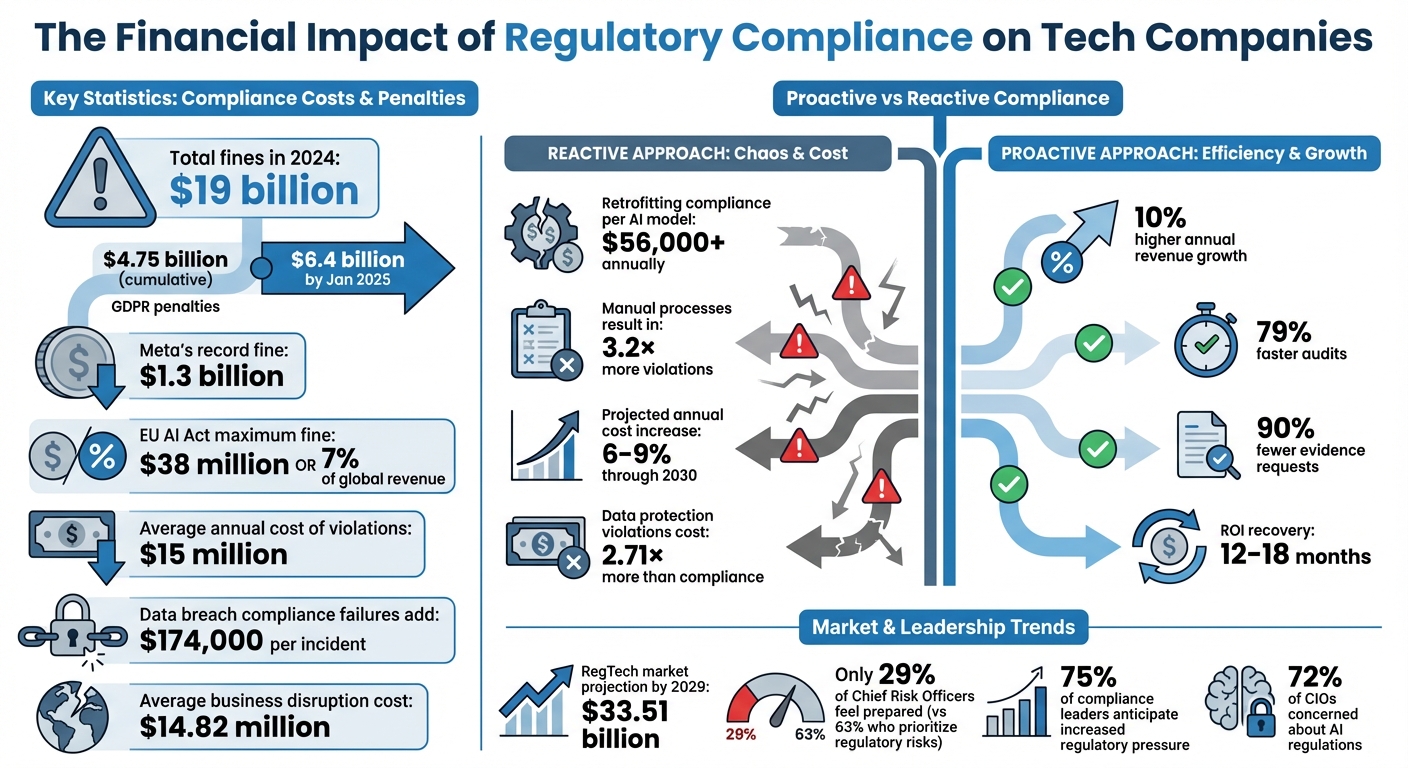
The Financial Impact of Regulatory Compliance on Tech Companies in 2024-2025
Strategies for Creating a Strong Compliance Culture
sbb-itb-8feac72
The Leadership Compliance Challenge
Regulatory compliance is reshaping how leaders make decisions, forcing them to balance pushing boundaries with staying within the rules. The old "move fast and break things" mindset has become a liability, risking hefty fines and lost competitive edge.
This shift demands a fresh approach to innovation. As Archit Sood, Product Manager, explains:
"The shift isn't from moving fast to moving slow. It's from moving deliberately and building trust."[5]
In simpler terms, compliance shouldn't be seen as a roadblock. Instead, it's like an "architecture upgrade" that encourages organizations to design systems that are both resilient and transparent from the beginning.[5]
Innovation vs. Regulatory Requirements
The tension between innovation and regulation plays out in everyday decisions - whether it's launching products, developing features, or forming partnerships. Leaders must find a way to balance their teams' drive for rapid experimentation with the ever-changing regulatory landscape.
The cost of getting this balance wrong can be steep. Retrofitting compliance into an AI model after deployment costs over $56,000 annually per model, far more than building governance into the process from the start.[6] Organizations relying on manual compliance processes face 3.2 times more violations and are projected to see a 6–9% annual cost increase through 2030.[6]
Forward-thinking leaders are moving past the idea that compliance and innovation are mutually exclusive. JP Panzica of Accelerate Partners puts it this way:
"The question isn't whether to prioritize compliance or innovation. The question is how to build governance structures that enable both simultaneously."[6]
This means embedding legal and compliance experts directly within product teams during development, rather than treating them as afterthoughts or gatekeepers.[11][13]
Modern frameworks like DORA and PCI DSS 4.0 focus on achieving security outcomes and managing risks rather than simply checking boxes.[7] Companies that adopt this proactive mindset see 10% higher annual revenue growth compared to those that stick to reactive approaches.[6]
Failing to address these challenges not only stifles innovation but also exposes businesses to serious financial, operational, and reputational risks.
Compliance Risks Tech Leaders Face
Aligning innovation with regulation is no longer optional. Ignoring compliance brings measurable risks - financial penalties, operational setbacks, and reputational harm.
Financial penalties are often the starting point. For instance, the EU AI Act, fully effective as of February 2, 2025, allows fines of up to $38 million or 7% of global annual revenue.[6] By January 2025, GDPR fines had reached approximately $6.4 billion, and Meta faced a record $1.3 billion fine for data transfer violations.[6]
Operational risks are just as pressing. The SEC now requires public companies to disclose major cybersecurity incidents within four business days, adding pressure to incident response teams.[13] Similarly, DORA mandates strict security and uptime standards for tech providers working with financial institutions, making compliance even more complex.[11]
Reputational damage can have the longest-lasting impact. For example, Alphabet lost about $109 billion in market value in February 2023 after its chatbot Bard incorrectly claimed that the James Webb Space Telescope took the first picture of an exoplanet.[1]
| Compliance Risk Category | Real-World Impact | Prevention Cost |
|---|---|---|
| Reactive Governance | Technical debt, costly retrofitting | $56,000+ per AI model annually |
| Manual Processes | 3.2× more violations, team burnout | 6–9% annual cost increase |
| Proactive Governance | Faster scaling, stakeholder trust | Lower cost when built from the start |
| Automated Systems | 79% faster audits, strategic focus | High ROI, 90% fewer evidence requests |
Emerging risks add to the complexity. "Shadow AI", where employees use unauthorized AI tools, creates significant security and data leakage concerns.[1] Similarly, "AI-washing", or exaggerating AI capabilities, can lead to securities fraud lawsuits.[9] David Sanchez from the SEC emphasizes:
"If you are using or plan to use AI in drafting official statements or other investor-facing documents, you should be thinking about what you are doing to ensure that the AI-drafted disclosures are accurate."[1]
Regulatory fragmentation makes these challenges even harder. Leaders must navigate conflicting state laws in the U.S. while adhering to global frameworks like the EU AI Act.[1][6] This "one AI, many jurisdictions" scenario demands agile governance that can adapt to diverse requirements.[10] With 75% of compliance leaders anticipating increased regulatory pressure[8] and 63% of Chief Risk Officers prioritizing regulatory risks - but only 29% feeling adequately prepared to address them[13] - there's a clear gap between awareness and action.
Creating a Compliance-Focused Leadership Culture
Grasping compliance risks is one thing; creating a culture where regulatory adherence is second nature is another. The difference between organizations that manage regulatory pressure successfully and those that falter often lies in leadership's attitude. Is compliance treated as just another box to check, or is it woven into the fabric of daily operations?
Leading by Ethical Example
Leaders set the tone for what’s acceptable within an organization. When executives actively participate in the same compliance training as their teams, it sends a powerful message: the rules apply to everyone. Gopakumar Pillai, CEO of SBL, emphasizes this point:
"Visible support from the management motivates employees to adhere to the compliance programme." [16]
This visibility is more impactful than many leaders may realize. With only 27% of U.S. employees strongly believing in their company's values[18], leadership’s actions - or inactions - are closely scrutinized. If leaders fail to uphold the standards they promote, trust erodes, and operational integrity suffers. The financial consequences can be severe: companies dealing with non-compliance issues lose an average of $14.82 million, with business disruption often proving more damaging than legal settlements[18].
In today’s environment, effective compliance leadership requires more than enforcing rules. Soft skills like empathy and influence are critical. As compliance expert Devi Narayanan explains:
"Compliance is no longer about understanding rules. It is about understanding people." [4]
This people-focused approach shifts compliance leadership from a punitive model to one where leaders coach employees through challenges. Supporting compliance teams with proper funding, staffing, and technology ensures that compliance is seen as a strategic priority[19][14][15][16]. When leaders embrace this mindset, compliance naturally integrates into daily operations.
Making Compliance Part of Daily Work
Ethical leadership is just the start. To truly embed compliance into an organization, it must become a seamless part of everyday tasks. Whether it’s procurement, product design, or supply chain management, workflows should be designed with compliance in mind[14][17].
Simplifying policies is another key step. Dense legal jargon often creates confusion, while clear, practical language paired with relatable examples helps employees understand how guidelines apply to their roles[14][17]. Real-world scenarios - like data breaches or whistleblower cases - are far more effective at driving behavioral change than lengthy manuals[4]. Herb Kelleher, co-founder of Southwest Airlines, captured this perfectly:
"Culture is what people do when no one is looking." [14]
To reinforce this culture, tie rewards directly to compliance goals. Performance reviews and bonuses should reflect adherence to ethical standards, showing employees that compliance isn’t just required - it’s valued. Publicly recognizing employees who demonstrate ethical behavior also sends a strong message. At the same time, anonymous reporting channels and zero-tolerance policies for retaliation create a safe environment for raising concerns[14][16].
Clear quality standards also reduce uncertainty around compliance[14]. Regular briefings that highlight "compliance wins" - like successful audits or avoided incidents - help shift the narrative. Instead of being seen as a regulatory burden, compliance becomes a strategic ally that safeguards reputations and drives growth[15]. By embedding straightforward, actionable guidelines into daily routines, organizations not only mitigate risks but also gain an edge in competitive, highly regulated markets.
How Tech Leaders Can Address Compliance
Creating a culture that values compliance takes more than just good intentions. It demands practical strategies that weave regulatory requirements into everyday operations without stifling innovation. By approaching compliance as an opportunity rather than a burden, tech leaders can turn it into a strength.
Prioritizing Compliance Training
Traditional compliance training sessions, often held once a year, tend to disrupt workflows and achieve poor retention. To address this, many tech leaders are turning to microlearning - short, focused training sessions that seamlessly integrate into daily routines[21][23]. This method not only cuts training time by 30–50% but also improves retention and engagement[21].
For instance, MidFirst Bank adopted an AI-powered learning platform to automate training, boosting engagement by 10% and saving $11,000 annually. Similarly, a major U.S. bank with over 70,000 employees saw a 75% increase in course participation after automating its compliance training with the Docebo platform, completely eliminating manual audits[20].
Personalized, role-specific training is another game-changer. AI-driven systems tailor content to individual roles, ensuring employees receive only the training relevant to their responsibilities. One financial services firm replaced its traditional annual anti-bribery training with AI-powered simulations, increasing completion rates from 62% to 94% in just three months[21]. As Asha Palmer, SVP of Compliance Solutions at Skillsoft, puts it:
"We view risk-based learning as the gold standard for compliance, driven by stricter laws and regulations, and the need for effectiveness and efficiency"[21].
Embedding these training tools into platforms like Microsoft Teams or Slack enables "just-in-time" learning[21][23]. Automated processes, such as enrolling employees during role changes or after security incidents, further streamline compliance and make it a natural part of the workflow. This shift in training methods lays a strong foundation for leveraging technology to stay compliant.
Using Technology for Compliance Management
As regulatory demands have grown by over 200% in the past decade, manual compliance methods have struggled to keep up[24]. To stay ahead, tech leaders are increasingly adopting Governance, Risk, and Compliance (GRC) platforms, which provide real-time insights and centralized control[25][26].
AI-powered compliance tools are especially effective. These systems use advanced analytics to track regulatory changes, identify patterns, and even predict potential violations before they happen[24][25]. Regulatory intelligence platforms automatically monitor government websites and legal databases, updating internal policies without human intervention[27].
The financial stakes are high. On average, regulatory violations cost companies $15 million annually, while data breaches involving compliance failures add an extra $174,000 to the total cost of the incident[12][24]. Unsurprisingly, the global RegTech market is projected to grow to $33.51 billion by 2029, reflecting its increasing adoption[12].
These platforms also simplify audits by automating evidence collection. They gather logs, screenshots, and approvals into organized repositories, eliminating the last-minute scramble often associated with audits[25]. Jack McCullough, President of the CFO Leadership Council, highlights the benefits:
"One of the clearest gaps I notice is between governance and finance systems. Organizations that close this gap gain speed, credibility and control in transactions"[22].
While cloud-based AI compliance platforms typically cost $50 to $500 per user per month, enterprise-level deployments - though requiring significant upfront investment - often recoup costs within 12–18 months through reduced penalties and lower labor expenses[24].
Connecting Rewards to Compliance Goals
Strong training and advanced tools are essential, but they work best when paired with incentives that align with compliance objectives. Regulators now expect organizations to reward ethical behavior while penalizing misconduct[28]. Yet, many companies still treat compliance as separate from performance evaluations.
To address this, tech leaders are incorporating compliance metrics into Key Result Areas (KRAs) and performance reviews. For example, some organizations tie executive bonuses to leadership, culture, and risk management, with frameworks allocating percentages like 25% to "Leadership and Culture", 20% to risk management, and 10% to regulatory outcomes[26][29].
Objective metrics - such as training completion rates, adherence to data privacy rules, and timely due diligence - help ensure accountability. Leaders can also encourage ethical behavior by requiring executives to host a set number of compliance or ethics events each quarter, reinforcing the "tone from the top"[29]. The U.S. Department of Health and Human Services emphasizes this approach:
"Excellent compliance performance or significant contributions to the compliance program could be the basis for additional compensation, significant recognition, or other, smaller forms of encouragement"[28].
Clawback policies further protect organizations by discouraging short-term unethical decisions aimed at boosting share prices[29].
Non-compliance is costly - data protection violations, for instance, cost 2.71 times more than maintaining compliance[16]. Tying rewards to compliance metrics not only safeguards the organization but also underscores that ethical behavior is both required and valued. By implementing these strategies, tech leaders can turn compliance from a challenge into a strategic advantage, strengthening their organizations in the process.
Conclusion: Managing Regulatory Requirements as a Tech Leader
Key Takeaways for Tech Leaders
The role of compliance in leadership has undergone a major transformation. By 2026, compliance isn't just about following regulations - it’s become a cornerstone of customer trust and a critical factor in maintaining a company's ability to operate effectively[3]. Leaders who approach compliance as a driver for growth are coming out ahead[30].
Here are three principles shaping successful compliance leadership today:
- Focus on communication and relationship-building over rule interpretation. Devi Narayanan from V-Comply explains, "In 2026, success in compliance will hinge more on how officers communicate, persuade, and lead than on how well they interpret regulations"[4].
- Embed compliance into innovation from the start. Companies relying on manual compliance processes face 3.2 times more violations compared to those using automated systems[6].
- Centralize accountability within governance. Strong governance requires a single executive with the authority to make critical decisions, rather than relying on consensus-driven committees that may falter under pressure[2].
The stakes are high. GDPR fines have surpassed €4.4 billion ($4.75 billion), with tech companies shouldering the ten largest penalties[3]. Additionally, while 72% of CIOs express concerns over managing emerging AI regulations, only 29% believe these risks are being adequately addressed[13]. This gap between awareness and action presents both a challenge and an opportunity for tech leaders who can step up to close it.
These guiding principles pave the way for actionable steps to enhance leadership in compliance.
Next Steps for Developing Compliance Skills
Shifting from technical expertise to compliance-aware leadership requires a new set of skills, particularly in areas that haven’t traditionally been a focus for engineers. Future leaders need to excel in both policy understanding and interpersonal dynamics[4].
Programs like those offered by Tech Leaders provide targeted training to bridge this gap. These initiatives emphasize non-technical skills - such as leadership, AI business strategy, and effective communication - needed to navigate the increasingly complex regulatory environment of 2026. Through peer masterminds, tailored learning plans, and private coaching, tech professionals can develop critical soft skills like empathy, influence, and storytelling, which are now essential for effective compliance leadership[4].
FAQs
How can leaders balance fast innovation with compliance?
Leaders can strike a balance between innovation and compliance by weaving regulatory adherence directly into their innovation workflows. This means adopting proactive governance, embedding compliance checkpoints into product development, and encouraging collaboration between compliance and innovation teams. When compliance is seen as a strategic partner rather than a roadblock, it helps establish trust, minimize risks, and keep processes flexible. A culture that prioritizes compliance ensures that regulatory requirements are met without stifling progress in technology.
Which compliance risks should tech leaders prioritize first?
Tech leaders need to prioritize compliance risks related to AI regulation, data protection, governance, and risk management. As AI becomes more embedded in everyday operations, issues such as transparency, traceability, and explainability have taken center stage. These factors are not just operational challenges - they are also critical areas that regulators are closely examining.
What’s the fastest way to embed compliance into daily work?
Embedding compliance into an organization’s culture and daily operations is the quickest route to success. Leadership plays a critical role here by promoting a mindset where accountability is second nature, seamlessly weaving compliance into everyday workflows.
Leveraging technology, like automated compliance tools, can make this process even smoother. These tools help monitor activities, track data, and create audit trails, turning compliance into a natural, continuous part of operations instead of a sporadic effort.