

Resource Allocation Conflicts: Economic Causes Explained
Resource allocation conflicts happen when organizations struggle to distribute limited resources like budgets, staff, or equipment across competing projects. These disputes often arise due to economic pressures, including:
- Budget constraints: Tight budgets force departments to fight for funding, leading to inflated projections and friction.
- Market instability: Shifting customer needs and revenue fluctuations intensify competition for resources.
- Unequal distribution: Perceived unfairness in resource allocation creates resentment and competition.
These conflicts harm productivity, undermine collaboration, and increase employee burnout. To tackle this, organizations should adopt transparent allocation policies, rely on data-driven decisions, and strengthen leadership communication. By addressing the root economic causes, companies can reduce disputes, improve efficiency, and better align resources with priorities.
What Are Common Resource Allocation Problems?
Economic Factors That Cause Resource Allocation Conflicts
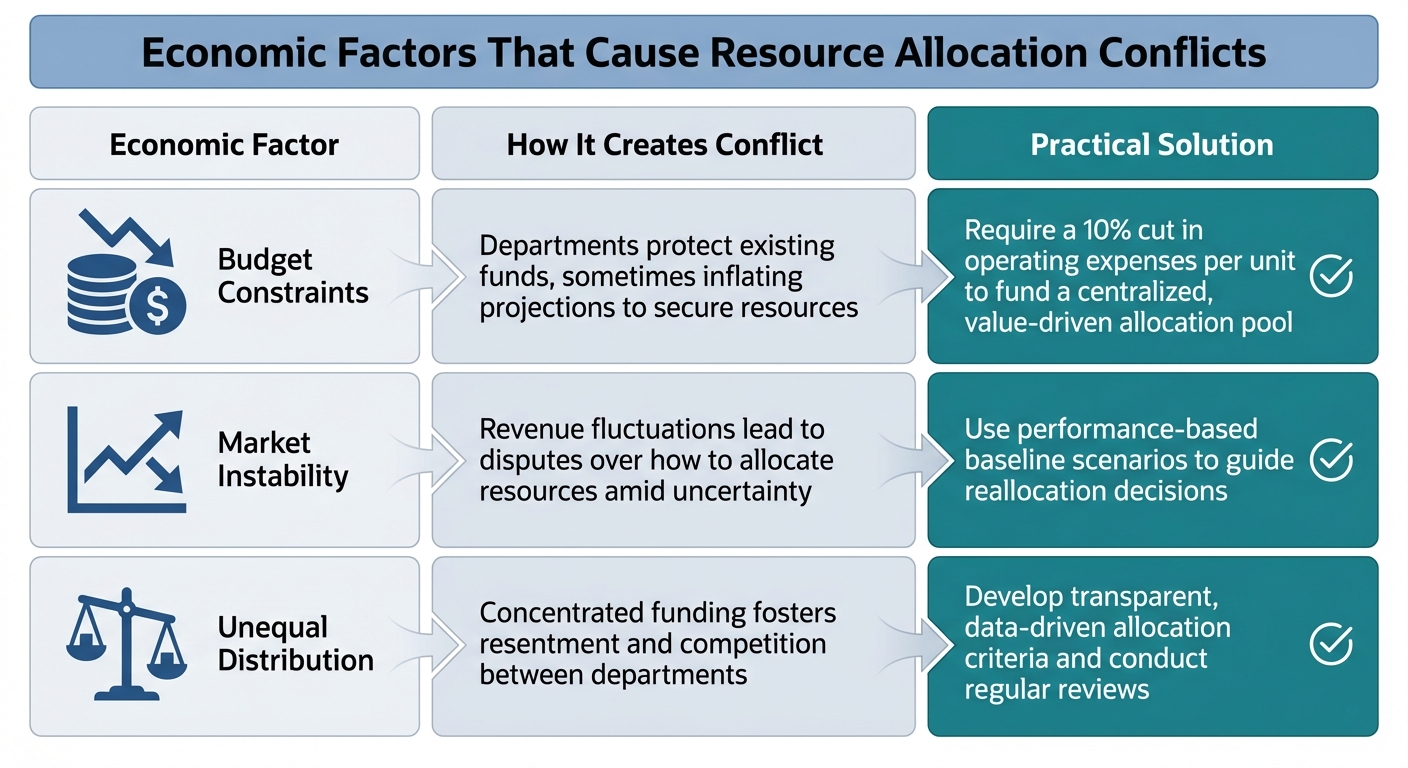
Economic Factors Causing Resource Allocation Conflicts and Solutions
Budget Constraints and Financial Pressure
When budgets tighten, departments often become protective of their revenue sources, inflating projections to secure funding. Leaders tend to cling to established revenue streams - often referred to as "cash cows" - fearing that reallocating funds to newer initiatives could jeopardize their teams. This financial pressure creates friction because returns on investment rarely grow in a predictable, linear fashion. For instance, managers might find themselves debating whether to allocate an extra $50,000 to marketing or product development, knowing that either choice could disrupt workflows.
Budget cuts also strain workloads. Only 34% of projects are completed on time and within budget, while 77% of employees report experiencing burnout, a condition often tied to resource overload [3]. To navigate these challenges, some organizations implement practical measures like requiring each unit to reduce operating expenses by 10%, pooling the savings for value-driven allocation [1]. These financial struggles become even more pronounced in unstable market conditions.
Market Instability and Revenue Fluctuations
Resource allocation becomes even trickier when external market forces come into play. Market instability often compels leaders to choose between maintaining steady revenue streams and pursuing uncertain growth opportunities. During periods of fluctuating revenues, leaders may resist reallocating resources from reliable performers, even when data suggests those areas may soon underperform. This hesitation can lead to heated debates about whether a struggling unit's performance is due to industry-wide challenges or insufficient funding.
Market volatility also amplifies the perceived risks of every decision, intensifying competition for capital [1][4]. As John Thomas from Singapore Management University notes:
"Resource allocation decisions often involve uncertainty and risk, stemming from factors such as market volatility, technological changes, and competitive pressures."
– John Thomas, Department of Public Administration, Singapore Management University [4]
A more effective approach involves adopting performance-based baseline scenarios. These scenarios allow organizations to adjust allocations quickly when initial assumptions no longer align with market realities [1]. However, these external pressures only add to the internal challenges of distributing resources fairly.
Unequal Resource Distribution
Uneven resource allocation can create resentment across an organization. When funding is concentrated in specific projects or departments, it often appears arbitrary, leading to frustration and competition. This dynamic encourages leaders to prioritize their own departments' needs over the organization's broader goals, even when a more balanced approach could yield greater overall value.
To address these issues, organizations should rely on data-driven methods for resource allocation. Establishing clear, empirical criteria for decision-making and creating a shared language around resources can help. Regularly reviewing allocation strategies ensures that funds are directed to areas with the highest potential impact [1][5][6]. Tackling these disparities is critical for reducing conflict and fostering a sense of fairness across the organization.
| Economic Factor | How It Creates Conflict | Practical Solution |
|---|---|---|
| Budget Constraints | Departments protect existing funds, sometimes inflating projections to secure resources. | Require a 10% cut in operating expenses per unit to fund a centralized, value-driven allocation pool. |
| Market Instability | Revenue fluctuations lead to disputes over how to allocate resources amid uncertainty. | Use performance-based baseline scenarios to guide reallocation decisions. |
| Unequal Distribution | Concentrated funding fosters resentment and competition between departments. | Develop transparent, data-driven allocation criteria and conduct regular reviews. |
How Organizational Structure Affects Resource Conflicts
The way decisions are made within an organization can significantly influence resource conflicts, often amplifying tensions that stem from economic pressures.
Problems with Top-Down Decision-Making
In hierarchical organizations, decision-making often flows from the top down, creating a disconnect between those making the decisions and those with detailed knowledge of specific projects. Senior leaders may lack the nuanced understanding that project managers or technical teams possess, while those on the ground rarely have access to the broader strategic insights that guide executive decisions [7][8]. This gap in information deepens the rigidity of hierarchical systems.
From the perspective of technical staff, resource decisions made from above can appear to prioritize political considerations or hidden business constraints over technical soundness [7]. As Özgen Güngör, a Software Engineer and Writer, aptly puts it:
"A decision that seems obviously wrong from a technical perspective might make perfect sense when you understand the next decision layer." [7]
This disconnect is compounded by the perception that power within organizations is tied to controlling scarce resources. A study involving 387 employees and 99 supervisors across 99 teams found that hierarchical structures often lead to power struggles, with team members competing to influence resource allocation [2]. These conflicts send negative social signals, undermining psychological safety and discouraging the open exchange of ideas.
Traditional top-down resource allocation is also slow to adapt to shifting project needs or changing market conditions [9]. To reduce these tensions, technical teams can present their resource requests in terms of measurable business outcomes - such as reducing customer churn - and provide multiple options with clear trade-offs in cost, risk, and benefits [7].
These issues within top-down decision-making often spill over into conflicts between departments.
Conflicting Priorities Between Departments
Departments often clash when it comes to resource allocation, especially when legacy revenue streams are at stake. Leaders of established departments may resist reallocating resources toward emerging opportunities, creating friction. In fact, only half of organizations effectively align their budgets with overarching corporate strategies [11]. When high-level strategies fail to translate into actionable goals, departments may focus on their own priorities instead of working toward shared objectives.
This misalignment is stark. Only 30% of managers report that their budgets for capital expenditures and product development align with their company’s strategic plans [10]. Top-down targets can feel arbitrary, ignoring local market realities, while bottom-up processes are prone to "sandbagging", where teams under-promise to make targets easier to hit [10]. Cognitive biases, such as groupthink and loss aversion, further hinder bold decision-making or the reallocation of resources away from underperforming projects [11]. As McKinsey partners Aaron De Smet and Tim Koller note:
"Inertia inevitably takes hold in most organizations. Leaders default to allocating resources in the same old ways, failing to champion growth." [11]
Many organizations stick to incremental budgeting, where last year’s figures set the baseline for the next, instead of prioritizing new growth opportunities [11]. Interestingly, companies that finalize their annual budgets in two months or less tend to outperform in both revenue growth and return on capital [11]. However, the tendency to protect legacy revenue streams, combined with unclear allocation methods, only exacerbates these issues.
This lack of clarity in resource allocation processes further fuels interdepartmental tensions.
Unclear Allocation Processes
When the decision-making process for resource allocation lacks transparency, it often leads to disputes and mistrust. Without clear guidelines, managers may inflate their projections to secure larger budgets, which can breed resentment when resources are distributed based on flawed assumptions rather than hard data [1]. Alarmingly, only 28% of companies consistently use financial metrics to rank their top strategic programs [11].
Opaque processes can also allow consensus to override sound decision-making. On the flip side, companies where employees feel comfortable challenging their leaders are 1.8 times more likely to achieve revenue growth that outpaces competitors [11]. The stakes are high: 83% of executives identify resource allocation as the most critical lever for driving growth [1], yet only 41% of companies consider a range of potential outcomes or scenarios when evaluating investments [10]. Moreover, organizations where strategy leaders hold significant sway over the CEO and CFO are nearly twice as likely to see higher returns on capital [11].
To combat these challenges, companies should adopt a shared framework for resource allocation and embed it into their organizational culture [1]. Using standardized financial metrics like NPV or ROI for evaluating projects can ensure consistency across departments [10][11]. Additionally, shortening financial planning cycles to three months or less can improve agility and reduce opportunities for political maneuvering [11].
sbb-itb-8feac72
Economic Consequences of Resource Allocation Conflicts
Resource allocation disputes don’t just disrupt operations - they create ripple effects that can significantly impact an organization's finances, productivity, and workforce morale. The costs of these conflicts often extend far beyond the immediate disagreements, affecting both short-term efficiency and long-term innovation.
Lower Productivity and Efficiency
When teams struggle to access the resources they need, productivity takes a hit in two ways: immediate losses in output (static costs) and slower innovation over time (dynamic costs) [12]. The numbers paint a stark picture: reallocating resources to equalize revenue productivity across firms could boost aggregate Total Factor Productivity by 43% in the United States, 115% in China, and 127% in India [14].
These conflicts also undermine collaboration. Instead of working together, team members often see each other as competitors, leading to a breakdown in knowledge sharing [13]. This lack of cooperation creates bottlenecks, especially in environments where tasks are interconnected. When one team is short on resources, delays can cascade across multiple projects [3].
The gap in productivity becomes even more apparent when comparing well-managed organizations to those plagued by misallocation. In markets with severe resource disputes, firms in the 90th percentile of revenue productivity outperform those in the 10th percentile by a factor of 5. In contrast, this gap is only a factor of 3 in better-managed U.S. markets [14]. A striking example comes from India’s retail banking sector, where private firms achieve labor productivity levels five times higher than state-run institutions, largely due to more effective resource management [14].
These inefficiencies don’t just slow down operations - they also lead to mounting costs for conflict resolution.
Costs of Managing Conflicts
Resolving resource disputes often requires substantial investment in mediation, arbitration by senior leaders, and overhauls of allocation systems. As Yuval Atsmon, a Senior Partner at McKinsey, explains:
"The problem with resource allocation isn't ignorance of its importance... The challenge lies in determining where the resources will bring the most value, how much money and talent to redistribute, and how to put those shifts effectively into action." [1]
In many cases, these disputes escalate into "turf wars", where department leaders fight to protect legacy business units rather than supporting high-growth opportunities [1]. Breaking these deadlocks often involves creating central investment pools or hiring external consultants, adding to the financial burden.
What makes the issue even more challenging is its contagious nature. A single disagreement over a project’s budget can spiral into widespread distrust across the organization [13]. This systemic erosion of trust demands even greater resources to repair.
Impact on Employee Retention
The fallout from resource conflicts doesn’t stop at financial costs; it also takes a toll on employee morale and retention. When employees are forced to compete with colleagues for limited resources, it creates a hostile work environment. This lack of psychological safety discourages open communication, stifles idea-sharing, and fosters interpersonal tensions [13].
Misallocation of resources also leads to uneven workloads. Overburdened employees often face burnout, while underutilized staff experience "boreout", a state of disengagement caused by a lack of meaningful work. Both scenarios push employees to leave, forcing organizations to bear the costs of recruitment, training, and the loss of institutional knowledge.
The long-term damage to innovation is particularly concerning. In a tense and competitive atmosphere, employees are less likely to propose new ideas or take creative risks, fearing backlash from internal rivals. As Diego Restuccia and Richard Rogerson, Professors of Economics, note:
"Misallocation appears to be a substantial channel in accounting for productivity differences across countries, but the measured magnitude of the effects depends on the approach and context." [12]
This suppression of innovation compounds over time, creating a cycle of stagnation that can be difficult to break. The economic and organizational consequences of resource allocation conflicts are far-reaching, affecting not just productivity and finances but also the very culture of innovation within an organization.
How to Reduce Resource Allocation Conflicts
Managing resource allocation conflicts requires a proactive approach. By combining clear policies, data-driven strategies, and effective leadership, organizations can address economic pressures and ensure resources are distributed fairly and efficiently.
Create Clear and Transparent Allocation Policies
The first step in preventing conflicts is to establish straightforward and consistent rules for resource distribution. This means defining criteria, approval processes, and escalation protocols to eliminate ambiguity and build trust among team members.
One effective approach is setting up a central investment pool. For example, requiring each unit to cut operating expenses by 10% and contribute to this pool ensures that resource requests are based on measurable value rather than personal influence or legacy status. This system encourages managers to justify their needs with data rather than relying on relationships [1].
Another critical practice is resource leveling, which adjusts project timelines to prevent overloading employees. This ensures workloads are distributed fairly, promoting both efficiency and employee well-being. Considering that 92% of workers prioritize emotional and psychological well-being in their workplace [15], equitable workload management is vital not just for productivity but also for retention.
In 2024, EnableU, a provider of aged care and disability services, adopted a demand-driven resource allocation model. Managing Director Conrad Wang implemented a "just-in-time compute" system, aligning staffing and technology with real-time demand. This adjustment led to an 18% reduction in idle staffing costs while maintaining high service standards [16].
Once clear policies are in place, leveraging data can further refine the allocation process.
Use Data to Guide Allocation Decisions
Effective resource allocation relies on evidence, not assumptions. Organizations that use evidence-based decision-making are 36% more likely to grow faster and 22% more likely to achieve higher profitability [10]. Despite this, only 41% of organizations consider a range of potential outcomes when deciding on investments [10].
To overcome bias and internal resistance, organizations should build a strong analytical foundation. Tools like predictive analytics - which use machine learning and statistical modeling - can forecast resource demands, identify peak usage periods, and highlight potential shortages [9]. Resource management software with suitability scoring can also ensure employees are matched to tasks based on their skills, qualifications, and availability [15].
Developing baseline momentum scenarios using historical data can help avoid overly optimistic projections. This counters the tendency of some managers to inflate growth estimates to secure more resources [1]. As Yuval Atsmon, Senior Partner at McKinsey, explains:
"The challenge lies in determining where the resources will bring the most value, how much money and talent to redistribute, and how to put those shifts effectively into action." [1]
Encouraging managers to provide data-backed justifications for their requests - by asking questions like "Why do you believe this improvement will happen?" - can lead to more objective decision-making [1]. Maintaining up-to-date digital profiles of employees’ skills and preferences ensures assignments are based on merit and fit [15].
For example, in 2024, Jason Rowe, Director of Hello Electrical, discovered a skills gap during a smart home integration project. Four senior technicians lacked the necessary programming expertise. By reallocating two technicians and hiring an external consultant for one week at a cost of $5,000, Rowe avoided project delays and saved an estimated $20,000 in potential rework costs [16].
While data strengthens decisions, strong leadership ensures these decisions are implemented effectively.
Develop Leadership and Communication Skills
Leadership plays a crucial role in executing resource allocation plans. Leaders must balance strategic priorities with empathy, ensuring critical projects receive adequate resources while supporting employees’ career goals and well-being [9][15].
Clear communication is key. Explaining allocation decisions and creating a shared understanding of resource priorities can reduce resistance and prevent conflicts [9][17][1]. Leaders also need to develop capacity planning skills to anticipate resource availability and avoid burnout, which affects 77% of employees [3]. As Lisa Schwarz, Senior Director of Global Product Marketing at NetSuite, puts it:
"Resource allocation isn't just about doing what's best for the business - it's also about doing right by employees." [15]
Programs like those offered by Tech Leaders help professionals bridge the gap between technical expertise and leadership skills. These programs focus on conflict resolution, strategic resource management, and effective communication - essential abilities for navigating resource constraints in today’s competitive markets.
The best leaders use real-time monitoring to identify and address bottlenecks quickly [9][3]. Simulation tools for "what-if" scenarios allow them to test the impact of resource changes before implementing them [3]. Additionally, creating shared resource pools enables talent to move seamlessly across departments, avoiding territorial disputes over resources [1].
With 83% of executives identifying resource allocation as a critical factor for growth [1], investing in leadership development is not just beneficial - it’s essential for long-term success.
Conclusion: Solving Economic Causes for Better Resource Management
Economic challenges like tight budgets, market fluctuations, and unequal resource distribution often lead to conflicts over allocation. Recognizing these underlying causes is essential to tackling disputes that can sap productivity and lower employee morale. Companies that fail to address these economic drivers risk facing inefficiencies, high turnover rates, and missed opportunities for growth.
To resolve these issues, organizations need to focus on three key strategies: transparency, data-driven decision-making, and strong leadership. Transparent processes provide clear insights into how resources are allocated and why certain decisions are made [9]. Data-driven methods, such as using ROI and NPV analysis, help minimize bias and ensure resources are allocated where they will have the most impact [1][10]. In fact, companies that rely on evidence-based decisions are 36% more likely to experience faster growth and 22% more likely to achieve higher profitability [10]. Tools like predictive analytics, competence mapping, and simulations can also play a crucial role in forecasting demand and aligning resources with actual needs.
Leadership is equally critical. Effective leaders communicate openly, foster accountability, and create a shared understanding of resource priorities. By embedding resource reallocation into the company's culture, leaders can reduce resistance and ensure smoother transitions [1]. As executives increasingly recognize resource allocation as a key driver of growth [1], investing in leadership development becomes non-negotiable. Programs like those offered by Tech Leaders demonstrate the importance of equipping leaders with conflict resolution and strategic planning skills to navigate resource constraints successfully.
When organizations embrace transparency, rely on data-driven practices, and cultivate strong leadership, they set the stage for meaningful growth. Shifting from political maneuvering to structured processes, replacing guesswork with analytics, and prioritizing clear communication are all essential steps toward managing resources more effectively and boosting overall company value [1].
FAQs
What are effective ways to resolve resource allocation conflicts in organizations?
Conflicts over resource allocation often emerge when teams vie for limited assets like funding, skilled personnel, or technology. These clashes can create friction, slow down decision-making, and disrupt team morale. The root causes typically include unclear priorities, limited insight into how resources are being used, and internal power struggles.
To tackle these issues, leaders need to establish a transparent process that ties resource allocation to the organization's strategic goals. Strategic planning is key - it helps map out both immediate and future resource needs, preventing overuse or neglect. By prioritizing resources transparently through criteria-based frameworks, organizations can ensure decisions feel fair, reducing friction between teams. Regular performance-based reviews and reallocations can also help maintain efficiency and flexibility. Finally, encouraging open communication and nurturing a collaborative culture can transform conflicts into opportunities for progress and innovation.
How can strong leadership resolve conflicts over resource allocation?
Effective leadership is key to transforming resource allocation conflicts into opportunities for collaboration and progress. Strong leaders focus on setting clear priorities, maintaining transparency in their decisions, and reallocating resources - like budgets, talent, or time - where they can make the biggest impact. This ensures that team efforts align with the organization’s strategic goals while reducing unnecessary friction.
When disagreements emerge, effective leaders encourage open communication, define roles and responsibilities clearly, and create an atmosphere where diverse viewpoints are welcomed. By tackling conflicts in a constructive way, they build trust, improve team dynamics, and steer the group toward solutions that spark innovation and boost performance.
For technical managers eager to develop these leadership capabilities, Tech Leaders offers programs that blend resource management techniques with AI-driven business insights, equipping leaders to make decisions that resonate across their organizations.
Why is using data important for effective resource management?
Using data for resource management transforms decision-making by replacing guesswork with clear, actionable insights. By evaluating metrics like projected revenue, talent availability, and potential risks, leaders can direct resources toward areas with the greatest potential for impact. This method helps organizations steer clear of biases, such as overcommitting to outdated projects, and instead shifts focus to opportunities for growth.
What sets data-driven resource allocation apart is its flexibility. Regularly reviewing and adjusting plans ensures that every dollar and every hour are spent wisely, delivering maximum value. For engineering leaders, these skills are essential for bridging technical expertise with business goals, paving the way for smarter decisions that fuel innovation and progress.