
Role Clarity in Agile Teams: Frameworks That Work
Role clarity is key for Agile teams to work effectively. Without clear roles, teams face delays, confusion, and unnecessary rework. Here’s what you need to know:
- Why It Matters: Clear roles improve accountability, reduce overlap, and help teams self-organize. Studies show teams with defined roles have up to 20% fewer delivery delays.
- Core Agile Roles:
- Product Owner: Manages the product vision and backlog.
- Scrum Master: Facilitates Agile processes and removes obstacles.
- Development Team: Builds and delivers product increments.
- Frameworks for Clarity:
- Tools to Use:
- RACI Matrices: Define who’s Responsible, Accountable, Consulted, and Informed for tasks.
- Retrospectives: Regularly review and refine roles.
Clear roles ensure everyone knows their responsibilities, enabling teams to collaborate and deliver effectively. Use frameworks, tools, and regular discussions to maintain alignment.
Core Agile Roles and Their Responsibilities
Product Owner, Scrum Master, and Development Team
Agile teams rely on three key roles, each with distinct responsibilities to keep things running smoothly. The Product Owner serves as the visionary and the voice of the customer, focusing on maximizing the product's value. They manage and prioritize the product backlog, defining the "what" and "why" by determining which features hold the most importance [5][7].
The Scrum Master acts as a servant leader, facilitating the Agile process rather than directing tasks. Their role involves clearing obstacles, coaching the team on Agile principles, and ensuring the framework operates effectively [5][8].
As Dave West, CEO of scrum.org, puts it: "The scrum master is the role responsible for gluing everything together and ensuring that scrum is being done well" [5].
The Development Team is a self-organizing group that includes everyone needed to build the product - engineers, designers, testers, and writers. They handle the "how" of delivery, working collaboratively to turn backlog items into functional product increments during each sprint [3][5].
Mike Cohn, a Certified Scrum Trainer, describes their approach: "The short answer is, everyone does everything... no one has a that's not my job attitude" [7].
For optimal performance, Agile teams generally consist of 5 to 11 members, with development teams specifically sized between 3 and 9 people to maintain effective communication [5][7]. In essence, the Product Owner drives the vision, the Scrum Master ensures the process is followed, and the Development Team brings it all to life [5]. This structure helps address accountability gaps and coordination challenges, allowing teams to self-organize successfully.
Preventing Role Overlap and Confusion
To keep Agile teams functioning efficiently, it's vital to maintain clear boundaries between roles. The Product Owner must remain the sole authority on backlog priorities to prevent conflicting directions [5]. Tools like delegation poker can help clarify uncertain boundaries [5], while sprint retrospectives provide a space to address friction and fine-tune responsibilities [5]. A well-documented roles matrix, which outlines specific accountabilities - such as separating stakeholder management from technical issue resolution - ensures no tasks are overlooked [9].
It's important to remember that Agile roles define responsibilities, not job titles. For instance, a Product Manager can take on the Product Owner role without needing an official title change [5][6]. By reinforcing these distinctions, teams can achieve the clarity needed for effective collaboration and execution.
sbb-itb-8feac72
Understanding Agile Roles: Scrum Master, Product Owner, and Development Team
Frameworks for Achieving Role Clarity
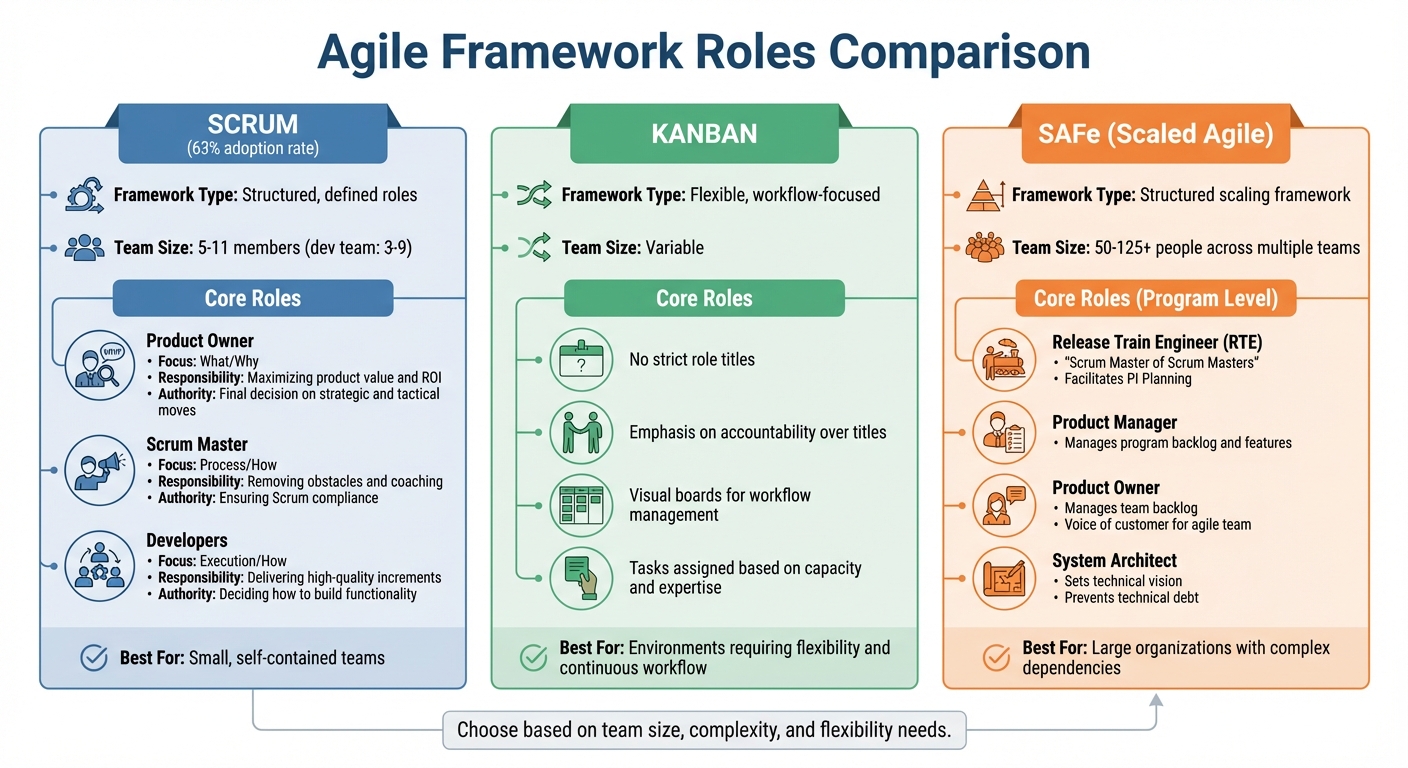
Agile Framework Roles Comparison: Scrum vs Kanban vs SAFe
Using Scrum to Define Roles
Scrum's three-role structure is widely recognized for providing clarity, with 63% of Agile adopters relying on it [10]. Each role has a distinct focus: the Product Owner oversees the "what" and "why", managing the product vision and backlog; the Scrum Master ensures the team adheres to Scrum principles and helps remove obstacles; and the Developers work as a self-organizing unit to deliver a complete increment during each sprint [5].
Scrum maintains this clarity through its regular ceremonies - Daily Scrums, Sprint Planning, and Retrospectives. A critical rule in Scrum is that only the Product Owner sets priorities, ensuring the team avoids conflicting directions [5].
| Role | Primary Focus | Key Responsibility | Authority |
|---|---|---|---|
| Product Owner | What / Why | Maximizing product value and ROI [7] | Final decision on strategic and tactical moves [7] |
| Scrum Master | Process / How | Removing obstacles and coaching the team [5] | Ensuring compliance with Scrum principles [7] |
| Developers | Execution / How | Delivering high-quality, usable increments [6] | Deciding how to turn backlog items into functionality [7] |
For teams needing a more adaptable approach, Kanban provides an alternative framework.
Kanban's Flexible Role Assignments
Kanban takes a less rigid approach to roles compared to Scrum. It emphasizes accountability without assigning strict titles, focusing instead on managing workflow [12]. This flexibility allows teams to adjust responsibilities as priorities evolve, ensuring work is completed effectively without unnecessary constraints.
Using visual boards and regular feedback loops, Kanban helps team members take on tasks based on their capacity and expertise. This system ensures that responsibility shifts naturally while maintaining order and accountability.
Scaling Agile with SAFe Framework
When organizations grow beyond small teams and need to coordinate efforts across multiple groups, the SAFe framework offers a structured solution. Designed for operations involving 50 to 125+ people, SAFe introduces specialized roles at different levels - Team, Program, Large Solution, and Portfolio - to align technical work with broader business goals [11].
At the Program level, SAFe adds roles like the Release Train Engineer (RTE), who facilitates PI Planning and oversees Agile Release Trains [11][1]. The Product Manager handles the program backlog and defines features, while the Product Owner focuses on the team backlog and represents customer needs [11][13]. Additionally, the System Architect provides technical direction and ensures the team avoids accumulating technical debt [11][13].
Srini Ippili, an Agile Transformation Leader, explains: "Product Owners report to Product Managers and serve as the single voice of the customer for their agile team" [11].
| Role Level | Scrum (Team Level) | SAFe (Program/Scaled Level) | Primary Distinction |
|---|---|---|---|
| Process Facilitation | Scrum Master | Release Train Engineer (RTE) | The RTE acts as the "Scrum Master of Scrum Masters", coordinating across Agile Release Trains [11][1]. |
| Product/Value | Product Owner | Product Manager | The Product Owner manages the team backlog, while the Product Manager oversees the program backlog and features [11][13]. |
| Technical/Design | Development Team | System Architect | The Development Team delivers increments; the System Architect sets the technical vision and runway [11][13]. |
The choice of framework depends on your team's needs. Scrum works well for small, self-contained teams. Kanban is ideal for environments requiring flexibility and a continuous workflow. SAFe is suited for larger organizations managing complex dependencies while aligning work with business goals [11].
How to Implement Role Clarity in Your Agile Team
Assess Current Roles and Identify Gaps
To strengthen role clarity within your Agile team, start by diagnosing potential confusion. Ask questions like, "Does everyone know who decides, contributes, and needs to be informed?" This helps identify whether the issue lies with specific individuals or the entire team. There are two key areas to examine: organizational design (when the wrong people are in roles) and decision design (when ownership is unclear). Use the interdependence test to determine if a role is truly necessary - does the role's decisions or information significantly affect others? If not, that role may not need a permanent place in the team.
Role clarity operates on two levels: Local Role Clarity, where each individual understands their own responsibilities, and Team-wide Role Clarity, where everyone understands and supports each other's roles. Encourage team members to reflect on their responsibilities individually before opening the discussion to the group. Also, consider team size - teams larger than 10–12 members can dilute decision-making, while smaller ones might lack key functions [15].
Once you've identified gaps, formalize these findings using a structured tool like a matrix.
Define Roles Using RACI Matrices
A RACI matrix is a practical way to define roles, breaking down who is Responsible (does the work), Accountable (has final authority), Consulted (provides input), and Informed (is kept updated) for each task. Assigning a single person as Accountable for each task prevents confusion and ensures ownership. As Lucidchart explains:
"If you assign multiple team members to be responsible for a task, then suddenly it feels like no one is" [14].
To create a RACI matrix, list all project tasks, identify stakeholders, and assign the appropriate RACI labels. Review the matrix for overlaps or gaps, keeping it as streamlined as possible. Simplifying roles reduces the need for repeated clarifications and can potentially save up to five working days [16]. Including the names of those Responsible and Accountable in meeting agendas can also set clear expectations before discussions begin [15].
Use Retrospectives to Refine Roles
Once roles are defined, retrospectives become key to maintaining clarity. Use these sessions to review and update your RACI matrix each sprint. Start with a quick check - around five minutes - on role-related action items from the previous sprint to ensure they’ve been addressed. As Clear Retro puts it:
"A sprint is production. A retrospective is preventive maintenance" [17].
Limit action items to one to three per sprint, assigning a single owner and a measurable definition of done to each. Use questions like, "Is role confusion affecting individuals or the entire team?" to uncover any lingering issues. To encourage quieter team members to share their thoughts, allocate about 10 minutes for silent writing before discussions. This approach helps surface subtle role overlaps or gaps, creating a feedback loop that keeps the team aligned and effective.
Conclusion
Role clarity is a continuous effort that plays a big part in the success of Agile teams. Scrum lays out clear roles, Kanban allows for more adaptable assignments, and SAFe provides structure for scaling teams ranging from 50 to 125 people [11][13]. While each framework tackles role confusion in its own way, they all aim for the same outcome: giving the people closest to the work the autonomy and accountability they need to solve problems effectively [5]. This balance between framework guidance and team practices helps teams refine roles as they grow and evolve.
Frameworks act as starting points, but real clarity comes from tools like RACI matrices, retrospectives, and open discussions about responsibilities. As Dave West, Product Owner and CEO at scrum.org, explains:
"The three roles provide a minimum definition of responsibilities and accountability, allowing teams to deliver work effectively" [5].
That "minimum definition" is just the beginning.
The focus should always be on responsibilities and accountability rather than job titles [5]. For example, your Product Owner might still be labeled a "Business Analyst" on their business card, and that's okay. What truly matters is that everyone knows who makes decisions, who contributes, and who needs to be kept in the loop. Without this clarity, teams risk falling back into hierarchical management structures or experiencing high turnover [2][4].
These insights offer a clear path to action. Start by evaluating current roles, identifying any gaps, and choosing the framework that aligns with your team's size and complexity. Tools like RACI matrices and regular retrospectives will help maintain clarity over time. Whether you're working in a small five-person Scrum team or managing multiple teams through SAFe, the principles remain consistent: define clear boundaries, avoid overloading key roles, and create regular opportunities to reflect and adjust. Role clarity isn’t about being rigid - it’s about enabling your team to self-organize and thrive.
FAQs
How can we tell if role confusion is a people issue or a decision issue?
Role confusion can stem from two main areas. It's a people-related challenge when unclear responsibilities or a lack of trust among team members create friction. On the other hand, it's a decision-making challenge if the confusion arises from vague authority or poorly defined decision-making boundaries. Pinpointing whether the issue is tied to team relationships or structural processes is key to tackling the problem at its core.
When should we use Scrum vs Kanban vs SAFe for role clarity?
Scrum is ideal for smaller teams that thrive on clearly defined roles, such as Product Owner, Scrum Master, and Development Team, all working together to deliver in iterative cycles. On the other hand, Kanban is better suited for teams that value workflow flexibility and continuous delivery, as it operates with less emphasis on formalized roles. For larger organizations or projects requiring scalability, SAFe offers a structured approach. It defines roles across team, program, and portfolio levels, helping maintain alignment and clarity in more complex environments.
What’s the simplest RACI matrix we can start with?
A straightforward RACI matrix begins by outlining the main tasks or deliverables. For each, assign one responsible individual, one accountable person, and specify who should be consulted and informed. Keeping the focus on essential roles ensures the matrix stays clear and easy to follow.