

Satya Nadella's Leadership: Lessons for Engineers
Satya Nadella transformed Microsoft from a struggling tech giant into a $2.4 trillion company by 2023. His leadership philosophy offers engineers a blueprint for success that goes beyond technical expertise. Here’s what you can learn:
- Growth Mindset: Shift from a "know-it-all" to a "learn-it-all" approach. Nadella embraced challenges, eliminated rigid systems like stack ranking, and prioritized collaboration.
- Empathy: Nadella emphasized understanding others - whether customers or team members - as a key to building better products and stronger teams.
- Clarity and Focus: He broke down complex problems into actionable goals, helping teams navigate uncertainty and deliver results.
- Continuous Learning: Investing in new areas like AI and cloud computing showed how staying curious can redefine industries.
Nadella’s leadership proves that combining technical skills with curiosity, empathy, and clarity can drive both personal and organizational growth.
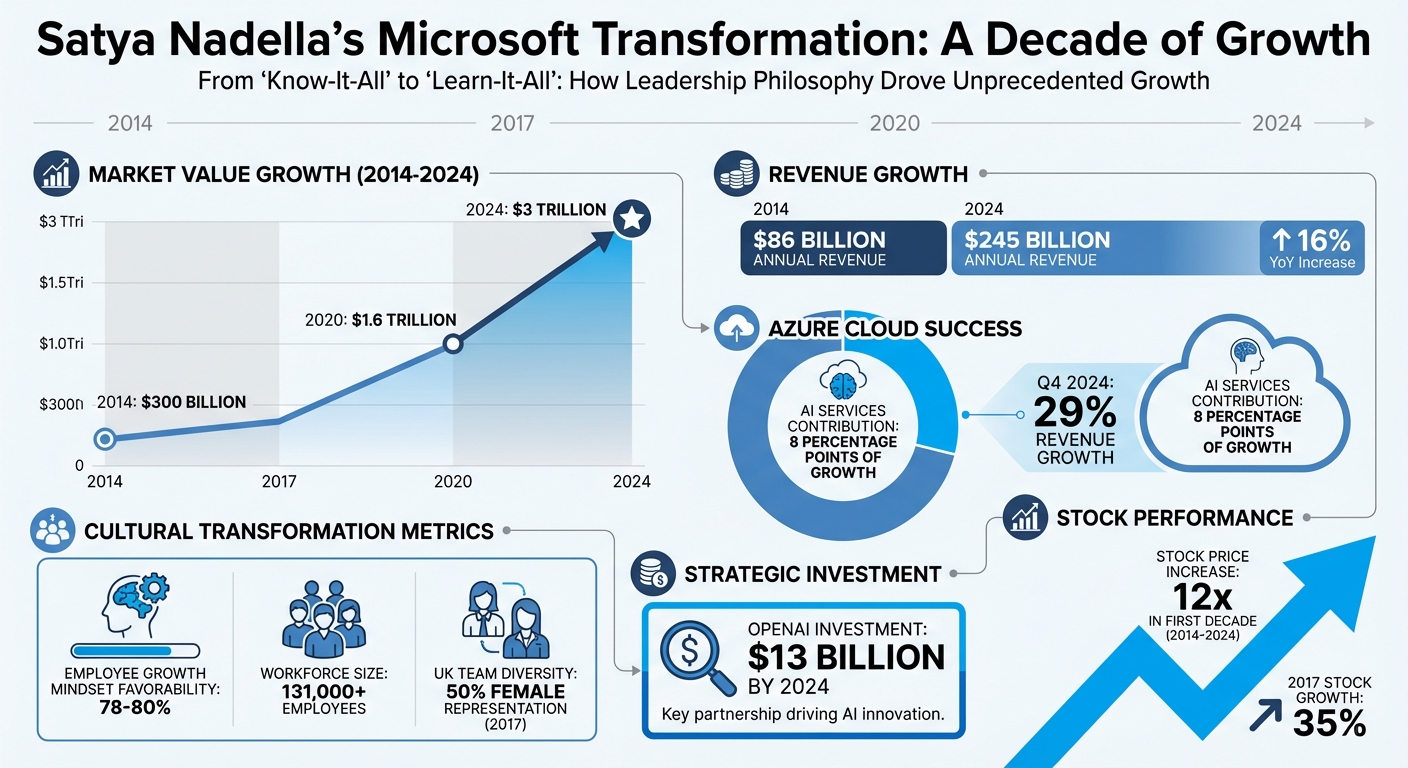
Satya Nadella's Microsoft Transformation: Key Metrics and Growth 2014-2024
Adopting a Growth Mindset: Lessons from Nadella
What is a Growth Mindset and Why It Matters
When Satya Nadella became CEO of Microsoft, he inherited a company culture often described as "know-it-all" - a mindset that discouraged innovation by pushing employees to constantly prove their expertise [7][8]. Nadella sought to change this by introducing psychologist Carol Dweck's growth mindset philosophy. This approach emphasizes the idea that abilities can be cultivated through effort and learning rather than being seen as fixed traits [5][7].
"If you take two kids at school, one of them has more innate capability but is a know-it-all. The other person has less innate capability but is a learn-it-all. The learn-it-all does better than the know-it-all." – Satya Nadella, CEO, Microsoft [5][9]
This cultural shift wasn't just theoretical - it had a measurable impact. Microsoft's market value soared from about $300 billion in 2014 to over $1.6 trillion by 2020 [7]. One of the first steps Nadella took was eliminating "stack ranking", a controversial system where employees were compared against each other. Instead, Microsoft introduced a framework that prioritized collaboration and rewarded those who helped others succeed [7][8]. Today, the company actively tracks employee sentiment about the growth mindset through daily pulse surveys, with favorability consistently landing between 78% and 80% among its workforce of over 131,000 [8]. These changes highlight how a shift in mindset can transform not just individual behavior but an entire organization's trajectory.
How Engineers Can Develop a Growth Mindset
For engineers, adopting a growth mindset means leaning into challenges - even when they feel uncomfortable. Nadella's leadership demonstrates how embracing the unfamiliar can lead to unexpected success. Take the example of Peter Lee, a senior researcher at Microsoft Research. In 2017, Nadella asked Lee to lead the company’s emerging healthcare division, despite Lee having no background in healthcare. This "stretch assignment" pushed him to apply AI and cloud computing to an entirely new domain. The outcome? Lee not only succeeded but was later elected to the National Academy of Medicine, while Microsoft became a significant player in healthcare technology [7].
"Growth mindset is a euphemism because it can feel pretty painful, like a jump into the abyss." – Peter Lee, Corporate Vice President of Microsoft Healthcare, Microsoft [7]
One practical way engineers can develop this mindset is by reframing failure. Instead of seeing it as a personal flaw, view it as valuable data for improvement. Consider Microsoft’s pivot with Linux. Back in 2001, former CEO Steve Ballmer famously referred to Linux as "a cancer." Fast forward to 2020, and Linux had become more popular on Azure than Windows itself [7]. This dramatic shift required abandoning a fixed, competitive mindset and seeing the potential for collaboration and growth in areas previously viewed as threats [7]. By rethinking challenges as opportunities to learn, engineers not only fuel innovation but also build the adaptability and leadership skills needed for long-term success.
Building a Learn-It-All Culture: Nadella's Approach
Why Continuous Learning Matters in Engineering
What worked yesterday might not work today - that's a reality Satya Nadella understood when he stepped in as Microsoft's CEO in 2014. At the time, the company was clinging to its dominance in desktop software, even as cloud computing was transforming the tech landscape. Nadella made a bold decision to prioritize Azure, a $5 million initiative aimed at overtaking a $20 billion server business [13]. This shift required the company to let go of outdated practices and embrace new strategies. It’s a perfect example of how staying adaptable and open to learning can secure long-term success.
"The most important skill set for long-term relevance is - how do you be a learn-it-all and not a know-it-all." – Satya Nadella, CEO, Microsoft [14]
The results speak for themselves. By the fourth quarter of 2024, Azure's revenue had grown by 29%, with AI services accounting for 8 percentage points of that growth [12]. The takeaway for engineers? Continuous learning isn’t just helpful - it’s essential. In fast-evolving fields like AI and cloud computing, the ability to adapt and learn new skills matters more than relying on past expertise.
How Engineers Can Promote Team-Wide Learning
Nadella’s focus on a growth mindset didn’t stop at the individual level - it extended to the entire organization. Building a "learn-it-all" culture begins with leading by example. After a public misstep at a major tech conference, Nadella didn’t shy away from accountability. Instead, he issued a public apology to employees, met with women in tech groups to understand their perspectives, and used the incident as an opportunity for personal growth [11][3]. His actions showed that even leaders at the top need to learn from failures.
Engineers can adopt a similar mindset by fostering psychological safety within their teams. This means creating an environment where team members feel comfortable admitting they don’t know something, asking questions, and sharing ideas without fear of criticism [15]. One way to encourage this is by moving away from rigid, top-down directives. Instead, empower developers by letting them choose their tools and treating them like valued collaborators [5]. This approach not only builds trust but also sparks creativity and innovation.
Another way to nurture a learning culture is to reward curiosity. Celebrate team members who explore new ideas or openly acknowledge gaps in their knowledge. This reinforces the idea that learning is a strength, not a weakness [15]. Nadella himself demonstrated this when he spent weekends in December 2025 studying how startups achieve speed. He realized that Microsoft’s size had created silos between science, engineering, and infrastructure teams. To address this, he reorganized the company, reducing silos by creating 16 direct reporting lines and fostering collaboration among these groups [14]. Engineers can take inspiration from this by encouraging cross-functional teamwork and viewing setbacks as opportunities to learn, rather than failures to avoid.
Creating a team-wide learning culture not only complements individual growth but also lays the foundation for technical breakthroughs.
Empathy as a Core Leadership Trait
Why Empathy Matters in Technical Leadership
Back in 1992, a profound moment during an interview with a distressed child taught Satya Nadella a lesson that would later redefine Microsoft's culture: true empathy goes beyond surface-level responses. This realization shaped his leadership philosophy and the way he views empathy - not as a "nice-to-have" quality, but as a fundamental business skill.
In Nadella's words, "I think of empathy as not just as something nice to have but (it) is core to (the) innovation agenda in the company" [17]. He believes that real breakthroughs come from understanding the "unmet, unarticulated needs" of customers - something data alone can’t reveal. For engineers, empathy isn't about being overly sentimental; it’s about creating better products and building stronger, more collaborative teams.
The numbers back this up: 82% of employees say they’d consider leaving for a company that demonstrates more empathy, while 72% of CEOs admit they need to improve on this front [16]. Under Nadella’s leadership, initiatives focused on diversity and inclusion led to Microsoft's UK team achieving 50% female representation by October 2017. That same year, Microsoft’s stock soared by 35% [18][17].
Nadella’s personal life also underscores his belief in empathy. Raising his son Zain, who had cerebral palsy, gave him the ability to see the world through someone else’s eyes. For Nadella, technical expertise alone isn’t enough - emotional intelligence is just as critical.
These lessons naturally translate into actionable ways engineers can incorporate empathy into their day-to-day work.
How Engineers Can Practice Empathy
Empathy isn’t a switch you flip - it’s a skill that needs consistent practice [16]. When Nadella became CEO in February 2014, he noticed that Microsoft’s culture leaned heavily on "Precision Questioning", a method where sharp, analytical questions were used to pick apart ideas. While effective in some ways, it often stifled collaboration. To address this, Nadella introduced non-violent communication training for leaders, shifting the focus toward constructive, supportive feedback [18]. Engineers can take a cue from this by rethinking how they give feedback - seeking to understand the reasoning behind decisions rather than simply pointing out flaws.
Another way to foster empathy is by being open about mistakes. Nadella himself has been candid about his own missteps, creating an environment of psychological safety where team members feel comfortable acknowledging their uncertainties and learning from setbacks [1].
Active listening is another cornerstone of empathetic leadership. Nadella has said, "Having empathy for your team is perhaps the best way to make progress in your career. If you have empathy for your people, they will do their best work and you'll make progress" [16]. For engineers, this means being fully present during one-on-one conversations and making an effort to understand different perspectives.
Lastly, adopting design thinking can help engineers anticipate user needs and develop solutions that truly address those needs. By putting themselves in the users’ shoes, engineers can craft more precise and impactful products.
Satya Nadella: Leading through the AI Revolution
sbb-itb-8feac72
Driving Innovation Through Clarity, Energy, and Success
Satya Nadella sums up his leadership philosophy in six simple but powerful words: "Create clarity, generate energy, and deliver success" [21]. This approach serves as the foundation of his leadership at Microsoft, seamlessly integrating earlier lessons on mindset and empathy. Under his guidance, Microsoft’s annual revenue skyrocketed from $86 billion to $236.6 billion, and the company’s stock price increased twelvefold in his first decade as CEO.
Clarity: Defining Goals in Uncertain Times
Nadella emphasizes that leaders must bring clarity to moments of uncertainty [1]. For engineering teams, this means breaking down complex technical challenges into actionable steps rather than waiting for perfect conditions to emerge.
Take, for example, the OpenAI leadership crisis. Nadella’s focus on clarity allowed Microsoft’s technical teams to stay on track, solving problems instead of being distracted by external chaos [19]. His approach encourages engineers to define what success looks like for their specific projects - such as reducing query latency by a measurable percentage or improving code quality metrics [20]. This clarity starts with leaders listening more during technical discussions and being decisive when setting a direction [1][22]. Tools like the "Model, Coach, Care" framework - where leaders model a growth mindset, coach team members to unlock their potential, and genuinely care about their well-being - further enhance team performance [21][20].
Once clear goals are set, the next challenge is to sustain momentum and motivation.
Energy: Motivating Technical Teams to Excel
Nadella firmly believes that emotional intelligence outshines technical expertise when it comes to energizing teams.
"In the long run EQ trumps IQ. Without being a source of energy for others very little can be accomplished." - Satya Nadella, CEO, Microsoft [22]
Between 2014 and 2019, Nadella made his leadership principles mandatory reading for all new managers and rolled out internal courses to reinforce them. During this time, Microsoft’s market value climbed from $300 billion to $1.2 trillion as the company embraced a cloud-first, mobile-first strategy [23][25].
For engineers, "generating energy" means inspiring their teams to push forward, even during uncertain times [22][24]. A key part of leadership is instilling confidence in others [26]. Leaders can create a sense of psychological safety by sharing their own struggles, which encourages team members to take risks and innovate [22]. Nadella’s approach demonstrates that effective leadership isn’t confined to technical expertise - it’s about motivating an entire organization to thrive [24].
This energized mindset sets the stage for achieving and celebrating measurable progress.
Success: Achieving Results Despite Constraints
Nadella views success as the ability to deliver results in a world full of constraints, recognizing that challenges and limitations are part of the process [22][25]. In fiscal 2024, Microsoft reported $245 billion in revenue - a 16% increase from the previous year - even while eliminating approximately 15,000 roles during its AI-driven transformation [6]. Nadella calls this the "enigma of success", emphasizing that waiting for perfect conditions is not an option.
"Life is an overconstraint problem. So you can't say, 'I'm just waiting for you to remove all the constraints and I'll be perfect.'" - Satya Nadella, CEO, Microsoft [22]
For engineering teams, success is measured through tangible progress. Nadella himself tracks three daily metrics: people he connects with, ideas generated, and tasks completed [2]. His advice? Innovate within the constraints you face, and don’t hesitate to explore unconventional paths to achieve the best outcomes [23][25].
Applying Nadella's Lessons with Tech Leaders Programs
Bridging the Gap Between Technical and Leadership Skills
Satya Nadella’s focus on blending technical expertise with leadership skills serves as a foundation for Tech Leaders programs. These initiatives tackle a common hurdle engineers face: transitioning from purely technical roles into leadership positions. Moving from a "know-it-all" mindset to a "learn-it-all" approach isn’t something that can be achieved by simply reading books or attending seminars - it demands hands-on mentorship and targeted training [10][11].
Tech Leaders programs aim to bridge this gap by offering engineering leadership training and entrepreneurship courses that focus on developing non-technical skills. Participants are encouraged to expand their roles through peer masterminds and personalized coaching sessions [2]. This method aligns with Nadella’s philosophy of creating clarity and generating energy, even within limited resources.
A key component of these programs is the emphasis on empathy as a driver of innovation and team cohesion [2][4][25]. By practicing active listening and fostering psychological safety in technical discussions, engineers develop the emotional intelligence needed for effective leadership. These skills are not just about managing teams but also about inspiring them, enabling engineers to lead with a balanced mix of technical expertise and human connection.
This structured framework lays the groundwork for mastering AI-driven strategies in leadership.
Using AI and Business Strategy for Leadership Success
Building on these leadership principles, Tech Leaders programs incorporate AI and business strategy to prepare engineers for the ever-changing tech landscape. Nadella’s bold $13 billion investment in OpenAI by 2024 reshaped Microsoft’s approach to innovation [12]. For instance, in Q4 2024, AI services played a significant role, contributing 8 percentage points to Azure’s 29% revenue growth. This highlights the growing importance of rethinking workflows and adopting modern tools [12].
The curriculum takes inspiration from Nadella’s transformative strategies, using real-world examples to emphasize entrepreneurial agility. Engineers are shown how small, cross-functional teams can iterate quickly without waiting for lengthy hierarchical approvals [14]. This approach teaches them to leverage their technical expertise while transitioning into roles such as independent consultants or innovation leaders [25].
Conclusion: Key Takeaways for Engineers
Lessons from Nadella's Leadership Approach
Satya Nadella's leadership journey at Microsoft demonstrates that being a great engineer isn’t just about technical know-how - it’s about mindset and empathy too. Under Nadella's leadership, Microsoft’s market value skyrocketed from around $300 billion in 2014 to over $3 trillion by 2024. This remarkable transformation stemmed from a leadership philosophy rooted in curiosity and adaptability rather than a rigid focus on expertise alone [20,44].
One of Nadella’s core principles is shifting from being a "know-it-all" to a "learn-it-all." This approach encourages engineers to embrace failures as learning opportunities and to let curiosity drive their problem-solving. Empathy, often dismissed as a soft skill, plays a powerful role in this process. Nadella himself explained:
"Empathy helps create competitive, profitable solutions. That's not softness. That's the point" [2].
By practicing empathy, engineers can uncover insights that data alone might miss, leading to better solutions and deeper customer understanding.
Nadella’s leadership framework revolves around three key pillars: creating clarity in uncertain situations, energizing teams, and delivering results even under constraints. A great example of this is Microsoft’s decision to launch Office for iOS in 2014. Despite potential conflicts with proprietary platforms, Nadella prioritized customer needs, showcasing how bold, empathetic decisions can drive success [27].
Practical Steps for Engineers to Build Leadership Skills
For engineers aiming to grow into leadership roles, small daily habits can make a big difference. Start by tracking three simple metrics: how many people you engage with, how many ideas you generate, and how many tasks you complete [2]. In meetings, focus on what you want to learn instead of proving a point. Sharing your own mistakes openly can also foster an environment of trust, as Nadella demonstrated after his misstep at the 2014 Grace Hopper Conference [11].
If you’re looking for more structured guidance, programs like those offered by Tech Leaders can help bridge the gap between technical expertise and leadership skills. These programs focus on developing non-technical strengths such as empathy, clarity, and strategic thinking, along with practical areas like AI business strategies and entrepreneurship. Whether you’re working toward a leadership position or exploring independent consulting, these resources can help you make an impact far beyond the code you write.
FAQs
How can engineers develop and apply a growth mindset in their daily work?
Engineers can nurture a growth mindset by treating every task as a learning opportunity. Start your day with a small, achievable goal - like diving into a new API, trying out a testing framework, or refining the readability of legacy code. When faced with challenges, don’t hesitate to seek feedback from peers or mentors. This approach echoes Satya Nadella’s emphasis on humility and the value of continuous improvement.
After wrapping up a task, take a moment to reflect. Ask yourself: What worked well? What didn’t? What could I do differently next time? Viewing setbacks as lessons rather than failures can help shift your perspective and keep you moving forward. To stay creative, balance your workload by mixing short-term projects with exploratory sprints. These sprints give you space to experiment with new ideas without the pressure of immediate results.
To make these habits a natural part of your routine, weave them into your daily workflow. Share your learnings during stand-ups, pair-program to gain insights from teammates, and keep a personal journal to document your progress and reflections. Additionally, structured training programs and supportive communities, like engineering leadership initiatives, can help you channel your curiosity into actionable growth and meaningful contributions.
Why is empathy important for technical leaders?
Empathy stands out as an essential quality for technical leaders, enabling them to form genuine connections with their teams. This connection builds trust and encourages collaboration, laying the groundwork for a workplace where creativity flourishes. By truly understanding the challenges and viewpoints of their team members, leaders can shape solutions that not only address internal goals but also align with customer expectations.
Satya Nadella, Microsoft’s CEO, has highlighted empathy as more than just compassion. He views it as a critical tool for uncovering unspoken customer needs and driving transformative changes. Leaders who embrace empathy are often better prepared to handle complex challenges, motivate their teams, and achieve meaningful outcomes.
How can engineers foster a culture of continuous learning within their teams?
Engineers can create an environment of continuous learning by approaching leadership with curiosity and humility. Satya Nadella once highlighted the value of a growth mindset, urging teams to view skills and abilities as things that can evolve rather than static traits. When leaders embody this mindset, they encourage their teams to remain open to fresh ideas and treat learning as a lifelong journey.
Here are some ways teams can nurture this culture:
- Organize regular learning opportunities like workshops, hackathons, or informal knowledge-sharing events over lunch.
- Promote open feedback, treating mistakes as valuable chances to grow and improve.
- Recognize and celebrate learning efforts, such as mentoring others, sharing insights, or documenting key takeaways.
- Offer access to resources, whether it’s curated reading lists or online courses, to make learning more accessible.
Leaders can set the tone by sharing their own learning goals, showing that growth is a priority at every level. For engineers looking for structured development, Tech Leaders provides programs that blend technical training with leadership and business strategy, equipping teams to excel in a learning-focused culture.