
Scaling Leadership Influence Through Global Collaboration
Leading across borders is no longer optional - it’s a requirement for modern leadership success. Effective global collaboration can increase innovation by 45% and improve business outcomes by 23%, but it comes with challenges like time zone conflicts, cultural misunderstandings, and communication barriers.
Here’s what you need to know:
- Key Benefits: Diverse teams bring unique perspectives, enabling "follow-the-sun" productivity and faster innovation.
- Major Challenges: Time zone issues, trust-building without face-to-face interaction, and adapting leadership styles to regional expectations.
- Critical Skills: Leaders must understand how authority, decision-making, and trust differ across regions.
- Practical Solutions: Use tools like RACI matrices for clarity, rotate meeting times for fairness, and create shared team norms to streamline collaboration.
The bottom line? You need to build strong global networks, align international teams with shared goals, and leverage tools that bridge gaps in communication and time zones. Start now to expand your leadership influence beyond borders.
The Hidden Art of Constructive Politics in Global Leadership
sbb-itb-8feac72
Building Cross-Border Understanding for Leadership Success
Expanding your leadership influence across borders requires more than just learning new languages - it’s about understanding the core differences in how people view authority, make decisions, and build trust. Leadership strategies that thrive in one region can fall flat - or even cause issues - in another. This challenge is amplified by the fact that most leadership training is rooted in Western frameworks, while 70% of the global workforce operates within collectivist and hierarchical structures [3]. This disconnect can create friction before you’ve even started.
The key to overcoming these challenges lies in developing Cultural Intelligence (CQ) - a blend of motivation, understanding, planning, and adaptable actions. The benefits of doing so are far from theoretical: companies with highly diverse executive teams are 33% more likely to achieve top-tier profitability, and those with diverse management teams see 19% higher revenue compared to their less diverse peers [7]. These numbers highlight the tangible advantages of mastering cultural complexity.
How Leadership Styles Differ Across Regions
Leadership expectations vary widely across the globe. What’s seen as effective in one culture might come across as overbearing - or too passive - in another. For example, leaders in Germany and Russia are often expected to be decisive and directive, making strong calls without much consultation. In contrast, Scandinavian countries value leaders who act as facilitators, ensuring tasks are distributed fairly and team input is encouraged.
"When misunderstandings arise among members of global teams, it's often because managers conflate attitudes toward authority and attitudes toward decision-making." - Erin Meyer, Professor at INSEAD [10]
The complexity deepens when considering how authority and decision-making styles interact. Americans, for instance, lean toward egalitarian social interactions but often adopt a more autocratic approach when making final decisions. Meanwhile, Japanese workplaces, despite their strict social hierarchies, emphasize consensus-driven decision-making, ensuring everyone’s input is thoughtfully considered [10]. In cultures like China and Russia, frequent check-ins from leaders aren’t seen as micromanagement - they’re interpreted as signs of support and acknowledgment [3].
Trust-building also takes different forms. In "Task Cultures" like the United States and Germany, trust is earned through competence and results - you prove yourself by delivering, and relationships follow. On the other hand, in "Relationship Cultures" across Asia, the Middle East, and Latin America, trust is built through personal connections. Before diving into business discussions, leaders often need to establish rapport through shared meals, conversations about family, or showing genuine interest in personal lives.
Communication styles add another layer of complexity. In Western settings, direct feedback is the norm - leaders in the U.S. and Germany are expected to be clear and straightforward. However, in many Asian and Middle Eastern cultures, indirect communication is used to maintain harmony and avoid embarrassment. What might seem vague to a Western leader is often a nuanced way of addressing issues without causing conflict.
Understanding these cultural nuances is the first step toward building empathy and adapting leadership practices to meet the needs of diverse teams.
Building Empathy and Cross-Border Awareness
Given the varied expectations around leadership, empathy and cross-border awareness are no longer optional - they’re essential. With 89% of white-collar workers now part of global virtual teams [7], the ability to navigate cultural differences has become a core skill for effective collaboration.
Start by implementing cultural onboarding for your team. Create short, ongoing training sessions that cover local customs, business etiquette, and communication preferences. These modules should help your team appreciate different ways of solving problems and interacting professionally.
"Cultural diversity is not a challenge to be overcome, but a reservoir of potential to be tapped." - Bala Sathyanarayanan, EVP & CHRO, Greif, Inc. [9]
Small gestures can make a big impact. Rotate meeting times to ensure no single region always bears the inconvenience, like joining calls late at night. This simple adjustment shows respect and fosters goodwill. Similarly, acknowledge regional holidays like Diwali, Lunar New Year, or Ramadan - this demonstrates that you see your team members as individuals, not just contributors to a project.
Establish shared norms for your team. Document expectations around response times, communication platforms, and decision-making processes. This creates a "third culture" - a hybrid approach that respects differences while providing clarity for everyone involved.
For team members from cultures where open disagreement is discouraged, introduce "quiet channels" for anonymous or written feedback. This allows concerns to be raised without direct confrontation [9]. In some cultures, being overly transparent about mistakes can harm your credibility, so adjust your communication style accordingly [8]. The goal isn’t to change who you are as a leader but to adapt thoughtfully to the diverse perspectives and needs of your team.
Methods for Successful Global Collaboration
Once you've gained an understanding of cross-border dynamics, the next step is turning that awareness into action. Effective global collaboration doesn’t just happen - it requires deliberate strategies that connect people, align objectives, and use the right tools to overcome distance. Here’s how to transform cultural insight into practical approaches for working across borders.
Using Global Networks to Expand Your Reach
Building a global network isn’t about racking up LinkedIn connections or collecting business cards. The depth of your relationships matters more than the number of them - a few meaningful, trust-based connections will always outperform hundreds of shallow ones [4]. Leaders with strong global connections tend to uncover more creative solutions [4].
To start, join professional groups like the Young Presidents' Organization (YPO) or Entrepreneurs' Organization (EO). These organizations provide access to international mentorship and offer regional chapters for localized engagement [11]. Beyond LinkedIn, platforms like Slack can facilitate real-time community interactions, while Meetup and Eventbrite help you find industry-specific global workshops [11].
Global mentorship is a two-way street - it builds trust and facilitates knowledge-sharing. Leaders who nurture global relationships are 22% more likely to lead successful, transformative projects [12]. After meeting new contacts, follow up with personalized messages referencing key points from your conversation. This keeps the relationship alive and growing [11]. Additionally, informal video calls, like virtual coffee breaks, can build camaraderie beyond task-focused meetings [2].
The trend is shifting from transactional vendor relationships to strategic partnerships. These partnerships create "affinity ecosystems", where risks and rewards are shared based on outcomes rather than simple deliverables [13].
"We will have to build our own digital capability on top of the technology that we have adopted. Because every company is a software company." - Satya Nadella, CEO of Microsoft [13]
Once your network is in place, the next step is making sure all teams are aligned around shared objectives.
Creating Shared Goals Across International Teams
After establishing strong connections, the focus should shift to aligning goals across teams. Misalignment is a major challenge - 70% of international joint ventures fail due to cultural differences [14]. However, companies with globally aligned goals are 60% more likely to boost team collaboration and productivity [5]. The solution? Start with shared goals instead of trying to fix misalignment later.
Dedicate 2–3 days to alignment workshops that bring together team members from different locations. These workshops focus on uniting everyone around the mission, budget, and service expectations, setting a clear foundation for collaboration [2].
"Leadership teams should invest in cross-geography employee forums that meet regularly to promote cross-cultural communication." - Karrin Nicol, Talent and HR Advisor at Asari.io [15]
Create a team charter - a document that outlines how the team will communicate, make decisions, resolve conflicts, and provide feedback [6]. This serves as a go-to resource when cultural differences cause friction. To clarify roles and responsibilities, use RACI matrices (Responsible, Accountable, Consulted, Informed), which prevent confusion and ensure accountability across departments and regions [6].
Communication is the glue that holds global teams together. Practices like “check for understanding,” where team members paraphrase what they’ve heard, can bridge gaps, especially with high-context cultures that rely on indirect communication [5][14]. Additionally, involve local leaders in adapting core organizational values to ensure they resonate in different cultural contexts [5].
| Method | Purpose | Key Tool/Framework |
|---|---|---|
| Team Charter | Defines communication norms and rules | Shared Document/Quarterly Review |
| RACI Matrix | Clarifies roles and decision-making | Project Management Software |
| Alignment Workshop | Synchronizes mission and expectations | 2–3 Day Intensive Session |
| Async Systems | Reduces time zone challenges | Video Recaps (Loom), Templates |
Digital Tools That Bridge Distance Gaps
The right digital tools can make distance feel irrelevant. 83% of businesses use collaboration tools to support remote and international teams [19], and companies with effective global team strategies are 21% more profitable than those without [20].
Take Siemens, for example. In 2024, the company adopted Microsoft Teams across its global operations, cutting project turnaround times by 25% through real-time collaboration and faster decision-making [19]. Similarly, the World Wildlife Fund (WWF) combined Slack for instant communication with Asana for task management, streamlining conservation efforts across multiple countries [19].
Modern tools like AI-powered translation and scheduling assistants help tackle language and logistical challenges [16]. For instance, MarqVision, a global brand protection firm, uses Deel AI to provide instant HR and compliance answers to its international team.
"Our global team can turn to Deel AI for instant answers to their HR questions, anytime. It's been a huge time-saver for our People team." - Yunjung (Rina) Bae, Director of People at MarqVision [16]
Interoperability is another key factor, especially in regions with technology restrictions. Platforms like Mio enable teams to sync communication across apps like Google Chat and Microsoft Teams, ensuring seamless collaboration [17].
"Interoperability is not just a convenience but a necessity in today's global landscape." - Jake Bailey, Chief Commercial Officer at Mio [17]
To avoid notification fatigue, establish clear communication protocols. Define which tools are for urgent issues (e.g., Slack) and which are for less immediate updates (e.g., email) [19]. Adopt a 24-hour handoff system using project management tools to document progress, so work continues smoothly as one region signs off and another begins [18]. Tools like World Time Buddy or Every Time Zone can help visualize overlapping hours for scheduling [18][20], while AI assistants can suggest meeting slots that minimize after-hours participation [16].
Actionable Steps to Expand Your Leadership Influence
Understanding global collaboration is one thing; putting it into practice is another. The challenge often lies in bridging the gap between knowledge and execution. By taking deliberate actions, leaders can move from theory to making a tangible global impact.
Small-Group Learning for Big Results
Conferences and webinars can provide a broad overview, but small-group learning is where real leadership growth happens. Virtual leadership practice groups, typically consisting of 8 to 15 participants, create a space for leaders from various regions to connect, practice new skills, and share insights in a supportive environment [25].
For example, since 2017, a global tech company in Mountain View, California, has partnered with Cultivating Leadership to implement its "Leading in Complexity" program. This initiative introduced virtual leadership practice groups to over 4,000 directors and VPs worldwide. The focus was on developing skills like deep listening and engaging with diverse perspectives to navigate ambiguity. Many participants reported a transformation in their leadership style [25].
"Cultivating Leadership pushes the boundaries in many ways on what people have seen and heard previously... As a result, leaders are engaged in the content and readily begin to consider its application to themselves. Over time, this leads to what our leaders refer to as 'personal transformation' - no mean feat in a corporate context." – Senior Leader, Learning and Development, Global Tech Company [25]
To make these programs even more effective, organizations can adopt asynchronous designs. This allows for decision-making documentation and focuses on results rather than requiring everyone to participate in real-time [22]. Pairing large workshops with smaller, ongoing practice groups ensures leaders can apply new skills, receive peer feedback, and build meaningful connections. Organizations with robust global networks are 23% more likely to achieve better business outcomes [4]. This method fosters collaboration across borders and strengthens professional relationships over time.
Tech Leaders Programs: Bridging Technical Expertise and Leadership
Technical professionals often face a unique hurdle when stepping into global leadership roles. While their technical knowledge is invaluable, it’s not enough to lead across borders. Leadership requires skills like strategic thinking, team management, and cross-cultural communication - abilities that aren’t always part of a technical background.
The Tech Leaders program addresses this challenge by offering engineering leadership training and entrepreneurship development for technical experts. These programs focus on blending technical expertise with leadership essentials, such as AI business strategy and team management. This approach helps participants transition from technical roles to positions where they can influence decisions, lead international teams, or even work as independent consultants.
The program includes elements like peer masterminds, personalized learning plans, and private coaching. These tools help technical professionals use their existing expertise as a foundation for broader leadership influence. A clear pathway from technical contributor to global leader can mean the difference between staying in a specialized role and expanding influence across borders.
For technical leaders managing distributed teams, the challenge isn’t just about learning leadership principles - it’s about applying them in diverse contexts. Cultural norms, communication styles, and business practices vary widely, and successful leaders need to navigate these differences effectively. Programs like Tech Leaders provide the structure to make this learning practical and relevant. It’s worth noting that 85% of successful leaders credit continuous learning and coaching for their career growth [23]. This structured development helps leaders build the cross-cultural understanding they need to collaborate effectively on a global scale.
Coaching and Mentorship: Personalized Leadership Growth
While group learning and structured programs are essential, personal guidance through coaching and mentorship is equally important. Small-group learning builds networks, but one-on-one mentorship offers tailored advice to tackle specific challenges. Global mentorship, in particular, helps emerging leaders develop skills like empathy, adaptability, and cross-cultural communication [26].
The impact of mentorship is clear: 84% of CEOs say their career success was influenced by formal or informal mentors [26], and 70% of Fortune 500 companies include mentorship as a key part of their leadership development strategy [26]. However, effective mentorship requires more than just matching people - it needs structure, clear goals, and cultural awareness.
When creating a coaching framework for global leadership, it’s important to match mentors and mentees based on factors like language, cultural background, and professional expertise. A mix of formats can also be beneficial: one-on-one coaching for senior leaders, group coaching for those with shared challenges, and peer coaching to encourage collaborative problem-solving [27]. Setting clear objectives with defined timelines and milestones ensures these relationships stay focused and productive [21].
Challenges like time zone differences and language barriers can be addressed with creative solutions, such as alternating meeting times, using translation tools, or leveraging asynchronous methods like recorded video updates [21][2]. Consistency is key - leaders with diverse networks are 45% more likely to develop innovative ideas and solutions [4]. Building and maintaining these networks requires regular interactions and mutual support.
"Global alignment works best when local authenticity is honored." – Riddle Workforce [27]
To measure success, track outcomes through metrics like cost savings from retention, promotion rates of coached leaders, and behavioral changes observed in 360-degree feedback reviews [27][22]. This data-driven approach ensures that coaching and mentorship programs lead to measurable improvements, not just surface-level discussions, while reinforcing a leader’s ability to navigate global challenges effectively.
Tracking and Maintaining Global Leadership Results
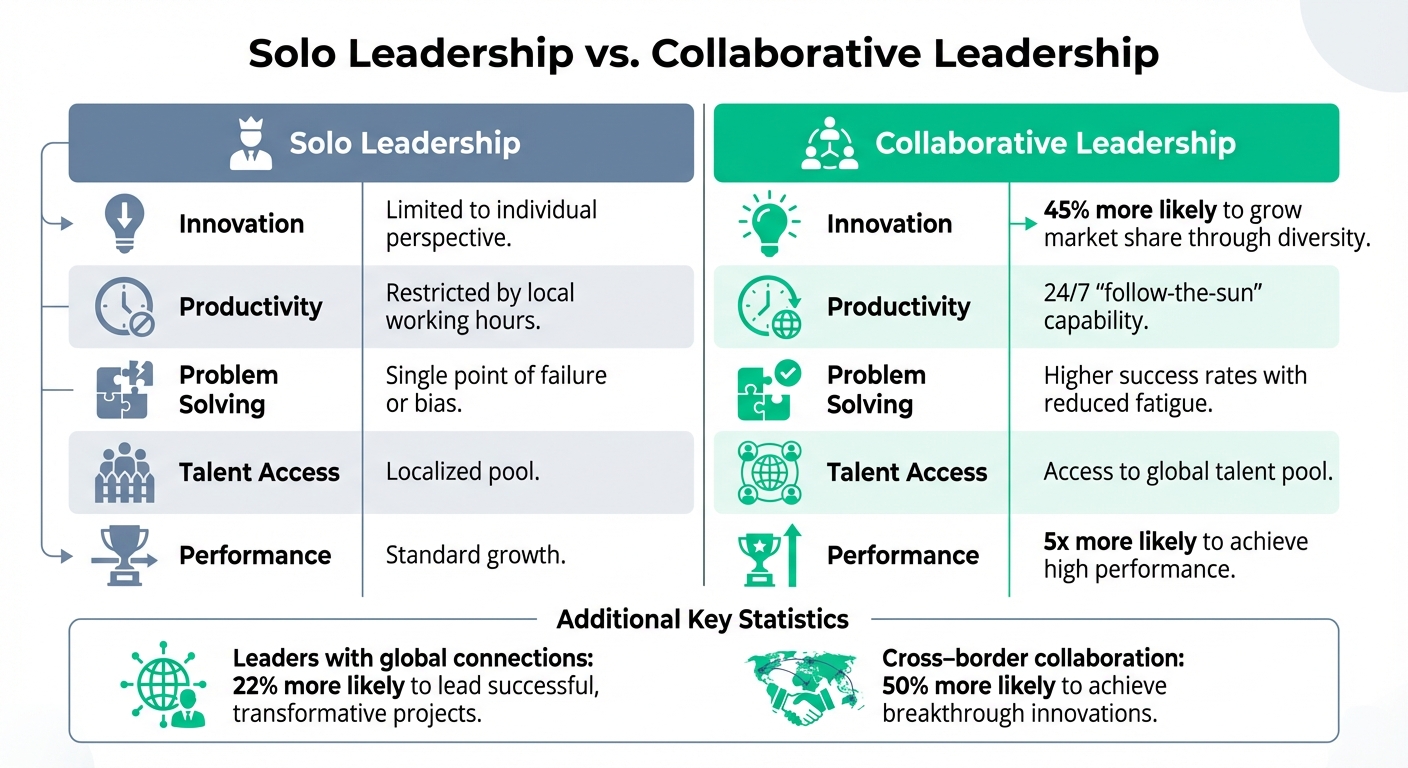
Solo vs Collaborative Leadership: Impact on Innovation and Performance
To demonstrate the impact of global leadership, it’s essential to measure progress systematically and commit to ongoing improvement. Without tracking the right metrics, leaders can’t prove the value of their efforts or pinpoint areas that need fine-tuning.
Key Metrics for Leadership Performance
Financial metrics, like Return on Partnership Investment (ROPI), provide clear benchmarks. For instance, a common standard is a 4:1 return - $4 earned for every $1 spent [29]. Productivity metrics, such as project completion rates and revenue per employee, highlight whether global teams are hitting their targets [28][22].
Employee engagement and retention also reveal the health of leadership strategies. Metrics like communication effectiveness - measured through response times or meeting productivity - can uncover friction points in distributed teams [28][30].
Structured tracking systems make a big difference. Companies using these methods report 73% higher confidence in their ROI decisions compared to those relying on informal tracking [29]. Real-time dashboards, rather than quarterly reviews, allow leaders to catch and address underperformance before it impacts revenue [29]. Tools like Asana, Jira, HubSpot, and Salesforce centralize performance data, simplifying the monitoring of global operations [28][29].
"The partnerships you measure are the partnerships you improve." – InfluenceFlow [29]
These metrics create a clear framework for comparing different leadership styles, showing the tangible benefits of collaborative approaches.
Comparison: Solo Leadership vs. Collaborative Leadership
The contrast between working solo and fostering global partnerships is striking when you look at the data:
| Feature | Solo Leadership | Collaborative Leadership |
|---|---|---|
| Innovation | Limited to individual perspective | 45% more likely to grow market share through diversity [28] |
| Productivity | Restricted by local working hours | 24/7 "follow-the-sun" capability [28] |
| Problem Solving | Single point of failure or bias | Higher success rates with reduced fatigue [30] |
| Talent Access | Localized pool | Access to a global talent pool [28] |
| Performance | Standard growth | 5x more likely to achieve high performance [28] |
Leaders who embrace global connections are 22% more likely to lead successful, transformative projects [12]. Companies that collaborate across borders are also 50% more likely to achieve breakthrough innovations [24]. These numbers highlight the potential of expanding beyond local networks.
Maintaining Influence Through Continuous Development
Sustaining influence requires more than just initial success - it depends on ongoing skill-building and relationship management. Organizations with robust global networks are 23% more likely to achieve superior business outcomes, but maintaining those networks takes consistent effort [4].
Peer groups and virtual masterminds provide accountability and support. Monthly meetings with other global leaders create opportunities to share challenges, brainstorm solutions, and build trust over time [12]. These forums help leaders develop shared frameworks for solving complex problems.
Leadership training programs that address cross-cultural dynamics tend to be more effective. Programs that move beyond Western individualistic models to include collectivist and hierarchical perspectives see higher completion rates and better results [22]. For example, Tech Leaders programs combine technical expertise with cross-cultural communication and AI strategies, preparing engineers for global leadership roles.
The best leaders see development as a continuous process, not a one-time event. Teams that receive frequent feedback show a 12.5% boost in productivity [28]. Regular check-ins, quarterly reviews, and ongoing learning keep global partnerships strong. Leaders with diverse networks are also 45% more likely to uncover innovative ideas and solutions [4].
Conclusion: Growing Leadership Influence Through Global Partnerships
In today’s connected world, growing leadership influence isn’t just an advantage - it’s a necessity. Organizations with strong global networks see 23% better business results, and diverse leadership drives 45% more innovation [4]. These numbers highlight the difference between leading transformative initiatives and being left behind.
To achieve these outcomes, leaders need to focus on three critical areas:
- Prioritizing cultural intelligence: With 70% of international joint ventures failing due to cultural differences [14], understanding and respecting local norms and communication styles is no longer optional - it’s survival.
-
Building trust: Reliability and transparency lay the groundwork for enduring partnerships. As one expert puts it:
"Influence is earned, not given... Think of your relationships like a bank account: every positive interaction is a deposit" [31].
- Committing to continuous growth: The best leaders don’t see collaboration as a one-time effort. They create clear communication norms, empower regional teams with decision-making tools like decision rights matrices, and rotate meeting schedules to accommodate global participants [1]. They also prioritize alignment workshops before launching cross-border projects and focus on meaningful, high-quality international relationships [2][4].
By embracing these principles - cultural intelligence, trust, and ongoing development - leaders can build the global partnerships that are essential for success. Transitioning from a solo leadership mindset to a global collaborative approach takes effort, but the rewards are undeniable: access to diverse talent, new ideas, and expanded markets. Programs like Tech Leaders help bridge this gap, blending technical expertise with cross-cultural communication and AI strategies to prepare engineers for global leadership roles.
The question is: How quickly can you shift to a model of global collaboration? The time to start building the networks and skills that will shape your leadership legacy is now.
FAQs
How can I build trust with global teammates I’ve never met?
Building trust with teammates across the globe starts with clear and open communication. Regular updates keep everyone aligned, while consistent video calls add a personal, face-to-face element that’s hard to replicate through text. Showing empathy and a genuine curiosity about different backgrounds can go a long way in creating a sense of psychological safety and connection. Sharing personal stories and being emotionally aware strengthens these bonds even further. These thoughtful practices help close the gap of physical distance and encourage better collaboration within global teams.
What’s the best way to handle time zones without burning people out?
Managing time zones effectively while avoiding burnout starts with prioritizing asynchronous communication. Tools like shared documents, recorded updates, and detailed messages allow team members to contribute at times that work best for them.
Additionally, consider flexible scheduling and rotating meeting times to distribute the burden more evenly across the team. This approach ensures no single group consistently bears the brunt of inconvenient hours.
Equally important is fostering an environment of awareness and respect. Open conversations about individual preferences and needs can help everyone feel valued and supported. By balancing these strategies, teams can create a work environment that respects diverse schedules while staying productive and cohesive.
What metrics show that global collaboration is effective?
Key indicators point to growing IT service and talent exchanges, greater international bandwidth availability, and enhanced collaboration in data and services among like-minded economies, despite challenges posed by declining multilateral cooperation. Additionally, companies with strong global networks are 23% more likely to deliver better business results, highlighting the importance of seamless collaboration.