

Scenario Planning for AI-Driven Innovation
AI is evolving too fast for traditional planning to keep up. Between 2022 and 2023, private investment in generative AI surged from $3 billion to $25 billion, with enterprise spending projected to exceed $150 billion by 2027. Organizations need a smarter way to prepare for this unpredictable future - scenario planning.
Scenario planning helps businesses create strategies that work across multiple possible futures. Instead of relying on a single prediction, this approach tests plans against various outcomes, ensuring flexibility when disruptions occur. For example, companies like Siemens and Novo Nordisk used this method to stay ahead of industry shifts, while others, like McDonald's and Air Canada, faced setbacks from unprepared AI implementations.
Here’s how to start:
- Identify key uncertainties like regulatory changes or AI adoption rates.
- Develop scenarios using tools like a 2x2 matrix to map different futures.
- Stress-test strategies against these scenarios, focusing on actions that work in any situation.
With tools like Anaplan Intelligence or Excel Scenario Manager, businesses can refine their strategies and monitor trends in real time. The takeaway? Success in the AI era won’t come from predicting the future - it’ll come from preparing for uncertainty.
Amplifying Agility With AI-Powered Scenario Planning
sbb-itb-8feac72
How to Implement Scenario Planning for AI
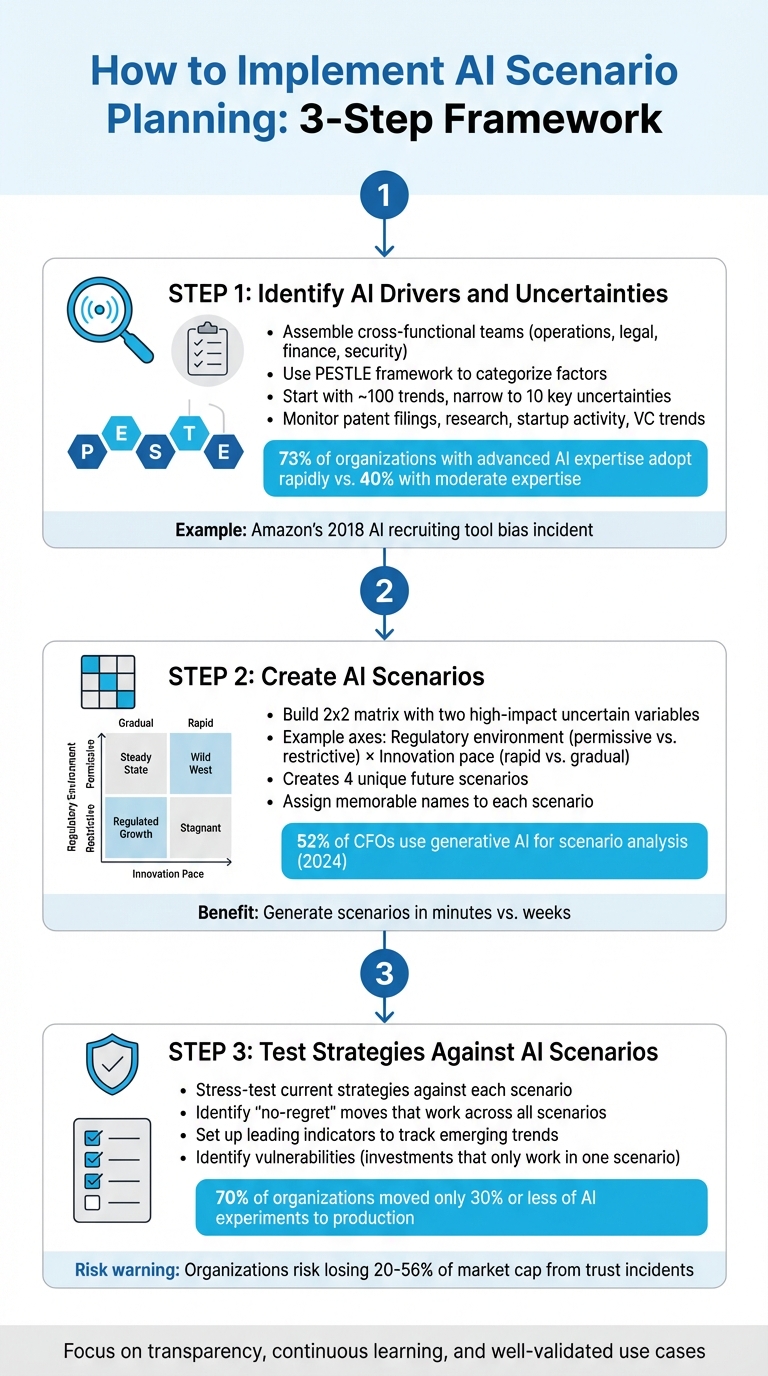
3-Step AI Scenario Planning Implementation Framework
Implementing scenario planning for AI requires a thoughtful blend of analysis and creativity. By following a structured process, you can navigate uncertainties and test strategies against multiple potential futures. Here’s a breakdown of the three key steps.
Step 1: Identify AI Drivers and Uncertainties
Start by mapping out the forces shaping your industry. Bring together cross-functional teams from operations, legal, finance, and security to brainstorm potential risks and opportunities. Reviewing past AI-related missteps can also provide valuable lessons. For instance, in 2018, Amazon had to abandon an AI recruiting tool after discovering it discriminated against resumes with the word "women." This bias arose from historical hiring data dominated by men[3]. Such cases highlight the importance of identifying early warning signs.
Organize your findings using frameworks like PESTLE to categorize factors such as technological advancements, ethical regulations, and market dynamics. Begin with a broad list - perhaps 100 trends - and then narrow it down to around 10 key uncertainties that could significantly impact your business[4]. Pay attention to both large-scale shifts ("megatrends") and smaller, emerging signals of disruption. Monitoring patent filings, new research, startup activity, and venture capital trends can provide additional insights.
For example, consider the adoption gap in AI: 73% of organizations with advanced AI expertise are adopting the technology rapidly, compared to just 40% of those with moderate expertise[1]. This disparity itself is a critical uncertainty - will your competitors outpace you?
Once you’ve identified and prioritized the key uncertainties, you’re ready to build structured AI scenarios.
Step 2: Create AI Scenarios
Using the uncertainties you’ve identified, construct distinct scenarios. A common approach is to create a 2x2 matrix by selecting two highly uncertain, high-impact variables. For example, one axis could represent the regulatory environment (permissive vs. restrictive), while the other reflects the pace of innovation (rapid vs. gradual). This framework produces four unique futures, each requiring different strategies[1].
For AI-specific scenarios, focus on factors like AI maturity in your industry, access to diverse datasets, and the ease of integrating AI systems[5]. Assigning memorable names to each scenario can make them easier to communicate and remember.
The objective isn’t to predict which scenario will happen but to ensure your organization is prepared for any of them. By 2024, 52% of CFOs were using generative AI to enhance scenario analysis, enabling them to generate multiple "what-if" scenarios in minutes rather than weeks[6].
Step 3: Test Strategies Against AI Scenarios
Once your scenarios are ready, stress-test your current strategies against each one. For every major initiative, ask, "Would this plan still work if a different scenario unfolds?" This step is critical - 70% of organizations have moved only a small portion (30% or less) of their generative AI experiments into production[1], exposing potential weaknesses in strategies reliant on overly optimistic conditions.
Focus on "no-regret" moves that hold value across all scenarios. These might include promoting transparency, fostering continuous learning, and prioritizing well-validated use cases[1][7]. Transparency is particularly crucial, as organizations risk losing between 20% and 56% of their market cap following trust-related incidents[1].
Set up leading indicators for each scenario to help you track emerging trends and pivot quickly when needed. This approach allows for real-time adjustments rather than waiting for an annual review.
Finally, identify vulnerabilities within your strategy. Are there investments that only succeed in one specific scenario? For example, if your plans heavily rely on autonomous AI agents but stricter regulations emerge, maintaining human oversight as a backup could safeguard your operations. This ensures you retain institutional knowledge and flexibility if AI returns on investment take longer than expected[1].
AI Tools and Resources for Scenario Planning
Using AI tools can significantly refine how you approach scenario planning. Modern platforms integrate predictive analytics, generative AI, and autonomous agents, enabling you to model various future scenarios with speed and precision that far surpasses traditional spreadsheet methods.
Top Tools for AI Scenario Planning
Anaplan Intelligence is a standout platform for enterprise-level scenario planning. It combines predictive, generative, and agent-based AI capabilities, managing 3.3 million integrations daily and supporting 2 million production models[8]. Anaplan's capabilities have earned it recognition as a 9X Leader in the 2025 Gartner® Magic Quadrant™ for Financial Planning Software[9].
Within the Anaplan suite, several tools offer specialized functionalities:
- CoPlanner uses generative AI and large language models to uncover patterns and simplify data visualization. You can ask conversational queries and get instant insights.
- PlanIQ focuses on enhancing predictive accuracy by analyzing both internal data and external market trends through machine learning and neural networks.
- Optimizer tackles complex resource allocation problems using linear optimization algorithms, making it ideal for tasks like territory planning and supply chain management.
Real-world examples illustrate the impact of these tools:
- Coca-Cola improved sales and demand forecasting accuracy by 20% using PlanIQ[10].
- Autodesk reduced forecast roll-up time by 80%, accelerating their go-to-market strategies with the Optimizer[10].
- Lumen Technologies cut quota-setting time in half with Predictive Insights[10].
Dany Krivoshey, Chief Digital and Transformation Officer at Unilever International Group, emphasized the scale of Anaplan's capabilities:
"Now with AI solutions, everything from integrating the information into the system, cleaning the information, then preparing the information for forecast, then running the [Anaplan Intelligence] statistical models at scale of our 300 million data rows - this is incredible!"[8]
These tools empower organizations to test and refine strategies more effectively within diverse AI-driven scenarios.
For smaller organizations or those exploring AI-enhanced planning, Excel Scenario Manager remains a practical option. While it lacks advanced AI features, it supports basic "what-if" analysis and can be enhanced with Python or R scripts for more complex modeling.
Tool Comparison
Selecting the right tool depends on your organization's specific needs, such as data complexity, scale, and readiness for advanced planning. Here's a quick comparison to help guide your decision:
| Tool | AI Capabilities | Best Use Case | Key Limitation |
|---|---|---|---|
| Anaplan CoPlanner | Generative AI, natural language interface | Identifying patterns in large datasets; ad-hoc analysis | Requires enterprise investment; steeper learning curve for smaller teams |
| Anaplan PlanIQ | Machine learning, neural networks | Enhancing demand and sales forecasting accuracy | Best for organizations with mature data infrastructure |
| Anaplan Optimizer | Linear optimization, prescriptive analytics | Addressing resource allocation challenges | Not designed for exploratory scenario generation |
| Excel Scenario Manager | Basic "what-if" analysis; Python/R integration | Small-scale testing; budget-conscious organizations | Limited scalability; no real-time updates |
When evaluating tools, prioritize those with strong data integration capabilities. Platforms should unify structured data (like financial records) with unstructured inputs (such as news or customer sentiment) and provide dynamic models that adjust to real-time shifts. Transparency is equally important - look for tools offering explainable AI outputs and secure data handling to maintain trust among stakeholders[6][10].
With 52% of CFOs now using generative AI for scenario planning[6], it's clear that businesses are moving away from static, annual plans toward continuous, AI-driven strategies. Start by identifying your most pressing challenge - whether it's supply chain management, workforce planning, or capital allocation - and choose the tool that aligns with that specific need[1].
Applications of AI Scenario Planning
AI scenario planning is reshaping industries, with its use varying significantly between tightly regulated fields like healthcare and finance and fast-changing markets such as retail and marketing.
In healthcare and finance, companies are turning regulatory hurdles into strategic advantages. By designing "compliance-first" AI systems for tasks like diagnostics and fraud detection, these organizations align with GDPR and other data governance standards. This approach not only helps them meet legal requirements but also builds trust with global enterprise clients. Meanwhile, competitors often struggle to keep up with these compliance demands, giving early adopters a clear edge[11].
Manufacturing and logistics companies tend to focus on applications that are both impactful and low-risk. For instance, they use scenario planning to implement predictive maintenance and AI-driven scheduling systems, reducing the chances of costly equipment breakdowns. This cautious approach reflects their preference for improving back-office operations rather than rushing into customer-facing AI solutions[11].
On the other hand, retail and marketing sectors operate at a faster pace. These industries rely on scenario planning to quickly test AI tools for customer interaction and content creation. With AI model costs dropping by 75% in the past two years and performance improving by 50%[11], staying ahead of the curve is critical. Falling behind even briefly could mean losing ground to more agile competitors.
These examples illustrate the importance of identifying uncertainties and testing strategies against multiple potential futures. Real-world case studies further emphasize the strategic benefits of AI scenario planning.
Case Studies in AI Scenario Planning
Siemens offers a compelling example of how early scenario planning can drive sustained growth. By analyzing trends like urbanization and digitalization, Siemens focused on "Smart Infrastructure" solutions well before competitors did. This foresight paid off, as the segment became the largest contributor to an 11% revenue increase in fiscal year 2023 for the $75 billion company[4].
Novo Nordisk took a similar approach in the pharmaceutical industry. Using scenario planning, the company anticipated shifts in healthcare priorities and patient needs, leading them to invest in GLP-1 obesity medications. These early investments secured a market-leading position in weight loss treatments, leaving competitors scrambling to catch up[4].
An unnamed semiconductor equipment manufacturer faced stagnant growth between 2014 and 2024. By leveraging scenario planning, the company identified new opportunities outside its core segments. This decision resulted in top-quartile shareholder returns of 20% annually over the decade - a remarkable turnaround[4].
The risks of neglecting scenario planning are equally clear. Failures like McDonald’s AI voice-order system misinterpreting customer requests and Air Canada’s chatbot error, which led to legal liabilities, highlight the financial and reputational dangers of insufficient planning[3].
These case studies reveal a consistent trend: organizations that invest in mapping out multiple AI futures - including potential failure scenarios - outperform those that rely on linear predictions. As Pierre Wack aptly noted:
"Predictive models are most likely to fail in the crucial moments of disruption, precisely when their guidance is essential"[3].
Scenario planning bridges this gap, equipping organizations to navigate unpredictable futures with greater confidence and adaptability.
Overcoming Challenges in AI Scenario Planning
Even the most advanced scenario planning can falter when biases or flawed data creep in. Organizations that identify and address these challenges early stand a better chance of navigating AI-driven disruptions. Let’s dive into practical ways to tackle these obstacles.
Managing Bias and Data Quality Issues
Cognitive biases, like availability bias (focusing on easily recalled information) and stability bias (resisting change), can dangerously narrow decision-making, especially when dealing with unpredictable changes. Social biases, such as groupthink, may stifle alternative viewpoints, while overconfidence can lead teams to underestimate uncertainties or dismiss potential risks outright [12].
A striking example comes from AI recruiting, where historical biases embedded in data skewed outcomes [3]. This highlights how bias in AI-specific data can perpetuate existing imbalances, directly impacting strategic planning.
To combat these challenges, organizations can adopt several approaches:
- Premortems: Encourage leaders to imagine a strategy has failed and analyze what might have gone wrong. This backward approach can uncover hidden risks.
- Cross-functional Workshops: Bringing diverse teams together can help identify blind spots and learn from others' near misses.
- Generative AI as a Sparring Partner: Use AI tools to explore unconventional scenarios and challenge assumptions [12][13].
Here’s a quick overview of common biases and how to mitigate them:
| Bias Type | Mitigation Strategy |
|---|---|
| Availability Bias | Expand your perspective beyond your industry or geography; leverage AI for broader horizon scanning [12] |
| Stability Bias | Engage senior leaders in creating "experiential" narratives; conduct premortems [12] |
| Social Bias | Normalize dissent within teams and use AI to provide objective, data-based counterpoints [12][13] |
| Data Bias | Use diverse training datasets and ensure human oversight in AI processes [3][13] |
These steps build on earlier scenario planning efforts, ensuring data accuracy and a balanced approach to foresight.
Avoiding Over-Reliance on Historical Data
While addressing biases is essential, relying too heavily on historical data can also be risky, especially when AI introduces rapid, non-linear changes. For instance, a major fast-food chain recently abandoned an AI pilot after it failed to adapt to dynamic, real-world conditions [3].
To navigate this, organizations must pair historical insights with forward-looking signals. These could include tracking patent filings, analyzing scientific research, monitoring startup activity, or observing venture capital trends [4]. This dual approach helps maintain agility in an ever-changing environment.
The 3C-AI Framework offers a structured way to approach scenario planning. It involves:
- Characterization: Mapping risks and uncertainties.
- Construction: Developing plausible future scenarios.
- Clustering: Prioritizing the most relevant scenarios.
- Assessing: Stress-testing strategies against these scenarios.
- Iteration: Continuously refining the process [3].
Another key tool is establishing signposts - leading indicators that signal which scenario might be unfolding [3]. And while AI can provide valuable insights, keeping humans in charge ensures that ethical judgment and critical thinking remain central when historical data proves unreliable [1][3].
As Voltaire aptly put it:
"Uncertainty is an uncomfortable position, but certainty is an absurd one" [4].
Conclusion
As artificial intelligence (AI) continues to transform industries, the need to prepare for an uncertain future has never been more pressing. Global enterprise investments in generative AI are expected to surpass $150 billion by 2027 [1]. Yet, despite this rapid growth, nearly 70% of organizations have transitioned only 30% or fewer of their AI experiments into production [1]. This gap often stems from a tendency to predict the future rather than preparing for multiple potential outcomes.
That’s where scenario planning makes a difference. It allows businesses to test strategies against a variety of possible futures, uncover vulnerabilities before they escalate, and recognize early signs of disruption in time to act [1][4]. Take DHL, for example - its focus on foresight enabled the company to weather significant trade disruptions, ultimately achieving record revenues of €94.4 billion in 2022 [2].
Organizations that adopt scenario planning can adapt swiftly during crises, seize emerging opportunities, and make confident decisions even in uncertain times [4][3]. This adaptability is crucial to managing AI’s unpredictable effects. Dr. Frank Appel, former CEO of DHL Group, captured this sentiment perfectly:
"In our volatile and connected world, traditional, linear forms of analysis have repeatedly been proven wrong. They, alone, simply aren't enough to help us anticipate and prepare for change" [2].
Key Takeaways
To navigate the evolving AI landscape, start by identifying key drivers and uncertainties in your industry - areas like trust, shifting regulations, or return on investment. Develop multiple plausible scenarios rather than relying on a single prediction, and stress-test your strategies against each one. Use signposts to track which direction the future is heading and prioritize "no-regret" actions that provide value no matter how AI develops [1][4][3].
Leverage the 3C-AI Framework - Characterization, Construction, Clustering, Assessing, and Iteration - to create a structured, repeatable process [3]. Bring together cross-functional teams, including strategy, legal, HR, and ethics, because AI risks extend far beyond IT [3]. While AI can accelerate scenario building and uncover insights, human judgment remains critical for addressing ethical challenges and ensuring accountability [1].
Ultimately, the organizations that succeed in the AI era won’t be the ones with the most precise predictions. Instead, they’ll be the ones that built resilience by preparing for uncertainty. By adopting this agile mindset, you can transform uncertainty into a strategic advantage.
FAQs
How does scenario planning help businesses adapt to AI-driven changes?
Scenario planning is a strategic approach that helps businesses prepare for the unpredictable changes brought by AI. Instead of betting on a single prediction, it involves exploring multiple potential outcomes by asking what-if questions. For example, what happens if AI adoption accelerates rapidly? What if regulations slow progress? Or how might a disruptive new business model reshape the landscape? By considering these possibilities, companies can challenge assumptions, spot emerging trends, and test strategies under different circumstances. The goal? To stay agile and ready for whatever the market throws their way.
Thanks to advancements in analytics and AI-powered tools, scenario planning is now quicker and more precise. These tools allow businesses to refine their scenarios in real time, ensuring strategies remain adaptable and backed by solid data. Beyond planning, this approach also helps companies pinpoint where to channel their resources - whether it's investing in workforce skills, upgrading infrastructure, or developing new products. By focusing on these priorities, organizations can allocate resources wisely and navigate uncertainty with greater confidence.
What are the steps to effectively use scenario planning for AI-driven innovation?
To effectively use scenario planning for AI-driven innovation, here’s a step-by-step approach:
- Define your focus and timeline: Start with a specific goal, like exploring AI's potential impact on your industry. Pair this with a clear time frame - say, the next three years.
- Understand stakeholders and use cases: Think about who will engage with the AI, such as customers or internal teams. Design scenarios that address their unique challenges and needs.
- Challenge assumptions: Take a hard look at assumptions you might be making, like the availability of data or the market's readiness for AI. This ensures your scenarios are grounded in reality.
- Create and refine scenarios: Leverage tools - including AI itself - to craft a range of "what-if" situations. Fine-tune these until they represent distinct, plausible futures.
- Test strategies: Assess how your current strategies hold up in each scenario. Use this to pinpoint areas that need improvement or opportunities you might be missing.
- Monitor trends: Keep an eye on key developments, such as breakthroughs in AI or shifts in regulations. Update your scenarios regularly to stay aligned with the latest changes.
Tech Leaders' programs are designed to help technical professionals master these steps. By bridging technical know-how with strategic insight, they prepare you to lead confidently in an AI-driven landscape.
What are the best AI tools for scenario planning in an evolving industry?
AI tools designed for scenario planning are reshaping how businesses prepare for the future. By blending data-driven decision-making, predictive modeling, and real-time responsiveness, these tools help companies stay ahead in a fast-changing world. The best ones combine cutting-edge AI with intuitive features, making it easier to predict and adapt to industry changes.
- Anaplan: This platform excels with its AI-focused approach. It automates data integration, runs predictive simulations, and delivers real-time insights, making it a go-to for finance, supply chain, and workforce planning.
- Cube: Cube simplifies forecasting and scenario analysis through AI-powered collaboration tools, enabling teams to make quick, well-informed decisions.
- Pigment: With its AI-driven modeling engine, Pigment helps teams efficiently create and compare multiple scenarios, turning raw data into actionable plans.
These tools equip business leaders with the confidence to tackle uncertainty head-on, turning potential risks into strategic advantages.