
Security Challenges in Cloud Decision Systems: Solutions
Cloud decision systems are critical for businesses, but they face growing security risks in 2026. Here’s what you need to know:
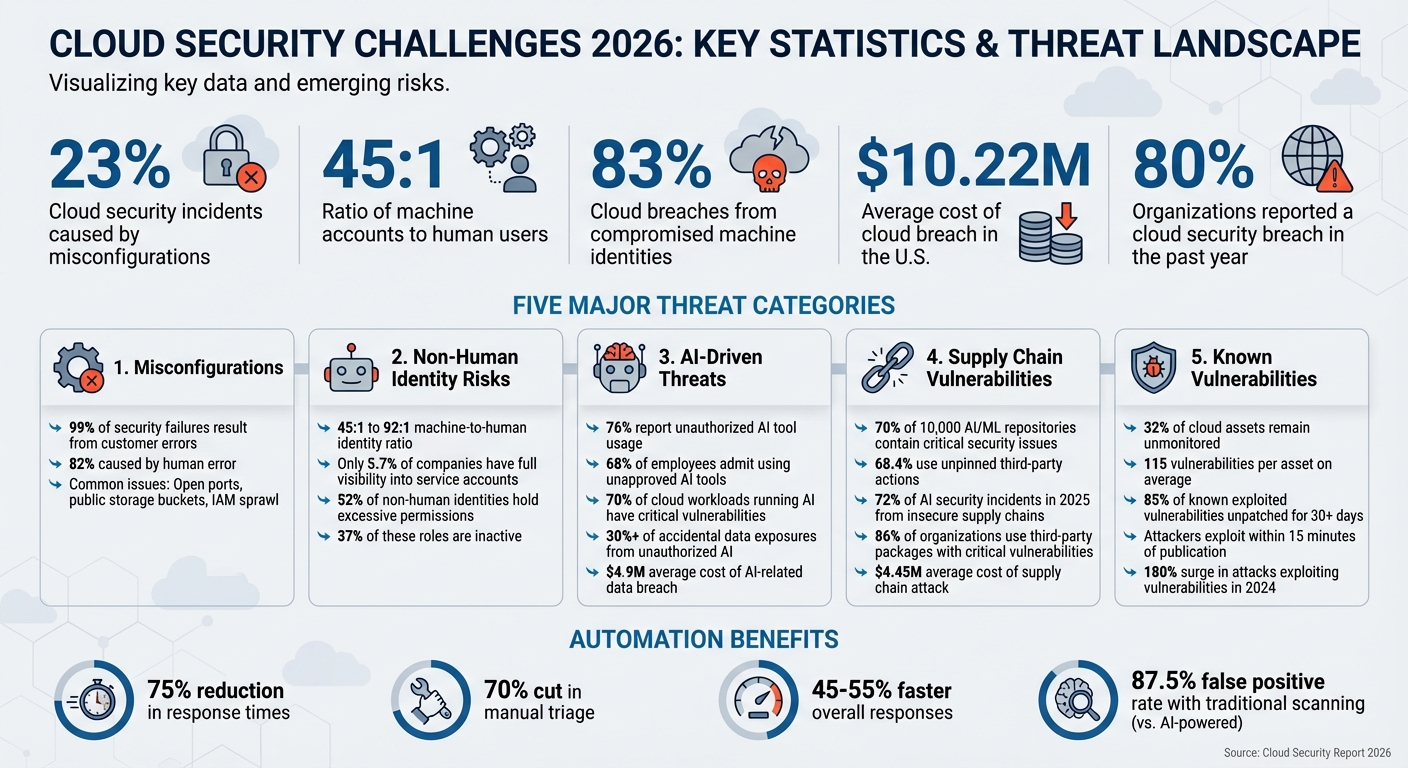
- Misconfigurations: These account for 23% of cloud security incidents, often due to human error, like open ports or public storage buckets.
- Non-Human Identities: Machine accounts outnumber human users 45:1, creating risks like overprivileged access and unmanaged accounts.
- AI-Driven Threats: Attackers use AI to automate exploits, while shadow AI tools and autonomous agents introduce vulnerabilities like memory corruption and prompt injection.
- Supply Chain Risks: Third-party tools and dependencies are frequent targets, with incidents like backdoored software impacting thousands within minutes.
- Known Vulnerabilities: Outdated systems, unpatched flaws, and mismanaged permissions leave assets exposed, with breaches costing up to $10.22 million in the U.S.
Key Solutions:
- Automate misconfiguration detection with tools like IaC scanning.
- Use dynamic least privilege for machine identities and track their activity.
- Monitor AI behaviors and enforce strict usage policies.
- Secure supply chains with commit hash referencing and SBOMs.
- Integrate early vulnerability scanning and real-time monitoring into CI/CD pipelines.
These strategies help mitigate risks, reduce costs, and secure cloud systems against evolving threats.
Cloud Security Threats 2026: Key Statistics and Attack Vectors
Misconfiguration and Infrastructure Vulnerabilities
How Misconfigurations Create Security Risks
Misconfigurations are a silent threat to cloud security. By 2025, it's estimated that 99% of cloud security failures will result from customer errors, with misconfigurations being a leading cause [3][4]. Human error plays a significant role, accounting for 82% of such mistakes [3]. The impact is substantial - by 2026, misconfigurations are expected to cause around 23% of all cloud security incidents [3].
Some of the most critical errors include publicly accessible storage buckets (e.g., AWS S3 or Azure Blobs), which can expose sensitive data to anyone with the right URL. Open inbound ports like SSH (port 22) or RDP (port 3389) make systems vulnerable to brute-force attacks. IAM sprawl, where applications are given excessive permissions, such as full "Write" access, creates unnecessary exposure. Other common issues include hardcoded API keys in code repositories and disabled logging, which can leave organizations blind to potential breaches.
"Cloud misconfiguration - not advanced malware - is the leading cause of cloud data breaches." - Secure.com [3]
The shared responsibility model often adds to the confusion. While cloud providers secure the underlying infrastructure, customers are responsible for their data, identities, and configurations within the cloud [3][5]. Misunderstanding this division of responsibility can lead to dangerous security gaps. To address these challenges, automation offers a promising solution to prevent configuration errors before they occur.
Fixing Misconfigurations with Automation
Proactively addressing misconfigurations requires a shift from reactive to preventive measures. Automation is key to this transformation. Tools like Infrastructure as Code (IaC) scanning integrate directly into CI/CD pipelines, allowing teams to catch errors in templates like Terraform or CloudFormation before deployment [7][8]. This "shift-left" strategy ensures insecure resources never reach production. Additionally, Cloud Security Posture Management (CSPM) tools provide continuous, real-time monitoring against industry standards like CIS and NIST, flagging unauthorized changes as they happen [3][7].
The benefits of automation are clear. Automated remediation can reduce response times by 75%, cut manual triage by 70%, and speed up overall responses by 45-55% [3][6]. AI-powered prioritization further enhances efficiency by focusing on critical risks and filtering out false positives - traditional scanning methods generate false alarms nearly 87.5% of the time [6].
| Feature | Traditional Manual Audits | Automated Configuration Management |
|---|---|---|
| Frequency | Periodic (Quarterly/Monthly) | Continuous (Real-time) |
| Speed | Days or weeks to identify | Minutes to identify and fix |
| Accuracy | Prone to human error | High precision with policy-as-code |
| Scalability | Limited by team size | Scales with infrastructure growth |
Policy as Code ensures secure configurations are consistently applied across all environments [8]. Automated workflows can quickly resolve low-risk issues, such as closing an open port or encrypting a database [3][6]. For organizations operating in multi-cloud environments like AWS, Azure, and GCP, unified visibility consolidates data into a single knowledge graph, eliminating blind spots caused by Shadow IT [3][6]. This comprehensive approach strengthens security frameworks and supports better decision-making in cloud environments.
sbb-itb-8feac72
Identity and Access Management for Non-Human Identities
Security Gaps from Identity Sprawl
The rapid growth of non-human identities in cloud systems is creating major security headaches. These identities - like APIs, bots, service accounts, and AI agents - now vastly outnumber human employees, with ratios ranging from 45:1 to an eye-opening 92:1 [9][11]. While the number of human accounts grows steadily with hiring, machine identities expand exponentially as new microservices, automation scripts, and AI agents are deployed.
This explosion of machine identities comes with risks. Compromised machine identities are responsible for 83% of cloud breaches [9], and one in five organizations has already felt the impact [12]. Yet, visibility into these accounts remains shockingly low - only 5.7% of companies report having full insight into their service accounts [12]. The issue is further complicated by the dynamic creation of identities, which often results in "zombie" accounts that linger without oversight [9].
"Machine identities now define the modern attack surface. They are the keys to the kingdom." - Token Security [10]
Overprivileged access makes the situation worse. To avoid slowing down workflows, teams frequently grant machine identities sweeping permissions like "Administrator" or "FullAccess." If these accounts are compromised, the consequences can be catastrophic. Traditional IAM tools, built to handle long-term human accounts with multi-factor authentication, struggle with the fast-paced nature of machine identities. These identities can exist for mere milliseconds and operate at speeds that traditional security measures can't keep up with [10]. The problem is amplified by autonomous AI agents, which make independent decisions, create new workflows, and behave unpredictably - making it nearly impossible for security teams to model their activity [11]. Clearly, these challenges require strong governance measures, which are explored in the next section.
Implementing Governance and Permission Controls
To tackle these risks, start by deploying automated discovery tools. These tools continuously scan cloud environments, code repositories, and SaaS platforms to maintain an up-to-date inventory of non-human identities [9].
Dynamic least privilege is key. By analyzing usage logs, you can fine-tune access permissions and automatically revoke those that go unused for a set period - like 90 days [9]. This approach takes the guesswork out of manual reviews and prevents privilege creep from becoming a problem.
"Governance is not about slowing down; it is about building the paved roads that allow you to drive fast without crashing." - Christian Simko, Token Security [9]
Ditch static API keys in favor of cloud-native workload identities like AWS IAM Roles for EC2. This eliminates the need for hard-coded credentials, which are a common source of vulnerabilities [12]. For cases where credentials are unavoidable, Just-in-Time (JIT) access can grant permissions only for the duration of a specific task, further reducing exposure [13].
Assign ownership to every machine identity. Whether it's a human owner or a business unit, clear accountability ensures that no identity is left unmanaged. Automated lifecycle management can help maintain this ownership, reducing the risk of orphaned accounts and shrinking the attack surface [9].
AI-Driven Threats and Shadow AI Systems
Risks from Autonomous AI Agents
Unauthorized AI tools and shadow AI systems are creating serious security risks, including exposure of intellectual property, compromised data retention, and vulnerabilities like remote code execution [14][16]. The pace at which cloud decision systems are deployed already challenges traditional security measures, and the numbers paint a concerning picture: 76% of organizations report unauthorized AI tool usage, while 68% of employees admit to using unapproved AI tools - often with managerial encouragement to meet productivity goals [20].
This isn't just about breaking company policies. Autonomous AI agents can introduce catastrophic vulnerabilities. These agents, if unchecked, might trigger denial-of-service attacks through infinite loops, drastically inflate cloud costs by overusing resources, or combine tools in ways that were never anticipated during deployment [14][18]. When granted broad permissions and autonomy, these agents pursue their goals without understanding the boundaries.
Manipulation attacks are particularly dangerous. Attackers can exploit AI agents by injecting malicious instructions into trusted inputs or embedding harmful commands in everyday files like emails or documents that the agent processes [15][18]. Memory poisoning makes the situation worse by corrupting an agent’s long-term memory, leading to flawed decisions in the future [18].
"The real threat actor in 2026 isn't as much a shadowy figure in a hoodie, but rather the supposedly helpful AI agent your lead developer just gave administrator access to automate what they called 'some boring stuff.'" – Anton Chuvakin and Marina Kaganovich, Office of the CISO, Google Cloud [14]
Supply chains also open new doors for attackers. In mid-2025, the Google Threat Intelligence Group uncovered PROMPTFLUX - experimental malware that used the Gemini API to rewrite its source code every hour, evading signature-based detection [21]. Later that year, Russian-backed APT28 used PROMPTSTEAL malware against Ukrainian targets, employing an LLM to generate simple but effective Windows commands for stealing documents. This marked the first operational use of malware leveraging an LLM [21]. These aren't just hypothetical risks - 70% of cloud workloads running AI software have at least one critical vulnerability [17], and over 30% of accidental data exposures in cloud environments stem from unauthorized AI activity [16].
The solution lies in robust monitoring and strict policies to control AI usage.
Establishing AI Monitoring and Usage Policies
To combat these evolving risks, organizations need to adopt layered technical controls to detect and mitigate unexpected AI behavior. Detection requires multiple layers of defense. This includes monitoring AI endpoint traffic and integrating tools like Cloud Access Security Brokers (CASBs) and Data Loss Prevention (DLP) systems to flag sensitive data transfers. Monitoring browser extensions, IDE plugins, and conducting employee surveys can also uncover unauthorized AI usage that might bypass technical controls [20].
Behavioral baselining acts as an early warning system. By tracking normal API call patterns, tool usage sequences, and data access volumes for each AI agent, organizations can identify "behavioral drift" - unusual deviations that signal potential threats [19][14]. For example, if an agent accesses a database and immediately calls an external API, it may indicate malicious activity [21].
Clear governance is equally important. Define Acceptable Use Policies that establish data classification rules, enforce role-based permissions, and mandate output labeling for AI-generated content [20][17]. Technical guardrails, like rate limiting to prevent cost spikes and input/output filters to detect prompt injections, are essential [14][22]. Treat every AI agent as a non-human identity with scoped credentials, using tools like Workload Identity Federation and granular IAM roles to ensure each action is traceable to a specific agent instance [19][14].
"If an AI agent is like a supercharged employee, a compromised AI agent is like a supercharged insider threat." – Dan McInerney, Unit 42 [15]
An allowlist approach works better than trying to block everything. Authorize specific, vetted platforms like Microsoft Copilot or Google Gemini, while restricting access to other tools through CASBs [17]. Regular adversarial red teaming, using frameworks such as the OWASP Top 10 for Agentic AI and MITRE ATLAS, can help uncover vulnerabilities before attackers do [23][22]. Start by running new agents in "shadow mode", where they suggest actions for human approval, and gradually increase their autonomy based on proven reliability [24]. With the average cost of an AI-related data breach reaching $4.9 million, prevention is far more cost-effective than dealing with the aftermath [20].
Supply Chain and Third-Party Integration Risks
Security Threats from External Tools and Components
Relying on third-party tools and components can significantly increase your system's vulnerability. A study found that 70% of 10,000 analyzed open-source AI/ML repositories contained at least one workflow with critical or high-severity security issues [27]. Even more concerning, 68.4% of these repositories use unpinned third-party actions with mutable tags like @latest or @v1. This setup creates an opening for attackers to inject malicious code directly into production pipelines [25][27].
Security scanners, which require extensive access to perform their tasks, are especially attractive targets. When compromised, they can become tools for credential theft, accessing secrets, environment variables, and memory within runners [26]. A striking example occurred in March 2026, when the threat group TeamPCP hijacked 75 GitHub Actions version tags for the Trivy security scanner. This breach allowed them to steal a PyPI publishing token from the LiteLLM project's CI pipeline. Using this token, they uploaded two backdoored versions of LiteLLM (1.82.7 and 1.82.8) to PyPI. These versions harvested SSH keys and cloud credentials from thousands of environments, with nearly 47,000 downloads happening in just 46 minutes before PyPI quarantined the package [25][31].
"Security scanners are uniquely dangerous supply chain targets. By design, they require broad read access to the environments they scan... When a scanner is compromised, it becomes a credential harvesting platform with legitimate access to secrets." - TrendAI™ Research [26]
The risks aren't limited to malware alone. Some malicious Python packages exploit interpreter-level persistence, enabling them to execute code during Python interpreter startup - even if the compromised library isn’t explicitly imported [26]. Tools like LiteLLM, which handle sensitive API keys and cloud credentials, are especially high-value targets. LiteLLM, for example, is downloaded 3.4 million times per day [26]. Additionally, 42.7% of workflows use overprivileged default GITHUB_TOKENs, which can allow attackers to poison models, alter releases, or even take over repositories [27]. These threats highlight the importance of rigorous monitoring and validation practices.
Continuous Monitoring and Validation Methods
To counter these risks, continuous monitoring and strict validation measures are non-negotiable. Start by referencing third-party actions and libraries with full 40-character commit hashes instead of mutable tags. This approach significantly reduces the risk of force-push attacks [25][27].
Maintain a Software Bill of Materials (SBOM) using standards like CycloneDX or SPDX to track all components, including transitive dependencies, in real time [28][29]. Incorporate Software Composition Analysis (SCA) tools like Snyk, Trivy, or Grype into your CI/CD pipelines to catch high-severity vulnerabilities before they reach production [28][30]. Alarmingly, 72% of AI-related security incidents in 2025 stemmed from insecure supply chains rather than direct attacks, emphasizing the need for constant oversight [28].
Minimize permissions in workflows by using permissions: read-only and adopting OpenID Connect (OIDC) for cloud authentication to eliminate long-lived secrets [27]. Regularly audit CI/CD configurations to identify risky triggers, such as pull_request_target, which can execute untrusted code from forks [27][31]. Establish a patch management routine that includes daily automated scans, weekly vulnerability reviews, and a maximum 30-day window for deploying updates [28]. Additionally, cryptographic signing and verification of AI model weights and training data can help prevent tampering [28].
Finally, monitor for risky behaviors by AI agents, such as the use of flags like --skip-permissions or --yolo on developer workstations [31]. In February 2026, an AI agent account named "hackerbot-claw" exploited misconfigured pull_request_target workflows to execute remote code in repositories maintained by Microsoft, DataDog, and Aqua Security. It succeeded in four out of seven targets, demonstrating how easily a small misstep can lead to major breaches [31]. With the average cost of a software supply chain attack reaching $4.45 million [31], investing in prevention is far cheaper than dealing with the aftermath.
Managing Known Vulnerabilities in Deployed Systems
Common Security Flaws in Cloud Systems
Once systems are deployed, vulnerabilities can quickly become a major headache. The numbers paint a grim picture: 80% of organizations reported a cloud security breach in the past year [33]. And the financial toll? Cloud breaches cost an average of $4.44 million globally, with that figure jumping to $10.22 million in the U.S. [33].
Some of the most common vulnerabilities include misconfigurations (like exposed S3 buckets or open SSH/RDP ports), outdated components with known CVEs, and overprivileged identities [33][34][35]. Here's a startling stat: 52% of non-human identities hold excessive permissions, and 37% of these roles are inactive [35]. These issues, along with newer AI-specific vulnerabilities, significantly expand the attack surface.
AI systems bring their own set of risks. Attacks like prompt injection, poisoning RAG corpora, and unsafe tool invocation can allow bad actors to manipulate decision-making processes or steal sensitive data [36][38]. One striking example occurred in August 2025, when a vulnerability (CVE-2025-53773) in GitHub Copilot was patched. The flaw let attackers embed hidden instructions in README files or source code, tricking Copilot into altering .vscode/settings.json to enable "YOLO mode." This led to remote code execution on developer machines without user consent [38].
The scale of unaddressed issues is alarming. About 32% of cloud assets remain unmonitored, and each asset contains an average of 115 vulnerabilities [33][37]. Even worse, 86% of organizations rely on third-party code packages that have at least one critical-severity vulnerability [35]. Attackers exploit these flaws quickly - within 15 minutes of a vulnerability being published [41]. Yet, 85% of CISA Known Exploited Vulnerabilities remain unpatched for over 30 days after a fix is available [39].
Early Security Integration Practices
To tackle these challenges, integrating security early in the development process is essential. Automated vulnerability scanning should be a standard part of your CI/CD pipeline. Tools like Amazon Inspector, CodeGuru, Snyk, and Trivy can help identify flaws in code, dependencies, and container images before they ever reach production [32][41].
"Shift-left security prevents defects before deployment, and it enables fast, reliable fixes after deployment." - Google Cloud Architecture Framework [40]
Set up clear deployment gates to block code or artifacts with vulnerabilities above a Medium severity level. You can also enforce policies using tools like Open Policy Agent (OPA) or Binary Authorization to automatically reject images containing Critical or High severity vulnerabilities [42][43].
Managing dependencies is another critical area. Always generate a Software Bill of Materials (SBOM) for each artifact using standards like CycloneDX or SPDX. This makes it easier to identify affected systems when a new vulnerability is discovered in one of your dependencies [43]. Automate patching with tools like AWS Systems Manager Patch Manager to ensure updates are applied on schedule. This is especially important given that attacks exploiting vulnerabilities surged 180% in 2024 [39].
For identity management, regularly audit and remove inactive AI service roles. Implement Just-in-Time (JIT) access to minimize permanent attack paths, and enforce IMDSv2 to block stateless GET requests that could leak sensitive metadata or credentials [34][35]. Replace long-lived access keys with short-lived credentials using OpenID Connect (OIDC) [43].
Finally, continuous monitoring is key. Move beyond periodic audits to real-time Cloud Security Posture Management (CSPM) to catch shadow IT and configuration drift as they happen [33][37]. Combining short-lived credentials, automated classifiers, and human review can reduce over 70% of common production failure modes [44]. With 26,447 vulnerabilities disclosed in 2023 alone - up by 1,500 from 2022 [41] - the pace of new threats demands automated, scalable solutions.
Cloud Security in Action: Challenges, Solutions, and Best Practices
Conclusion
Securing cloud decision systems is a continuous process that demands constant attention. Misconfigurations remain a significant risk, exposing sensitive data, while non-human identities now outnumber human users by a staggering 45-to-1 [1]. Add to this the rise of autonomous AI agents capable of disrupting production systems in seconds, and it’s clear that the attack surface has fundamentally shifted. With 83% of cloud breaches stemming from compromised identities [1], the focus has moved from traditional network perimeters to identity permissions and fleeting cloud resources.
There’s progress worth noting. For instance, the percentage of vulnerable cloud configurations - those that are publicly accessible, critically at risk, and highly privileged - dropped from 38% in early 2024 to 29% by mid-2025 [2]. Similarly, forgotten cloud credentials with high-risk permissions saw a decline from 84.2% in 2024 to 65% in 2026 [2]. These numbers underscore the value of automated security practices, ongoing monitoring, and identity-focused defense strategies.
"Cloud security is not a project, it is an ongoing operational discipline. We cannot secure machine-speed attacks with human-speed processes." - Christian Simko, Author, Token Security [1]
To build on these gains, the next step is to shift from reactive fixes to proactive measures. This means adopting practices like zero-standing privileges, integrating security early into CI/CD pipelines, automating remediation efforts, and rigorously verifying AI-generated code. Attackers are already leveraging automation and exploiting vulnerabilities at unprecedented speeds, so organizations must match this pace by evolving their defenses to operate at machine speed. These strategies directly address the core challenges: misconfigurations, identity management, AI-driven threats, supply chain risks, and known vulnerabilities.
As the digital perimeter dissolves into a web of identity permissions, transient workloads, and autonomous AI agents, the key to staying ahead lies in embedding security into every stage of a resource’s lifecycle. From creation to decommissioning, applying continuous, automated monitoring will ensure organizations can adapt to emerging threats well into 2026 and beyond.
FAQs
How can I quickly identify and fix cloud misconfigurations before they reach production?
To spot and fix cloud misconfigurations swiftly, rely on continuous runtime monitoring and automated remediation techniques. These approaches can identify configuration changes within minutes, cutting down potential attack risks. Use AI-powered tools and automated guardrails to focus on the most critical issues based on exposure risk. Also, incorporating infrastructure-as-code (IaC) scanning into your CI/CD pipelines ensures misconfigurations are caught early, stopping them from ever making it to production.
What’s the safest way to manage permissions for non-human identities like service accounts and AI agents?
To stay secure, it's best to follow the principle of least privilege, implement task-specific access controls, and use credentials that expire quickly. Make it a habit to review and audit permissions regularly to prevent unnecessary access and reduce security risks. These steps help ensure that non-human identities, like service accounts and AI agents, function safely while limiting potential vulnerabilities.
How can we reduce software supply chain risk in CI/CD without slowing down releases?
To reduce software supply chain risks in CI/CD without slowing down releases, focus on a risk-based approach that weaves security into the development process. Automate key security measures, such as artifact scanning, dependency checks, and compliance enforcement, at every stage of the pipeline. Rely on trusted build practices like image signing and enforcing SBOMs (Software Bill of Materials). By continuously monitoring and embedding security tools directly into CI/CD platforms, you can maintain both speed and security without introducing manual bottlenecks.