

Why Social Perception Matters for Charismatic Leaders
Great leadership in tech isn’t just about technical skills - it’s about understanding people. Social perception, or the ability to read and respond to emotions and unspoken cues, is a critical skill that many tech leaders overlook. Without it, even highly skilled leaders risk miscommunication, lower team morale, and poor project outcomes.
Here’s why social perception is essential:
- 70% of digital transformation success depends on people, not technology. Yet, 70% of leadership messages fail to connect with teams.
- Leaders who actively listen improve project success rates by 46%, while unresolved conflicts cut productivity by over 30%.
- Poor social perception leads to disengaged teams, flawed decisions, and higher employee turnover.
The good news? Social perception can be developed. By practicing active listening, acknowledging uncertainty, and using empathy, leaders can build stronger connections, improve team dynamics, and drive better outcomes. Programs like Tech Leaders’ coaching offer practical tools to help tech professionals grow from individual contributors to effective leaders.
Key takeaway: Understanding and connecting with your team isn’t optional - it’s the foundation of successful leadership in today’s tech-driven world.
The Problem: Poor Social Perception Weakens Leadership
What Social Perception Means in Leadership
Social perception is the skill to read, interpret, and respond to the emotions and needs of others effectively. For tech leaders, this goes beyond listening to words - it’s about understanding the deeper meaning behind them. It could involve noticing when a team member seems disengaged, picking up on unspoken tension during a meeting, or identifying subtle signs that a project is veering off course.
In high-pressure tech environments, the brain cycles between rational thinking, emotional reactions, and survival instincts [2]. When people feel unsafe, their emotional brain takes over, triggering survival responses that block rational thought and problem-solving.
"The emotional brain... is also the gatekeeper that decides on whether we can even access the rational brain - if we do not feel safe enough... the emotional brain will signal the survival brain to 'get into action'" - Charlotte de Jong Schouwenburg, Business Psychologist and Co-founder of Bravely [2]
This isn’t just theory - it’s how our brains are wired. When leaders fail to address emotional cues, they unintentionally activate this "gatekeeper", shutting down the cognitive abilities their teams need to tackle challenges. This disconnect can quickly lead to negative outcomes, especially in fast-paced, high-stakes environments.
What Happens When Leaders Lack Social Perception
When leaders miss nonverbal cues, the consequences ripple through their teams. Over half of communication - 55% - is nonverbal [3]. Leaders who focus solely on spoken words risk missing critical signals, like an engineer who’s unusually quiet in meetings, unspoken tension between colleagues, or body language that contradicts verbal feedback.
The business impact of this oversight is staggering. Leaders with strong social awareness and emotional intelligence outperform their peers by 127% in measurable business outcomes [3]. On the flip side, unresolved conflicts and poor team dynamics can reduce productivity by over 30% [1], worsening the talent shortages already plaguing the tech industry.
A lack of social perception also leads to flawed decision-making. Leaders may fall into confirmation bias or emotional projection, misinterpreting team dynamics and missing key informal influencers [3]. Instead of addressing the real drivers of team behavior, they rely on rigid organizational charts, leading to decisions based on incomplete or inaccurate information. This creates initiatives that lack team buy-in and leaves teams stuck in survival mode - unable to shift into the creative and problem-solving mindset needed for success.
sbb-itb-8feac72
Social Perceptions in Leadership
Why Leaders Struggle with Social Perception
Several leadership traits can unintentionally undermine team communication, especially when combined with poor social perception.
Overconfidence and Jumping to Conclusions
Leaders with technical backgrounds often approach problems with the precision of debugging code, expecting human behavior to follow predictable patterns. This mindset can backfire in leadership roles, where emotional dynamics play a significant role in team behavior [4]. The same rationality that drives success in engineering can become a weakness if it overlooks these nuances.
Studies indicate that leadership effectiveness drops when charismatic behavior is overdone [6]. Overconfident leaders are particularly prone to ignoring problems and dismissing feedback, creating blind spots that limit growth [6]. By failing to recognize social cues, they risk putting their teams in a defensive mode, which can stifle creativity and innovation [7].
A well-known example of this was Steve Jobs during Apple's 2010 "Antennagate" crisis with the iPhone 4. Despite ongoing complaints from carriers about technical issues, Jobs reportedly dismissed the concerns and shifted blame to other phone manufacturers and network providers [6]. This incident shows that technical skill alone cannot make up for a lack of emotional awareness in leadership.
Discomfort with Uncertainty
Another challenge for leaders is managing ambiguity. Unlike computers, which operate predictably, humans bring biases, emotions, and unpredictability into the mix. Leaders who struggle with uncertainty often cling to their current reality, viewing alternative ideas or experimental approaches as threats [5]. This discomfort can lead to rushed decisions that fail to consider the human dynamics at play.
The numbers tell a concerning story: nearly 73% of employees report feeling disconnected from their company’s mission when their leaders lack inspirational qualities [1]. This disconnect often stems from leaders who prioritize certainty over understanding, missing the chance to foster alignment and engagement within their teams.
Dismissing Different Viewpoints
The independent, problem-solving mindset that works well for engineers can become a drawback in leadership. Many emerging leaders default to completing tasks on their own, overlooking delegation or the value of alternative perspectives [4]. This approach can create what researchers call the "yes people" cycle, where team members stop offering dissenting opinions and simply go along with the leader’s ideas [6]. The result? A lack of diverse input that hinders innovation and prevents critical insights from surfacing.
"Unethical charismatic leaders will focus on their own personal goals and build their message based on themselves... They will strike back like bullies when they hear criticism."
- Robert Sutton, Professor, Stanford University [6]
On the flip side, leaders who develop strong listening skills see a 46% improvement in project success rates compared to those who dominate conversations [1]. Transitioning from technical expert to effective leader requires embracing empathy and social interaction - skills that many in tech roles still struggle to master [2]. Without these, the ability to integrate diverse perspectives remains out of reach, setting the stage for further challenges in leadership.
How to Improve Social Perception
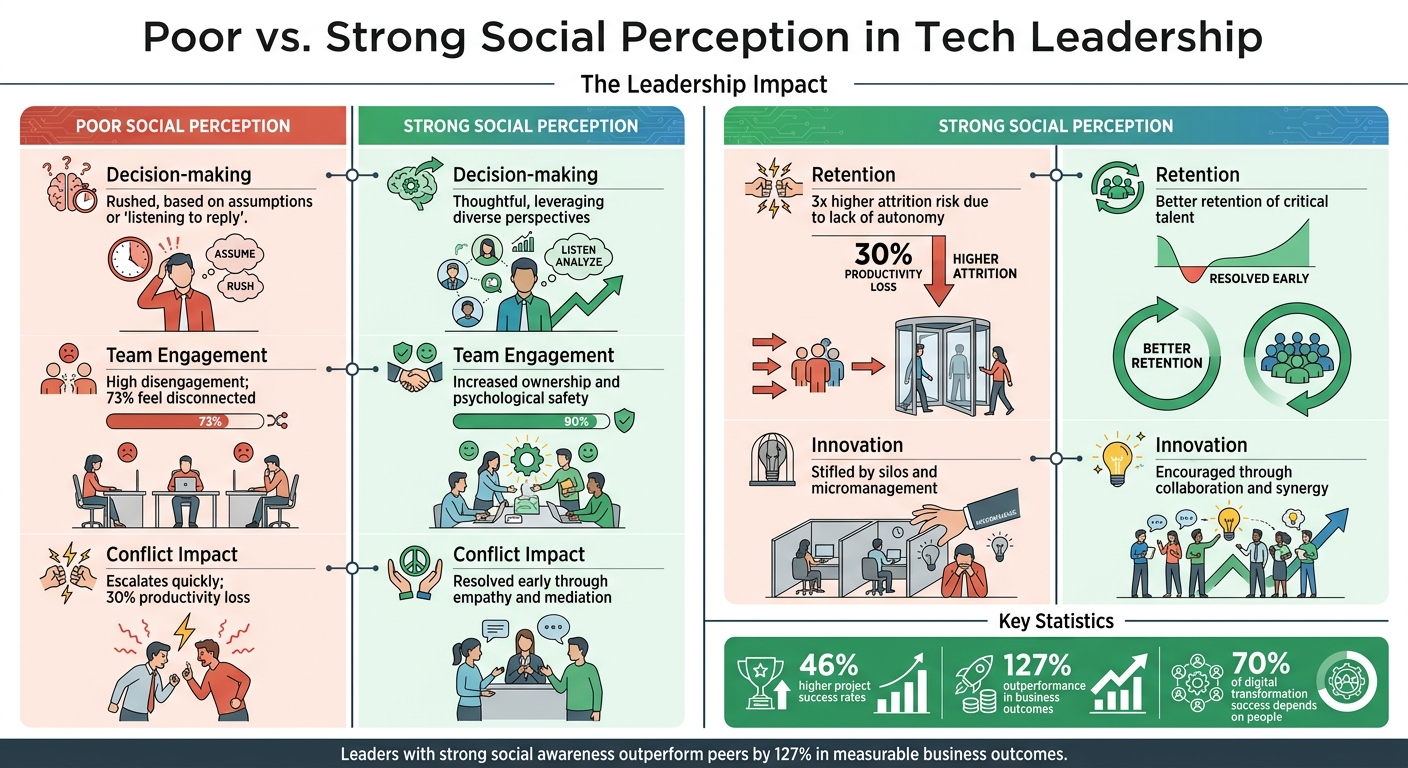
Impact of Social Perception on Tech Leadership Performance
Bridging the gap between technical skills and social awareness is entirely possible with intentional effort. Strengthening social perception is key to combining technical know-how with emotional leadership. Let’s explore some practical ways to enhance this essential skill.
Practice Active Listening and Embrace Different Perspectives
Did you know that people spend nearly half of their waking hours listening? Yet, much of this listening is surface-level - focused on crafting a response rather than truly understanding [8]. For tech leaders, breaking this habit can transform how they connect with their teams. The LRA Model offers a simple framework:
- Listen with genuine curiosity.
- Reflect back what you’ve heard to confirm understanding.
- Ask open-ended questions to dig deeper [8].
This shift from "listening to reply" to "listening to understand" means paying attention not just to words, but also to emotions and body language.
"Listening is one of the easiest skills to understand, yet one of the most challenging habits to change" - Brad Schwartz, Tech Leaders Coach [8]
To make this a habit, try placing a reminder - like a Post-it note that says "Stay curious" - on your desk. Use phrases such as "It sounds like..." or "It seems..." during discussions to reflect what you hear and invite clarification [8][2].
Another critical element is creating psychological safety. When team members feel safe to voice concerns without judgment, they remain in a rational mindset, which is crucial for solving problems [2][1]. Leaders who excel at listening often see 46% higher project success rates compared to those who dismiss input [1].
Get Comfortable Saying 'I Don't Know'
Admitting uncertainty can feel awkward, especially for leaders accustomed to having all the answers. However, acknowledging when you don’t know something builds trust and prevents hasty decisions that could lead to mistakes.
Saying "I don't know" signals openness and encourages a culture of learning. It also helps avoid overconfidence, which can create blind spots in leadership. This transparency is particularly important in tech, where over 70% of digital transformation success depends on people and culture, not just technology [1].
When leaders model vulnerability, they make it easier for others to do the same. This creates an environment where team members feel safe sharing ideas and challenges, fostering stronger collaboration and problem-solving.
Use Empathy to Strengthen Team Connections
Empathy doesn’t mean agreeing with everyone - it means understanding and connecting.
"Empathy isn't about being agreeable. It's about being connected" - Christopher Downard, Engineering Leader [9]
Strong social perception helps leaders identify burnout, notice when quieter voices are being overlooked, and address issues early before they escalate.
The LSD Technique provides a practical approach for tense situations:
- Listen carefully.
- Summarize both the content and emotions.
- Direct the conversation with an open-ended question [2].
For example, a project manager named Sarah used this method when a developer, Alex, expressed frustration over a tight deadline. She acknowledged his stress about maintaining quality, then asked, "What do you think we could do to prioritize the most critical features while still meeting the deadline?" This shifted the conversation from defensiveness to collaboration [2].
When giving feedback, focus on what you want to see "more of" rather than emphasizing mistakes. This approach sets clear expectations while minimizing defensiveness [2].
Comparison: Poor vs. Strong Social Perception
The impact of social perception - or the lack of it - shows up clearly in leadership outcomes:
| Feature | Poor Social Perception | Strong Social Perception |
|---|---|---|
| Decision-making | Rushed, based on assumptions or "listening to reply" [8] | Thoughtful, leveraging diverse perspectives [8] |
| Team Engagement | High disengagement; 73% feel disconnected [1] | Increased ownership and psychological safety [2][1] |
| Conflict Impact | Escalates quickly; 30% productivity loss [8][1] | Resolved early through empathy and mediation [1] |
| Retention | 3x higher attrition risk due to lack of autonomy [1] | Better retention of critical talent [1] |
| Innovation | Stifled by silos and micromanagement [1] | Encouraged through collaboration and synergy [8][1] |
Unresolved conflicts can reduce productivity by over 30%, while engineers lacking autonomy are 3x more likely to leave their roles [1]. Improving social perception takes dedication, but the rewards - better team dynamics, higher retention, and improved outcomes - are well worth the effort.
How Tech Leaders Develop Perception-Driven Leadership
Tech Leaders takes the principles of social perception and weaves them into leadership programs designed specifically for technical professionals.
These programs focus on helping leaders transition from being individual problem-solvers to becoming team enablers. Duncan Stimpson refers to this as "the hidden shift" - a mindset change that encourages experts to step away from micromanaging tasks and instead prioritize fostering team growth [10].
Engineering Leadership Training for AI-Driven Industries
One of the key frameworks taught by Tech Leaders involves recognizing three distinct brain states: Rational (focused on logic), Emotional (centered on empathy), and Survival (fight, flight, or freeze) [2]. This model equips tech professionals with a practical way to assess a room's dynamics during challenging discussions or critical meetings.
Leaders are trained to identify these states through subtle non-verbal cues like eye contact, posture, breathing patterns, and tone of voice [2]. For example, a team member in the Survival state might avoid eye contact, exhibit tense body language, and breathe shallowly - indicators that they need reassurance and psychological safety before they can contribute effectively to problem-solving [2].
The program also highlights "influencing without authority" - a vital skill for tech leaders. This involves translating complex technical concepts into actionable insights that resonate with non-technical stakeholders [10]. To further enhance leadership capabilities, participants undergo assessments focusing on personality traits and emotional intelligence, which help uncover blind spots and natural tendencies [10].
"Technical leadership development isn't about fixing people, it's about supporting high performers through a complex shift from expert to enabler." - Duncan Stimpson, Author, Thomas.co [10]
Personalized Coaching and Peer Masterminds
Tech Leaders combines personalized coaching with peer mastermind groups to create a balanced and practical learning experience. One-on-one coaching focuses on emotional regulation, using mindfulness techniques to help leaders shift from reactive survival states to more rational, solution-oriented approaches [2]. Tools like Offman's Core Quadrants are introduced to help leaders better understand their strengths, potential weaknesses, and personal triggers.
The peer mastermind groups provide a collaborative space where participants can practice these new skills with others who are navigating similar challenges. These sessions often include anonymous peer feedback, giving leaders an opportunity to compare their self-perception with how their team views them. This process helps pinpoint gaps in social perception and accelerates their growth as leaders [1].
This combination of coaching and peer interaction is especially critical in today’s tech-driven environments, where over 70% of digital transformation success depends on people and culture [1].
Conclusion
The ability to improve social perception plays a key role in achieving success as a tech leader. Leaders who can interpret social cues, grasp team dynamics, and respond with empathy are proven to deliver up to 46% higher project success rates, while avoiding over 30% productivity losses caused by unresolved conflicts [1][11]. They also influence decision-making with 40% greater effectiveness [11]. Considering that 70% of digital transformation success hinges on people and culture rather than technology, strong social perception is what sets apart leaders who inspire from those who simply manage [1].
The good news? Social perception is a skill that can be developed with consistent effort. Techniques like mirroring, active listening, and adapting to team feedback can boost a leader's perceived charisma by 35% within six months [11]. Structured training combined with honest feedback can transform even the most technically focused professionals into leaders who truly empower their teams.
To help leaders grow in this area, Tech Leaders offers specialized training centered on understanding brain states, managing emotions, and influencing without formal authority. These programs are designed to help leaders navigate the intricate human dynamics within modern engineering teams.
If you're ready to move beyond technical expertise and step into impactful leadership, Tech Leaders provides engineering leadership training and personalized coaching to equip you with the tools you need. Developing social perception is the first step toward becoming a leader who inspires - and it all begins with how well you understand and connect with those around you.
FAQs
How do I know if I’m missing key social cues at work?
If your colleagues frequently feel dismissed, interrupted, or stressed without you realizing it, you might be overlooking social cues. Take some time to observe team dynamics and assess whether you're accurately picking up on emotions and reactions during conversations. Reflecting on these interactions can reveal blind spots, help you become more attuned to others' feelings, and enhance both your emotional awareness and leadership skills.
What can I do in meetings to build psychological safety fast?
Creating a space where everyone feels comfortable sharing their thoughts without fear of judgment is key to building psychological safety in meetings. Start by showing genuine interest in what others have to say. Actively listen to their ideas and make it clear that diverse perspectives are not just welcomed but valued.
Encourage participation by setting clear expectations for open dialogue. Acknowledge contributions - big or small - to show that every voice matters. When people see their input being respected, it fosters trust and openness. By taking these steps, you can cultivate a meeting environment where ideas and concerns are shared freely, leading to more productive and engaging discussions.
How can I improve empathy without sounding insincere?
To genuinely build empathy, start by practicing active listening. Pay close attention to what others are saying without interrupting or rushing to respond. Make an effort to truly understand their perspectives instead of relying on surface-level gestures that might come across as insincere.
Another important step is to validate their feelings. Acknowledge their emotions and respond with thoughtfulness, showing that you care about their experiences. Observing and learning from leaders who prioritize self-awareness can also provide valuable insights into how empathy can be practiced effectively.
At its core, empathy thrives on authentic engagement. When you genuinely connect with others, you build trust and ensure your actions come across as heartfelt rather than performative.