

Ultimate Guide to Stakeholder Consensus
Stakeholder consensus is about finding broad support for decisions by addressing key concerns, not achieving unanimous agreement. It’s especially useful for high-stakes decisions like platform migrations or setting company-wide policies. Here's how to make it work:
- Understand Related Concepts: Consensus differs from alignment (shared understanding), buy-in (commitment to execute), and command decisions (leader-driven calls). Use consensus for decisions that impact multiple teams and are hard to reverse.
- Map Stakeholders: Identify who’s affected and their level of influence. Use a power-interest grid to prioritize engagement efforts.
- Set Clear Criteria: Define measurable goals upfront (e.g., cost limits, performance targets) to keep discussions focused.
- Use Structured Methods: Techniques like single-text drafting, decision matrices, and joint fact-finding streamline the process and reduce conflicts.
- Leverage Tools: Digital platforms like shared documents and virtual whiteboards help organize input, especially for distributed teams.
- Handle Deadlocks: When discussions stall, refocus on shared facts or break into smaller groups for deeper analysis.
Consensus-building isn’t about perfection - it’s about resolving key objections and moving forward efficiently. By following a structured process, you can save time, avoid resistance, and make decisions that stick.
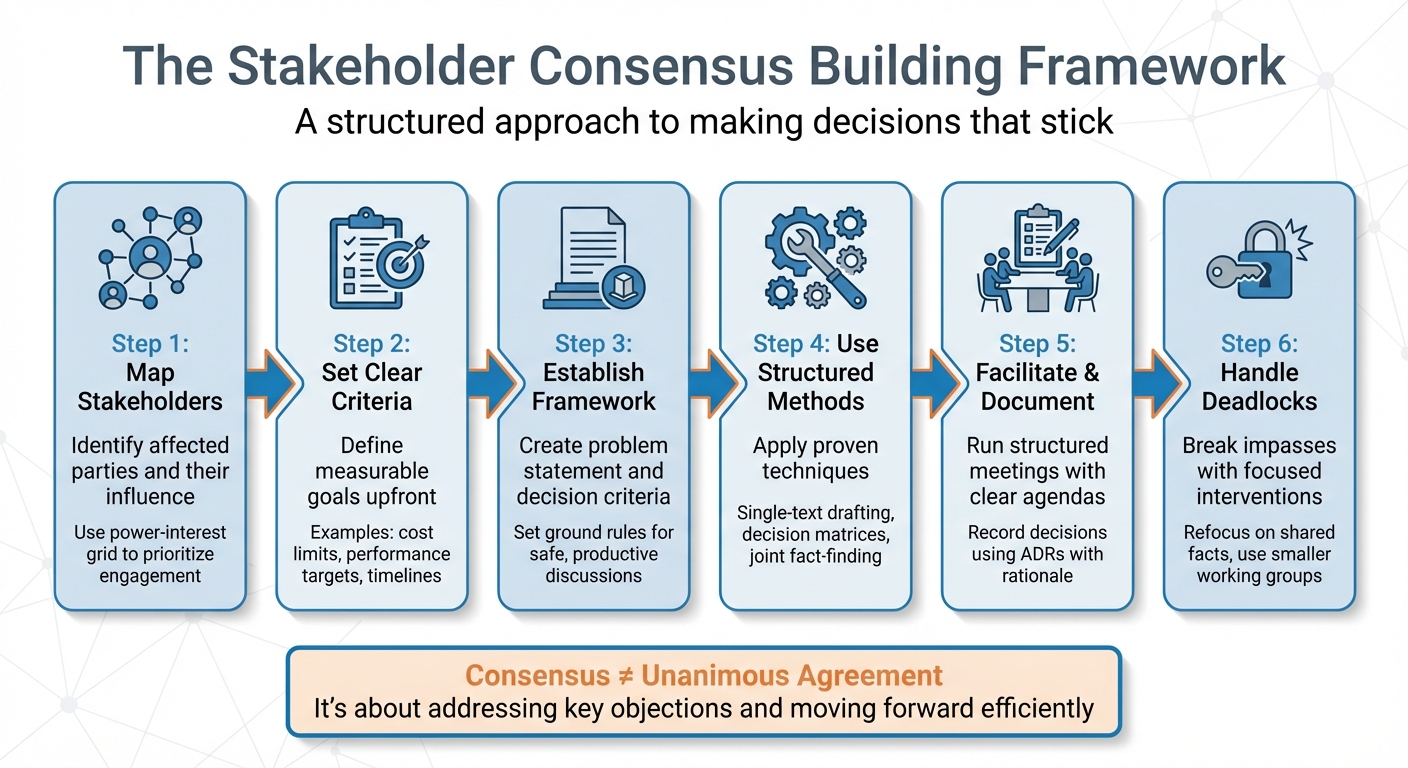
Stakeholder Consensus Building Framework: 6-Step Process
How Can Consensus Be Built Among Diverse Stakeholders?
Core Principles of Consensus Building
Start with the basics: define who’s involved, the scope of decisions, and how collaboration will work. Skipping these steps can turn meetings into a mess of inefficiency.
Identifying and Mapping Stakeholders
Begin by listing everyone affected by or influential in the decision. For something like a platform migration, this might include executives, product managers, engineering leads, security teams, operations staff, and even key customers. According to The MIT Short Guide to Consensus Building, brief assessments can help you understand their interests [2] [7].
Next, map stakeholders on a power–interest grid. This simple tool helps you tailor your approach:
- High power, high interest: Engage them early and in-depth.
- High power, low interest: Provide concise updates focused on outcomes.
- Low power, high interest: Involve them through working groups or feedback channels.
This mapping ensures no one critical is left out - especially quieter but essential voices like InfoSec or Legal, whose concerns could derail progress if addressed too late. By starting with this clear picture of who’s involved and what they need, you set the stage for smoother collaboration.
Prerequisites for Consensus
With stakeholders mapped, the next step is to establish a clear decision framework. Start by drafting a short problem statement and defining decision criteria that balance technical goals with business priorities. For example, if you’re planning a cloud migration, outline which workloads are included, the performance and cost targets, and any regulatory requirements.
When deciding on a new API standard, use measurable criteria like:
- Reliability: Achieving 99.9% uptime.
- Scalability: Handling 10× current traffic.
- Developer experience: Adoption within three months.
- Cost: Staying within a $50,000 monthly budget.
Agreeing on these criteria upfront keeps discussions focused on meeting shared goals rather than personal preferences.
Creating an environment where everyone feels safe to voice their thoughts is just as important. Set clear ground rules: no interruptions, time-limited speaking turns, and critiques aimed at ideas, not individuals. Use facilitation methods that encourage broad participation. For instance, instead of pushing for quick agreement, ask questions like, “What could go wrong with this approach?” This kind of constructive disagreement often leads to stronger, more informed decisions.
Methods and Tools for Building Consensus
When it comes to making decisions, having practical methods in place can simplify the process. By starting with clear criteria and understanding the roles of stakeholders, you can move from endless discussions to actionable results.
Consensus-Building Frameworks
To build consensus, begin by mapping out stakeholders, defining decision-making roles, and identifying veto points. From there, set clear goals, establish ground rules, and create a timeline with milestones. Use structured brainstorming to generate ideas, evaluate them with agreed-upon criteria, and finalize decisions through iterative single-text drafting [1][2][3][4][5][7].
For instance, if you're choosing a data platform, start by defining the objective, such as "Select a scalable solution for the next three years." Lay down ground rules like "one speaker at a time" and "focus critiques on ideas, not individuals." Agree on a timeline for the process [2][5]. Use shared documents to record performance benchmarks, cost estimates in USD, and risk assessments [6]. Group potential solutions into three to five categories, like "Managed cloud", "Hybrid", or "On-premises" [3]. Then, evaluate these options using pre-established criteria, such as ROI, total cost of ownership in USD, time-to-market, and technical risk [1].
Facilitation Techniques for Decision-Making
Several techniques can help manage disagreements and guide groups toward the best solutions. For example, joint fact-finding is ideal for tackling technical disputes. This method brings all parties together to agree on the questions that need answering and the data sources that everyone will trust [1][2]. By aligning on evidence and its interpretation upfront, you can avoid messy "data wars" [1].
Single-text drafting is another effective approach, especially when stakeholders present competing proposals. Start with a neutral draft, and then have the group suggest edits while a facilitator revises the document in real time. This method consolidates feedback into one evolving draft until objections are resolved [2][4].
For evaluating options, decision matrices make complex tradeoffs easier to understand. Lay out options in rows and criteria in columns - think cost in USD, implementation risk, scalability, and user impact. Each stakeholder scores the options, and the group reviews patterns together instead of relying on gut instincts [1]. You can also assign weights to prioritize business needs, such as 40% for time-to-market, 30% for net present value, and 30% for reliability.
When you need to narrow down choices quickly, multi-voting and the nominal group technique are useful. In multi-voting, participants get a set number of votes (e.g., three to five) to distribute among options, with the top choices moving forward for deeper analysis [1]. The nominal group technique adds structure by starting with silent idea generation, followed by round-robin sharing, group clarification, private ranking, and finally aggregating results. This approach prevents groupthink and ensures quieter participants have their say before open discussions begin [1].
Digital Tools for Collaboration
For distributed teams, digital tools can bridge the gap and make consensus-building more efficient. Shared documents like Google Docs or Office 365 support single-text drafting with version control and comment threads [3][4][6]. Meanwhile, virtual whiteboards such as Mural or Miro allow teams to map stakeholders, visualize options, and conduct remote exercises like dot-voting or clustering [3].
Combining synchronous meetings with asynchronous feedback helps accommodate U.S. time zones and reduces the need for constant meetings [1][3]. For example, you could share a decision matrix in a shared document, give stakeholders 48 hours to score options and leave comments, and then hold a focused meeting to review the results and resolve any disagreements. This hybrid approach respects everyone's time while keeping the process moving forward.
sbb-itb-8feac72
Applying Consensus Building in Technical Contexts
Using consensus-building techniques can be especially effective in technical settings where deadlines are tight, trade-offs are complex, and stakeholders have varied priorities. To make this work, focus on designing processes, running meetings, and documenting decisions in a way that ensures clarity and collaboration.
Designing the Consensus Process
Start by identifying everyone impacted by the decision - this could include teams like engineering, product, operations, security, and even external partners. Establish a core decision-making group with representatives who can effectively speak for their teams. To gather broader input, use transparent methods like RFCs (Request for Comments) or designated feedback periods [1].
Lay the groundwork by setting clear rules, a detailed work plan, and a timeline. This should include schedules for design reviews, the roles of participants, and the criteria for making decisions [2][7].
When disagreements arise, especially around feasibility or risk, avoid endless debates about data by agreeing upfront on what data is needed, how it will be collected, and how it will be interpreted. This "joint fact-finding" approach helps prevent disputes over the validity of information [1][2].
Running Consensus Meetings
Once the process is in place, the way meetings are conducted becomes critical to turning discussions into actionable decisions.
Begin each meeting with a clear agenda and purpose. For instance, you might state, "By the end of this session, we need to select one of three database sharding strategies." Reiterate the evaluation criteria - such as cost, latency, operational complexity, or time-to-market - to keep everyone aligned [1][5].
To ensure balanced participation, use structured methods like round-robin speaking or reserving time for quieter participants to share their views. If someone dominates the conversation, acknowledge their input but redirect the discussion: "Thanks for your insights from the backend team. Let’s pause here to hear from QA and Support before moving forward" [1][5].
Stick to the agenda by time-boxing discussions and setting aside off-topic issues for later. If the conversation dives too deeply into technical specifics, separate the "exploration" phase (where concerns and options are listed) from the "decision" phase (where options are scored and narrowed down). Use tools like multi-voting or a "disagree and commit" approach to finalize decisions. For highly complex issues, assign smaller subgroups to analyze details offline with a clear deadline, such as: "Security and SRE teams will evaluate encryption overhead by next Tuesday and confirm whether Option B meets latency targets" [3][2].
Documenting and Communicating Decisions
After decisions are made, document them thoroughly using structured formats like ADRs (Architecture Decision Records). Include details such as the rationale, constraints, trade-offs, and assumptions behind the decision [2]. Store these records in a version-controlled repository and plan for periodic reviews, such as after pilots, quarterly planning, or major updates.
Tailor how you communicate decisions based on your audience. For team contributors, provide technical specifics. For managers, focus on resources and timelines. For executives, highlight how the decision aligns with broader strategies. Always explain why a decision was made, not just what was decided, to foster trust and maintain engagement across the organization.
Overcoming Consensus Challenges
Even with strong processes in place, reaching consensus can sometimes hit a wall. Knowing how to recognize these moments and pivot effectively is what separates skilled technical leaders from those who allow decisions to stall.
Breaking Through Deadlocks
Deadlocks can show up in various ways: endless discussions that go in circles, entrenched positions that refuse to budge, side conversations that derail the main discussion, or certain voices being consistently overlooked [2][4][7]. When you notice these signs, it’s time to hit pause. A good way to refocus is by using joint fact-finding or drafting a shared document to guide the group toward resolving disagreements [1][2][4][6].
The single-text method, mentioned earlier, is another powerful tool for fostering collaboration and keeping the group aligned [2][4].
To ensure everyone’s voice is heard, stick to ground rules like round-robin speaking or setting time limits for individual contributions. Be clear about how decisions will be made: Are you aiming for full consensus? Near-consensus with noted dissent? Or will a designated leader make the final call after consulting the group? It’s important to remember that consensus doesn’t mean everyone has to love the outcome - it’s about addressing core interests. In some cases, near-consensus with documented dissent can be both effective and legitimate [2][4].
These strategies are particularly helpful when navigating the complexities of larger, more diverse teams.
Managing Multi-Team and Cross-Functional Scenarios
Resolving deadlocks is just the start. When dealing with multiple teams or cross-functional groups, challenges can multiply. Begin by conducting a stakeholder assessment: identify who holds influence, understand their priorities, and ensure all major functions or regions are represented [2][6][7]. Structured processes for building consensus often lead to more durable agreements and greater satisfaction compared to simple majority votes or top-down decisions, especially in situations with competing interests [2][4][6].
For larger groups, consider breaking them into smaller, cross-functional working groups. These smaller teams can dive deeper into options and then present their consolidated proposals to the broader group [1][2][5]. Clearly define roles using a RACI model (Responsible, Accountable, Consulted, Informed) so that everyone knows who is making decisions, who needs to provide input, and who just needs to stay informed [2][6].
In distributed teams, asynchronous tools like RFCs (Request for Comments) and shared documents can help maintain transparency across time zones. Save synchronous meetings for key decision points, ensuring all regions either participate directly or have their perspectives represented.
Developing Your Consensus Skills
Mastering these techniques builds on the foundational skills discussed earlier, enhancing your ability to navigate complex stakeholder dynamics. Consensus-building isn’t just about technical know-how - it requires a deep understanding of facilitation, negotiation, and strategic thinking. Recognizing group dynamics, identifying patterns, and managing power structures are just as critical as technical expertise.
To grow in these areas, consider structured leadership development programs. For example, Tech Leaders offers coaching and community support through weekly sessions that focus on leadership and strategic thinking [8].
As Kurt Dusek, a participant in the program, shared: "The program and the mastermind sessions always had the guidance and answers I needed. Finally some coaching and training that works for the people in our sector" [8].
Investing in leadership development helps shift your approach from reactive problem-solving to proactive consensus-building - an essential skill for expanding your influence beyond individual technical contributions.
Conclusion
Building consensus among stakeholders isn’t about getting everyone to agree on every detail; it’s about creating shared ownership of decisions that last. The approach outlined in this guide offers a practical framework: define your goal and constraints, identify stakeholders and their priorities, and establish a foundation of shared facts through joint fact-finding. Far from being just another interpersonal skill, this method serves as a strategic tool to minimize delays and avoid costly rework, especially in high-stakes, big-budget projects.
Contrary to popular belief, consensus-building doesn’t have to be a slow process. What really drags decisions out is unstructured debate. A structured process - using tools like clear criteria, multi-voting, and joint fact-finding - can actually streamline decision-making, even for complex challenges. And you don’t need to be a professional facilitator to get started. Simple steps like setting clear rules, defining objectives, and creating a structured flow for discussions can make a big difference. Remember, consensus isn’t about everyone getting exactly what they want; it’s about addressing the most critical interests and moving forward with documented agreements, even if some disagreements remain. These methods have proven effective in a range of technical decision-making scenarios.
Take, for instance, a platform migration from on-premises to the cloud. By mapping stakeholders early and conducting joint fact-finding - such as a total cost of ownership analysis in USD, risk assessments, and compliance reviews - teams from security, finance, and product can align on a phased migration plan, avoiding unnecessary delays. A structured consensus process, like single-text drafting, can cut down back-and-forth discussions by as much as 60% [2]. These examples highlight how treating consensus as a deliberate process, rather than leaving it to chance, delivers real, measurable results.
Try applying this three-step playbook to an upcoming decision - whether it’s an architecture review, roadmap prioritization, or vendor selection. Start by clarifying the goal, identifying stakeholders, and creating shared facts. Track how long it takes to reach a decision and monitor whether it holds up over the next 30 days. By doing this, you’ll transform consensus from an abstract idea into a tangible, measurable process that can be refined and improved over time.
Consensus-building is a skill that grows stronger with practice. Whether you’re handling incident response, aligning cross-functional OKRs, or tackling technical debt, applying this structured approach can broaden your impact and sharpen your leadership abilities. If you’re eager to accelerate this growth, structured leadership development programs can help. Tech Leaders offers coaching and weekly mastermind sessions designed to enhance leadership and strategic thinking, with over 300 technical leaders trained across five continents. The skills you develop today will shape the decisions you lead tomorrow.
FAQs
What is the best way to map stakeholders using a power-interest grid?
When mapping stakeholders, begin by evaluating two key factors: their power (influence they hold over the project) and their interest (how much they care or are involved). Visualize this on a two-axis grid. Stakeholders with high power and high interest should be your top priority for engagement, as they are pivotal to the project's success. On the other hand, those with low power and low interest need only minimal attention. Make it a habit to revisit and update the grid as dynamics shift over time, and use it as a guide to tailor your communication and engagement strategies for each group effectively.
How can I resolve deadlocks effectively during stakeholder consensus-building?
Resolving deadlocks during stakeholder consensus-building calls for a clear and organized approach to keep things moving forward while preserving collaboration. Start by setting up well-defined escalation procedures to handle any impasses quickly and effectively. Incorporate conflict resolution strategies like mediation or negotiation to uncover the root causes of disagreements and identify areas of mutual agreement.
Using decision-making frameworks, such as the DACI model (Driver, Approver, Contributor, Informed), can help clarify everyone's roles and responsibilities, which minimizes confusion and prevents gridlock. Tools like voting systems or prioritization techniques can also help groups navigate toward practical solutions. Above all, open and transparent communication is essential - encourage stakeholders to share their concerns early on to avoid small misunderstandings turning into larger roadblocks.
How can digital tools help distributed teams build stakeholder consensus?
Digital tools make it easier for distributed teams to work together by supporting real-time communication, collaboration, and transparency. They let team members share documents, collect feedback, and hold discussions at their own pace, ensuring everyone stays on the same page - no matter where they are or what time zone they’re in.
These tools also play a key role in tracking decisions, keeping everyone accountable, and documenting progress. This makes reaching agreements more efficient while ensuring all stakeholders remain informed and actively involved.